ICD-10 code S31.44XA: Vaginal and vulvar puncture wound with foreign body
ICD-10 code S31.44XA: Definition and billable status ICD-10 code S31.44XA is the...

Last Updated: Oct 12, 2026
Billable Code Specific Code
S22.062A is the billable ICD-10-CM code for unstable burst fracture of T7-T8 vertebra, initial encounter for closed fracture. It applies when the physician or radiologist documents a burst fracture at T7-T8 and explicitly calls it unstable.
The code sits in subcategory S22.06 under category S22 (Fracture of rib(s), sternum and thoracic spine). S22.06 holds five T7-T8 fracture codes, chosen by documented fracture type and stability. Without a written stability statement, S22.062A cannot be assigned over its stable counterpart, S22.061A.
Let Pabau's smart automation suggest the right codes, reduce claim denials, and keep your practice compliant—effortlessly.
Automate repetitive tasks and focus on what matters most—your patients.
Reduce coding errors and ensure compliance with the latest regulations.
Clean claims, fewer denials, and faster reimbursements.
Powerful insights and reporting to help your practice thrive.
HIPAA compliant SOC 2 certified GDPR-compliant Trusted by 4,000+ clinics worldwide

ICD-10 Code S22.062A describes an unstable burst fracture of T7-T8, distinct from the stable variant, S22.061A. Physician documentation must state instability explicitly for the code to hold up.
The 7th character ‘A’ means the active treatment phase, not the patient’s first visit. It applies through initial surgical and non-surgical management until care moves to routine healing.
A concurrent thoracic spinal cord injury takes its own S24.1- code, assigned by the documented cord level rather than the T7-T8 bone level.
A missing stability statement and a missing mechanism of injury are two frequent reasons S22.062A claims get downcoded or returned.
Pabau’s claims management software checks ICD-10 and CPT pairings before submission, so spinal trauma claims need less manual cross-checking.
ICD-10 Code S22.062A is the billable ICD-10-CM diagnosis code for an unstable burst fracture of the T7-T8 vertebra, initial encounter for closed fracture.
The CDC/NCHS ICD-10-CM web tool lists it as valid for HIPAA-covered transactions. Orthopedic, spine and physical therapy practices meet it in acute-phase documentation and surgical pre-authorization.
The code hierarchy runs S22 (category) → S22.06 (T7-T8 fracture subcategory) → S22.062 (unstable burst type) → S22.062A (initial encounter). Truncated forms such as S22.062 or S22.06 are not billable. The full 7-character code is required for claim submission.
A burst fracture is a high-energy failure of the vertebral body. The bone shatters under axial load, and fragments spread outward in several directions. T7-T8 sits in the mid-thoracic spine, roughly level with the lower tips of the shoulder blades. A burst fracture here carries a different risk profile from one in the lumbar spine.
A burst fracture becomes unstable when it involves the posterior column as well as the anterior vertebral body. That column takes in the posterior cortex, pedicles, facets and posterior ligamentous complex.
Spinal surgery literature, including material from the American Academy of Orthopaedic Surgeons (AAOS), links instability to a higher risk of progressive deformity and neurological compromise. The ICD-10-CM tabular list does not define “unstable” itself. The classification depends entirely on physician or radiologist documentation.
Imaging findings that commonly support an unstable classification include a posterior wall breach on CT and loss of more than 50% of vertebral body height. Kyphotic angulation beyond 30 degrees and a widened interspinous distance point the same way. Coders cannot infer instability from imaging alone. The physician or radiologist must state it explicitly.
The 7th character “A” in ICD-10 Code S22.062A designates the initial encounter. The CMS ICD-10-CM Official Guidelines tie it to active treatment of the fracture, not to the patient’s first office visit. Reading “A” as “first visit” is a common source of fracture coding errors.
A patient still receiving active treatment for the fracture keeps “A,” whoever is directing that treatment. Once active treatment ends and visits shift to checking routine healing, “D” replaces “A.” Using “D” while hardware is being placed or the fracture is still actively managed is a coding error, and it can draw a compliance audit.
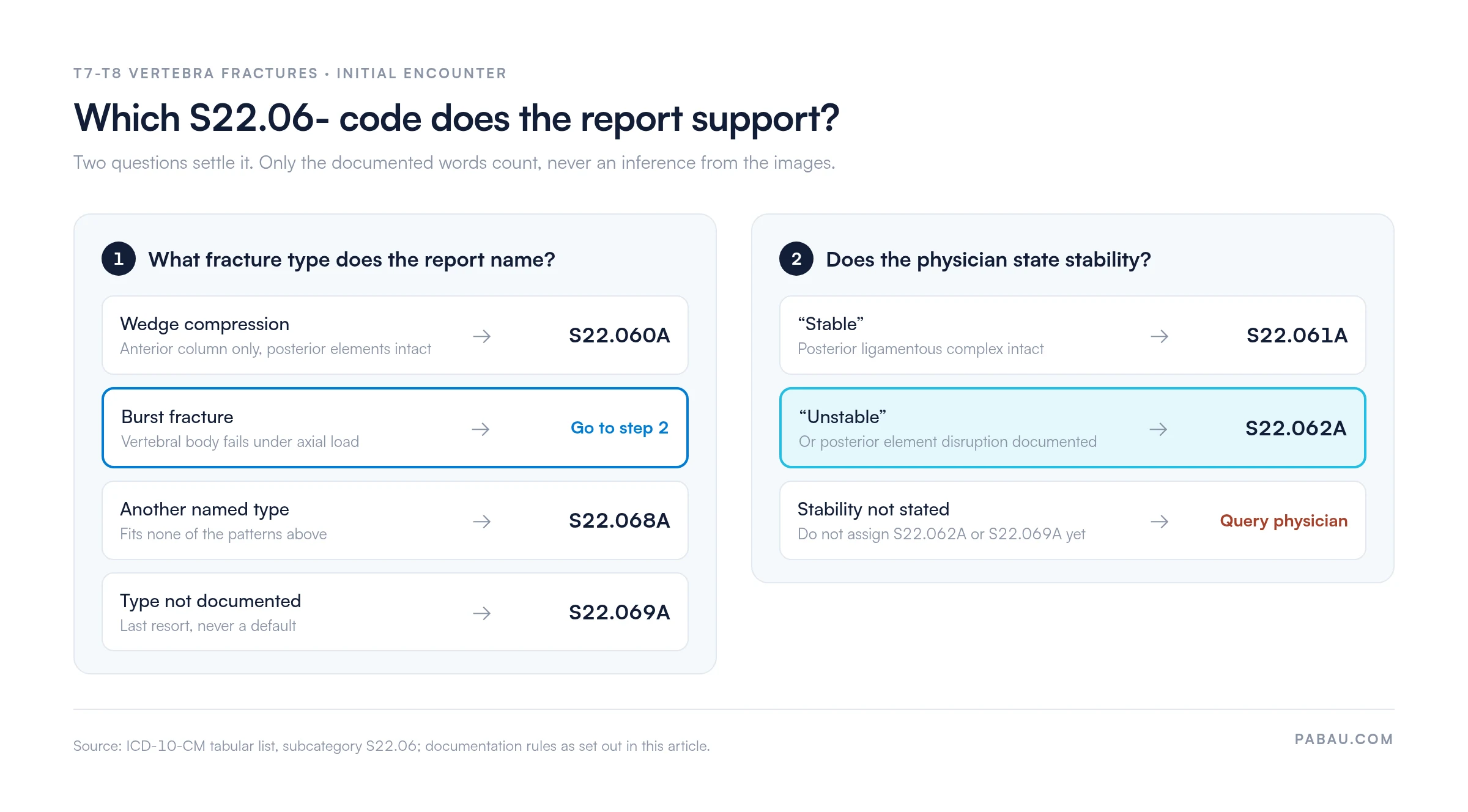
Five codes cover closed T7-T8 vertebra fractures at the initial encounter. Picking the wrong one, or defaulting to unspecified, is a common documentation-driven error in spinal trauma billing. The choice hinges on what the radiologist or surgeon explicitly stated about fracture type and stability.
If the radiology report says “burst fracture” without stating stability, the coder cannot assign S22.062A. A query to the treating physician comes first.
Defaulting to S22.069A is not an acceptable shortcut, because it signals incomplete documentation and often prompts a payer request for records. The decision path below maps the report’s wording to each of the five codes.
Several sections of the ICD-10-CM Official Guidelines govern how ICD-10 Code S22.062A is assigned and sequenced. They sit at the center of medical billing compliance for spinal trauma claims.
Run a physician query before assigning S22.062A whenever the imaging report says ‘burst fracture’ without a stability descriptor. Radiologists usually add ‘stable’ or ‘unstable’ in an addendum when asked. That one step prevents a downcode from S22.062A to S22.069A and protects claim value.
ICD-10 Code S22.062A rarely appears alone on a claim. These are the companion diagnosis and procedure codes most often paired with it.
Each procedure code in that table carries its own documentation rules, and our CPT code reference library sets them out code by code.
Match the procedure code to the levels treated. Open treatment of a second fractured vertebra adds 22328 to 22327, while augmentation of one thoracic body bills as 22513.
National Correct Coding Initiative (NCCI) edits and payer-specific bundling rules govern which CPT codes can be billed together. Check them before submission, especially when decompression is billed alongside fixation. Reviewing electronic remittance advice from earlier claims shows which bundling edits tend to repeat.
ICD-10 Code S22.062A is defensible only when the medical record contains each of the following elements. Vague documentation forces a downcode, and on a surgical spine case that changes the payment considerably.
Payer policies for surgery paired with ICD-10 Code S22.062A operate separately from ICD-10-CM coding rules. Meeting the coding standard does not guarantee coverage unless the payer’s medical necessity criteria are also met.
Medicare’s Local Coverage Determinations (LCDs) for spinal surgery vary by Medicare Administrative Contractor (MAC) jurisdiction. Before assuming a procedure paired with S22.062A is covered, check the active LCD for the relevant MAC. LCDs commonly ask for:
Most denials on ICD-10 Code S22.062A claims trace back to thin documentation, such as a missing stability statement or mechanism of injury. A denial management workflow catches these patterns before they repeat.
A code lookup that cross-references S22.062A against related codes and DRG groupers shows where an assignment might trigger a payer edit. Pair it with the AAPC Codify ICD-10-CM lookup for crosswalk verification. Knowing what makes a clean claim helps billing teams build pre-submission checklists for high-value trauma codes.
Build a trauma coding checklist for every S22.06xA claim. Confirm the fracture type, stability, level and external cause code. Then check the spinal cord exam, the CPT-ICD-10 crosswalk and any required prior authorization. Running it before submission catches every denial trigger in the table above in one pass.
A spinal trauma claim is usually checked by hand, from the op note’s stability statement to the payer’s bundling rules. Each manual step is a chance to miss the external cause code or bill the wrong CPT level.
Pabau, the practice management platform we build, moves those checks into the claim itself. Its error-checking claims management software validates ICD-10 and CPT pairings against payer rules. Through its Claim.MD connection, it also surfaces eligibility data and payer-specific edits before the claim leaves the practice.
Your billing team spends less time reworking returned claims, and fewer S22.062A claims come back downcoded to S22.069A.

Pabau’s claims management software validates ICD-10 codes against CPT pairings and payer rules before submission, reducing the manual review burden on high-value trauma claims.

S22.062A is only as strong as the sentence in the chart that calls the fracture unstable. If that sentence is missing, query the physician before you code, rather than after the payer asks for records.
Spinal cord involvement deserves the same discipline. Code the documented cord level from the S24.1- series, and leave it off when the neurological exam is negative.
The trade-off is a few minutes of querying per case against a downcoded or denied claim on a high-value surgical episode. Book a demo to see how Pabau checks S22.062A claims against payer rules before they go out.

Looking for guidance on ICD-10 submission through a clearinghouse? Claim.MD clearinghouse overview explains how real-time eligibility and 837P validation work for spinal fracture claims.
ICD-10 Code S22.062A is the billable diagnosis code for an unstable burst fracture of the T7 or T8 thoracic vertebra, initial encounter for closed fracture. It belongs to the S22.06 subgroup and requires physician or radiologist documentation explicitly classifying the fracture as unstable before it can be defensibly assigned.
Yes, S22.062A is a valid, billable ICD-10-CM code for HIPAA-covered transactions. The truncated form S22.062 without the 7th character is not billable – the complete 7-character code is required for claim submission.
S22.061A is a stable burst fracture of T7-T8; S22.062A is an unstable burst fracture. The distinction requires physician or radiologist documentation of fracture stability – coders cannot infer it from imaging alone. Unstable fractures involve posterior element disruption and carry higher risk of spinal cord compromise, which typically warrants surgical stabilization rather than bracing alone.
The 7th character “A” designates the initial encounter phase – meaning active or definitive treatment is underway. It does not mean the patient’s first office visit. “A” remains correct throughout surgical management, casting, and initial non-surgical care. Once the fracture is healing and care shifts to routine follow-up, the 7th character changes to “D.”
Use S22.062D for a subsequent encounter, once active treatment has ended. The patient is in routine follow-up, and no active or definitive treatment is directed at the fracture. If any surgical intervention, active medication management, or directed rehabilitation for the fracture is still occurring, “A” remains the correct 7th character.
Medicare covers medically necessary treatment for unstable burst fractures. Coverage for a specific surgical procedure depends on the Local Coverage Determination (LCD) from the relevant Medicare Administrative Contractor (MAC). Requirements vary by jurisdiction and are updated annually – verify the current LCD before submitting surgical claims paired with S22.062A.
The record needs CT or MRI imaging confirming a burst pattern at T7 or T8, plus a physician or radiologist statement calling the fracture unstable. It also needs the level, the mechanism of injury, neurological exam findings and a treatment plan. Missing the stability classification is the most common reason this code is challenged or downcoded.