

ICD-10 Code S42.444P: Medial epicondyle fracture, right humerus
ICD-10 Code S42.444P: full descriptor and code validity ICD-10 Code S42.444P car...

Last Updated: Oct 13, 2026
Billable Code Specific Code
S20.472D is the billable ICD-10-CM code for other superficial bite of left back wall of thorax, subsequent encounter.
Let Pabau's smart automation suggest the right codes, reduce claim denials, and keep your practice compliant—effortlessly.
Automate repetitive tasks and focus on what matters most—your patients.
Reduce coding errors and ensure compliance with the latest regulations.
Clean claims, fewer denials, and faster reimbursements.
Powerful insights and reporting to help your practice thrive.
HIPAA compliant SOC 2 certified GDPR-compliant Trusted by 4,000+ clinics worldwide

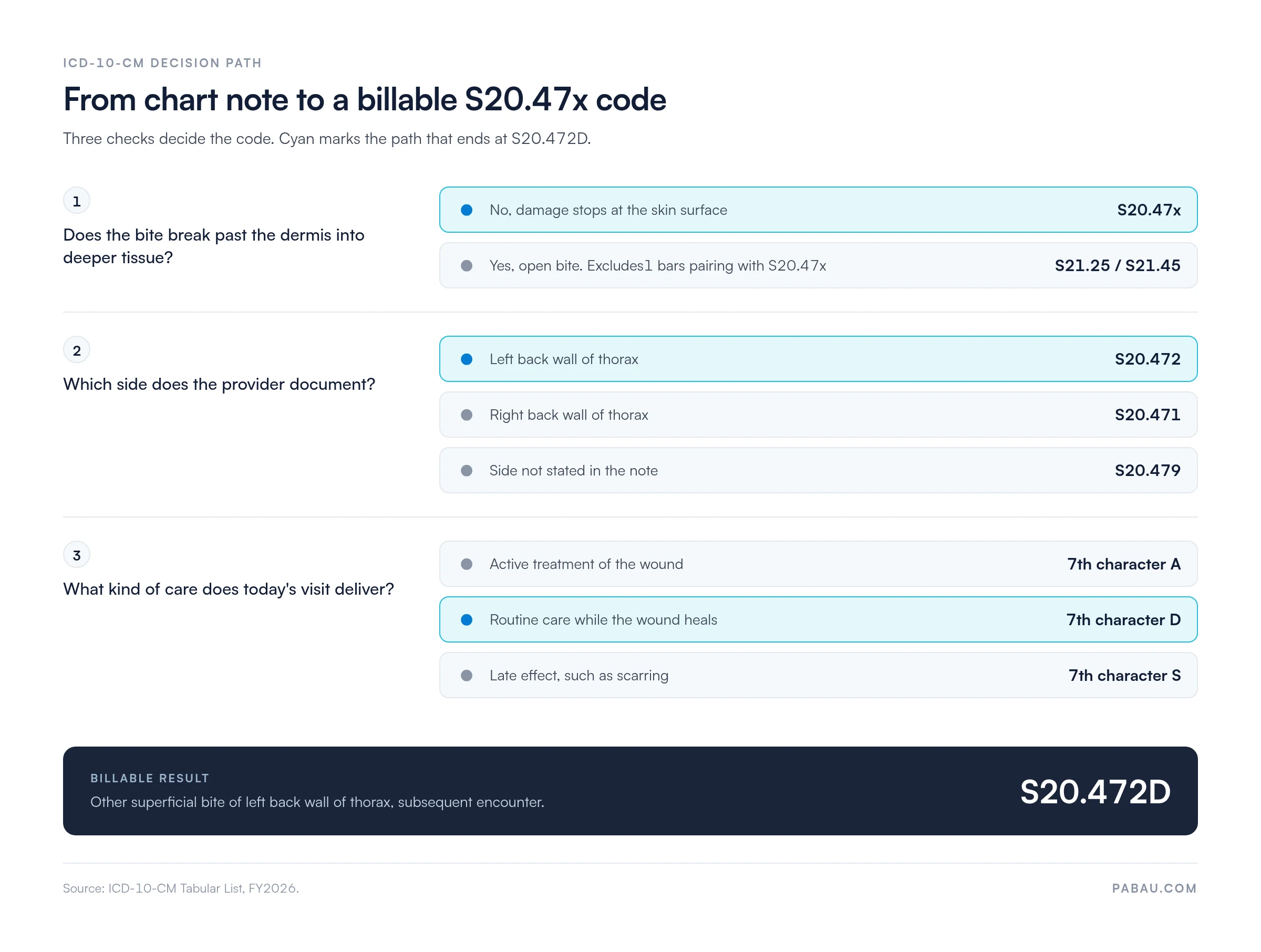
S20.472D classifies a superficial bite on the left back wall of the thorax at a follow-up visit, not the first one.
The 7th character D applies only after active treatment has ended and the patient is receiving routine care during healing.
An Excludes1 note bars coding S20.472D alongside S21.25 or S21.45, the open bite codes for the back wall of the thorax.
Documentation has to state the site, the side, and the wound depth, or the coder cannot defend the code.
Practice management software like Pabau routes ICD-10 coded claims through the Claim.MD clearinghouse, which flags code errors before submission.
ICD-10 Code S20.472D covers “other superficial bite of left back wall of thorax, subsequent encounter.”
It is a fully billable code under the Centers for Medicare and Medicaid Services (CMS) ICD-10-CM Tabular List for fiscal year 2026. The 7th character D is what separates it from S20.472A and S20.472S, and it is the character coders get wrong most often.
This code sits in Chapter 19 of ICD-10-CM, which covers injury, poisoning and certain other consequences of external causes (S00-T88). Within that chapter it falls under the superficial injuries of the thorax subsection (S20-S29). As a subsequent-encounter code, it applies once the patient has completed active treatment. The visit is for routine care, wound monitoring, or dressing changes during healing.
Knowing where S20.472D sits in the ICD-10-CM hierarchy helps coders pick the right level of specificity and avoid non-billable parent codes. The table below traces the code from its chapter down to the full seven-character form.
S20.47 is the non-billable parent code for other superficial bites of the back wall of the thorax. Three child codes under S20.47 specify laterality: S20.471x (right), S20.472x (left), and S20.479x (unspecified). The 7th character extension is always required to make any of these child codes billable. Submitting S20.472 without a 7th character will return a code validity rejection at the clearinghouse level.
The 7th character is where most coding errors on injury claims occur. Per the CDC/NCHS ICD-10-CM official guidelines, the 7th character reflects the type of encounter at the time of service. The date of injury does not decide it. All three options for S20.472 are set out below, along with the clinical scenarios that govern each choice.
S20.472A applies when the provider delivers active treatment for the bite wound on that date of service. A patient arriving at urgent care with a fresh bite to the left back wall of the thorax is an initial encounter. Irrigation, debridement, and dressing are active treatment, even if another provider saw the patient the day before.
ICD-10 Code S20.472D is the correct code when the bite wound is healing and the visit is routine monitoring or maintenance care. Active treatment has concluded. The provider is checking healing progress, changing a dressing, or assessing for signs of infection during recovery. Applying A at a wound-check visit is a common audit trigger.
S20.472S applies only when the current visit is for a late effect that developed because of the original superficial bite wound. Scarring or residual skin changes that result directly from the bite qualify. When using S20.472S, the sequela code is sequenced first, followed by the late-effect code describing the specific condition present.
ICD-10-CM requires the coder to specify laterality whenever the clinical documentation supports it. For S20.47x codes, the 5th and 6th character positions carry the site and laterality detail. Never default to unspecified when the medical record clearly states left or right.
When a chart note states “bite wound to the left upper back / posterior thorax,” S20.472D is the correct subsequent-encounter code. Use S20.479D only when the provider’s documentation genuinely cannot identify the side, not as a shortcut. Payers may flag habitual use of unspecified laterality codes as a documentation quality issue during audits.
Knowing what S20.472D excludes matters as much as knowing what it covers. Misapplying the Excludes1 rule is a frequent denial driver on injury claims.
Depth, side, and encounter type resolve in a fixed order. The path below shows how one chart note lands on a single billable code.
The ICD-10-CM tabular list carries a “use additional code” instruction on S20.47x codes to capture the external cause of the bite. An accidental animal bite and an accidental human bite both take a W-series code, and a human bite is coded W50.3.
The Y-series code Y04.1 applies only when the human bite is an assault, so it does not cover the general case. Check the AAPC ICD-10-CM code lookup for the W-code that matches the documented mechanism.
Some payers require the external cause code on injury claims, while others accept it as supplemental. Treat it as documentation best practice rather than a universal mandate.
Always check your primary payer’s LCD (Local Coverage Determination) or policy for external cause code requirements on bite wound claims. Requirements differ between commercial payers, Medicare, and Medicaid. Submitting without a required external cause code can trigger a claim-level rejection rather than a simple denial.
Strong documentation is the foundation of a defensible S20.472D assignment. Auditors focus on whether the clinical record supports three elements: the anatomical site, the laterality, and the encounter type. A deficiency in any one of them turns a clean claim into a denial or a post-payment audit finding.
A documentation checklist built into the EHR template for wound follow-up visits reduces the risk of missing any of these elements. Structured intake and progress note templates keep providers consistent and make the coding call straightforward.
S20.472D is a straightforward billable code, but the billing context around it needs attention. Automating the pre-submission checks with software for billing teams catches most of these errors before the claim leaves the practice.
Accurate coding of S20.472D depends on the provider’s documentation as much as on the coder. A coder cannot assign laterality or encounter type that the clinical record does not support. When the note is ambiguous, query the provider instead of defaulting to an unspecified code.
Most practices find a wrong 7th character only after the payer sends the claim back. The correction, the resubmission, and the wait for the next remittance cycle all land on the billing team weeks after the visit happened.
Pabau, our practice management software, keeps the diagnosis code with the encounter it belongs to. The code is attached at checkout and carried onto the invoice. From there it routes to the Claim.MD clearinghouse, which validates ICD-10-CM codes and 7th character combinations before the payer sees them.
Every Pabau subscription includes the full platform, so a single-site practice runs the same claim checks as a multi-location group. Your billing team spends less time reworking bite wound claims and less time waiting on payment.

Pabau integrates with Claim.MD to validate diagnosis codes, check 7th character accuracy, and route injury claims through a real-time clearinghouse before they reach the payer. Fewer rejections, faster reimbursement.

The single character on the end of an S20.47x code carries more denial risk than picking the code itself. A coder who reads the encounter type off the visit rather than off the calendar will get it right almost every time.
The harder part sits upstream. A coder can only assign what the note supports, so repeat denials on bite wound claims usually trace back to the documentation template. Book a demo to see how Pabau validates ICD-10 codes before your injury claims reach the payer.

Need to understand how ICD-10 codes move through the billing pipeline? Revenue cycle management explained covers how diagnosis codes like S20.472D interact with claims submission and reimbursement.
Want to reduce denials on injury claims before they reach the payer? Medical billing compliance guide outlines the documentation and coding requirements that keep injury claims clean.
Looking for a structured approach to clearinghouse submission? Understanding the 837 file format explains how ICD-10-CM diagnosis codes reach payers through electronic claim submissions.
ICD-10 Code S20.472D is a billable ICD-10-CM diagnosis code that classifies “other superficial bite of left back wall of thorax, subsequent encounter.” It applies when the patient returns for routine wound care or monitoring while a treated bite on the left posterior thorax heals. The code is valid for FY2026 under the CMS ICD-10-CM Tabular List.
S20.472A (initial encounter) is used when the provider is delivering active treatment for the bite wound. S20.472D (subsequent encounter) applies when active treatment is complete and the patient returns for routine care during healing. S20.472S (sequela) is assigned when the patient presents with a late effect, such as scarring, that directly resulted from the original bite wound.
Use 7th character A whenever the provider is actively treating the injury on that date of service. The number of days since the wound occurred does not matter. Switch to D once active treatment is complete and the patient is receiving only routine maintenance care, such as dressing changes or wound monitoring. The distinction rests on the type of care delivered, not the visit count.
A superficial bite (S20.472D) involves damage limited to the skin surface, without penetration into subcutaneous tissue. An open bite breaches deeper tissue layers and is coded S21.25 without penetration into the thoracic cavity, or S21.45 with penetration. The Excludes1 note on S20.47x codes means the two groups cannot be used together on the same claim for the same site and encounter.
The ICD-10-CM tabular list includes a “use additional code” instruction to identify the external cause of the bite. An accidental animal or human bite takes a W-series code, and a human bite is coded W50.3. Whether the external cause code is required depends on payer policy. Some commercial payers and state Medicaid programs require it, while others treat it as supplemental.
Yes. S20.472D is a valid, billable ICD-10-CM code for fiscal year 2026, which runs from October 1, 2025 through September 30, 2026. The CMS ICD-10-CM Tabular List and the CDC/NCHS ICD-10-CM tool both confirm it.
The provider’s clinical note must explicitly state the side (left or right) for laterality to be coded. S20.472D (left) requires documentation of the wound on the left posterior thorax. When the record is ambiguous, the coder should query the provider rather than default to S20.479D (unspecified). Persistent use of unspecified laterality codes on injury claims can flag a practice for documentation audits.




