ICD-10 Code T86.852: Intestine transplant infection
ICD-10 Code T86.852: Definition and billable status ICD-10 Code T86.852 is the I...

Last Updated: Oct 16, 2026
Billable Code Specific Code
S20.159D is the billable ICD-10-CM code for superficial foreign body of breast, unspecified breast, subsequent encounter.
S20.159D sits in the S20-S29 block for injuries to the thorax, and became effective October 1, 2025 under the FY2026 ICD-10-CM edition. Nine codes share the S20.15 subcategory, and two facts in the record pick between them. One is which breast, the other is which phase of treatment. The same two-fact logic decides neighboring S-codes such as S12.131D.
Let Pabau's smart automation suggest the right codes, reduce claim denials, and keep your practice compliant—effortlessly.
Automate repetitive tasks and focus on what matters most—your patients.
Reduce coding errors and ensure compliance with the latest regulations.
Clean claims, fewer denials, and faster reimbursements.
Powerful insights and reporting to help your practice thrive.
HIPAA compliant SOC 2 certified GDPR-compliant Trusted by 4,000+ clinics worldwide

S20.159D is a billable ICD-10-CM code for a superficial foreign body of the breast, unspecified side, at a subsequent encounter.
The 7th character D means active treatment is still ongoing after the initial encounter. Use S20.159A for the first visit and S20.159S for sequela.
Assign S20.159D only when laterality is undocumented. If the side is known, use S20.151D for the right breast or S20.152D for the left.
The code became effective on October 1, 2025, under the FY2026 ICD-10-CM edition, and remains valid for FY2026.
Practice management software like Pabau connects to Claim.MD, so you can submit S20.159D on an electronic CMS-1500 to thousands of US payers.
S20.159D is a valid, billable ICD-10-CM diagnosis code. It can be submitted on a HIPAA-covered transaction for reimbursement purposes. The full official description is: Superficial foreign body of breast, unspecified breast, subsequent encounter.
ICD-10 Code S20.159D is confirmed billable by CMS ICD-10-CM code files and the CDC/NCHS tabular list for FY2026. Coders should verify effective date and status annually, as ICD-10-CM updates on October 1 each year.
Knowing where S20.159D sits in the classification tree helps coders navigate related codes and confirm they are at the correct specificity level. ICD-10-CM organizes codes from broad injury categories down to individual billable codes through a parent-child hierarchy.
S20.159 is not billable on its own. It needs a 7th character to specify the encounter type, and S20.159D is one of three valid completions. The others are A for initial and S for sequela, the same pattern that completes a sequela code such as sequela code such as S14.118S. The parent S20-S29 block covers every injury to the thorax, from blunt trauma and lacerations to contusions and foreign bodies of the chest wall.
The 7th character is the most misapplied element of S-code coding. Choosing wrongly between A, D, and S is a leading reason breast injury claims get flagged for review. The distinction is clinical, not administrative, and it works the same way on any superficial injury code, including S60.152S.
Key distinction: a subsequent encounter is not a routine check-up or a wellness visit. Under ICD-10-CM Official Guidelines, character D applies while the patient is still under active treatment for the injury. Once treatment has concluded and the patient returns for a late effect, the code is S20.159S. A first course of treatment takes S20.159A, whether or not a referral or second opinion is involved.
A patient referred from urgent care to a specialist for the same breast foreign body is still at an initial encounter. Assign S20.159A if active treatment has not yet started. The 7th character tracks treatment phase, not the number of visits.
A superficial foreign body of the breast is foreign material embedded in the superficial layers of breast tissue, without penetration to deeper structures. Typical objects include splinters, wood fragments, glass shards, metal debris, thorns, and plant material lodged in the skin or the subcutaneous tissue over the breast.
Presentation involves localized discomfort, sometimes erythema or swelling at the site, and in some cases a visible or palpable object. Treatment usually means wound exploration, extraction, irrigation, and dressing. When the patient returns for ongoing wound management or a further extraction attempt, that is the encounter S20.159D captures.
Unspecified laterality is a documentation-driven decision, not a clinical shortcut. ICD-10-CM Official Coding Guidelines require coders to capture laterality whenever it is documented. Assign S20.159D only when the medical record genuinely does not say whether the foreign body is in the right or the left breast.
Assigning S20.159D when laterality is available in the record is a specificity error. Some payers flag unspecified codes for extra review when a more specific option exists, which slows reimbursement.
S20.159D belongs to a family of nine breast foreign body codes, separated only by laterality and encounter type. The grid below shows how those two facts resolve to a single code. Checking that intersection is the fastest way to verify a pick before the claim is built.
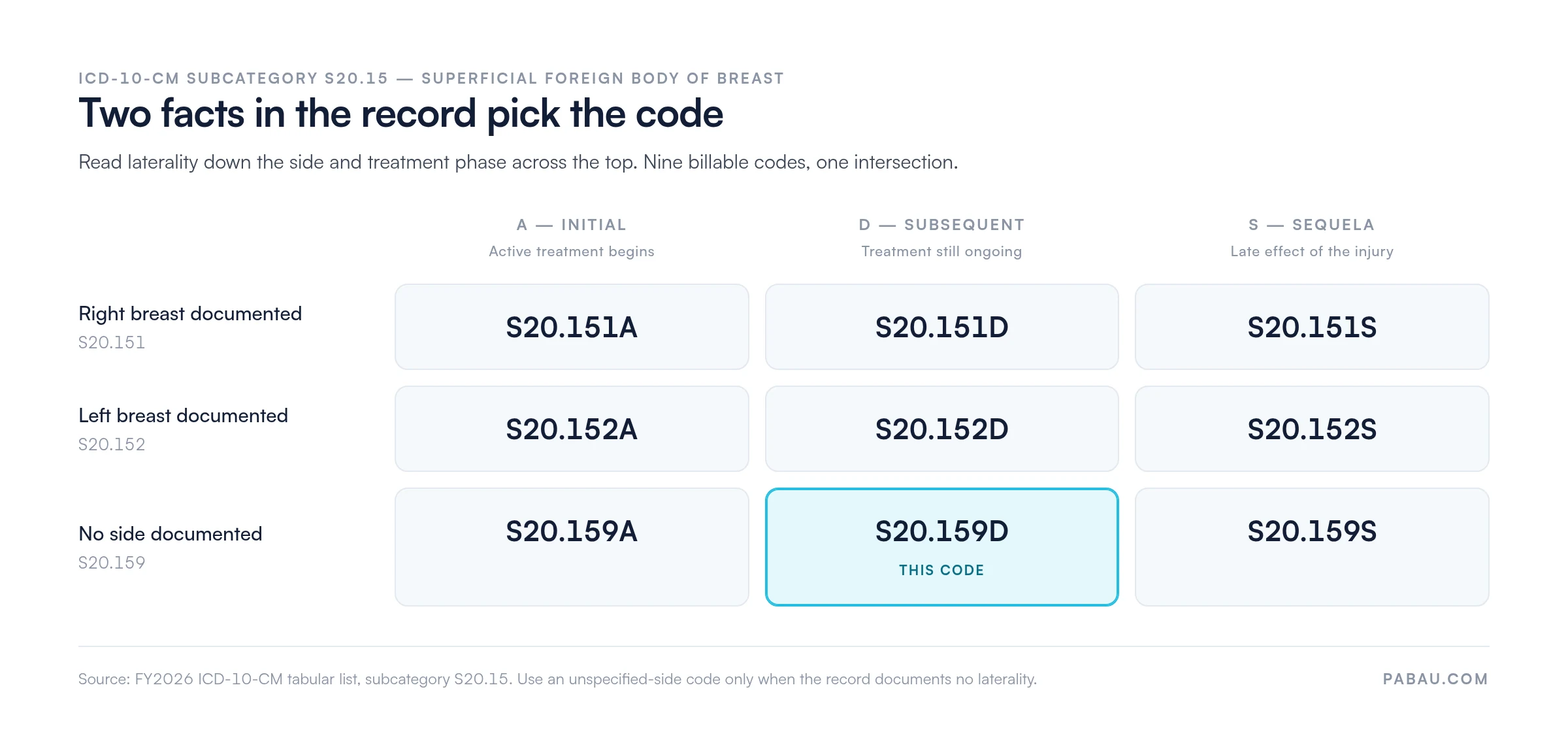
The table below adds the full descriptions and billable status, plus two neighboring thorax codes that are easy to confuse with this family.
Contusion of the breast is a separate family under S20.0. Do not reach for an S20.15 code when the note describes bruising rather than embedded material. For thorax injuries beyond the breast, the AAPC ICD-10-CM code lookup lists every code in the S20 category with its current billable status.
When a splinter sits on the thorax outside the breast and the note names no wall, the follow-up visit takes ICD-10 code S20.95XD.
Correct documentation supports the use of ICD-10 Code S20.159D and reduces denial risk. The record must carry enough clinical detail to justify both the code’s description and the subsequent-encounter designation. Following HIPAA-compliant documentation practices also protects the practice during a payer audit.
The CDC/NCHS ICD-10-CM coding tool carries the official tabular list and index. Use it to confirm the current description and any applicable notes for S20.159D before the claim goes out.
S20.159D is a valid billable code accepted for HIPAA-covered transactions. Understanding medical billing compliance requirements helps practices submit these claims correctly and reduce avoidable denials. Getting the fundamentals of medical billing right up front prevents many of those denials before a claim ever goes out.
Some payers apply extra scrutiny to subsequent-encounter injury codes, particularly when no initial encounter code appears in the patient’s claim history with that payer. Practices can reduce denial risk by:
A structured denial management process is what turns a rejected subsequent-encounter claim into a paid one. For practices submitting a clean claim, every diagnosis code has to sit at the right specificity level and be supported by the record.
Practice management software like Pabau closes that loop inside the practice. Its Claim.MD integration turns the invoice you already raised into an electronic CMS-1500 claim and sends it to thousands of US payers.
Eligibility checks run in real time before treatment, and claim statuses and electronic remittance advice come back into Pabau. The billing team can therefore see whether the initial encounter was adjudicated before S20.159D goes out.
Coding errors here are rarely deliberate. Three things usually cause them:
Pabau keeps documentation and billing in one place. Diagnosis codes are recorded against the encounter that produced them, and the claims management software builds the claim from the invoice you already raised. It then validates the administrative details, checks eligibility, and tracks status and remittances after submission.
The coding decision still belongs to the coder. Pabau’s job is to put the full note, the prior encounter, and the current treatment phase in front of them. For S20.159D that decides whether the coder assigns the unspecified code or the laterality-specific one.
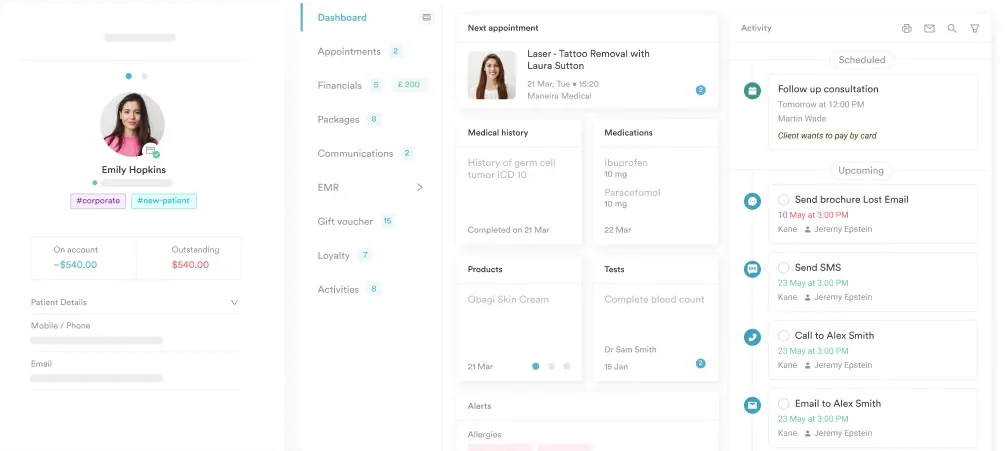
Practices using Pabau keep digital client records that link clinical notes to the billing workflow. When a clinician documents a splinter in the left breast with irrigation performed, the coder sees that detail at claim build. Fewer laterality errors and fewer subsequent-encounter misclassifications follow from that.
Multi-visit wound care runs the same way. Each encounter’s treatment phase is recorded against the client, which supports accurate 7th character assignment across the whole course of treatment. Pabau’s skin clinic software and OB/GYN EMR both handle these repeat-visit injury workflows.
For wound care follow-up visits involving foreign body codes, build a documentation template that captures laterality and treatment phase on every note. A 10-second checkbox saves a claim denial and a provider query.

Pabau links the clinical note to the invoice, so the diagnosis code on the chart is the one on the claim. Submit electronic CMS-1500 claims to thousands of US payers through our Claim.MD integration.

S20.159D is a straightforward billable code when the documentation is solid. Two failure points account for most denials on it. The first is assigning the unspecified laterality code when the record documents a side. The second is applying the subsequent-encounter character to a first treatment visit.
Both failures start in the note rather than the claim, which is why the fix belongs in documentation rather than in coding review. Give the clinician a place to record the side and the treatment phase, and the code follows on its own. Sound revenue cycle management begins in the note, well before the claim reaches a clearinghouse. Book a demo to see how Pabau connects the note to the claim.

Coding an initial encounter for a limb injury instead? S46.921A walks through the same A, D, and S logic on a muscle laceration.
Need a 7th character beyond A, D, and S? S52.042Q explains the fracture-specific characters that cover healing status.
Wondering what happens after the claim leaves your system? Claim.MD clearinghouse covers the payer edit checks a diagnosis code has to pass.
S20.159D is the billable ICD-10-CM code for a superficial foreign body of breast, unspecified breast, at a subsequent encounter. It applies when a patient returns for ongoing active treatment after the initial visit. Use it only when the record does not name the side.
Yes. S20.159D is a valid, billable ICD-10-CM code accepted on HIPAA-covered transactions for reimbursement. It became effective October 1, 2025, under the FY2026 edition. It is a complete code and needs no additional characters.
S20.159A is used at the initial encounter, when active treatment begins. S20.159D is used at later visits while active treatment for the same injury continues. If treatment is complete and the patient presents with a late complication, use S20.159S. The 7th character tracks treatment phase, not visit count.
The 7th character D marks a subsequent encounter. The patient is still receiving active treatment for the same condition and has been seen for it before. The convention runs across the injury chapter, following the same A, D, and S pattern.
Use S20.159D only when the record does not document which breast is affected. If the note specifies the right breast, use S20.151D. If it documents the left breast, use S20.152D. Coding guidelines require the laterality-specific code whenever laterality appears in the record.
The S20-S29 block covers injuries to the thorax, inside the wider S00-T88 chapter. S20 covers superficial thorax injuries, including abrasions, blisters, contusions, and foreign bodies of the breast and chest wall. S20.159D sits under S20.15.