ICD-10 Code S06.341D: Traumatic right cerebral hemorrhage
ICD-10 Code S06.341D: Definition and quick-reference data ICD-10 Code S06.341D i...

Last Updated: Oct 9, 2026
Billable Code Specific Code
S06.1X0S is the billable ICD-10-CM code for traumatic cerebral edema without loss of consciousness, sequela. It applies when a patient is treated for a late effect of brain swelling from a past head injury. The original injury caused no loss of consciousness.
The code sits in category S06 (Intracranial injury). Its 'S' seventh character marks a sequela encounter, so the code for the residual condition, such as post-traumatic headache, is sequenced first.
Let Pabau's smart automation suggest the right codes, reduce claim denials, and keep your practice compliant—effortlessly.
Automate repetitive tasks and focus on what matters most—your patients.
Reduce coding errors and ensure compliance with the latest regulations.
Clean claims, fewer denials, and faster reimbursements.
Powerful insights and reporting to help your practice thrive.
HIPAA compliant SOC 2 certified GDPR-compliant Trusted by 4,000+ clinics worldwide

S06.1X0S is the billable ICD-10-CM code for traumatic cerebral edema without loss of consciousness, sequela, and it is valid on HIPAA-covered claims.
The seventh character ‘S’ marks a sequela encounter for a late effect, not an initial (‘A’) or subsequent (‘D’) encounter for an active injury.
The sixth character ‘0’ means no loss of consciousness at the original injury. Other values record LOC duration, death before regaining consciousness, or unknown LOC status.
On a sequela claim, the residual condition is coded first and S06.1X0S follows as the causal injury code.
Pabau, the practice management platform we build, holds back any claim missing payer-required details until it is fixed, so fewer sequela claims bounce back.
ICD-10 Code S06.1X0S is a billable, specific ICD-10-CM diagnosis code for traumatic cerebral edema without loss of consciousness, sequela.
Use it when a patient is treated for a late effect of post-traumatic brain swelling after the acute injury has resolved. The original injury must have caused no loss of consciousness. Each character carries its own meaning, so misreading one produces a different code.
The code belongs to the CMS ICD-10-CM code set, which NCHS and CMS update every fiscal year. It falls under chapter 19 (Injury, poisoning and certain other consequences of external causes, S00-T88) and category S06 (Intracranial injury).
Sequela coding means the visit is for a late effect or residual condition caused by a prior injury. The traumatic event itself has resolved, and the patient now presents with its lasting consequences. ICD-10-CM Official Guidelines Sections I.B.10 and I.C.19 apply ‘S’ once the acute phase is over and the encounter treats the resulting condition.
Getting the medical billing fundamentals right matters here, because a sequela claim is sequenced differently from an acute visit. When the nature of the sequela is documented, its code goes first, such as a memory deficit or post-traumatic headache code. S06.1X0S follows to identify the causal injury.
One documentation failure comes up often: a note says “follow-up after TBI” but never states whether the injury is still active (D) or resolved (S). Coders can’t assign S06.1X0S without a clear statement that the acute injury has resolved and today’s visit treats a sequela.
The sixth character in S06.1X0S records that the patient had no loss of consciousness (LOC) at the original injury. Payers may challenge the code if imaging or clinical notes suggest an injury more severe than the documented LOC status.
The S06.1X_ family carries 11 sixth-character values: 0 through 9, plus ‘A’ for LOC status unknown. Nine of them take the sequela character ‘S’. Values 7 and 8 record death before regaining consciousness, so they take only ‘A’ and have no sequela variant.
LOC status must come from the original injury record. If that record is unavailable, query the treating physician rather than defaulting to S06.1X0S. Assigning “without LOC” when the record shows even brief unconsciousness is a coding error that audits catch.
Put the two decisions together and every S06.1X_ sequela code comes from two questions, answered in the order below.
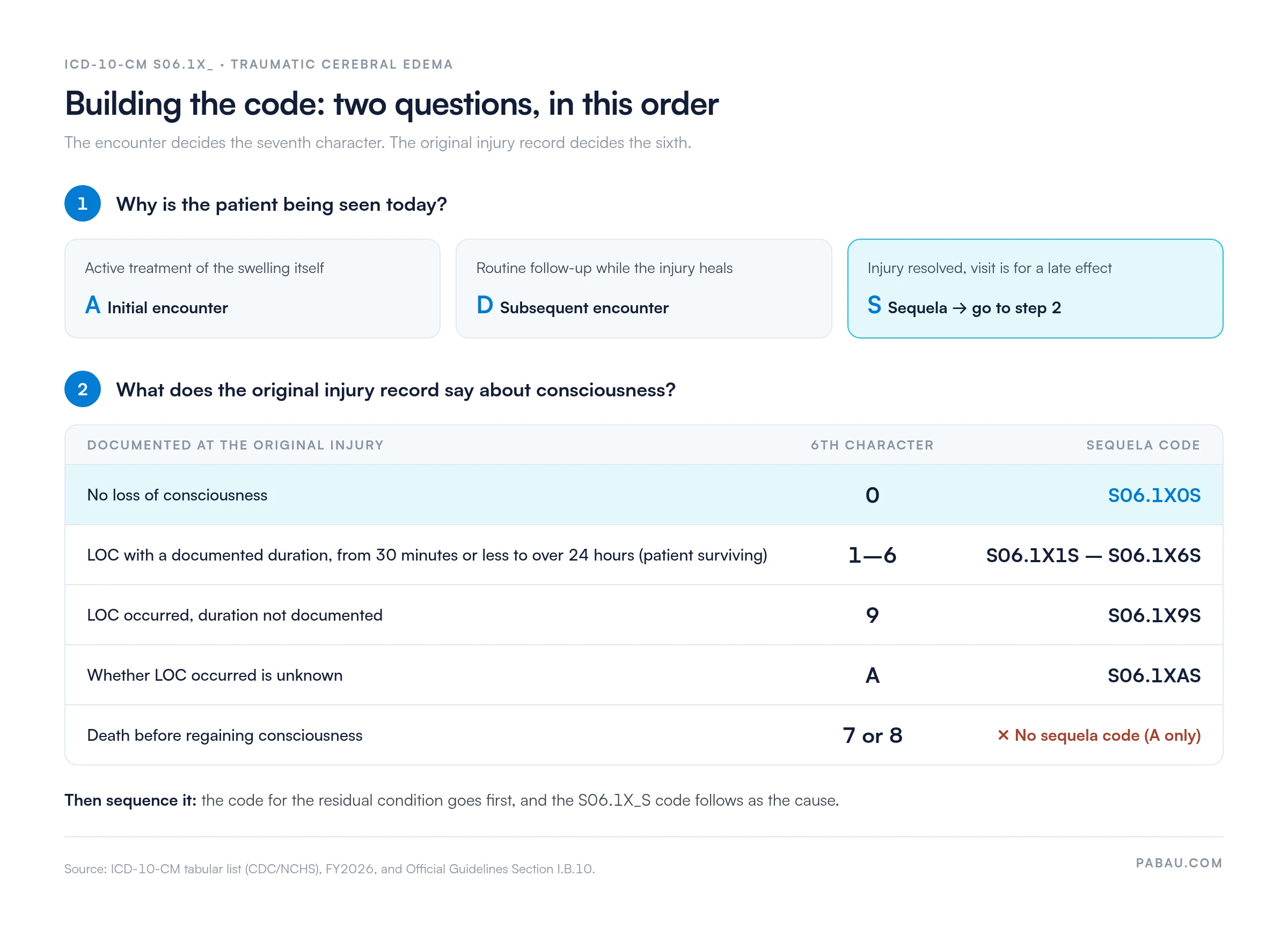
S06.1X0S sits in a family of related intracranial injury codes. Coders often confuse it with concussion sequela codes (S06.0X_S), diffuse TBI codes (S06.2X_), and unspecified focal TBI codes (S06.30_). The original injury diagnosis decides between them, not the current sequela presentation.
Focal injuries are coded by site and type instead. A right-cerebrum contusion with LOC over 24 hours, for example, takes S06.315S rather than any S06.1 code. Check each sibling in the diagnostic codes library before settling on one.
Never raise or lower the specificity of the original diagnosis to fit a more familiar code. If the injury record states “cerebral edema,” S06.1X_S is correct regardless of severity. If it states only “TBI” without the injury type, S06.30_S or S06.9X_S fits better than S06.1X0S.
Category S06 carries the official notes that govern what can be reported alongside S06.1X0S. Subcategory S06.1 has no excludes note of its own.
The CDC/NCHS ICD-10-CM web tool shows the current year’s includes and excludes notes in the tabular list. Check notes against the tool for the applicable fiscal year rather than relying on last year’s memory.
Physician documentation must support every element S06.1X0S encodes. A single missing element gives payers grounds to deny on medical necessity or coding accuracy. Clean claim submission starts with complete documentation at the point of care.
S06.1X0S appears on neurology and rehabilitation claims. The CPT codes billed alongside it reflect sequela management: evaluation, cognitive testing, rehabilitation, and imaging. Check current NCCI edits before submitting any pairing, because bundling rules change every year.
Practices that pair neurology with physical therapy may also report S06.1X0S on functional restoration claims, where the original TBI left motor or coordination deficits. Check your Medicare Administrative Contractor’s (MAC) local coverage determinations (LCDs) for cognitive rehabilitation criteria.
Check NCCI edits between neuropsychological testing codes (96132-96133) and cognitive rehabilitation codes (97129-97130) before billing them on the same date of service. Payers often bundle these codes. Billing both needs modifier 59 or XS, plus documentation that separates the evaluation from the therapy.
For Medicare patients, outpatient neurology sequela claims go to Part B and fall under your MAC’s LCDs. That matters most for neuropsychological testing and cognitive rehabilitation billed with this diagnosis. Check the MAC’s LCD portal for active TBI sequela policies before billing.
A reliable medical claims clearinghouse catches payer-specific rejections before claims reach adjudication. Eligibility checks help on sequela claims, where coverage can depend on time since the original injury and the LCD criteria for the service.
Most S06.1X0S denials trace to a handful of causes, and the right documentation and coding review prevents them. Structured denial management workflows cut write-offs on this code family.
Most S06.1X0S errors start in the coding workflow, so the fix starts there too. Run this sequence on every sequela visit:
Pabau handles the submission side with its medical claims management tools. Claims go to payers through Pabau’s Claim.MD connection, with eligibility checks, claim status tracking, and ERA posting in one dashboard.
Before a claim leaves, Pabau checks for payer-required details such as membership numbers and authorization codes. The Send button stays disabled until they’re filled in, so fewer sequela claims come back for resubmission.
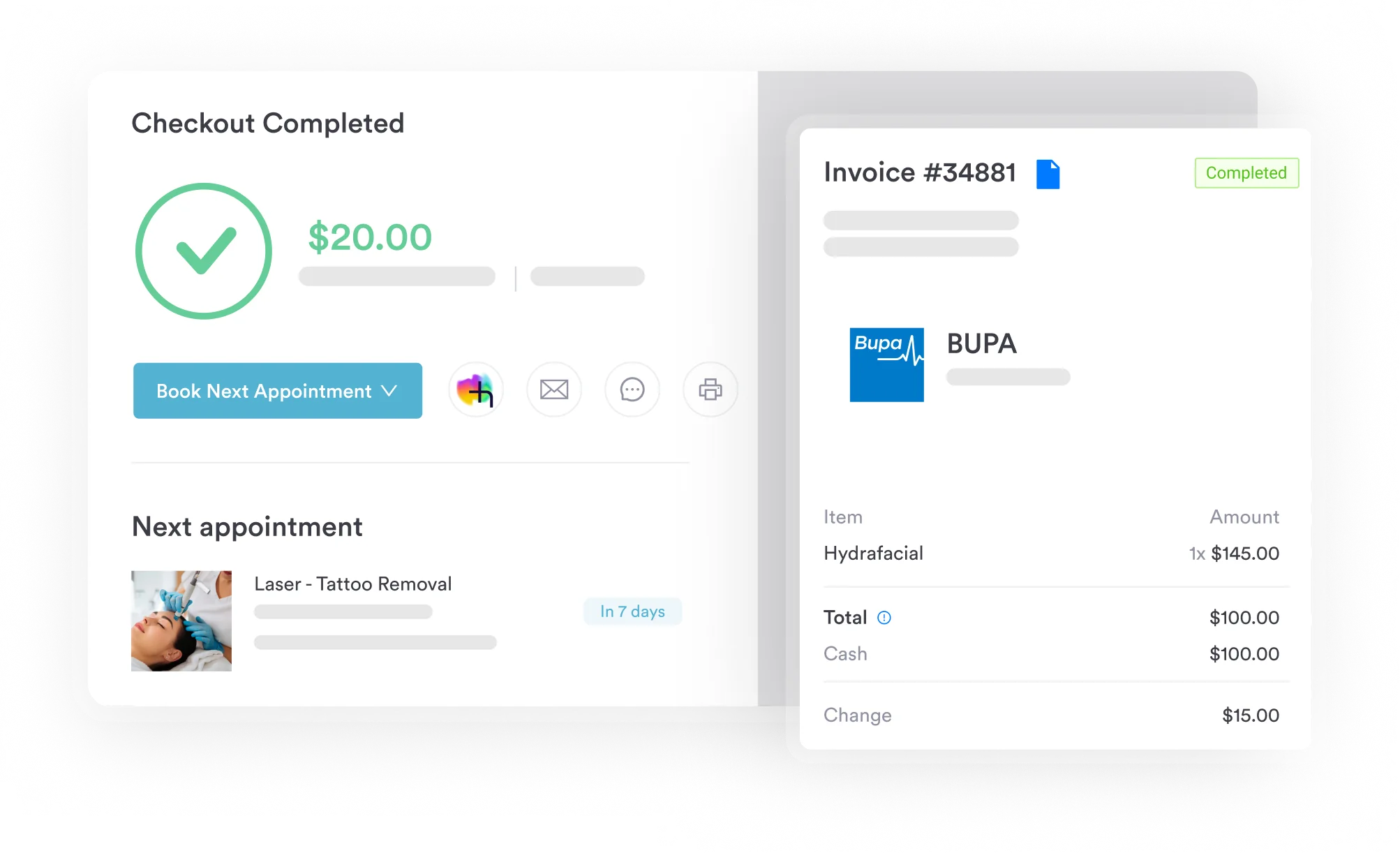

Pabau checks every claim for missing payer details before it goes out, then submits it through Claim.MD with eligibility checks and ERA posting built in.

S06.1X0S is rarely a hard code to choose. Claims fail when the record is thin: no statement that the injury resolved, no LOC status, or no causal link. Fix the note, and the code follows from it.
The cost is a few minutes before the visit, spent pulling the original injury record and confirming LOC. That time is cheaper than a resubmission cycle, and it protects the testing and rehab claims billed alongside.
If your team is tightening revenue cycle management for neurology, sequela visits are a good place to start. Book a demo to see how Pabau catches missing claim details before your S06.1X0S claims reach the payer.

Need guidance on electronic claim submission for neurology? 837 file submission guide covers how electronic claims are structured and transmitted to payers.
Want to understand ERA processing after a sequela claim is paid? Electronic remittance advice (ERA) guide explains how to read ERA files and post payments from neurology claims.
Coding hemorrhage sequela in the same category? ICD-10 code S06.344S covers traumatic hemorrhage of the right cerebrum, another S06 code with sequela variants.
Following up a diffuse brain injury instead? ICD-10 code S06.2X9D explains subsequent-encounter coding for diffuse TBI with LOC of unspecified duration.
ICD-10 Code S06.1X0S is the billable ICD-10-CM diagnosis code for traumatic cerebral edema without loss of consciousness, sequela. It’s used when a patient presents with a late effect of post-traumatic brain swelling that caused no loss of consciousness. The original acute injury has resolved. The code falls under category S06 (Intracranial injury), block S00-S09 (Injuries to the head).
Yes. S06.1X0S is a billable, specific ICD-10-CM code valid for HIPAA-covered claim submission. It is not a non-billable header or category code. Verify its status in the current fiscal year using the CDC/NCHS ICD-10-CM web tool, which is updated annually.
The ‘S’ is the seventh character for a sequela encounter. The patient is being seen for a late effect of the original cerebral edema, not for the acute injury itself. ‘A’ covers initial encounters with the active injury, and ‘D’ covers subsequent encounters during healing. Only ‘S’ applies once the acute injury has resolved and the visit treats a residual condition.
Both describe traumatic cerebral edema, but they differ in loss of consciousness and completeness. S06.1X0S means no LOC and a sequela encounter. S06.1X1 records LOC of 30 minutes or less and needs a seventh character before it can be billed. For a like-for-like comparison, set S06.1X1S (LOC of 30 minutes or less, sequela) against S06.1X0S.
The most common reasons are a wrong seventh character (A or D instead of S) and a missing causal link to the original event. Others are S06.1X0S listed as the primary diagnosis, and LOC status that contradicts the original injury record. Check the encounter type, sequencing, and source documentation before submission.
Generally, no. Per ICD-10-CM Official Guidelines Section I.B.10, a documented sequela condition is sequenced first as the principal diagnosis. Examples are memory deficit (R41.3) or post-traumatic headache (G44.309). S06.1X0S follows as the causal injury code. It may stand alone when no specific sequela condition is coded, but that’s uncommon in outpatient neurology billing.
Common pairings include office E&M codes 99213-99215, neuropsychological testing evaluation codes 96132-96133, cognitive rehabilitation codes 97129-97130, and brain MRI code 70553. Check current NCCI edits before billing any combination on the same date of service. Medicare and commercial payers often require prior authorization for neuropsychological testing and imaging.