ICD-10 Code S05.92XS: Unspecified left eye injury, sequela
ICD-10 Code S05.92XS: Quick reference ICD-10 Code S05.92XS is the billable diagn...

Last Updated: Oct 9, 2026
Billable Code Specific Code
S06.341D is the billable ICD-10-CM code for traumatic hemorrhage of right cerebrum with loss of consciousness of 30 minutes or less, subsequent encounter. It covers follow-up visits for a bleed in the right cerebral tissue once active treatment has ended.
The code sits in the S06.341 subcategory of ICD-10-CM Chapter 19. Its most common mix-up is S06.341A, the initial-encounter code, which applies only while the patient receives active treatment. A left-sided bleed is S06.351D, and an epidural bleed belongs to S06.4X-.
Let Pabau's smart automation suggest the right codes, reduce claim denials, and keep your practice compliant—effortlessly.
Automate repetitive tasks and focus on what matters most—your patients.
Reduce coding errors and ensure compliance with the latest regulations.
Clean claims, fewer denials, and faster reimbursements.
Powerful insights and reporting to help your practice thrive.
HIPAA compliant SOC 2 certified GDPR-compliant Trusted by 4,000+ clinics worldwide

S06.341D codes a follow-up visit for a traumatic bleed in the right cerebrum after a loss of consciousness of 30 minutes or less.
The 7th character D applies once active treatment is complete and the patient is receiving routine care while the injury heals.
Loss-of-consciousness duration comes from the acute-care record. LOC of 31 to 59 minutes moves the code to S06.342D, and 1 hour to 5 hours 59 minutes to S06.343D.
Laterality matters, because a left-sided bleed is S06.351D and an epidural bleed belongs to a separate category, S06.4X-.
Pabau, the practice software we build, connects to Claim.MD so neurology and neurosurgery practices can submit S06.341D claims and rework denials from one record.
ICD-10 Code S06.341D is a valid, billable ICD-10-CM diagnosis code for a traumatic bleed in the right cerebrum at a follow-up visit.
Its official descriptor is Traumatic hemorrhage of right cerebrum with loss of consciousness of 30 minutes or less, subsequent encounter. It applies once active treatment has ended and the patient is in the healing or recovery phase.
Each character after the category narrows the meaning. S06 is intracranial injury, and the 4th character 3 places the code in S06.3, focal traumatic brain injury. The 5th character 4 identifies a hemorrhage in the right cerebrum.
The 6th character 1 records a loss of consciousness of 30 minutes or less. The 7th character D marks a subsequent encounter. The breakdown below also shows which neighbor code each character points to when the record disagrees.
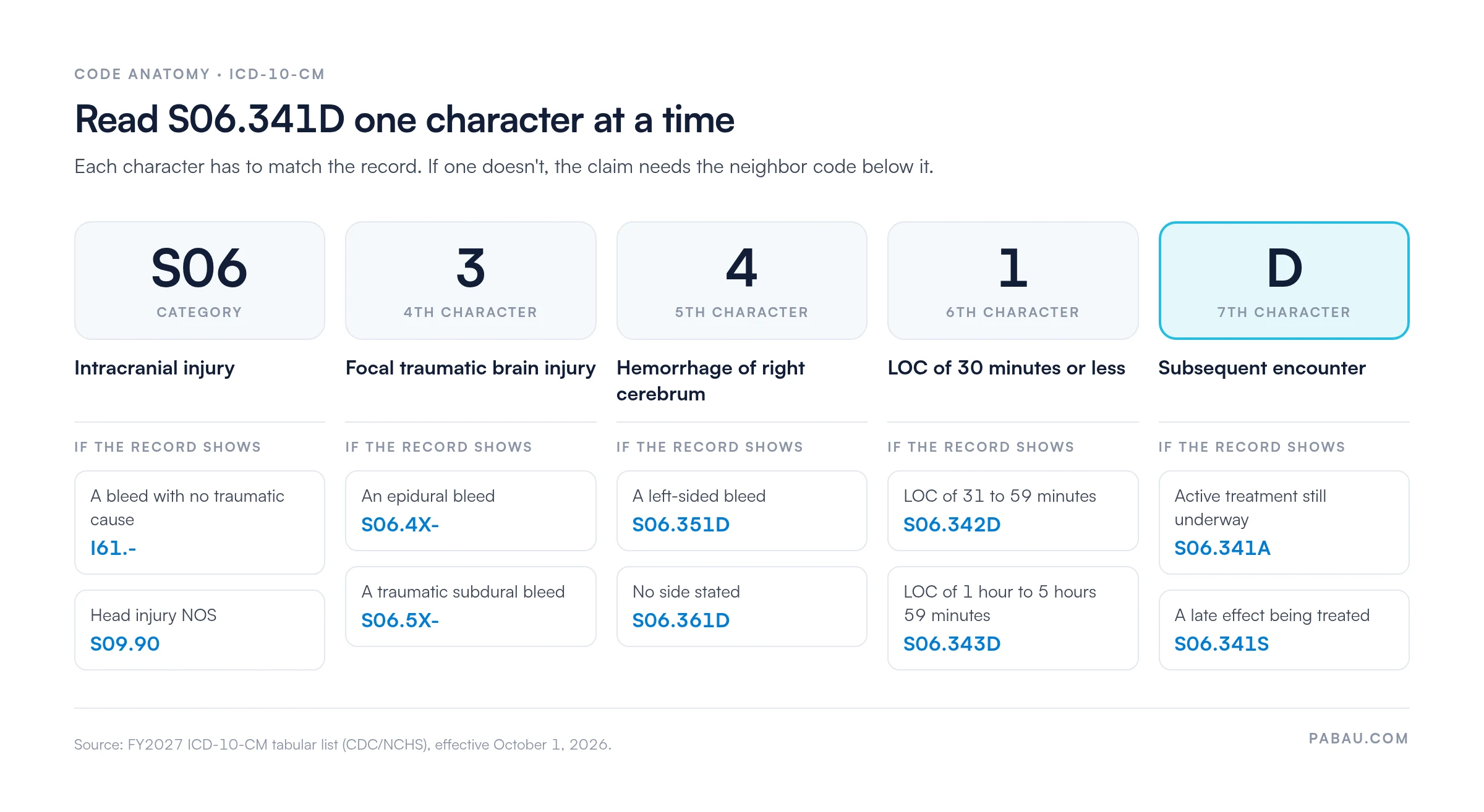
The descriptors on this page match the FY2027 ICD-10-CM tabular, effective October 1, 2026. Confirm any code against the CDC/NCHS ICD-10-CM web tool, which updates each October for the new fiscal year.
In ICD-10-CM Chapter 19, the 7th character tells the payer where the patient is in the episode of care. Three characters apply to S06.341:
Section I.C.19.a of the ICD-10-CM Official Guidelines ties the A character to active treatment. Whether the provider is seeing the patient for the first time does not matter.
A practice that first meets the patient after discharge still reports D if active treatment is over. A neurosurgeon who re-operates on a re-bleed reports A again, because treatment is active.
No fixed number of days or weeks moves a code from D to S. The switch is clinical and depends on what the visit treats. For a sequela, the late effect itself is sequenced first and S06.341S follows it, with the S added only to the injury code.
The 6th character of every S06.34 code records loss of consciousness (LOC). S06.341 requires documented LOC of 30 minutes or less, which the tabular also calls brief loss of consciousness. The duration comes from the acute-care record and is carried forward unchanged to every follow-up visit.
If the emergency record documents 20 minutes of unconsciousness, S06.341D is correct at every follow-up. A 45-minute duration points to S06.342D, and 2 hours points to S06.343D. Category S06 notes that D and S never apply to 6th characters 7 or 8, because those codes record a death.
Two of the rungs are easy to mix up. S06.349 means the patient lost consciousness but nobody recorded how long. S06.34A means the record cannot say whether consciousness was lost at all.
The full S06 series is also searchable through the AAPC Codify ICD-10-CM lookup. Our diagnostic codes library breaks down other S06 codes in the same format.
Most S06.341D errors come from one character that does not match the record: the encounter, the duration, the side, or the type of bleed. The table compares the neighbors coders confuse most often.
Read the imaging report before you pick the 5th character. S06.34 is right cerebrum, S06.35 is left, and S06.36 is side not specified. If the report names a side the visit note omits, code from the report or query the physician.
The ICD-10-CM tabular attaches notes to S06, S06.3, and S06.34. Each one applies to S06.341D and changes which other codes appear on the claim.
Subcategory S06.34 includes traumatic intracerebral hemorrhage and hematoma of the right cerebrum. S06.341 adds traumatic hemorrhage of the right cerebrum with brief loss of consciousness. Category S06 as a whole includes traumatic brain injury.
Category S06 carries an Excludes1 note for head injury NOS, coded S09.90. S06.3 carries an Excludes2 note for conditions classifiable to S06.4 through S06.6, plus focal cerebral edema (S06.1). Excludes2 means those conditions are not part of S06.341D, but both codes may be reported when the patient has both.
A patient with a right cerebral bleed and a traumatic subdural hematoma therefore gets S06.341D and a code from S06.5X-. A bleed with no traumatic cause is coded to I61.-, nontraumatic intracerebral hemorrhage, instead of S06.34-.
There is no national requirement to report external cause codes. A state mandate or a payer policy can still require them, and the guidelines encourage reporting them voluntarily. When they are reported, the cause code takes the same encounter character as the injury code. Typical cause codes for this injury include:
Place of occurrence (Y92) and activity (Y93) codes are generally reported once, at the initial encounter for treatment. They are usually left off an S06.341D claim.
Auditors reviewing S06.341D claims look for proof of each character in the code. Missing any one of these elements raises the risk of a denial or a downcode.
Practices using claims management software that connects to a clearinghouse can check these details before the claim goes out. That cuts rework on S06.341D denials.
Pre-authorization rules for outpatient follow-up after a brain injury vary by plan, so check them with each payer. The denial patterns below recur across payer types.
Practices that send electronic claims through a clearinghouse such as Claim.MD can catch formatting and code errors before a claim reaches the payer. Denial management in healthcare works best when those errors are caught before submission, not at remittance review. The CMS ICD-10 codes page publishes the annual code files that drive payer edits.
In outpatient reporting, Section IV of the Official Guidelines uses the first-listed diagnosis in place of the inpatient principal diagnosis. When the visit is chiefly for the right cerebral bleed, S06.341D is listed first. Other conditions the physician addresses follow it.
Category S06 tells coders to code also any associated skull fracture from S02.-. Fracture codes use their own 7th characters, so a routine-healing follow-up for a vault fracture is S02.0XXD. Confirm the S02 code against the original imaging and operative reports.
A 6-week neurosurgery follow-up after a fall that caused a right cerebral bleed and a vault fracture could be coded as:
Other traumatic intracranial bleeds follow the same 7th-character logic in separate S06 categories. Epidural hemorrhage is S06.4X-, traumatic subdural hemorrhage is S06.5X-, and traumatic subarachnoid hemorrhage is S06.6X-. Code each bleed the record documents.
Conditions unrelated to the injury, such as hypertension or diabetes, follow the injury codes and use their standard codes. The D character belongs only to the injury codes from Chapter 19 and any external cause codes. A clean claim on a multi-diagnosis visit depends on each code matching the visit.
Knowing the clinical pathway helps coders choose between D and S with confidence. A subsequent encounter for this injury usually includes one or more of the following:
When the note records these elements, the coder can confirm D and show medical necessity from the same document. Once the physician documents that recovery is complete, a visit for a late effect moves to S06.341S. The code for the late effect is then listed first.
Pull every S06.341D claim with a date of service more than 12 months after the injury date. Twelve months is not a clinical threshold. A long timeline without documented recovery symptoms draws auditor attention. Query the physician and decide whether D or S fits before any audit request arrives.
Coding S06.341D correctly depends on details spread across several records: the acute LOC duration, the imaging side, and the follow-up note. When those sit in separate systems, a coder rebuilds the picture by hand for each claim.
Pabau keeps treatment notes, forms, and invoices in the patient’s record. Through the Claim.MD integration, practices submit claims electronically and see payer responses, so a rejected encounter character can be corrected and resent quickly.

Pabau integrates with Claim.MD so neurology and neurosurgery practices can submit clean ICD-10 claims, track denial reasons, and resubmit corrected encounters faster.

S06.341D is correct only when four facts line up. The bleed is traumatic, it sits in the right cerebrum, LOC lasted 30 minutes or less, and active treatment is over. Check each one against the acute record and the imaging report, not the follow-up note alone. A single mismatched character turns a clean claim into a denial.
The coder who anchors the code to the original documentation rarely needs to defend it later. Pabau’s medical billing workflow, with the Claim.MD integration, gives neurology and neurosurgery practices one place to check those facts before submission. Book a demo to see how Pabau handles ICD-10 claim submission from note to payment.

Need to understand how claims clear before payment? Medical claims clearinghouse overview explains how EDI transactions, 837P files, and ERA remittances move between provider and payer.
Seeing recurring denial patterns across your TBI caseload? Denial codes in medical billing covers CARC reason codes, how to read an 835 remittance, and the appeal process.
Want to verify electronic remittance advice workflows? Electronic remittance advice (ERA) guide covers 835 transaction sets and how to match payments to S06.341D encounters.
ICD-10 Code S06.341D means traumatic hemorrhage of the right cerebrum with loss of consciousness of 30 minutes or less, at a subsequent encounter. It is used for follow-up visits after active treatment has ended, while the injury heals.
S06.341A applies while the patient receives active treatment, such as emergency care, surgery, or an inpatient stay. S06.341D applies to routine follow-up once active treatment is complete. The choice depends on active treatment, not on whether the provider is seeing the patient for the first time.
Use S06.341D while the patient recovers from the bleed itself. Use S06.341S when the visit treats a late effect, such as post-traumatic seizures or cognitive impairment. The late-effect code is listed first, and no fixed number of weeks triggers the switch.
S06.341 requires loss of consciousness of 30 minutes or less, documented at the time of the injury. LOC of 31 to 59 minutes is S06.342, and 1 hour to 5 hours 59 minutes is S06.343. With no loss of consciousness, the code is S06.340.
The most frequent denial is an A character on a follow-up visit. Laterality conflicts with the imaging report and missing acute records for the LOC duration come next. A missing cause code where the payer requires one and unsupported visit frequency also cause denials. Each one is fixed by correcting the code or attaching documentation.
No. S06.341D codes a bleed in the brain tissue of the right cerebrum. Epidural hemorrhage sits in its own category, S06.4X-, so an epidural bleed with LOC of 30 minutes or less at a follow-up visit is S06.4X1D. A patient with both bleeds gets both codes.