ICD-10 Code S06.341D: Traumatic right cerebral hemorrhage
ICD-10 Code S06.341D: Definition and quick-reference data ICD-10 Code S06.341D i...

Last Updated: Oct 9, 2026
Billable Code Specific Code
S06.6X0S is the billable ICD-10-CM code for traumatic subarachnoid hemorrhage without loss of consciousness, sequela. It applies when the bleed has resolved and the visit treats a condition it left behind, such as post-traumatic headache.
The code sits in category S06, intracranial injury. Its 7th character S marks a sequela encounter, so the residual condition is coded first and S06.6X0S follows it.
Let Pabau's smart automation suggest the right codes, reduce claim denials, and keep your practice compliant—effortlessly.
Automate repetitive tasks and focus on what matters most—your patients.
Reduce coding errors and ensure compliance with the latest regulations.
Clean claims, fewer denials, and faster reimbursements.
Powerful insights and reporting to help your practice thrive.
HIPAA compliant SOC 2 certified GDPR-compliant Trusted by 4,000+ clinics worldwide

S06.6X0S is a billable ICD-10-CM code for a residual condition left by a traumatic subarachnoid hemorrhage with no loss of consciousness.
The 7th character S marks a sequela encounter. The bleed has resolved, and the visit treats a condition it caused, such as post-traumatic headache.
Sequela claims often deny when S06.6X0D is billed instead of S06.6X0S, or when S06.6X0S is listed ahead of the residual condition code.
Pabau, the practice management platform we build, holds back any claim with missing required details, so incomplete claims never reach the payer.
ICD-10 Code S06.6X0S is a fully specified, billable ICD-10-CM code for traumatic subarachnoid hemorrhage without loss of consciousness, sequela. You use it when the bleed has resolved and the visit treats a condition it left behind. The code is valid in the current code set and carries no deletion notice in the CMS ICD-10-CM code release.
Traumatic subarachnoid hemorrhage (traumatic SAH) is bleeding into the subarachnoid space caused by a head injury. A ruptured aneurysm or other spontaneous vascular event is a different diagnosis. Blood collects in the cisterns and sulci around the brain. Falls, motor vehicle collisions and assaults are the most common causes.
The “without loss of consciousness” qualifier comes from the parent code S06.6X0. It covers cases where the patient did not lose consciousness at the time of injury (loss of consciousness of 0 minutes).
Sibling codes S06.6X1 through S06.6X6 grade documented LOC by duration, and S06.6X7 and S06.6X8 report death before regaining consciousness. S06.6X9 covers LOC of unspecified duration, and S06.6XA covers a record that doesn’t say whether LOC occurred.
For S06.6X0S, the sequela element is the defining feature. The acute hemorrhage has resolved, but a residual condition traced to it persists. Common sequela conditions coded alongside S06.6X0S include post-traumatic headache (G44.309), cognitive deficits and post-concussional syndrome (F07.81).
The 7th character S designates a sequela encounter under Section I.C.19.a of the ICD-10-CM Official Guidelines. In a sequela encounter, the provider treats a condition that resulted from a prior injury. The injury itself has healed, but a late effect remains.
Sequela and subsequent encounter sound alike, yet they report different visits. Character A applies to every encounter where the patient receives active treatment for the injury. Character D applies after active treatment ends, while the patient gets routine care during healing. Character S applies once the injury has resolved and the visit treats a condition it caused.
ICD-10-CM guidelines put the sequela condition first on a sequela claim, such as G44.309 for post-traumatic headache. The injury code with the S extension, S06.6X0S, follows it. The residual condition is the reason for the visit, and S06.6X0S explains its cause. Check the current fiscal year’s guidelines from CDC/NCHS each October, since the wording can change.
Before assigning S06.6X0S, check the physician’s note for two statements. One confirms the prior injury, such as ‘history of traumatic subarachnoid hemorrhage.’ The other names the residual condition the patient has now. A note that documents only the original injury, with no current residual condition, doesn’t support a sequela encounter.
S06.6X0S is most often confused with its 7th character siblings and with non-traumatic SAH. Three questions settle the choice, and the order matters.
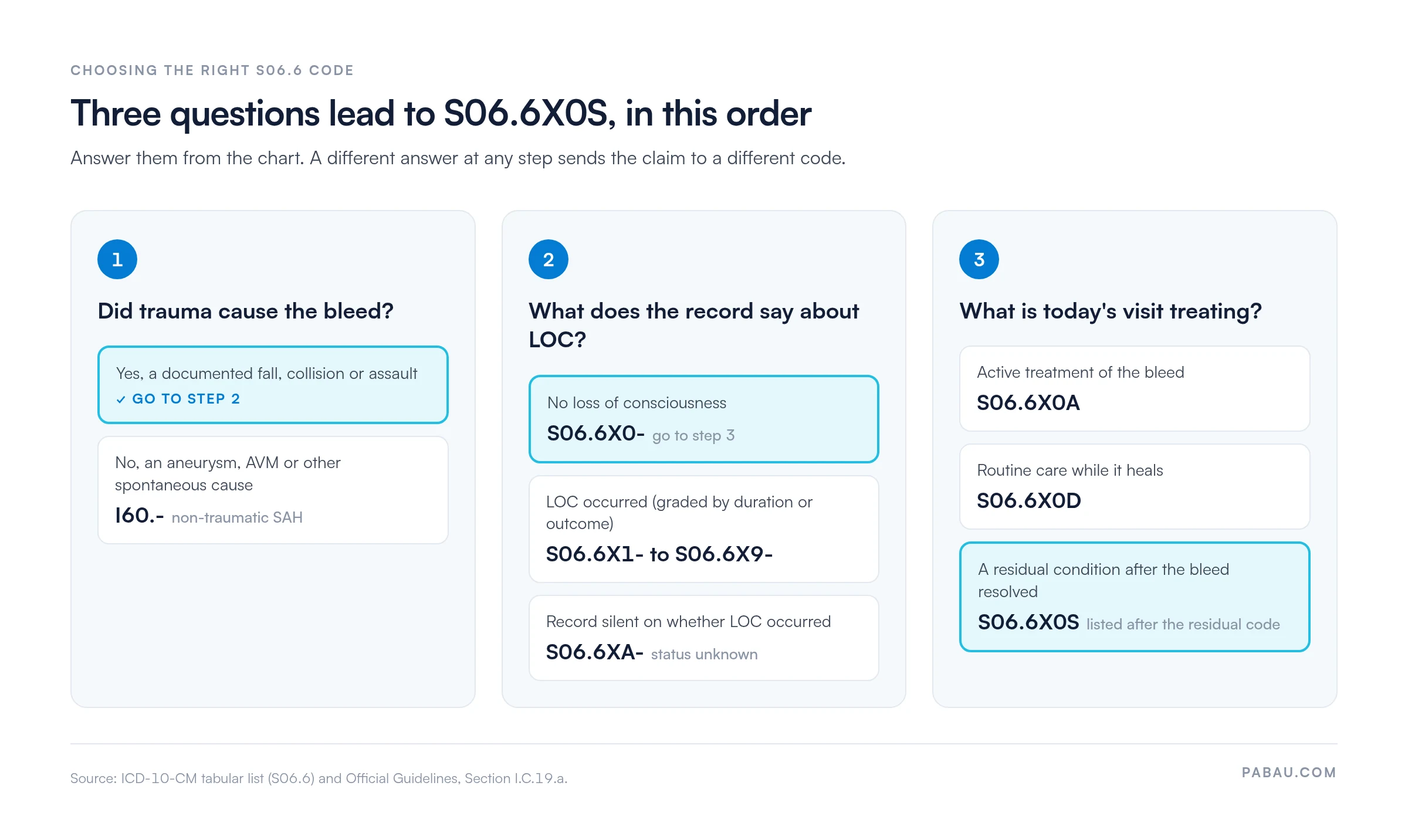
Traumatic and non-traumatic SAH are split by definition, not by a coded Excludes1 edit. S06.6 requires a traumatic mechanism, while I60.- covers spontaneous bleeds such as a ruptured aneurysm. One hemorrhage takes one or the other, depending on its documented cause.
Earlier claims for the same injury usually carry S06.6X0A, so check the acute record for the LOC status it reported. The neighboring S06 intracranial injury codes are in Pabau’s diagnostic code library.
ICD-10-CM tabular notes govern what you report alongside S06.6X0S. The official notes sit at the S06 category and S06.6 subcategory levels.
The AAPC code page reproduces the full tabular notes. Use it to confirm the current code year’s notes before submission.
Insufficient documentation is a common reason S06.6X0S claims fail review. The physician note or radiology report must supply four elements to support the code.
For background on how ICD codes are stored in Medicare claims data, see the ResDAC ICD coding resource.
Payers review traumatic brain injury (TBI) sequela claims for medical necessity like any other claim. A claim carrying S06.6X0S alone, without the residual condition code, gives the reviewer no reason for the visit. Expect a denial or a request for more documentation.
Payers commonly expect the following on an S06.6X0S claim.
Coverage criteria shift, so practices managing medical billing compliance for TBI sequela should recheck the applicable MAC LCD policies each year.
Sequela claims for ICD-10 Code S06.6X0S tend to fail in predictable ways. The five errors below are the ones to check before submission.
Our guides to denial management workflows and clean claim submission cover how to catch these errors before a claim goes out.
When a claim does come back, the electronic remittance advice (ERA) carries a claim adjustment reason code (CARC). That code tells your coders which issue triggered the denial.
The procedure codes for a sequela visit depend on what the residual condition needs. The pairings below are common in neurological sequela care for ICD-10 Code S06.6X0S.
Check the medical necessity crosswalk for each CPT-to-ICD-10 pairing in the AAPC CPT-to-ICD-10 crosswalk before submission. Coverage edits for neuropsychological evaluation vary between Medicare jurisdictions and commercial plans.
When billing 96132 (neuropsychological evaluation) with S06.6X0S, document the cognitive domains being evaluated. Link each one to the sequela condition. Generic ‘cognitive evaluation post-TBI’ language gives reviewers grounds to deny on medical necessity. Name the deficit: memory impairment, executive function loss or processing speed.
Code lookup pages tell coders what S06.6X0S means. They don’t help a practice catch an incomplete claim before it goes out. The 7th character choice, the residual condition code and the sequencing are settled at different points between the note and the claim. Manual checks at each step slip when volume rises.
Pabau’s claims software for coders keeps claim creation, submission and tracking in one dashboard. It runs validation checks in the background each time you send a claim. If a required detail such as a membership number or authorization code is missing, the Send button stays disabled until it’s filled in.
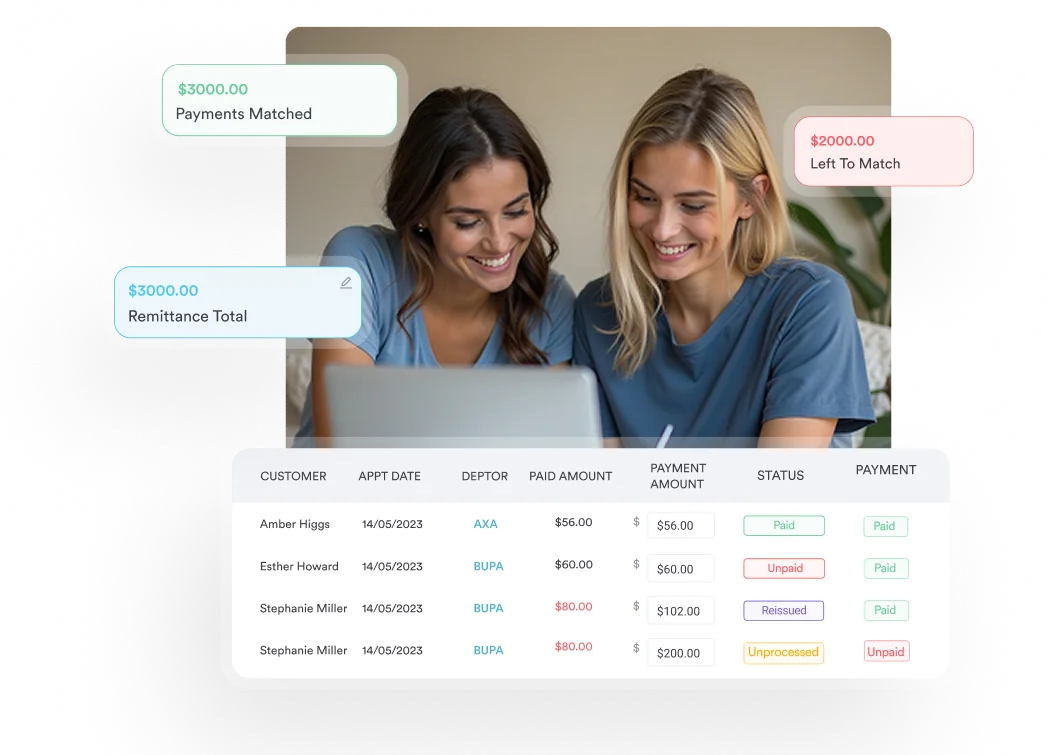
For US practices, Pabau submits claims through Claim.MD, our clearinghouse integration. Your team can run real-time eligibility checks before the visit and post ERA remittances when payment arrives. Each claim shows as pending, submitted, processing, paid or error, so a rejected sequela claim gets fixed and resubmitted quickly.

Pabau checks that required claim details, like membership numbers and authorization codes, are filled in before a claim can be sent. Track every TBI sequela claim from submission to payment in one dashboard.

S06.6X0S belongs on a claim only when three chart facts line up. The bleed was traumatic, the patient didn’t lose consciousness, and the hemorrhage resolved but left a condition you’re now treating.
So fix the documentation habit first. Ask providers to state the LOC status and the causal link in plain words, then code the residual condition ahead of S06.6X0S. A claim built on that note rarely needs an appeal.
Pabau handles the next step, holding back incomplete claims and tracking each one to payment. Book a demo to see how Pabau keeps your TBI sequela claims complete from submission to payment.

Want to see how clearinghouse submission works? How the Claim.MD clearinghouse works explains how a claim travels from your practice to the payer.
Looking up a denial reason code? Denial codes in medical billing maps common CARC and RARC codes to their causes.
Coding a traumatic SAH with a brief loss of consciousness? ICD-10 Code S06.6X1D covers the subsequent encounter when LOC lasted 30 minutes or less.
Coding another intracranial injury sequela? ICD-10 Code S06.344S covers the sequela of a traumatic hemorrhage of the right cerebrum.
ICD-10 Code S06.6X0S is the billable diagnosis code for traumatic subarachnoid hemorrhage without loss of consciousness, sequela. It identifies a late-effect encounter where the provider treats a residual condition, such as post-traumatic headache or cognitive impairment. That condition was caused by a prior traumatic subarachnoid hemorrhage that has since resolved. The code sits in ICD-10-CM Chapter 19 (S00-T88), category S06 (intracranial injury), subcategory S06.6 (traumatic subarachnoid hemorrhage).
Yes. S06.6X0S is fully specified at 7 characters and is valid for reimbursement in current fiscal years. No deletion or revision notice has been issued by CMS or NCHS. Confirm validity for each fiscal year using the official CDC/NCHS ICD-10-CM tool at icd10cmtool.cdc.gov.
The three codes differ only in the 7th character, which identifies the encounter type. S06.6X0A applies to any encounter where the patient receives active treatment for the traumatic SAH. S06.6X0D applies after active treatment ends, during routine care in the healing or recovery phase. S06.6X0S applies when the hemorrhage has resolved and the provider treats a residual condition it caused. Billing D when S is correct is a common denial trigger on this code.
S06.6X0S applies only when trauma caused the subarachnoid hemorrhage. Non-traumatic SAH from a ruptured aneurysm, arteriovenous malformation or other spontaneous cause is coded to the I60.- block. The two are clinically mutually exclusive by definition, since one hemorrhage has one documented cause. The code’s actual Excludes1 note is head injury NOS (S09.90).
Five errors commonly trigger S06.6X0S denials. The first is billing 7th character D instead of S. The second is a missing external cause code (V00-Y99) when the payer requires one. The third is listing S06.6X0S ahead of the residual condition code. The fourth is a physician note with no explicit causal link to the prior traumatic SAH. The fifth is coding non-traumatic SAH to S06.6 when I60.- applies. Each one can be caught before submission.
Common pairings include 99213 or 99214 for neurology office visits and 96132-96133 for neuropsychological evaluation. Practices also bill 70553 for brain MRI, 97150 or 97165 for rehabilitation, and 90837 for psychotherapy. Prior authorization for neuropsychological evaluation varies by payer and jurisdiction.