

ICD-10 Code S42.444P: Medial epicondyle fracture, right humerus
ICD-10 Code S42.444P: full descriptor and code validity ICD-10 Code S42.444P car...

Last Updated: Oct 13, 2026
Billable Code Specific Code
W57.XXXA is the billable ICD-10-CM code for bitten or stung by nonvenomous insect and other nonvenomous arthropods, initial encounter.
W57.XXXA explains how the injury happened, and another code has to say what the patient came in with. Get the sequence or the seventh character wrong, and the payer sends the file back.
Let Pabau's smart automation suggest the right codes, reduce claim denials, and keep your practice compliant—effortlessly.
Automate repetitive tasks and focus on what matters most—your patients.
Reduce coding errors and ensure compliance with the latest regulations.
Clean claims, fewer denials, and faster reimbursements.
Powerful insights and reporting to help your practice thrive.
HIPAA compliant SOC 2 certified GDPR-compliant Trusted by 4,000+ clinics worldwide

W57.XXXA is the billable ICD-10-CM code for a nonvenomous insect or arthropod bite at the initial encounter.
It is an external cause code, so it can never be the first-listed diagnosis on a claim.
The seventh character follows the treatment phase, not the calendar, with A for active care, D for healing, and S for a late effect.
Complications such as Lyme disease (A69.20) or anaphylaxis (T78.2XXA) always need their own code alongside W57.XXXA.
Practice management software like Pabau pairs ICD-10 code lookup with claim submission and tracking through the Claim.MD clearinghouse.
Yes, W57.XXXA is billable. It is a complete, specific ICD-10-CM code with all seven characters in place.
The official description reads bitten or stung by nonvenomous insect and other nonvenomous arthropods, initial encounter. It is valid for fiscal year 2026, which runs from October 1, 2025 through September 30, 2026, per CMS ICD-10 coding and billing guidance.
The code lives in Chapter 20 of ICD-10-CM, the external causes of morbidity chapter, range V00-Y99. Its block, W50-W64, is titled exposure to animate mechanical forces.
That block covers bites and strikes by people, rodents, dogs, other mammals, marine animals, reptiles, plants, and insects. Only the W57 category itself is specific to insects and other nonvenomous arthropods.
Billable does not mean primary, and that distinction is where these claims fall over. An external cause code describes the mechanism of injury, never the condition being treated. It cannot be the first-listed diagnosis on any claim.
So the injury or reaction code goes in position one, and W57.XXXA follows as a secondary code.
W57 covers bites and stings from organisms that deliver no venom. Nonvenomous is the operative word, and it is the one detail worth confirming in the note before anything else.
Here is how the common presentations break down:
The venomous split is the hard line in this category. When the note documents venom, or names a species known to be venomous, the correct code sits in the T63 range instead.
Reaching for W57.XXXA on a venomous encounter is a coding error a payer will flag on audit, not a judgment call.
Pick the seventh character from the phase of treatment, not from the date of the bite.
The ICD-10-CM Official Guidelines for Coding and Reporting set this out in Section I.C.20, which governs external cause codes. A, D, and S tell the payer where the patient sits in the course of care.
Follow one patient through and the rule gets easier to hold. A hiker presents on Monday with an attached tick and a spreading red patch, and the provider starts antibiotics.
That is W57.XXXA. Three weeks later she returns while still on that course of antibiotics, and it is still W57.XXXA, because active treatment has not stopped.
Six weeks on she comes back for a wound check with treatment finished. Now it is W57.XXXD. A year later, if she returns for a nerve complication traced to that bite, the encounter is a sequela and takes W57.XXXS.
The calendar never moved the character. The treatment phase did. The diagram below shows both decisions on one page.
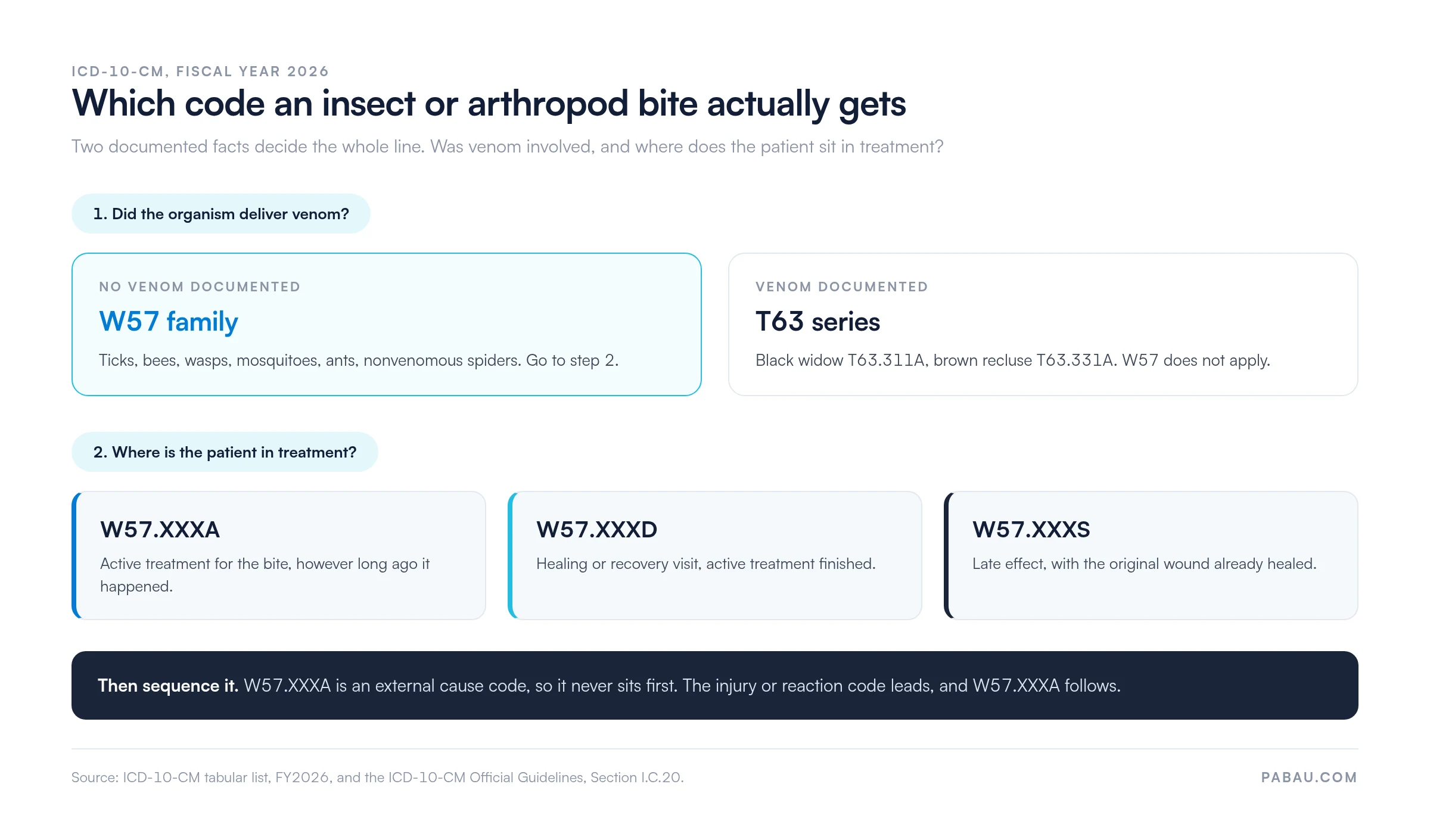
W57.XXXA names the mechanism and stops there. Whatever the patient is being treated for needs its own code, and that code leads the claim.
The table below covers the companions that show up most often on these encounters, plus the two venom codes that replace W57 outright.
Neither T63 code takes an XX placeholder, which trips up coders who pattern-match from W57. Type the full code exactly as the tabular list prints it.
Lyme deserves the same care. A69.20 only goes on the claim when a clinician documents a confirmed diagnosis. A tick bite with documented attachment is exposure, and CDC Lyme disease surveillance guidance keeps exposure and infection apart. Code what the note confirms, not what it rules out.
Every claim also carries a procedure code describing the work performed. For a bite visit that means an evaluation and management code, a removal code, a wound treatment code, or a combination.
The table maps the pairings that come up most.
Payers differ on tick removal. Some accept CPT 10120 for any embedded extraction. Others want the note to state the technique, the instrument, and whether the head came out whole.
Check the payer policy before you default to one code across every removal. The AMA CPT code set guidance is clear that a removal code needs a removal procedure in the record, not a tick-safety conversation.
Weak documentation, not weak coding, is behind most W57.XXXA denials. A claim can be coded correctly and still fail if the note does not support the code.
Payers expect the record to carry the same specificity as the code billed, and the CDC and NCHS ICD-10-CM coding tool is a useful cross-check. Six elements do most of the work.
A structured encounter template captures all six without asking the provider to remember them. That is worth building once, because the same fields drive the code, the claim, and the appeal if one is needed.
Audit a sample of W57 claims every quarter. Line up the seventh character on each claim against the encounter type recorded in the note. If follow-up visits keep going out with an A, the fix belongs in the intake template rather than the coder’s checklist.
It helps to picture where the claim goes. The coder builds it from the note, and the practice sends it as an 837P file to a clearinghouse.
The clearinghouse then runs its format and payer edits. Clean files pass to the payer, and the rest bounce back the same day. Bite claims usually bounce for one of five reasons.
Five questions, thirty seconds, and the file usually pays first time:
Catching a problem here costs a minute. Catching it after the denial costs an appeal, and the reason codes are rarely as specific as coders would like.
If your remittances keep landing with the same rejection, the denial reason codes reference is the fastest way to translate them into a fix.
Coding W57.XXXA correctly is one job. Getting the claim out the door and following it to payment is another. Most practices split those jobs between a clinical system and a separate billing tool. Reconciling the two by hand then eats the end of the week.
Pabau keeps both in the same record. Its ICD-10-CM and CPT lookup libraries sit inside the note and the claim form, so a coder can search a code without leaving the encounter. The claim form pre-fills from what is already recorded.
Before the send button unlocks, claims software for practices checks that the required claim fields are complete. That catches the blank membership or authorization number that would have bounced the file.
For US practices, Pabau submits through the Claim.MD clearinghouse. That covers real-time eligibility checks, CMS-1500 and 837P formats, electronic remittance advice, and claim status tracking.
When a bite claim comes back denied, the remittance posts in Pabau with its reason code attached. Your biller reads it in the same place they built the claim, with no trip to the payer portal.

Pabau puts ICD-10 and CPT lookup, clinical notes, and claim submission in one record, then tracks each claim through to payment. See how practices cut the rework on external cause claims.

W57.XXXA rarely fails because of the code. It fails on the two decisions sitting around it. Put the injury or reaction code first, then match the seventh character to the phase of treatment. Confirm the organism was nonvenomous, and the line is done.
Both decisions are made at the point of care, not at the point of billing. A note that names the organism, the site, and the treatment phase hands the coder each detail the payer will ask for. Fix the encounter template once and these denials stop repeating.
Pabau keeps ICD-10 lookup, claim submission, and denial tracking in one record. Book a demo to see how that works on external cause claims like this one.

Removing an embedded tick? CPT 10120 covers incision and removal of a foreign body from subcutaneous tissue, and the documentation payers expect with it.
Billing the visit rather than a procedure? CPT 99213 sets out the established patient office visit and the decision making the note has to support.
Denials piling up across every code? Denial management in healthcare walks through sorting, appealing, and preventing them as a repeatable process.
Want the claim to pay on the first pass? What is a clean claim explains which fields payers check first and where files usually stall.
Getting ready for an audit? Medical billing compliance covers the coding and documentation standards that keep a practice audit-ready.
Often, yes. ICD-10-CM pairs external cause codes with place of occurrence (Y92), activity (Y93), and status (Y99) codes. Assign them once, at the initial encounter, and only where the note supports them. Plenty of payers ignore them. State injury reporting programs and workers’ compensation carriers often want them.
No. W57 is limited to nonvenomous insects and other arthropods. Mammal bites take their own codes in the same block, such as W54 for dogs and W55 for cats. Using W57 for a mammal bite is a coding error, not a close-enough choice.
Not directly. Payment follows the procedure code and the first-listed diagnosis. W57.XXXA adds the mechanism behind the injury. It matters most to injury surveillance reporting, and to workers’ compensation and liability carriers deciding who covers the visit.
As many as the patient is in active treatment for that bite. The code repeats with an A while treatment continues, then switches to D once the visit becomes a healing check. There is no visit cap, though repeated A characters late in a course will draw payer attention.




