ICD-10 Code Z86.73: Personal history of TIA
ICD-10 Code Z86.73: Definition, descriptor, and code hierarchy ICD-10 Code Z86.7...

Last Updated: Nov 20, 2026
Billable Code Specific Code
Q79.60 is the billable ICD-10-CM code for Ehlers-Danlos syndrome, unspecified. It applies when a provider has diagnosed EDS but the subtype is not yet confirmed, most often during the workup before genetic results arrive.
EDS spans 13 recognized subtypes, most with identifiable genetic markers and distinct clinical profiles. Once testing or specialist review names the subtype, the claim moves to Q79.61, Q79.62, Q79.63 or Q79.69.
Let Pabau's smart automation suggest the right codes, reduce claim denials, and keep your practice compliant—effortlessly.
Automate repetitive tasks and focus on what matters most—your patients.
Reduce coding errors and ensure compliance with the latest regulations.
Clean claims, fewer denials, and faster reimbursements.
Powerful insights and reporting to help your practice thrive.
HIPAA compliant SOC 2 certified GDPR-compliant Trusted by 4,000+ clinics worldwide

Q79.60 is a valid, billable ICD-10-CM code for EDS when the documented subtype is unconfirmed.
Parent code Q79.6 is a non-billable category header and never belongs on a claim.
Once genetic testing confirms the subtype, payers expect the specific code from Q79.61 to Q79.69.
The note needs an EDS diagnosis from a qualified provider plus a statement that the subtype is unspecified or pending.
ICD-10 Code Q79.60 identifies Ehlers-Danlos syndrome of unspecified type, a hereditary connective tissue disorder caused by defects in collagen structure or processing.
CMS’s FY2027 ICD-10-CM code files list it as a billable code in Chapter 17 (Congenital malformations, deformations, chromosomal abnormalities, and genetic disorders, Q00-QA1). That placement reflects the condition’s congenital origin rather than an acquired or inflammatory process.
Three cardinal features commonly appear in documentation supporting this diagnosis: joint hypermobility, skin hyperextensibility, and atrophic scarring (widened or thin scars).
Not every patient presents with all three, and severity varies widely across subtypes. When a clinician documents EDS but cannot yet name the subtype, Q79.60 is the correct assignment.
The 2017 EDS International Classification, published by Malfait et al. in the American Journal of Medical Genetics, recognized 13 EDS subtypes. Each subtype has distinct diagnostic criteria, and most have an identifiable genetic cause.
The major exception is hypermobile EDS (hEDS), which as of the 2017 classification has no confirmed genetic marker. Coders sometimes confuse Q79.60 with Q79.62 (hypermobile EDS) for that reason, since both can describe a patient without a genetic answer.
The parent-child structure explains the most common submission error on EDS claims, which is reporting Q79.6 in place of Q79.60.
Q79.6 is a category header. The CMS ICD-10-CM code files explicitly flag Q79.6 as invalid for submission because it has subcodes. Submitting Q79.6 on a claim produces an automatic rejection. Q79.60 is the minimum specificity required for claim submission when the subtype is unconfirmed.
Check the full Q79.6x family before assigning the unspecified code, because four of its five billable codes name a confirmed subtype. The subtypes below follow the 2017 EDS International Classification.
Use the CDC/NCHS ICD-10-CM web tool to verify active code status for each Q79.6x subcode against the current fiscal year’s tabular list before submitting claims.
Q79.60 is correct when the provider’s documentation states that the EDS subtype is unconfirmed, unknown, or pending further evaluation. The clinician’s note drives that choice. A coder who is unsure which subtype applies queries the provider before reaching for the unspecified code. The chart below maps each documented finding to its code.
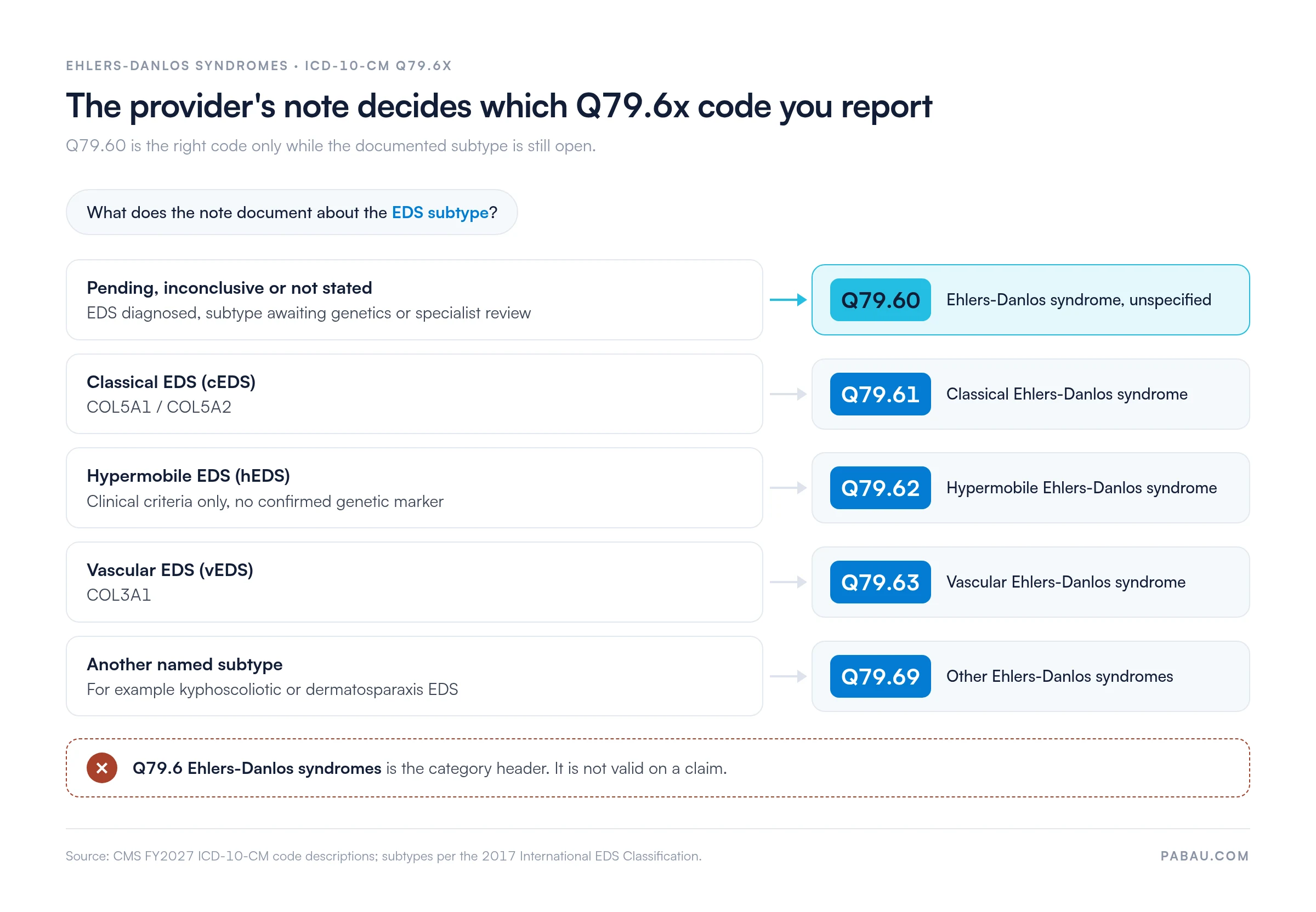
Three clinical situations justify Q79.60:
Once a clinical geneticist confirms the subtype, update the claim to the matching Q79.6x code. Continuing to use Q79.60 after genetic confirmation exposes claims to denial on specificity grounds. ICD-10-CM guidelines require the highest level of specificity the documentation supports, and that rule applies to every code on the claim.
Valid use of ICD-10 Code Q79.60 requires documentation that supports both the EDS diagnosis and the unspecified designation. A missing element gives a payer reviewer grounds to question the claim.
According to the AAPC ICD-10-CM coding resources, coders should code only what the provider documents. When the documentation cannot support a specific code, they query the provider.
Never assign Q79.62 (hypermobile EDS) based on observed joint hypermobility alone if the provider has not specifically documented that subtype.
Run a documentation audit on Q79.60 encounters every quarter. Flag any chart where the provider note lacks an explicit statement about subtype status. Without a phrase such as ‘subtype pending genetic testing’, a valid claim can turn into a denial that needs an appeal and attachments.
HIPAA mandates the use of ICD-10-CM diagnosis codes on all covered entity claims effective October 1, 2015. Beyond that baseline, payer-specific policies govern what services attached to Q79.60 require prior authorization (PA). These vary by MAC (Medicare Administrative Contractor), commercial plan, and state Medicaid program.
Services commonly triggering PA with Q79.60 include genetic testing referrals, physical and occupational therapy, durable medical equipment (orthotic bracing), and specialty medications for pain management.
Always check the applicable Local Coverage Determination (LCD) for the MAC jurisdiction before submitting. LCDs set the Medicare coverage terms for services billed with Q79.60, such as physical therapy, and they differ by region. For an EDS patient starting physical therapy, confirming the LCD before the initial visit avoids retroactive denials.
Claims with Q79.60 draw specificity challenges, because the unspecified designation invites a payer to ask for a subtype. Effective denial management workflows for these claims start with the five common denial triggers below.
When an appeal is necessary, the medical billing denial codes the payer returns (CARC codes) tell the team which documentation to resubmit. That beats sending a blanket appeal.
The ICD-10-CM Official Guidelines for Coding and Reporting, maintained jointly by CMS and the National Center for Health Statistics (NCHS), govern how Q79.60 is sequenced.
Chapter 17 Q-codes follow the general rules for congenital conditions. A congenital condition codes to the Q chapter at any age, whether it is newly diagnosed or has been managed for years.
The key to submitting a clean claim with Q79.60 is confirming the encounter reason drives the sequencing decision, not the diagnosis alone. For practices unfamiliar with congenital code sequencing, reviewing medical billing fundamentals alongside Chapter 17 guidelines helps build that judgment systematically.
Check the admission or encounter reason documented in the note before assigning principal diagnosis. For EDS patients, the encounter reason shifts frequently: one visit is for PT evaluation (manifestation primary), the next is a genetics consultation (Q79.60 primary). Copying one visit’s sequencing onto the next is an easy error to make on multi-visit EDS accounts.
The ICD-10-CM tabular list does not carry Excludes1 or Excludes2 notes directly on Q79.60 that restrict common comorbidities. Coders should, however, be aware of related codes frequently reported alongside Q79.60 and codes that require careful distinction.
M35.7 is the code most often confused with Q79.62 (hypermobile EDS). The two are distinct diagnoses. M35.7 describes hypermobility without the full EDS diagnostic framework, while Q79.62 means the patient meets the 2017 criteria for hEDS.
Never swap these codes based on clinical appearance alone, and query the provider if the documentation uses both terms without distinction.
Accurate reporting of ICD-10 Code Q79.60 starts with how the code is entered at the point of service documentation. Most EHR and practice management systems allow code lookup by either the numeric code (Q79.60) or the descriptor phrase (Ehlers-Danlos syndrome unspecified).
Searching by descriptor is safer for rare codes because it surfaces the full Q79.6x family. Coders can then confirm Q79.60 is the correct leaf node rather than the category header Q79.6.
An EDS patient often moves between genetics, physical therapy and pain management, and each service can carry its own authorization and diagnosis code. When those details live in spreadsheets, the billing team loses track of which approval expires and which visit needs Q79.60 as the principal diagnosis.
Pabau, a practice management platform with built-in claims management software, sends US claims through the Claim.MD clearinghouse. Practices check patient eligibility, submit CMS-1500 and 837P claims, and post ERA remittances against the same patient record.
Prior authorizations sit on the patient’s case, with the auth code, dates and sessions tracked and a warning when one is missing. Genetic testing, therapy and bracing for EDS often need separate approvals. Tracking them on the case keeps a missing authorization from surfacing as a denial weeks later.

Pabau checks eligibility, tracks prior authorizations on the patient’s case, and submits claims through Claim.MD. Claims for complex diagnoses like Q79.60 go out with the authorization already on file.

Q79.60 is a holding code. It is correct while the subtype is open. Once genetics names the subtype, a claim that still says unspecified starts costing the practice money.
The deciding work happens in the provider’s note. Ask providers to state the subtype status in words at every EDS encounter, and recode to Q79.61 through Q79.69 the day a result arrives. Keep Q79.6 off your code picklist entirely.
Book a demo to see how Pabau tracks EDS authorizations and claims from the first referral to the final remittance.

Need to understand how clearinghouse submission works for rare diagnosis codes? Medical claims clearinghouse guide explains how payer connectivity and claim validation reduce rejections before they reach the insurer.
Getting repeated denials on ICD-10 submissions? Electronic remittance advice explained breaks down how to read ERA files and identify the CARC denial codes driving Q79.60 rejections.
Want to verify Q79.60 coverage with a specific payer before submitting? Insurance eligibility verification guide covers how to check plan-specific diagnosis code coverage before the appointment.
ICD-10 Code Q79.60 is the billable ICD-10-CM diagnosis code for Ehlers-Danlos syndrome, unspecified. It is assigned when a clinician has confirmed an EDS diagnosis but the specific genetic subtype has not been identified or documented. It sits under category Q79.6 (Ehlers-Danlos syndromes) in Chapter 17 (Congenital malformations, deformations, chromosomal abnormalities, and genetic disorders, Q00-QA1). The CMS code files flag it as valid for submission.
Yes. Q79.60 is a valid, billable leaf-node code in ICD-10-CM. Its parent, Q79.6, is not billable and must never appear on a claim submission. Q79.60 is the minimum specificity required when the EDS subtype is unconfirmed.
Q79.60 covers unspecified EDS when the subtype is unknown or pending confirmation. Q79.61 is specific to classical EDS (cEDS), which is characterized by severe skin extensibility and widened atrophic scars and is associated with COL5A1/COL5A2 variants. Use Q79.61 only when the provider has documented classical EDS based on clinical criteria and genetic testing.
Yes. Q79.60 is designed for use when genetic subtyping is pending or unavailable. The code is valid as long as a qualified provider has documented an EDS diagnosis with a statement that the subtype is unspecified. Genetic confirmation is not required to assign Q79.60, but once it is available, update the claim to the matching Q79.6x subtype code.
The parent code is Q79.6 (Ehlers-Danlos syndromes), which is a non-billable category header. Q79.60 is the first billable subcode under Q79.6 and represents the unspecified subtype. Never submit Q79.6 alone on a claim because it lacks the specificity required for payer acceptance.
Five reasons come up most often. A claim reports the non-billable parent Q79.6 instead of Q79.60, or the payer wants a subtype code after genetic testing is complete. Other claims lack medical necessity documentation, or prior authorization for genetic testing or PT. The fifth is sequencing, where Q79.60 is listed as secondary on an encounter for EDS management.