ICD-10 code D50.9: Iron deficiency anemia, unspecified
ICD-10 code D50.9: Definition, descriptor, and billable status ICD-10 code D50.9...

Last Updated: Nov 13, 2026
Billable Code Specific Code
G89.29 is the billable ICD-10-CM code for other chronic pain. It covers chronic pain that no more specific code in subcategory G89.2 describes. Pain due to trauma, post-thoracotomy pain and other postprocedural pain go elsewhere.
Most questions about it come down to two decisions. The first is when it can be listed first on a claim. The second is how to tell it apart from R52 (pain, unspecified) and G89.4 (chronic pain syndrome).
Let Pabau's smart automation suggest the right codes, reduce claim denials, and keep your practice compliant—effortlessly.
Automate repetitive tasks and focus on what matters most—your patients.
Reduce coding errors and ensure compliance with the latest regulations.
Clean claims, fewer denials, and faster reimbursements.
Powerful insights and reporting to help your practice thrive.
HIPAA compliant SOC 2 certified GDPR-compliant Trusted by 4,000+ clinics worldwide

G89.29 is the billable ICD-10-CM code for other chronic pain, the residual code in subcategory G89.2 once G89.21, G89.22 and G89.28 are ruled out.
It can be listed first when the visit is for pain control or pain management, with any known cause added as an extra code.
When the visit treats the underlying condition, that diagnosis leads and no code from category G89 goes on the claim.
Chronic pain syndrome, central pain syndrome and cancer-related pain have their own codes, G89.4, G89.0 and G89.3, which G89.2 excludes.
The guidelines set no time frame for chronic pain, so the provider’s documentation decides, while payer policies may add their own duration test.
ICD-10 code G89.29 is the billable code for other chronic pain, the catch-all in subcategory G89.2, Chronic pain, not elsewhere classified. The CDC’s FY 2027 tabular list carries it as a valid, billable code for dates of service from October 1, 2026.
You reach it by elimination. G89.21 takes chronic pain due to trauma, G89.22 takes chronic post-thoracotomy pain, and G89.28 takes other chronic postprocedural pain. Chronic pain that none of those three describes, and that no Excludes1 note sends elsewhere, lands on G89.29.
How the code is used comes from the ICD-10-CM Official Guidelines for Coding and Reporting, which CMS and NCHS publish together. Section I.C.6.b covers category G89, and the rules below follow it. CMS also posts the FY 2027 code files if you load codes into your own system.
G89.29 fits chronic pain that has outlasted normal healing, isn’t related to cancer, and doesn’t match a more defined G89 code. In a working practice, that usually means one of these presentations:
Chronicity is the defining feature, yet the guidelines set no clock for it. Section I.C.6.b.4 says there is no time frame defining when pain becomes chronic, so the provider’s documentation decides. Many payer policies and pain management guidelines use three months as a working threshold.
Check the applicable MAC local coverage determination (LCD) before you rely on any duration, because that test belongs to the payer, not to ICD-10-CM.
Two sets of notes constrain G89.29. Category G89 carries its own Excludes1 and Excludes2 lists, and subcategory G89.2 adds an Excludes1 list of its own. Misreading either is one of the fastest routes to a denial, so the table maps each case to the code that takes it.
Run through the Excludes table before assigning G89.29 on every chart. If the pain is related to cancer, trauma or a procedure, or the provider names a syndrome, a more specific code exists. G89.29 is correct only once those options have been ruled out.
Sequencing turns on one question: why did the patient come in today? Section I.C.6.b of the guidelines gives three answers, and each one sets a different order.
The guidelines’ own example shows the first rule at work. A patient with a displaced disc, nerve impingement and severe back pain comes in for a spinal steroid injection. The pain code leads because pain control is the purpose, and the disc disorder follows.
The diagram below runs both decisions on one page, first which code applies and then where it sits on the claim.
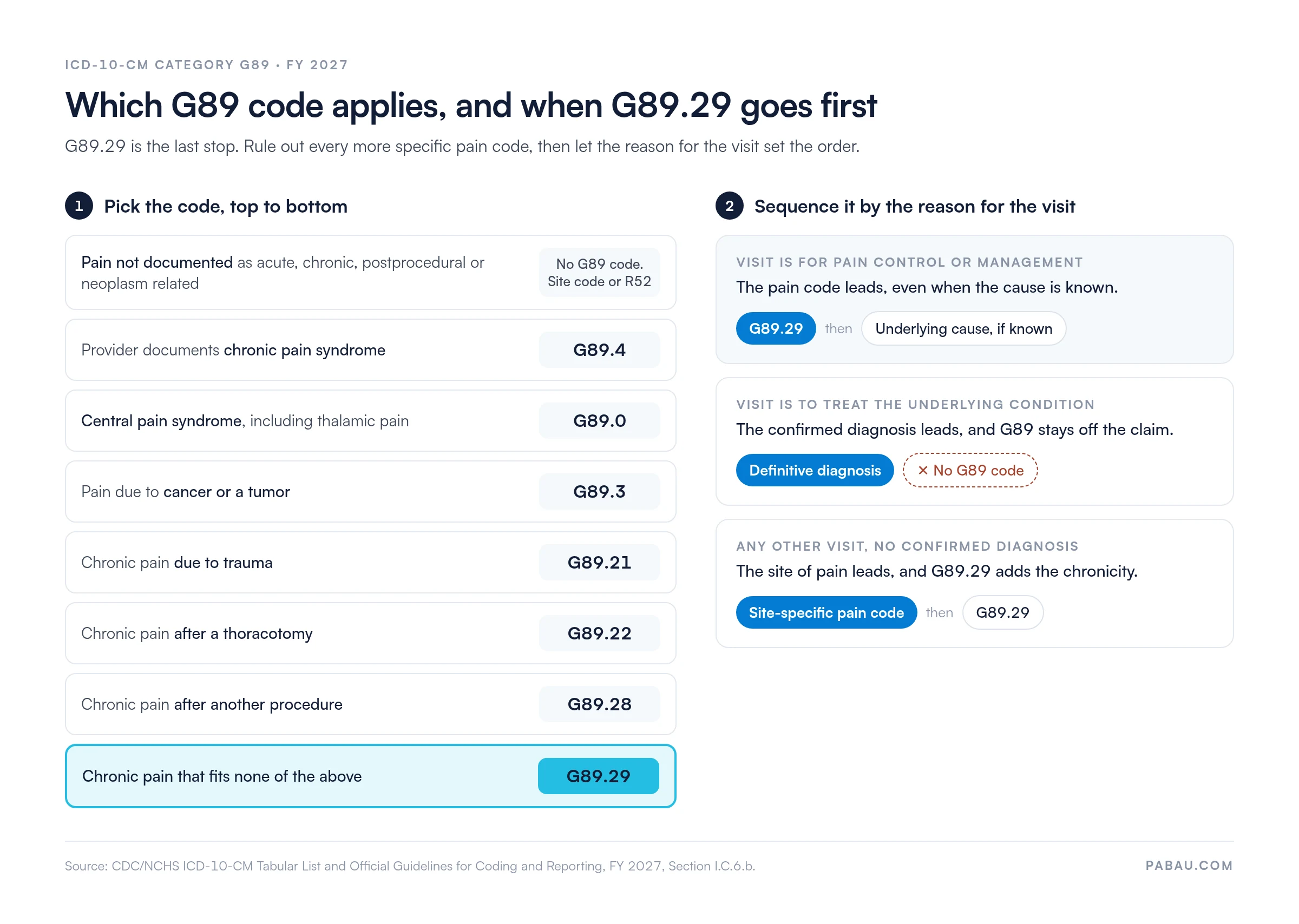
Most coding errors on this page come from picking a sibling code too loosely or too tightly. Central pain syndrome is a good example, because a note saying “central pain” points to G89.0 rather than G89.29.
The table runs the full comparison.
R52 is for pain the record doesn’t characterize at all, with no type or pattern documented. It fits a first presentation the clinician hasn’t evaluated yet.
G89.29 becomes correct the moment the note calls the pain chronic. “Ongoing low back pain for the past seven months without structural findings” is enough to move the assignment.
The G89.4 mix-up runs the other way. Coders sometimes read “chronic pain” as chronic pain syndrome, but the guidelines treat them as different terms. Use G89.4 only when the provider writes “chronic pain syndrome” as the diagnosis.
Payer auditors reviewing G89.29 claims look for a small set of elements in the note. Missing one can trigger a medical necessity denial even when the code is right.
If you chart in Pabau, the practice management and billing platform we build, note templates can prompt for each of these:
Clean claim submission for G89.29 starts at the point-of-care note, not at the billing desk. Coders can’t add documentation the provider never recorded.
It helps to know where each check happens, because each step catches a different mistake.
Medicare Administrative Contractors publish LCDs that govern pain management services. Noridian, Palmetto GBA, CGS and Novitas each maintain policies that list which diagnosis codes support covered services, such as epidural injections and nerve blocks. When G89.29 appears on those claims, payers expect the documentation elements above in the chart. Commercial plans write their own pain policies, and some pay codes Medicare rejects, such as HCPCS S0092 for a hydromorphone pump loading dose.
General billing compliance applies too. The code must reflect what the provider documented, not what is likeliest to pay. Using G89.29 to avoid a more specific, more scrutinized code is a compliance risk. Using it as the residual chronic pain code, where the note supports that, is fully appropriate.
G89.29 denials follow familiar patterns. The denial management steps are always the same: identify the reason code, map it back to the chart, and correct the source before resubmitting.
These are the triggers you’ll see most:
Appeal when the claim was coded correctly and the denial reflects a payer error or an incomplete review. Work through it in this order:
Scenario 1: Chronic diffuse musculoskeletal pain, no structural cause. A 54-year-old patient visits a pain management practice with 10 months of widespread aching. MRI and X-rays are unremarkable, with no neoplasm, prior surgery or trauma documented. The assessment reads “chronic pain, cause undetermined,” and the visit is for pain management. G89.29 is the first-listed code, and no cause code follows because none is confirmed.
Scenario 2: Chronic low back pain from a lumbar disc disorder. A 48-year-old patient has a confirmed lumbar disc disorder with radiculopathy. If the provider sees them for pain management, G89.29 leads and M51.16 (Intervertebral disc disorders with radiculopathy, lumbar region) follows. If the visit is to treat the disc disorder itself, M51.16 leads and G89.29 stays off the claim.
Scenario 3: Chronic pain in a patient with fibromyalgia. Fibromyalgia has its own code, M79.7, and it is itself a chronic pain condition. When the visit manages the fibromyalgia, report M79.7 alone. G89.29 belongs only on a pain management visit where the provider documents chronic pain beyond what M79.7 captures. In that case G89.29 leads and M79.7 follows, but check the payer’s LCD first.
Check the ERA reason codes before correcting any G89.29 claim. CARC 11 means the diagnosis is inconsistent with the procedure. CARC 50 means a non-covered service the payer doesn’t deem medically necessary. CARC 11 usually means the diagnosis choice or order doesn’t support the service. CARC 50 often means the LCD doesn’t cover the procedure with the diagnoses billed.
In many practices, the pain note lives in one system and the claim in another. A coder reads the note, re-keys the codes, and learns about a sequencing error weeks later from a CARC on the remittance.
Pabau keeps the chart and the claim in one place. The note that documents chronicity and the reason for the visit sits beside the claim built from it. The coder checks the code order against the record without switching screens.
Claims go out through the Claim.MD clearinghouse integration, which covers electronic claims to thousands of US payers. It also runs real-time eligibility checks and returns electronic remittance advice (ERA).
The outcome is fewer avoidable denials on chronic pain claims, and faster fixes when one does come back.

Pabau’s claims management connects your clinical documentation to clearinghouse submission, so G89.29 and its supporting codes move from the chart to the payer without rekeying.

G89.29 rewards discipline more than memory. Rule out the six more specific pain codes, then ask why the patient came in. Those two questions settle almost every G89.29 claim.
The code is valid for FY 2027, so the work that matters is in the note. A pain management visit that says so, with chronicity documented, supports G89.29 as the lead code. A visit that treats the underlying condition doesn’t, and leaving G89.29 off that claim is the correct call.
Book a demo to see how Pabau connects pain documentation to clean chronic pain claims.

Not sure the pain is chronic yet? ICD-10 code R52 covers pain that has no documented type or duration.
Working through a denial backlog? Denial management in healthcare outlines a systematic approach to categorizing, appealing and preventing recurring denials.
Checking a claim against payer rules? Medical billing compliance explains the rules that keep diagnosis coding defensible in an audit.
Need a foundation for understanding pain billing? Medical billing fundamentals covers the workflow from charge capture through payer adjudication.
Looking for the clearinghouse behind your pain claims? Claim.MD clearinghouse overview explains how the clearinghouse works with Pabau for US payers.
There is no single code. Report a low back pain code, such as M54.50 (low back pain, unspecified) or M54.59 (other low back pain). Add G89.29 to show the pain is chronic. A pain management visit lists G89.29 first.
Pair G89.29 with the knee pain code for the side: M25.561 for the right knee or M25.562 for the left. The site code alone doesn’t say the pain is chronic, so both are reported.
Yes. Z79.891 (long term current use of opiate analgesic) is a status code that adds context to the claim. It’s reported as an additional code and doesn’t replace G89.29.
Code G89.29 with F45.42, pain disorder with related psychological factors, as the note at category G89 instructs. If the pain is exclusively psychological, use F45.41 instead, and no G89 code.
Yes. G89.29 is valid and billable in the FY 2027 code set, which runs from October 1, 2026 to September 30, 2027. Codes update every October 1, so recheck it against the new CDC/NCHS release each year.