ICD-10 Code Y76.0: Diagnostic obstetric and gynecological devices
ICD-10 Code Y76.0: Definition and billable status ICD-10 Code Y76.0 is a valid, ...

Last Updated: Oct 23, 2026
Billable Code Specific Code
Q43.7 is the billable ICD-10-CM code for persistent cloaca. It sits under parent category Q43 (Other congenital malformations of intestine) in Chapter 17, and it covers short-channel and long-channel cloaca alike.
The condition occurs only in females and presents at birth, so Q43.7 appears almost entirely on neonatal and pediatric claims. Those usually go to Medicaid, CHIP or commercial pediatric plans. Most denials trace to missing operative documentation or to Q52.2 (Congenital rectovaginal fistula) added for a connection the cloaca already includes.
Let Pabau's smart automation suggest the right codes, reduce claim denials, and keep your practice compliant—effortlessly.
Automate repetitive tasks and focus on what matters most—your patients.
Reduce coding errors and ensure compliance with the latest regulations.
Clean claims, fewer denials, and faster reimbursements.
Powerful insights and reporting to help your practice thrive.
HIPAA compliant SOC 2 certified GDPR-compliant Trusted by 4,000+ clinics worldwide

Q43.7 is a valid, leaf-level billable ICD-10-CM code that needs no additional specificity digit.
Persistent cloaca affects only females, and Q43.7 applies to short-channel and long-channel cloaca alike.
Do not add Q52.2 (congenital rectovaginal fistula) to a Q43.7 claim for the same defect, because the Excludes1 note under Q52.2 lists cloaca (Q43.7).
Each surgical stage of a cloaca repair usually needs its own prior authorization, so one approval rarely covers the whole sequence.
Pabau’s claims management software will not send a claim until required details such as the authorization code are filled in.
ICD-10 code Q43.7 is the billable ICD-10-CM code for persistent cloaca. In this congenital malformation, the rectum, vagina and urethra drain through one common channel. It applies to female patients at any channel length and needs no further characters. The table below collects the reference data to confirm before you submit a claim.
Persistent cloaca is a congenital anorectal malformation that occurs exclusively in females. The rectum, vagina, and urethra fail to separate during embryonic development and drain through a single shared channel, called the common channel. The condition arises from incomplete partitioning of the embryonic cloaca before week 6 of gestation.
Coders need to understand two anatomically important distinctions. First, common channel length varies. Short-channel defects (under 3 cm) generally allow a simpler posterior sagittal repair. Long-channel defects (3 cm or more) require total urogenital mobilization.
ICD-10-CM code Q43.7 covers both presentations, because channel length does not change the diagnosis code. Second, the condition is exclusively female by definition, because the malformation involves the vagina. A male patient with a single perineal opening is coded under a different anorectal malformation code.
According to the Centers for Medicare and Medicaid Services ICD-10-CM guidelines, Chapter 17 codes apply to congenital malformations diagnosed at any age. That includes cases detected prenatally and documented after birth.
ICD-10-CM code Q43.7 covers all clinical presentations of persistent cloaca in female patients, regardless of common channel length, surgical history, or age at diagnosis. The tabular lists one inclusion term under it, “Cloaca NOS”, so a record that documents a cloaca without further detail still maps to Q43.7.
Q43.7 is a leaf-level code with no child codes beneath it. Reporting Q43 alone (the parent header) is incorrect and triggers a claim edit, so bill Q43.7 as the full four-character code.
When associated anomalies are documented and clinically significant, additional ICD-10-CM codes may be required alongside Q43.7.
Sacral agenesis and other vertebral anomaly codes from category Q76, plus renal agenesis codes from Q60, are commonly added in multisystem cases. The CDC/NCHS ICD-10-CM web tool provides the official tabular list with inclusion notes for Q43.7.
Only one Excludes note in the ICD-10-CM tabular names Q43.7, and it sits under Q52.2 (Congenital rectovaginal fistula). Q43.7 itself carries no Excludes1 or Excludes2 notes, only the inclusion term “Cloaca NOS”.
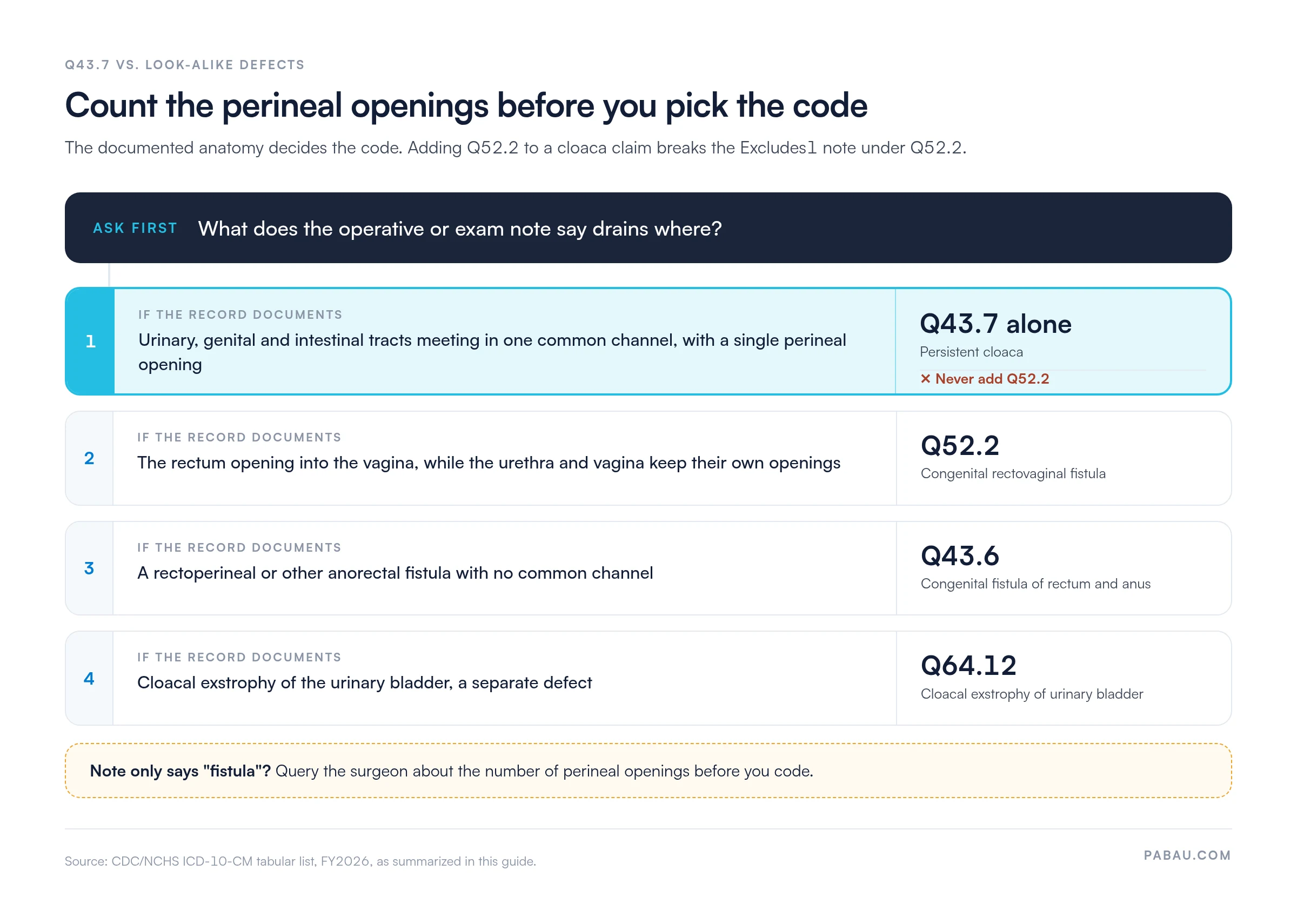
The Q52.2 note matters because the two defects can look alike in a brief operative note. In an isolated congenital rectovaginal fistula, the rectum opens into the vagina, but the urethra and vagina keep their own openings. That pattern goes to Q52.2.
In persistent cloaca, the urinary, genital and intestinal tracts meet in one common channel with a single perineal opening. That pattern goes to Q43.7 alone.
Adding Q52.2 for the rectovaginal connection inside the channel creates an Excludes1 conflict, and the claim will edit or deny. If the note only says “fistula”, query the surgeon about the number of perineal openings. The diagram below sets out how the documented anatomy maps to each code.
The Q43 category covers “Other congenital malformations of intestine.” These are the codes most likely to appear alongside Q43.7 on the same claim or patient record.
Consult the AAPC Codify ICD-10-CM lookup to verify the full tabular hierarchy for Q43 before coding neighboring categories.
Persistent cloaca repair is one of the most complex pediatric surgical procedures. Claims typically involve a staged sequence: colostomy creation at birth, reconstructive repair (PSARP or total urogenital mobilization), and colostomy closure. Each stage carries distinct procedure codes that pair with Q43.7 as the principal diagnosis on inpatient claims.
CPT codes for cloacal repair require verification against the current AMA CPT codebook and payer-specific local coverage policies before billing. The codes below are commonly paired options based on clinical literature and AAPC guidance.
Always confirm them against AHA Coding Clinic and the payer LCD before submitting. A medical claims clearinghouse then checks each diagnosis and procedure pair against payer edits before the claim reaches the payer.
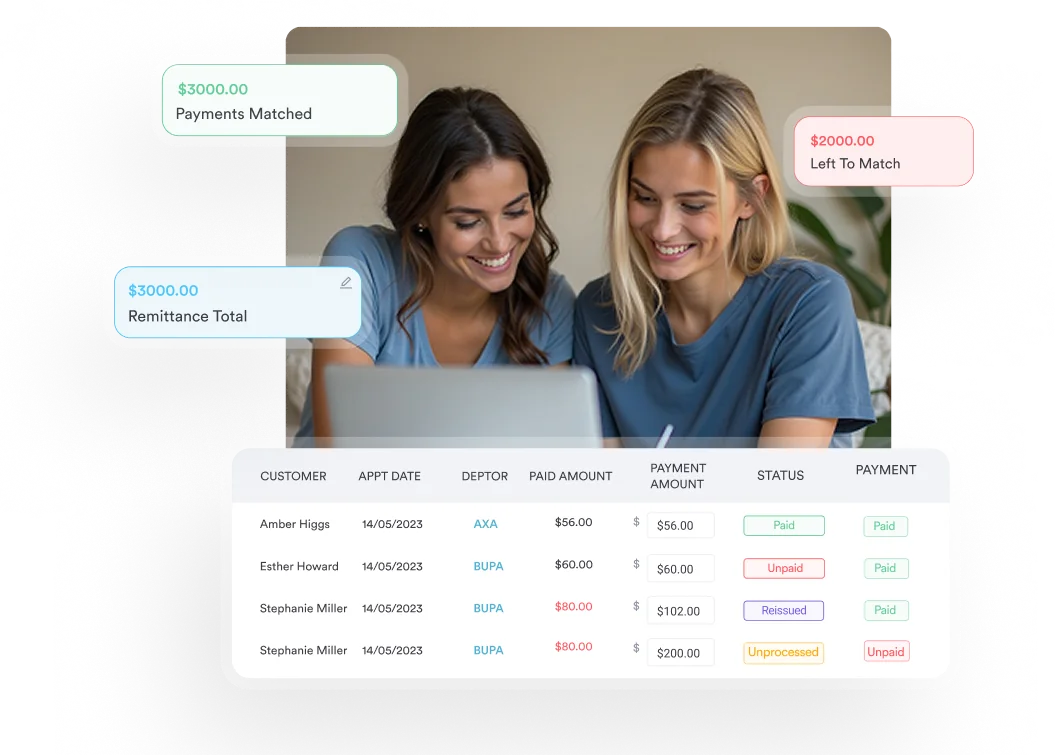
Pabau, the practice platform we build, sends these claims to Claim.MD from its claims management software. Remittances come back into the same record, so each stage’s payment can be matched to its claim.
Unbundling is a significant risk on cloacal repair claims. When PSARP and vaginoplasty happen in the same operative session, check AHA Coding Clinic guidance. It decides whether vaginoplasty is coded separately or included in the reconstruction code. Incorrectly billing both without edit-check review is a common audit trigger for pediatric surgical programs.
Strong documentation is the single biggest protection against Q43.7 claim denials. Payers auditing pediatric surgical claims expect the medical record to establish the diagnosis on its own, without leaning on the code.
Sound medical billing compliance starts with knowing exactly what documentation is required before the claim reaches the clearinghouse.
For inpatient claims, the attending physician must identify persistent cloaca as the principal diagnosis in the discharge summary when it drove admission. Sequencing it first on a pediatric surgical DRG claim follows the same medical billing fundamentals as any inpatient claim.
Medicare is rarely the payer for this pediatric diagnosis. Prior authorization rules therefore come almost entirely from Medicaid managed care organizations (MCOs) and commercial pediatric plans. Requirements vary significantly by state and plan, but several patterns hold across most payers.
Run insurance eligibility verification before the initial surgical consultation. A neonate transferred from the birth hospital is often not yet enrolled in Medicaid when the referral arrives.
Most payers require authorization for each surgical stage separately. A single auth for “cloaca repair” does not automatically cover colostomy closure six to twelve months later.
Verify requirements directly in each payer portal, because authorization policies change every year. The multidisciplinary team letter (pediatric surgeon, urologist, gynecologist) carries significant weight with payer medical directors who review rare surgical cases. Include it with the first request, not only on appeal.
Q43.7 claims fail at higher rates than most pediatric surgical codes because the condition is rare, the staging is complex, and documentation standards are high. A proactive denial management workflow that audits claims before submission catches most of the following issues.
Before appealing, classify each Q43.7 denial by its CARC against a reference of medical billing denial codes. CARC 29 (the time limit for filing has expired) is one of the two most common non-clinical denials on rare pediatric surgical cases.
The other is CARC 16 (claim lacks information). A CARC 16 denial is fixed by resubmitting with the missing data, while a CARC 29 denial is overturned only with proof of timely filing. Checking each claim against clean claim requirements before submission cuts appeal volume.
Send every Q43.7 claim through pre-submission documentation review, including claims that have never been denied. The staged nature of cloaca repair means a clean claim for Stage 1 does not guarantee Stage 2 passes without re-audit. Build a per-stage checklist. Confirm the diagnosis code is Q43.7 (not Q43), the auth number is present, and the procedure code matches AMA CPT. The operative report terminology should match the ICD-10-CM descriptor.
A cloaca case can run through three or more surgical stages over a year or longer. Each stage needs its own authorization, imaging and operative report. When those sit in separate systems, a missing Stage 3 authorization or a stray Q52.2 code often surfaces only when the denial arrives.
Pabau keeps that work in one patient record. When an invoice is ready, its claims software pulls the patient, treatment and insurer details into the claim. The Send button stays inactive until required details such as the authorization code are in place. A Stage 2 claim cannot leave without its own approval number.
Through the Claim.MD connection, billing teams run real-time eligibility checks before each stage. They submit claims electronically, track each claim’s status and post ERA remittances from the same dashboard. The result is fewer avoidable denials across a repair sequence that can run for more than a year.

Pabau checks eligibility through Claim.MD and holds each claim until its authorization code is in place. Every claim is then tracked from submission to ERA posting in one dashboard.

ICD-10 code Q43.7 is a single billable leaf code that covers every channel length, so code selection is rarely the problem. Q43.7 claims fail on vague operative wording, missing per-stage authorizations, and Q52.2 added for a connection the cloaca already includes.
Teams that build the Q52.2 check and the per-stage authorization check into pre-submission review stop most of these denials before a claim leaves the practice. Book a demo to see how Pabau runs those checks on staged pediatric surgical claims.

Need to understand how clearinghouse claim edits catch Q43.7 errors before submission? Understanding medical claims clearinghouses explains how real-time payer edits flag diagnosis and procedure code conflicts before a claim reaches the payer.
Want a structured approach to tracking authorization across staged surgical procedures? Revenue cycle management explained covers how RCM workflows handle multi-encounter authorization tracking for complex pediatric cases.
Looking to reduce denial rates on rare pediatric surgical claims? Electronic remittance advice (ERA) processing covers how 835 remittance files carry CARC denial codes that let billing teams classify and appeal Q43.7 denials systematically.
ICD-10 code Q43.7 is the billable ICD-10-CM diagnosis code for persistent cloaca. In this congenital malformation, the rectum, vagina, and urethra drain through a single common perineal opening. It falls under parent category Q43 (Other congenital malformations of intestine) within Chapter 17 of ICD-10-CM and is valid for fiscal year 2026.
Yes, Q43.7 is a valid, leaf-level billable code and may be submitted directly on insurance claims without further specificity. Do not use the parent code Q43 alone, because payers reject it as a non-billable header code.
Q43.7 codes persistent cloaca, where the urinary, genital and intestinal tracts meet in one common channel with a single perineal opening. Q52.2 codes an isolated congenital rectovaginal fistula, where the urethra and vagina keep their own openings. The Excludes1 note under Q52.2 lists cloaca (Q43.7), so the two are never reported together for the same defect.
Commonly paired CPT codes include colostomy creation (44320) and colostomy closure (44620/44625). Posterior sagittal anorectoplasty (46744/46748) and total urogenital mobilization (46746/46748) need verifying against current AMA CPT. Always verify current CPT assignments against the AMA CPT codebook and payer guidance before billing. Unbundling risk applies when several procedures happen in the same operative session.
Anorectal malformation (ARM) is the broader category, covering imperforate anus and various rectal fistula presentations in both males and females. Persistent cloaca is a specific subtype of ARM occurring exclusively in females, defined by the three-structure common channel. A female patient with isolated imperforate anus and no vaginal/urethral confluence is coded under Q42.x (atresia codes), not Q43.7.
A Q43.7 claim is most often denied for an Excludes1 conflict, when Q52.2 is reported alongside it for the same defect. Operative notes that say “anorectal malformation” instead of “persistent cloaca” also trigger medical necessity denials. Missing per-stage authorization, unbundled PSARP and vaginoplasty claims, and billing the non-billable header Q43 cause the rest. Check the Excludes notes in the CDC ICD-10-CM tabular before refiling.