ICD-10 Code Y76.0: Diagnostic obstetric and gynecological devices
ICD-10 Code Y76.0: Definition and billable status ICD-10 Code Y76.0 is a valid, ...

Last Updated: Oct 23, 2026
Billable Code Specific Code
O25.3 is the billable ICD-10-CM code for malnutrition in the puerperium, the six weeks that begin immediately after delivery. It applies when the provider diagnoses malnutrition in a patient during that postpartum window.
The code sits in category O25, Malnutrition in pregnancy, childbirth and the puerperium, in Chapter 15 of ICD-10-CM. It needs no further characters and takes sequencing priority over codes from other chapters. Malnutrition during pregnancy is coded to O25.1- instead, and O25.2 applies when delivery occurs during the current admission.
Let Pabau's smart automation suggest the right codes, reduce claim denials, and keep your practice compliant—effortlessly.
Automate repetitive tasks and focus on what matters most—your patients.
Reduce coding errors and ensure compliance with the latest regulations.
Clean claims, fewer denials, and faster reimbursements.
Powerful insights and reporting to help your practice thrive.
HIPAA compliant SOC 2 certified GDPR-compliant Trusted by 4,000+ clinics worldwide

O25.3 is a billable ICD-10-CM code for malnutrition in the puerperium, the six weeks that follow delivery.
Malnutrition during pregnancy is coded to O25.10-O25.13 by trimester, and malnutrition during the delivery admission is coded to O25.2.
The record needs a provider-documented malnutrition diagnosis and a delivery date that places the encounter in the postpartum period.
O25 carries no use-additional-code note, but Chapter 15 guidelines allow an E40-E46 code to specify the malnutrition type.
Practice software such as Pabau keeps the delivery date and diagnosis on one record, then submits and tracks the claim your coder builds.
ICD-10 Code O25.3 is the billable diagnosis code for malnutrition in the puerperium, the period that begins at delivery and lasts six weeks. It sits in the ICD-10-CM Tabular List, which the CDC’s National Center for Health Statistics (NCHS) publishes and CMS adopts for US claims. Its category, O25, covers malnutrition in pregnancy, childbirth and the puerperium.
Verify the code’s active status against the current-year tabular list before submission. The CDC/NCHS ICD-10-CM web tool lets coders confirm billable status and review the full O25 hierarchy for any fiscal year.
O25.3 applies when a provider diagnoses malnutrition in a patient during the puerperium. The official guidelines define that period as starting immediately after delivery and continuing for six weeks. Any complication that occurs within those six weeks counts as a postpartum complication.
Encounters that typically fall under O25.3 include:
The last case rests on guideline I.C.15.o.3. It allows Chapter 15 codes after the postpartum period when the provider documents that the condition is pregnancy related. Without that statement, a malnutrition diagnosis made more than six weeks after delivery is coded outside Chapter 15, to the E40-E46 range.
O25.3 carries no instructional notes of its own. The rules that govern it come from the Chapter 15 notes, the Official Guidelines, and the notes on neighboring categories.
The FY2026 tabular list shows no use-additional-code note at O25 or O25.3, and the FY2027 addenda leave the category unchanged. The E40-E46 code is still worth adding. Guideline I.C.15.a.1 allows codes from other chapters alongside Chapter 15 codes to further specify a condition.
When the provider documents the type, such as moderate protein-calorie malnutrition (E44.0), report that E-code after O25.3. When the note says only “malnutrition”, E46 captures it, because it includes Malnutrition NOS. Payer edits vary, so check whether your major payers expect the E-code on every O25.3 claim.
The chapter also asks for a Z3A weeks-of-gestation code “if applicable”. That note is written for encounters during pregnancy. On a postpartum encounter the pregnancy has ended, so check current Coding Clinic guidance and your payer’s edits before adding one.
Category O25 divides malnutrition by when it occurs. Pregnancy, childbirth and the puerperium each have their own code, and only the pregnancy codes carry a trimester. The timeline below maps each code to its window.
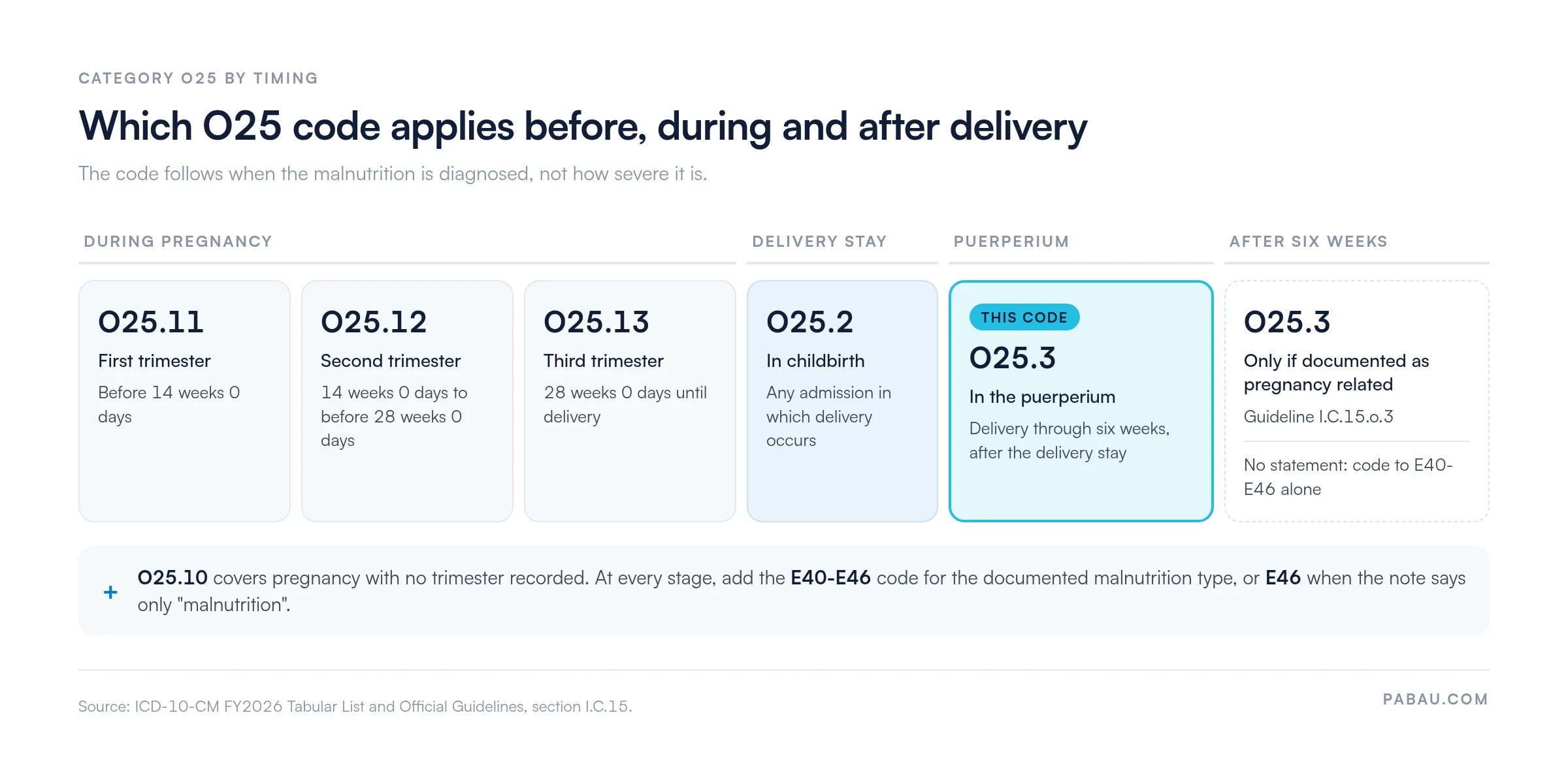
The choice between O25.2 and O25.3 turns on the admission in which the diagnosis is made. Guideline I.C.15.a.3 says that when delivery occurs during the current admission, the “in childbirth” code applies. Malnutrition diagnosed on day two of the delivery stay is therefore O25.2. The same diagnosis at an office visit three weeks later is O25.3.
Supporting O25.3 on a claim takes four elements in the medical record. Capturing each one before the claim is built saves chasing records afterward, which is where clean claim submission makes the biggest difference on postpartum encounters.
After the six weeks, add a fifth element: a provider statement that the malnutrition is pregnancy related. Without it, the diagnosis moves out of Chapter 15.
Chapter 15 codes have sequencing priority over codes from other chapters, as the ICD-10-CM Official Guidelines state in section I.C.15.a.1. CMS posts the annual code files and guidelines for each fiscal year.
When a postpartum encounter is for managing malnutrition, O25.3 is the first-listed diagnosis and the E-code follows it. Pabau sends claims through the Claim.MD clearinghouse for US practices, but the sequence itself is set by your coder.
Z39.2, routine postpartum follow-up, fits only when no complication is addressed. Once the provider diagnoses and manages malnutrition at the visit, the Chapter 15 code leads. A clear view of the medical billing workflow helps front-desk and billing teams spot that switch when the note is written.
A diagnosis code does not trigger prior authorization on its own. Authorization depends on the service billed with it, such as an inpatient readmission or a specialist nutrition program. Most state Medicaid programs now extend postpartum coverage to 12 months after delivery, so confirm the patient’s plan and benefit period at each visit.
Payers reviewing O25.3 claims commonly look for:
Put the delivery date in every postpartum note, even on a follow-up. It proves the encounter falls inside the six-week puerperium, and it is the first fact a reviewer checks against O25.3.
O25.3 denials tend to trace back to five causes. Build checks for them into your denial management workflows, so patterns show up across patients and not claim by claim.
Checking O25.3 rejections against the medical billing denial codes shows which of these causes drives your pattern, so the fix matches the problem.
Coders working with O25.3 regularly meet neighboring codes in Chapter 15 and in the malnutrition block. AAPC’s ICD-10-CM lookup lets you move between these related codes while you work.
An O25.3 claim holds up when the delivery date, the provider’s diagnosis and the supporting notes sit together. In many practices they are spread across a delivery summary, a paper intake form and a separate billing system. The coder then has to rebuild the timeline before the claim can go out.
Pabau, the practice management platform we build, keeps those details on one patient record. Your coder assigns the codes from that record, and Pabau’s claims management software submits the claim through Claim.MD and tracks its status. Rejections come back to the same record, so the team can correct and resubmit without searching for the notes.

Pabau keeps delivery dates, diagnoses and notes on one record, then submits and tracks your claims through Claim.MD. See how it fits your practice.

Code O25.3 on timing first. If the patient has delivered and the encounter falls within six weeks, malnutrition belongs to O25.3. The delivery admission takes O25.2 instead, and pregnancy encounters take a trimester code under O25.1-.
The trade-off is documentation. A delivery date in every postpartum note and an E-code for the documented type cost a few seconds each. They also remove the two questions a reviewer is most likely to ask.
Book a demo to see how Pabau keeps postpartum records and claims together for your practice.

Need guidance on managing medical billing denials systematically? Revenue cycle management for healthcare practices covers the end-to-end billing workflow from eligibility check through payment posting.
Want to understand how clean claims reduce rework? Superbill creation and management explains how well-structured charge capture prevents downstream coding errors.
Coding a postpartum complication with no specific code? ICD-10 code O90.9 explains when an unspecified complication of the puerperium is the right choice.
ICD-10 Code O25.3 is the billable diagnosis code for malnutrition in the puerperium, the six weeks after delivery. It belongs to category O25 in Chapter 15 of ICD-10-CM.
Yes, O25.3 is a billable ICD-10-CM code. It is complete at four characters and needs no sixth or seventh character.
O25.1 is a non-billable subcategory for malnutrition in pregnancy, reported as O25.10-O25.13 by trimester. O25.2 covers malnutrition in childbirth, including the delivery admission. O25.3 covers malnutrition in the puerperium, after delivery.
The tabular list has no use-additional-code note at O25. Chapter 15 guidelines still allow an E40-E46 code to specify the malnutrition type, so add one when the provider documents the type.
Yes. O25.3 is the first-listed diagnosis when a postpartum encounter is for managing the malnutrition, because Chapter 15 codes take sequencing priority. The E-code for the malnutrition type follows it.
Only when the provider documents that the malnutrition is pregnancy related, as guideline I.C.15.o.3 allows. Without that statement, code the malnutrition to the E40-E46 range instead.