CPT code 93503: Swan-Ganz catheter billing and modifiers
CPT code 93503: Official descriptor and procedure overview In the AMA CPT code s...

Last Updated: Oct 23, 2026
Billable Code Specific Code
M45.3 is the billable ICD-10-CM code for ankylosing spondylitis of cervicothoracic region.
Let Pabau's smart automation suggest the right codes, reduce claim denials, and keep your practice compliant—effortlessly.
Automate repetitive tasks and focus on what matters most—your patients.
Reduce coding errors and ensure compliance with the latest regulations.
Clean claims, fewer denials, and faster reimbursements.
Powerful insights and reporting to help your practice thrive.
HIPAA compliant SOC 2 certified GDPR-compliant Trusted by 4,000+ clinics worldwide

ICD-10 Code M45.3 is a billable ICD-10-CM code for ankylosing spondylitis of the cervicothoracic region, valid for FY2026.
M45.3 carries an adult diagnosis restriction. It applies to patients aged 15 years and older, so pediatric use needs a documented clinical exception.
The most common error is defaulting to M45.9 when the notes already name the cervicothoracic region. Code to the highest specificity the chart supports.
Coding accuracy starts in the chart. Practice management software like Pabau keeps code selection and clinical documentation in one workflow.
ICD-10 Code M45.3 is a billable, specific ICD-10-CM diagnosis code. Its official descriptor is Ankylosing spondylitis of cervicothoracic region, the C7-T1 junction. The code carries an adult diagnosis restriction, so it applies to patients aged 15 years and older.
It took effect on October 1, 2025 under the CDC/NCHS ICD-10-CM FY2026 edition and stays valid through September 30, 2026. M45.3 is undercoded more often than it is miscoded. Coders reach for M45.9 even when imaging and physician notes name the affected region.
Ankylosing spondylitis (AS) is a chronic inflammatory arthritis that targets the sacroiliac joints and axial skeleton. It sits in the spondyloarthropathy family alongside psoriatic arthritis, reactive arthritis, and arthritis linked to inflammatory bowel disease. Inflammation drives progressive fibrosis and eventual bony fusion, or ankylosis, of the affected spinal segments.
The cervicothoracic region is the junction between the cervical and thoracic spine, centered on the C7-T1 segments. AS involvement here produces a distinctive picture. Rheumatology teams and chiropractic practices see neck stiffness, restricted cervical rotation, and pain radiating into the arms.
Because AS climbs the spine, cervicothoracic involvement usually appears in patients with established lumbar or thoracic disease. Expect concurrent M45 subcodes such as M45.6 when you code an advanced presentation.
M45 is the parent category for ankylosing spondylitis under ICD-10-CM Chapter 13, which covers the musculoskeletal system and connective tissue. The category is not billable on its own. Every claim needs a specific subcode naming the anatomical region.
The AAPC Codify ICD-10-CM lookup lists ten ankylosing spondylitis subcodes, from the occipito-atlanto-axial region through to unspecified. The FY2026 tabular list also nests a separate M45.A block under M45. Those codes cover non-radiographic axial spondyloarthritis, a related but distinct diagnosis.
The table below maps those ten subcodes. Knowing where M45.3 sits helps you choose correctly when notes name more than one region. It also separates M45.3 from M45.2 above it and from the frequently misused M45.9 below.
The following terms are clinically accepted synonyms and alternate descriptions coders may encounter in physician notes for M45.3:
Most musculoskeletal diagnoses lead to therapy, charted in a physical therapy EMR from first assessment to discharge.
Accurate use of ICD-10 Code M45.3 depends on what the chart already says before the encounter is coded. Missing one element below can trigger a payer query or a denial. Capturing them at the point of care.
Region of involvement, the inflammatory symptom checklist, and the imaging reference all arrive filled in. The chart is complete before the coder opens it.

Run a documentation audit on your most recent 10 M45.3 encounters. Flag any chart where the anatomical region is described only as ‘spine’ or ‘back’ without specifying the cervicothoracic segment. Those encounters are candidates for a physician query before claim submission.
The patterns below drive most of the denial and audit risk on ankylosing spondylitis claims. The same specificity trap runs through the whole M45 family. Reworking denied claims one at a time keeps cash moving but never lowers the denial rate.
Several conditions overlap with cervicothoracic AS on presentation. Accurate differential coding protects against medical necessity rejections and supports cleaner prior authorization. Codes such as M46.1 and M54.2 often reach the claim before AS is confirmed.
M45.3 and an M47 spondylosis code such as M47.9 should not both be applied to the same spinal region in one encounter. Spondylosis implies a degenerative cause, which does not fit the inflammatory classification of AS.
M45.3 appears on claims next to the procedure codes that follow the usual management pathway for cervicothoracic AS. Practices that offer osteopathy or physical therapy alongside rheumatology meet these pairings often. Reimbursement follows each payer’s policy, so verify coverage and prior authorization before you submit. Most practices transmit M45.3 with these CPT codes on an 837 file, the standard format for electronic claims. Coding sits in the middle of the revenue cycle, between registration and payment posting.
Biologic therapy management adds administration and drug codes for TNF inhibitors and IL-17 inhibitors. Verify payer-specific prior authorization for biologic claims before submission, because coverage criteria vary by plan and formulary.
Most coding errors on ICD-10 Code M45.3 trace back to thin documentation at the point of care. A physician records “cervical spine AS” without naming the junction level, or cites imaging without recording the report date. Practices comparing options can see how leading platforms measure up in our guide to medical billing software in the US.
Practice management software like Pabau keeps ICD-10-CM code selection and clinical documentation in the same workflow. Clinicians enter anatomical findings straight into structured encounter notes, and those entries reach the billing team without retyping. Pabau’s claims management software then carries the diagnosis through to the claim.
Structured intake and templated encounter notes also remove the blank field that pushes coders toward M45.9. By the time the claim is built, the region of involvement is already on the chart.

Pabau’s patient record management stores imaging references and lab results next to the encounter notes, HLA-B27 included. Every documentation element M45.3 needs is there when the coder opens the chart. Practices running physical therapy alongside rheumatology keep both schedules and both billing streams in the same system.
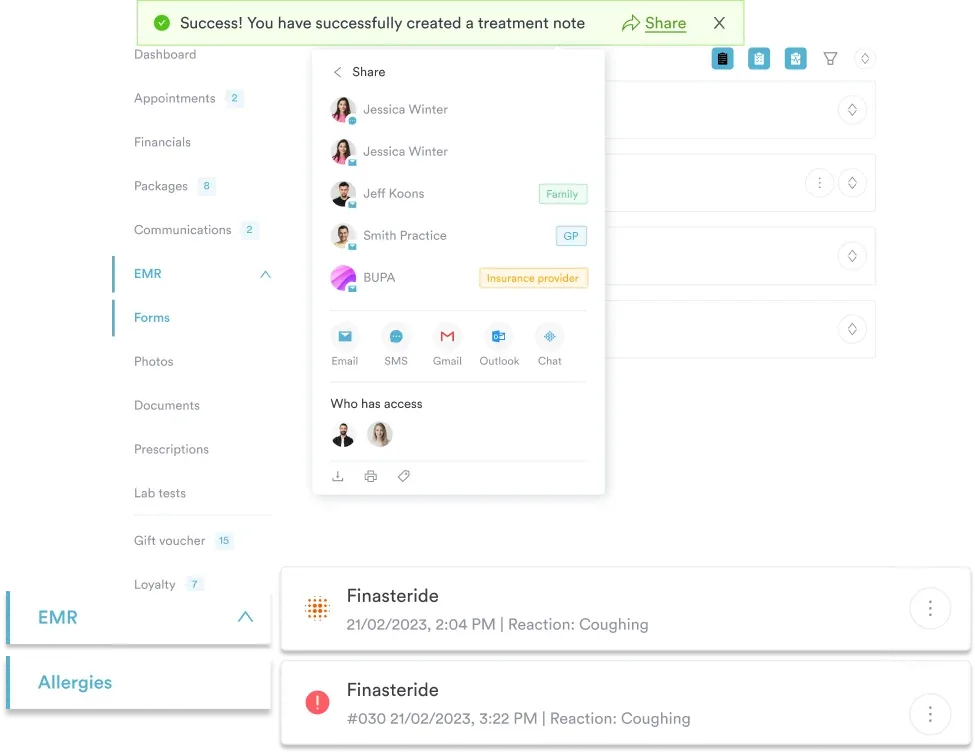
Build a rheumatology encounter template that includes a mandatory ‘Spinal region(s) affected’ dropdown with all M45 subcodes listed. When the physician selects the cervicothoracic region, the coder sees it immediately, and nobody has to reconstruct the chart later.

Pabau’s claims management tools support accurate ICD-10-CM code entry, complete documentation workflows, and cleaner claim submission for musculoskeletal practices.

ICD-10 Code M45.3 is one of the most consistently undercoded diagnoses in rheumatology billing. The cause sits upstream, in a chart that never records the anatomical detail the code needs. When the cervicothoracic region is documented, code it. Falling back on M45.9 with the region in hand carries compliance risk of its own.
Practices that build the documentation into the encounter itself see the sharpest drop in M45-family errors. Retrospective chart review never catches as much, and it costs the coder time nobody has. Book a demo to see how Pabau keeps M45.3 documentation and claims in one workflow.

Coding AS across more than one spinal region? M45.0 sets out the multiple-sites code and when it beats a single-region subcode.
Documenting ankylosing spondylitis lower down the spine? M45.7 walks through the lumbosacral subcode and the imaging findings that support it.
Ruling out seropositive rheumatoid arthritis? M05.A explains how abnormal rheumatoid factor and ACPA results change the coding decision.
Billing an open spinal biopsy? 20251 covers the billing rules, modifiers, and documentation for an open vertebral body biopsy.
Working through inflammatory differentials? M35.2 sets out the Behçet’s disease coding rules and the systemic findings behind them.
ICD-10 Code M45.3 is a billable, specific ICD-10-CM diagnosis code describing ankylosing spondylitis (AS) of the cervicothoracic region, which corresponds to the C7-T1 vertebral junction. It is valid for FY2026 (effective October 1, 2025) and applies to patients aged 15 years and older. The code falls under the M45 category (ankylosing spondylitis) within Chapter 13 of ICD-10-CM.
Yes, M45.3 is a billable and specific ICD-10-CM code confirmed by the CDC/NCHS FY2026 tabular list. It can be used directly on claims for reimbursement purposes, unlike the parent category M45, which is not billable. Always verify the code remains valid for the applicable fiscal year before submission.
M45.3 designates ankylosing spondylitis specifically affecting the cervicothoracic region (C7-T1). M45.9 is the unspecified site code and should only be used when the affected spinal region cannot be determined from available documentation. If the physician’s note or imaging report identifies the cervicothoracic region, M45.3 is the correct code and M45.9 is a coding error.
Documentation must name the cervicothoracic region or the C7-T1 vertebral segment explicitly. It also needs a confirmed AS diagnosis in the assessment section, supporting MRI or radiograph findings, HLA-B27 laboratory status, and inflammatory symptom characteristics. The patient must be aged 15 years or older. Missing any of these elements may result in a payer query or claim denial.
Commonly paired CPT codes include 99213-99215 (established outpatient visits), 72040 (cervical spine X-ray), 72141 (cervical MRI without contrast), 97110 (therapeutic exercise), and 86812 (HLA-B27 typing). CPT code selection depends on the specific services rendered during the encounter. Reimbursement and prior authorization requirements vary by payer and plan.
Yes. M45.3 carries an adult diagnosis restriction applicable to patients aged 15 years and older. For patients under 15 presenting with juvenile ankylosing spondylitis, M08.1 (Juvenile ankylosing spondylitis) is the appropriate code family. Applying M45.3 to a pediatric patient without documented clinical justification is a coding error.