ICD-10 code S61.201A: Open wound of left index finger without nail damage
ICD-10 code S61.201A covers a left index finger wound of unstated type ICD-10 co...

Last Updated: Oct 16, 2026
Billable Code Specific Code
M45.5 is the billable ICD-10-CM code for ankylosing spondylitis of thoracolumbar region.
This segment of the axial skeleton carries significant mechanical stress, and when ankylosing spondylitis targets it, the resulting inflammation and potential fusion carry specific clinical and billing implications that M45.5 precisely captures. Rheumatologists, physiatrists.
Let Pabau's smart automation suggest the right codes, reduce claim denials, and keep your practice compliant—effortlessly.
Automate repetitive tasks and focus on what matters most—your patients.
Reduce coding errors and ensure compliance with the latest regulations.
Clean claims, fewer denials, and faster reimbursements.
Powerful insights and reporting to help your practice thrive.
HIPAA compliant SOC 2 certified GDPR-compliant Trusted by 4,000+ clinics worldwide

ICD-10 Code M45.5 describes ankylosing spondylitis of the thoracolumbar region and is a fully billable, specific code for FY2026.
Valid for all HIPAA-covered transactions from October 1, 2025 through September 30, 2026.
Document the specific spinal site in the chart; use M45.9 only when the region is genuinely unspecified.
Pabau’s claims management software helps rheumatology and musculoskeletal practices submit M45.5 accurately and reduce denials.
ICD-10 Code M45.5 is a billable, specific ICD-10-CM diagnosis code that describes ankylosing spondylitis of the thoracolumbar region. It belongs to the M45 category (Ankylosing spondylitis) within the M40-M54 block (Dorsopathies), under Chapter XIII (Diseases of the musculoskeletal system and connective tissue, M00-M99) of ICD-10-CM as published by the CDC and NCHS.
A “billable” designation means the code is specific enough to be used on a claim without requiring a more precise sub-code. M45.5 is terminal within the M45 family for this anatomical site, so no further breakdown is needed. Payers, including Medicare, Medicaid, and commercial insurers, can process it in HIPAA-covered transactions for dates of service on or after October 1, 2025.
The table below summarizes every field a coder or biller needs to verify before submitting a claim using ICD-10 Code M45.5. Cross-reference this against your EHR’s code library to confirm FY2026 validity.
EHR systems, clinical notes, and payer correspondence use a range of terms that all map to ICD-10 Code M45.5. Knowing these synonyms helps coders confirm they are selecting the right code when documentation uses non-standard language. The American Association of Professional Coders (AAPC) recognizes the following equivalent terms.
When any of these phrases appear in a rheumatologist’s or physiatrist’s note referring specifically to the T12-L1 junction, M45.5 is the correct assignment. Confirm the note excludes cervical or lumbar-only involvement before selecting M45.5 over a sibling code. Accurate clinical record documentation at the point of care makes this distinction straightforward.
Ankylosing spondylitis (AS) is a chronic seronegative spondyloarthropathy characterized by inflammation of the axial skeleton, sacroiliac joints, and spinal entheses. Over time, unchecked inflammation leads to new bone formation and progressive spinal fusion, a process called syndesmophyte development. The thoracolumbar region is the junction between the thoracic and lumbar spine, broadly the T12 and L1 vertebrae, and it represents one of the most common early sites of AS involvement alongside the sacroiliac joints.
HLA-B27 positivity is strongly associated with AS, occurring in roughly 90% of diagnosed patients according to ACR and ASAS clinical guidelines, though HLA-B27 positivity alone does not confirm a diagnosis. Clinical correlation, imaging findings (sacroiliitis on MRI or radiograph), and symptom criteria are all required. Patients typically present with insidious-onset inflammatory back pain before the age of 45, with morning stiffness lasting more than 30 minutes and improvement with exercise rather than rest.
The thoracolumbar site designation in M45.5 matters clinically because biomechanical stresses at the T12-L1 level are distinct from those in the cervical or lumbar-only segments. Practitioners working in chiropractic and spinal care settings or sports medicine practices will encounter this anatomical specificity in clinical notes and should ensure the code selection reflects the documented region.
Two international criteria sets guide the clinical diagnosis of AS before a coder assigns M45.5. Understanding them helps coders verify that adequate documentation exists to support the code.
Modified New York Criteria (1984): Radiographic sacroiliitis (grade 2 bilateral or grade 3-4 unilateral) plus at least one of: low back pain and stiffness for more than 3 months improving with exercise, limited lumbar spine motion in sagittal and frontal planes, or limited chest expansion.
ASAS Axial Criteria (Assessment of SpondyloArthritis International Society): Chronic back pain for 3 or more months with onset before age 45, plus either sacroiliitis on imaging with one or more SpA feature, or HLA-B27 positivity with two or more SpA features. SpA features include inflammatory back pain, arthritis, enthesitis, uveitis, dactylitis, psoriasis, Crohn’s/colitis, good response to NSAIDs, family history of SpA, HLA-B27, and elevated CRP.
For coding purposes, the clinical note must document:
Proper documentation at the point of care feeds directly into cleaner claims. Practices using structured digital intake forms and AI-assisted clinical documentation tools reduce the risk of vague or incomplete notes that force coders to query providers before submission.

Flag any note that says ‘thoracic-lumbar back pain’ without an explicit ankylosing spondylitis diagnosis. Pain-only documentation does not support M45.5. Query the provider for a confirmed AS diagnosis and site specificity before coding.
The M45 category covers ankylosing spondylitis sub-coded by anatomical site, and selecting the wrong sibling code is one of the most common errors in inflammatory spine coding. The table below lists every code in the M45.x series alongside the M45.A series for non-radiographic axial spondyloarthritis, added effective October 1, 2021 (FY2022) and still current per the CMS FY2026 Tabular List.
M45.5 vs M45.9 is the most common selection decision coders face. Use M45.5 when the clinical note specifies thoracolumbar involvement. Reserve M45.9 only when the provider documents AS affecting the spine without identifying any particular region. Using M45.9 as a default when site information is available in the chart is a documentation and auditing risk.
Axial spondyloarthritis (axSpA) is the broader diagnostic category that includes both radiographic axSpA (which corresponds to classical ankylosing spondylitis) and non-radiographic axSpA (nr-axSpA). ICD-10 Code M45.5 represents radiographic axSpA at the thoracolumbar site: the patient has confirmed sacroiliitis on plain radiograph meeting Modified New York Criteria.
Non-radiographic axSpA (active inflammation on MRI but no definitive radiographic sacroiliitis) is captured by the newer M45.A series. When a rheumatologist’s note says “axial spondyloarthritis” without specifying radiographic confirmation, query the provider before assigning M45.5 vs M45.A5. The clinical distinction carries reimbursement implications because some biologics (IL-17A inhibitors) are increasingly approved specifically for nr-axSpA under separate payer criteria. The WHO ICD-10 browser provides the international classification context underlying both designations. Electronic remittance files post payments automatically, and the adjustment codes explain what was reduced and why.
Accurate use of ICD-10 Code M45.5 depends on applying a handful of practical rules that reduce denials and audit exposure. These draw on the CMS ICD-10-CM Official Guidelines for Coding and Reporting.
Practices that handle high volumes of rheumatology claims benefit from dedicated claims management software that flags incomplete diagnostic coding before submission. Catching a missing site qualifier at submission rather than during a denial cycle saves significant rework time.
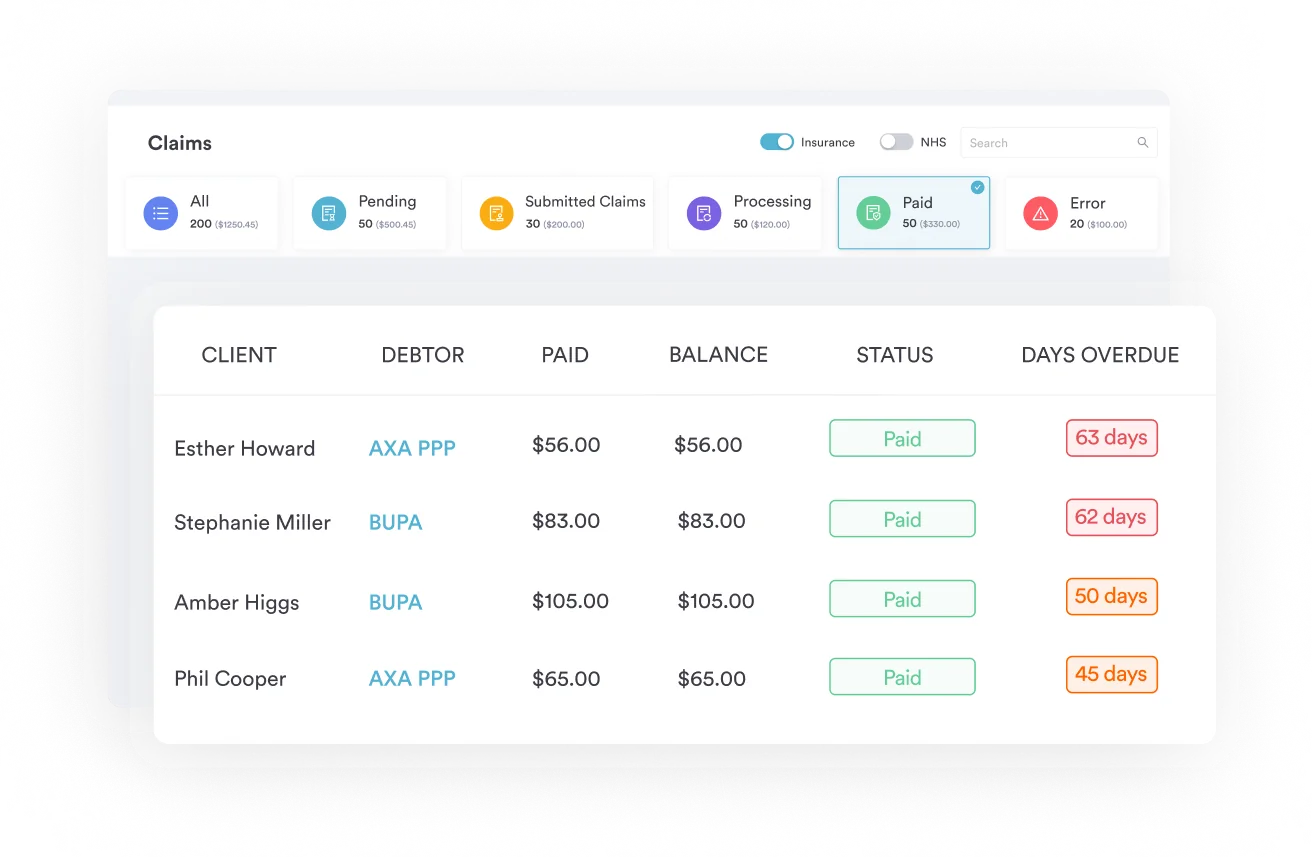

Pabau’s practice management platform helps rheumatology and musculoskeletal practices capture site-specific diagnoses at the point of care, submit clean claims, and track coding accuracy across their whole team.

Understanding the standard treatment landscape for ankylosing spondylitis helps coders anticipate the CPT and HCPCS codes that typically appear alongside M45.5 on the same claim, and supports accurate medical necessity documentation.
NSAIDs are the first-line pharmacological treatment for AS. When NSAIDs provide inadequate disease control, biologics, primarily TNF inhibitors (adalimumab, etanercept, certolizumab, golimumab, infliximab) and IL-17A inhibitors (secukinumab, ixekizumab), are initiated. Physical therapy is recommended throughout all treatment stages to preserve spinal mobility. Practices offering integrated physical therapy should ensure their HIPAA-compliant practice management workflows capture both the diagnostic code and the associated treatment modality codes correctly on each encounter.
From a rheumatology billing perspective, M45.5 commonly pairs with these CPT codes (note: payer-specific coverage for biologics should always be verified independently):
Coders in multi-specialty practices handling both rheumatology and physical therapy encounters should reference the practice management software features that support cross-specialty diagnostic and billing workflows.
The same documentation-first principle applies to related systemic and spinal presentations, such as M36.8 or unspecified dorsopathies coded as M53.9: capture the specific site or systemic association before defaulting to a vague code.
When billing biologic administration alongside M45.5, confirm the payer has an active prior authorization for the specific biologic. Submit the J-code or Q-code for the drug on the same claim as M45.5, and attach clinical documentation showing inadequate NSAID response as the medical necessity basis.
Getting the spinal site right is what separates a clean claim from a denial in ankylosing spondylitis billing. ICD-10 Code M45.5 is the correct, billable designation when clinical documentation confirms AS involvement at the thoracolumbar junction for FY2026 encounters.
Pabau’s claims management software supports rheumatology and musculoskeletal practices in capturing site-specific diagnoses at the point of care and submitting accurate claims. To see how Pabau handles diagnostic coding workflows end to end, book a demo.

Looking for another spine-related arthropathy code? M14.88 covers arthropathies in other specified diseases affecting the vertebrae.
Looking for a reference on another spine-related ICD-10-CM code? M88.1 covers the coding guidance for osteitis deformans affecting the vertebrae.
Coding a follow-up puncture wound visit instead? Ear puncture wound coding guide covers S01.332D, the code for a subsequent encounter for a left ear puncture wound.
ICD-10 Code M45.5 is a billable, specific ICD-10-CM diagnosis code that describes ankylosing spondylitis of the thoracolumbar region. It belongs to the M45 category within the dorsopathies block (M40-M54) of Chapter XIII (Musculoskeletal and connective tissue, M00-M99), and is valid for all HIPAA-covered transactions for FY2026 service dates (October 1, 2025 through September 30, 2026).
Yes, M45.5 is a billable code valid for Medicare and all HIPAA-covered transactions. However, Medicare coverage for associated treatments (biologics, specialist visits) depends on individual coverage determinations. Always verify payer-specific policies before assuming reimbursement approval.
M45.5 specifies ankylosing spondylitis of the thoracolumbar region (T12-L1 junction). M45.9 is used only when the spinal region is genuinely unspecified in the clinical documentation. If the provider’s note identifies the thoracolumbar site, M45.5 is the correct and more precise selection; defaulting to M45.9 when site detail exists is a documentation error.
Axial spondyloarthritis (axSpA) is the broader diagnostic spectrum that includes both radiographic axSpA (classical ankylosing spondylitis, coded under M45.x) and non-radiographic axSpA (coded under the newer M45.A series). M45.5 applies specifically to radiographic axSpA at the thoracolumbar site, where sacroiliitis is confirmed on plain radiograph meeting Modified New York Criteria.
Common CPT codes paired with M45.5 include 99213 and 99214 for rheumatology office visits, 97110 for therapeutic exercise in physical therapy, and 96413 or 96415 for biologic infusion administration. Payer-specific prior authorization requirements apply to biologic infusions; verify coverage before scheduling and submitting.
The clinical note must state a confirmed (not “rule out”) diagnosis of ankylosing spondylitis and explicitly identify thoracolumbar region involvement. Supporting documentation typically includes imaging reports confirming sacroiliitis, HLA-B27 test results, and the treating provider’s assessment. Vague notes referencing only “back pain” or “thoracic pain” do not support M45.5 and require a provider query before coding.