CPT code 93503: Swan-Ganz catheter billing and modifiers
CPT code 93503: Official descriptor and procedure overview In the AMA CPT code s...

Last Updated: Oct 23, 2026
Billable Code Specific Code
M43.9 is the billable ICD-10-CM code for deforming dorsopathy, unspecified.
The code took effect on October 1, 2025 under the 2026 ICD-10-CM edition.
Coders in musculoskeletal, chiropractic, physical therapy, and osteopathy practices reach for M43.9 often. Keeping that lookup inside your practice management system saves a browser tab and a transcription error.
Let Pabau's smart automation suggest the right codes, reduce claim denials, and keep your practice compliant—effortlessly.
Automate repetitive tasks and focus on what matters most—your patients.
Reduce coding errors and ensure compliance with the latest regulations.
Clean claims, fewer denials, and faster reimbursements.
Powerful insights and reporting to help your practice thrive.
HIPAA compliant SOC 2 certified GDPR-compliant Trusted by 4,000+ clinics worldwide

ICD-10 code M43.9 is the billable diagnosis code for deforming dorsopathy, unspecified, effective October 1, 2025.
Use M43.9 only when the record does not support a more specific M43 code, such as M43.0, M43.1, or M43.6.
M43.9 codes a structural spinal deformity, so never use it for back pain alone. Pain without a structural cause belongs to M54.9.
The M43 category carries an Excludes1 note, which rules out congenital spondylolisthesis and spinal curvature in osteoporosis.
Practice management software like Pabau attaches M43.9 to the clinical note and the invoice in one workflow.
M43.9 is a billable, specific ICD-10-CM code that supports a diagnosis for reimbursement. The 2026 edition of the code took effect on October 1, 2025.
The CDC/NCHS ICD-10-CM web tool confirms M43.9 as the American version of this code. International versions published in the WHO ICD-10 browser may differ.
Deforming dorsopathy is any back disease that changes the shape or alignment of the spine. Dorsopathy on its own means disease of the back, affecting the dorsal, or posterior, structures of the spine.
The deforming qualifier adds the structural element. That can be an abnormal curvature, a displaced vertebra, or a bony deviation. When the note does not say which type is present, M43.9 is the correct code.
Practices offering osteopathy services and back care meet this code regularly. The unspecified qualifier tells the payer that a structural abnormality is documented but not yet named.
Approximate synonyms and alternate clinical terms that map to M43.9 include:
Match the wording in the clinical note to one of these synonyms before you select M43.9. If the provider names a condition such as torticollis or spondylolysis, the specific code applies instead.
The full classification path shows coders the sibling codes, the parent category, and the chapter-level context this diagnosis belongs to.
The M40-M43 block covers deforming dorsopathies broadly. M43 gathers the structural conditions that fall outside kyphosis (M40) and scoliosis (M41).
Neighboring spine categories are built the same way. In M45, for example. M43.9 holds that base position in its own category, used only when no sibling code fits the documented diagnosis.
Chiropractors work with these codes constantly, and chiropractic software keeps adjustments, plans, and progress in one record.
M43.9 is the last resort within the M43 category. Before assigning it, review every subcategory code below. If the clinical note names any of these conditions, the specific code must be used instead.
Spondylolysis and spondylolisthesis both need a site-specific sixth character, so the spinal level has to appear in the note. Structural deformities classified outside M43.
If the documentation identifies the spinal level but not the condition, query the provider before defaulting to M43.9.
An Excludes1 note means two codes can never appear together for the same encounter. The M43 category excludes several conditions that read like deforming dorsopathies in a clinical note:
Each of these has its own code elsewhere in ICD-10-CM. Scanning the list before you assign M43.9 is faster than reworking a rejected claim later.
Check the provider’s clinical note for any named structural finding before assigning M43.9. Terms like ‘slippage,’ ‘pars defect,’ ‘neck contracture,’ or ‘vertebral fusion’ each map to a more specific M43 subcategory. Assign M43.9 only after confirming none of the subcategories fit.
Official ICD-10-CM guidelines require the most specific code the documentation supports. For M43.9, that means the record genuinely does not name a deformity type.
Three documentation scenarios make M43.9 appropriate:
Payers may ask for supporting notes when an unspecified code appears on repeat claims for ongoing treatment. A query to the treating clinician usually settles it and lowers denial risk. Where a payer still requires a paper claim, the practice needs the current revision of the form.

The CMS ICD-10 codes page publishes updated guidelines each fiscal year. Verify against the current edition before you submit a claim.
M43.9 and M54.9 share the words dorsopathy and unspecified, so they get swapped often. They describe different clinical concepts and sit in different ICD-10-CM blocks.
The key question: is the provider documenting a structural finding or a symptom of pain? A structural finding takes M43.9. Pain on its own takes M54.9.
Using M54.9 for a patient with a documented spinal deformity undercodes the encounter. Using M43.9 when the note mentions only back pain overcodes it.
Physical therapy providers see both presentations in the same week. A functional test such as the star excursion balance test records limitation, but it does not establish a structural diagnosis. The AAPC Codify ICD-10-CM lookup shows the current descriptors for both codes side by side.
Which procedure codes travel with M43.9 is one of the most practical questions billing staff ask. The table below lists CPT codes clinicians commonly report alongside a deforming dorsopathy diagnosis.
Payer acceptance depends on local coverage determinations, known as LCDs, and on medical necessity policy. Verify each pairing with the payer before you submit. Treating medical billing as a back-office afterthought is how errors like this reach the claim unnoticed.
Practices offering sports medicine services also pair M43.9 with imaging and rehabilitation codes. Document the medical necessity that connects the procedure to the deforming dorsopathy. The ResDAC ICD coding resources guide explains how ICD-10 codes appear in Medicare claims data.
Two workflow problems cause most of the trouble with M43.9. The code lands in the wrong field, or it ships on a claim with no note explaining why a specific code was not available.
In many practices the coder keeps a code lookup site open in one tab and the patient record in another. Practice management software like Pabau closes that split by holding the diagnosis search inside the encounter note.
Pabau’s clinical record documentation keeps the diagnosis code, the treatment note, and the invoice in one workflow. A coder reviewing a claim can trace M43.9 back to the encounter note without leaving the platform, which shortens audit preparation.
Practices coding other musculoskeletal diagnoses. So you get one search box and one audit trail across every specialty the practice runs.
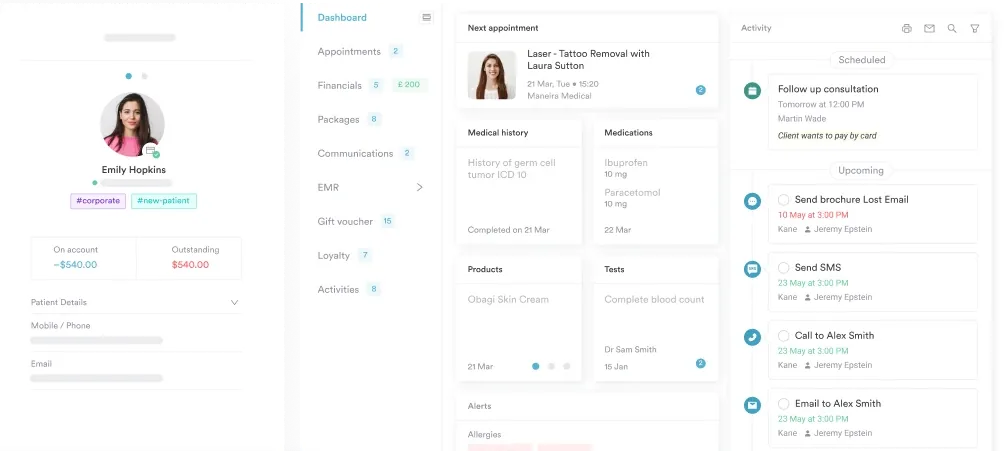

Pabau’s diagnosis search links M43.9 and related codes to SOAP notes, treatment plans, and invoices inside one workflow. Your coders stop copying codes between a reference site and the record.

M43.9 is a legitimate code, and the risk sits in how you support it. Assign it only after you have worked through every M43 sibling and the Excludes1 list.
Write the reason for the unspecified choice into the note the same day you make it. Then revisit the code once imaging or a specialist letter arrives. Payers rarely argue with a documented plan to refine a diagnosis.
M43.9 buys you time while the clinical picture settles. It is not a permanent home for thin documentation, and a repeat claim will eventually invite the question. Book a demo to see how Pabau links diagnosis codes, clinical notes, and claims for musculoskeletal practices.

Coding inflammatory spine conditions? M45.3 covers ankylosing spondylitis at the cervicothoracic junction, plus the documentation payers look for.
Seeing skeletal deformity in a younger patient? M91.91 walks through juvenile osteochondrosis of the right hip, including laterality and site detail.
Handling another unspecified code under payer scrutiny? M32.9 shows how to document systemic lupus erythematosus when no organ involvement is named.
Coding bone disease that can deform the spine? M83.5 explains drug-induced osteomalacia in adults and the drug detail the note must carry.
Coding an incidental lung nodule instead? Solitary pulmonary nodule coding guide covers R91.1, the code for a single lung lesion found on chest imaging.
ICD-10 code M43.9 is the billable ICD-10-CM diagnosis code for deforming dorsopathy, unspecified. It sits in the M43 category, within Chapter XIII of the musculoskeletal system and connective tissue codes. The code took effect on October 1, 2025 for the 2026 ICD-10-CM edition.
Yes. M43.9 is a billable, specific ICD-10-CM code, valid for reimbursement in the 2026 edition. Submit it on a claim for deforming dorsopathy when no more specific M43 subcategory code is supported by the documentation.
M43.9 codes a structural spinal deformity, while M54.9 codes back pain as a symptom. Use M43.9 when the documentation confirms a structural abnormality. Use M54.9 when the provider records only back pain, with no structural cause identified.
Use M43.9 only when the documentation does not support a more specific M43 code, such as M43.0, M43.1, or M43.6. Common situations include pending imaging, initial referral notes, and cases where the deformity type is not yet confirmed.
M43 runs from M43.0 for spondylolysis and M43.1 for spondylolisthesis through M43.2 for fusion of spine. It then covers M43.3 to M43.5 for recurrent dislocations, M43.6 for torticollis, and M43.8X- for other specified deforming dorsopathies. M43.9 closes the category as the unspecified option.
Commonly paired CPT codes include 99213 and 99214 for office visits, plus 72100 and 72110 for spinal X-rays. Rehabilitation pairings include 97110 for therapeutic exercise and 97530 for therapeutic activities. Chiropractors report 98940 and 98941 for spinal manipulative treatment. Payer LCD policies decide which pairings are reimbursed, so check before you submit.