

CPT Code 98981: RTM Treatment Management Billing Guide
CPT code 98981: Definition and official descriptor CPT code 98981 is an add-on c...

Last Updated: Nov 9, 2026
64418 is the CPT code for injection, anesthetic agent; suprascapular nerve. It describes a single-injection block of the suprascapular nerve, used for shoulder pain, rotator cuff pathology, adhesive capsulitis, and perioperative analgesia.
Imaging guidance is reported separately with 76942 or 77002 when documented, and neurolytic destruction goes to 64640. Common errors include missing laterality in the operative note, incorrect modifier selection, and imaging guidance billed without a separate report.
Let Pabau's smart automation suggest the right codes, reduce claim denials, and keep your practice compliant—effortlessly.
Automate repetitive tasks and focus on what matters most—your patients.
Reduce coding errors and ensure compliance with the latest regulations.
Clean claims, fewer denials, and faster reimbursements.
Powerful insights and reporting to help your practice thrive.
HIPAA compliant SOC 2 certified GDPR-compliant Trusted by 4,000+ clinics worldwide

CPT code 64418 covers a single injection of anesthetic into the suprascapular nerve, not the axillary nerve (64417) or another peripheral nerve (64450).
Laterality, the anesthetic agent used, the clinical indication, and any imaging guidance must all appear in the procedure note to pass payer review.
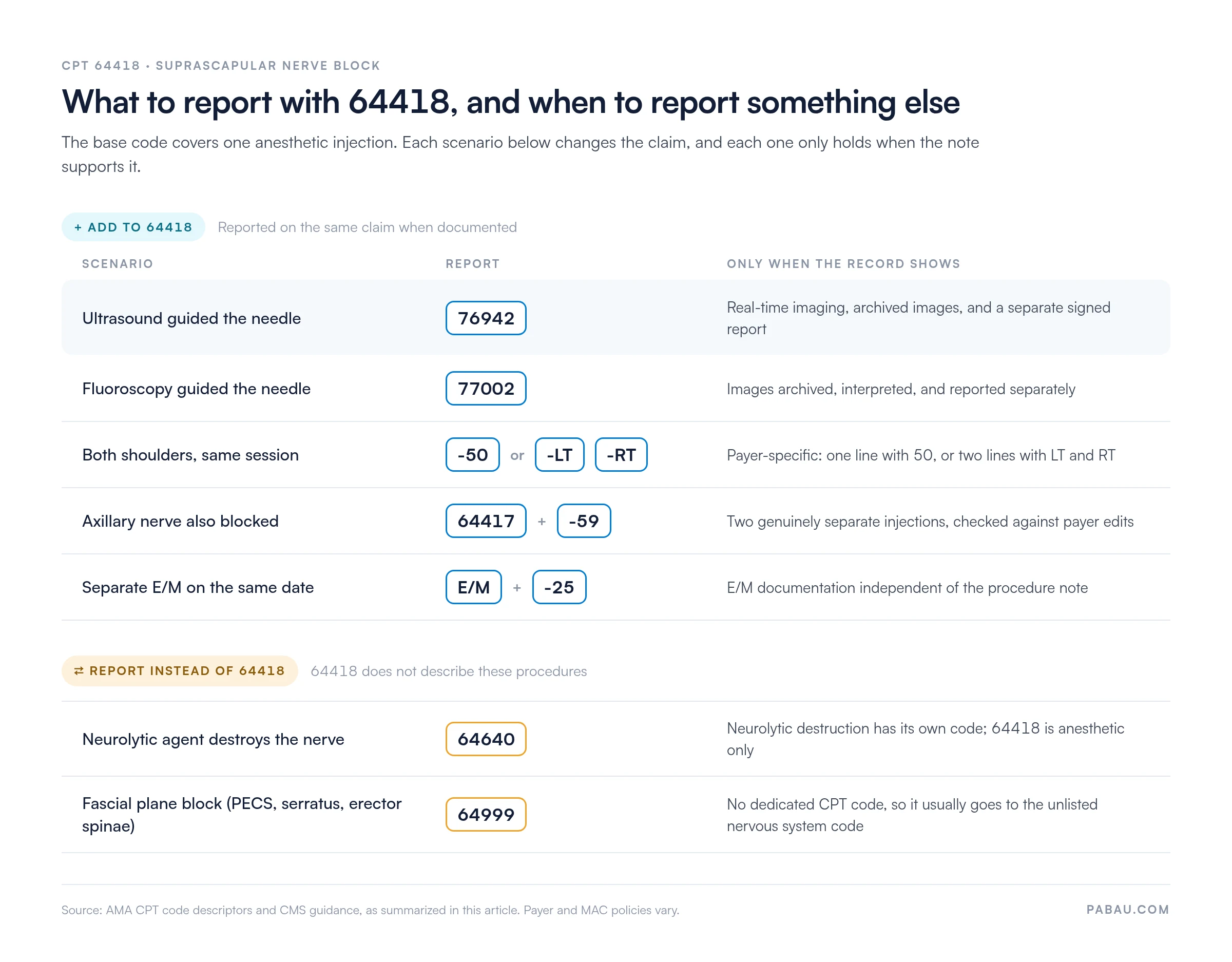
Ultrasound guidance (76942) is separately reportable alongside 64418 when imaging is used and a contemporaneous report is documented.
Neurolytic destruction is reported with 64640 and fascial plane blocks usually with unlisted 64999, never with 64418.
Pabau’s claims management software submits and tracks CPT 64418 claims electronically through its Claim.MD integration.
CPT code 64418 is defined by the American Medical Association as: Injection, anesthetic agent; suprascapular nerve.
The suprascapular nerve originates from the upper trunk of the brachial plexus (C5-C6). It supplies sensory and motor innervation to the shoulder joint, supraspinatus, and infraspinatus muscles. Blocking it relieves pain across a large portion of the glenohumeral joint without systemic analgesic load.
The code is used in pain management, anesthesiology, orthopedic surgery, and sports medicine settings. Typical scenarios include perioperative shoulder analgesia and chronic rotator cuff pain that has not responded to conservative care. Adhesive capsulitis is another, once corticosteroid injection has failed to give adequate relief.
CPT 64418 covers a single-injection block of the suprascapular nerve with an anesthetic agent, either a local anesthetic alone or one combined with a corticosteroid. Neurolytic injection is a separate procedure, reported under 64640 rather than 64418. The injection technique, the physician’s professional work, and normal pre- and post-injection monitoring are all bundled into the base code.
Several related services are explicitly not included. Understanding what 64418 excludes prevents both undercoding and unbundling errors.
The panel below sorts each common scenario by whether it adds a code to 64418 or replaces 64418 altogether.
Procedure note templates that capture these distinctions at the point of documentation keep the billed code matched to the injection the physician performed.
Incomplete documentation is a leading cause of 64418 denials. The procedure note must contain each of the following elements for the claim to survive payer review. Knowing the injection technique helps coders catch an incomplete note before submission.
Technique: The suprascapular nerve is targeted at the suprascapular notch or, increasingly, under real-time ultrasound guidance at the spinoglenoid notch. The physician positions the patient seated or prone and identifies the posterior shoulder anatomy. The needle is then advanced to the nerve, its position confirmed by landmark or image, and the anesthetic injected.
The whole procedure typically takes under ten minutes.
Documentation checklist for a payable 64418 claim:
Procedure note templates built around these five elements produce a clean claim from the first submission. Getting the note right at the point of care costs far less than chasing an appeal after a denial.
Build your 64418 procedure note template around the five-element documentation checklist above. Flag the template for mandatory laterality and anesthetic agent fields so the physician cannot save a note without both recorded. Missing laterality is one of the most avoidable reasons a 64418 claim is denied.
The nerve block code family includes several adjacent codes that coders frequently confuse with CPT code 64418. The usual mix-ups are 64417, which targets the axillary nerve, and 64450, the code for other peripheral nerves. All three describe single-injection peripheral nerve blocks, so selecting the wrong anatomical target is an audit risk.
Can 64417 and 64418 be billed together? Both codes cover anatomically distinct nerves serving different shoulder regions: 64417 targets the axillary nerve (deltoid/teres minor), while 64418 targets the suprascapular nerve (supraspinatus/infraspinatus). When a clinician performs both injections at the same session, billing both codes may be appropriate.
Verify against current AMA CPT Assistant guidance and your MAC’s local coverage determination before routinely reporting them together, as payer edits vary.
Ultrasound guidance is increasingly standard for suprascapular nerve blocks because it improves needle visualization and reduces the risk of pneumothorax.
When imaging is used, it is separately reportable, but only when specific conditions are met. Getting this wrong is an audit risk in both directions. Some coders under-report guidance they are entitled to, while others report it without the required documentation.
Three conditions must all be true to report 76942 with 64418:
If any of these three elements is missing, 76942 is not separately billable. Some Medicare Administrative Contractors bundle 76942 into the base 64418 reimbursement regardless; check your MAC’s current LCD before submitting.
Modifier selection is where many 64418 billing errors occur. The wrong modifier can trigger a denial, a reduced payment, or a request for additional documentation. The table below covers the modifiers most relevant to this code.
Bilateral billing: Modifier 50 applicability for 64418 is payer-specific. Medicare generally allows bilateral reporting but payment methodology (single line item vs. two line items) varies by MAC. Always verify against the current Medicare Physician Fee Schedule bilateral surgery indicator and your MAC’s billing requirements before submitting a bilateral claim.
Medicare reimbursement for CPT code 64418 is set annually through the Medicare Physician Fee Schedule. Rates vary by locality through the Geographic Practice Cost Index (GPCI), by facility vs. non-facility setting, and by that year’s conversion factor.
The figures below are 2026 national figures, before GPCI adjustment. Verify them for your MAC locality using the CMS Physician Fee Schedule lookup tool or the FastRVU 2026 RVU calculator.
The zero global period means the same code can be billed on subsequent visits without a global period bundling issue. The payment amounts above are national figures before GPCI adjustment, so your locality payment will differ. Use the current-year fee schedule for precise figures.
Prior authorization requirements for 64418 vary significantly by payer and plan. Medicare does not require prior authorization for most suprascapular nerve block procedures, but commercial insurers, Medicare Advantage plans, and Medicaid managed care organizations commonly do. Never assume a universal rule applies.
When prior auth is required, the following documentation supports the authorization request:
Confirm insurance eligibility verification before the appointment date and check whether the patient’s specific plan benefit requires auth. Local Coverage Determinations issued by Medicare Administrative Contractors define the medical necessity criteria for nerve block procedures in your region. They also govern when Medicare Advantage plans model their own policies on federal LCD language.
CPT code 64418 denials cluster around five root causes. Each has a specific corrective action and an appeal pathway that works when documentation is in order.
Structured denial management workflows catch these patterns before they age into write-offs. Tracking denial codes by root cause, not just by payer, shows whether the fix lies in documentation, workflow, or a payer contract.
Run a quarterly audit on 64418 denial codes from your clearinghouse remittance data. Group denials by CARC code (CO-4 for wrong modifier, CO-57 for medical necessity, CO-15 for missing auth). Three months of data will show whether your denials come from documentation, modifiers, or payer policy, and which to fix first.
The ICD-10-CM codes on a 64418 claim must reflect documented clinical findings. Payers cross-reference the diagnosis code against their LCD’s covered-condition list to validate medical necessity. The following codes are most commonly linked to suprascapular nerve block procedures based on the clinical indications the procedure addresses.
Cross-reference each diagnosis code against your payer’s covered-condition list before submitting, using the LCD or the AAPC’s code lookup tools. Laterality in the ICD-10 code must match laterality in the CPT modifier and in the procedure note. A right-shoulder injection billed with a left-shoulder ICD-10 code will trigger a clinical edit every time.
The denials in this guide start in the paperwork. Typical examples are a missing LT or RT, a 76942 line without its report, and a diagnosis coded to the wrong side. Checked by hand, those errors tend to surface weeks later on the remittance.
Pabau, the practice management and billing platform we build, includes error-checking claims management software with a Claim.MD integration. Claim.MD connects your practice to thousands of US payers for eligibility checks, electronic claim submission, and claim tracking.
Because the claim is built from the patient record, the laterality, diagnosis, and imaging details your clinician documented travel with it. Your team corrects a flagged claim once, before submission, instead of working the same error through an appeal.

Pabau connects to thousands of US payers through Claim.MD, so your CPT code 64418 claims are submitted electronically and tracked from submission to payment.

Whether a 64418 claim pays is mostly settled before the injection, by the note template. A template that requires laterality, the agent, and the imaging report protects every claim that follows it. One that leaves them to memory produces the denials in this guide.
Start there, then confirm your MAC’s bilateral and imaging rules once rather than claim by claim. The set-up takes an afternoon, and the rework it saves repeats with every shoulder block you bill. Book a demo to see how Pabau carries a documented nerve block from the note to a paid claim.

Need a clearinghouse that handles nerve block claims? How Claim.MD clearinghouse works explains the electronic claims workflow from submission through ERA remittance.
Seeing a pattern of claim rejections? Revenue cycle management fundamentals covers the end-to-end billing process and where nerve block claims most often break down.
Billing a new payer for nerve blocks? Getting credentialed with insurance companies walks through the credentialing steps that unlock payer acceptance for nerve block procedures.
CPT code 64418 is the procedure code for injection of an anesthetic agent into the suprascapular nerve. This peripheral nerve block treats shoulder pain, rotator cuff pathology, and adhesive capsulitis. It is distinct from CPT 64417 (axillary nerve) and 64450 (other peripheral nerve).
64417 (axillary nerve) and 64418 (suprascapular nerve) cover anatomically distinct nerves, so both may be reported when both injections are performed in the same session. Use modifier 59 on the secondary code to signal distinct procedural services. Payer edits vary, so verify against current AMA CPT Assistant guidance before routinely reporting them together.
Ultrasound guidance is not required to bill CPT 64418. When it is used, CPT 76942 is separately reportable if three conditions are met. Real-time imaging guided the needle, permanent images were archived, and a separate imaging report was generated. Some Medicare Administrative Contractors bundle 76942 into the base 64418 rate; check your MAC’s local coverage determination.
Medicare’s 2026 national payment for CPT code 64418 is about $89.85 in a non-facility setting and about $48.10 in a facility setting, before GPCI adjustment. Actual payment varies by locality and the annual conversion factor. Verify current-year figures using the CMS Physician Fee Schedule lookup tool.
Yes, 64418 can be billed bilaterally when both suprascapular nerves are injected at the same session, but the billing method is payer-specific. Some payers require modifier 50 on a single line item; others require two separate line items with modifier LT and RT. Verify your MAC’s bilateral surgery indicator and individual payer contracts before submitting.
Five denial reasons come up most often for CPT code 64418. The first two are insufficient medical necessity documentation and missing prior authorization. The others are an incorrect modifier (usually modifier 50 vs. LT/RT), 76942 billed without a separate imaging report, and a duplicate of the facility claim.




