ICD-10 code E55.9: Vitamin D deficiency, unspecified
ICD-10 code E55.9: Definition and official descriptor ICD-10 code E55.9 is the I...

Last Updated: Nov 10, 2026
Billable Code Specific Code
K59.00 is the billable ICD-10-CM code for constipation, unspecified. It applies when the record documents constipation but not its type, cause or duration.
The code sits in Chapter 11 (K00-K95, Diseases of the digestive system), in the K59 category for other functional intestinal disorders. A transit study, a causative drug or more than 12 weeks of symptoms in the note points to a more specific K59.0 code instead.
Let Pabau's smart automation suggest the right codes, reduce claim denials, and keep your practice compliant—effortlessly.
Automate repetitive tasks and focus on what matters most—your patients.
Reduce coding errors and ensure compliance with the latest regulations.
Clean claims, fewer denials, and faster reimbursements.
Powerful insights and reporting to help your practice thrive.
HIPAA compliant SOC 2 certified GDPR-compliant Trusted by 4,000+ clinics worldwide

K59.00 is the billable ICD-10-CM code for constipation when the record supports no specific K59.0 subtype.
Assigning K59.00 when the note supports K59.01, K59.02, K59.03 or K59.04 invites unspecified-code edits and denials.
Drug-induced constipation is coded K59.03, with an adverse effect code from T36-T50 added to name the drug.
Functional constipation diagnosed in a child by Rome IV criteria takes K59.04, not K59.00.
Pabau, the practice management platform we build, submits constipation claims through Claim.MD and posts each remittance back to the patient record.
ICD-10 Code K59.00 is the billable diagnosis code for constipation, unspecified, and it is valid for FY2027 claims under ICD-10-CM. Coders assign it when the clinical record identifies no specific constipation subtype.
It falls within the K59 category (Other functional intestinal disorders) in Chapter 11 of ICD-10-CM, which covers diseases of the digestive system (K00-K95).
“Unspecified” says nothing about severity. It records that the clinician diagnosed constipation without documenting its cause, transit pattern or duration in enough detail for a more specific K59.0 code. Payers treat unspecified codes as a last resort, so that wording shapes how the claim is reviewed.
According to the CMS ICD-10 codes page, K59.00 carries into the FY2027 ICD-10-CM code files, in effect since October 1, 2026, without change. Coders can confirm its validity and official descriptor in the CDC/NCHS ICD-10-CM web tool. The tool mirrors each annual release and shows the revisions that take effect every October 1.
K59.00 applies when constipation is the documented complaint and the clinical record establishes no specific subtype. Its index entry is constipation NOS, “not otherwise specified.” The code covers cases where the clinician has not characterized the type of constipation, or cannot yet do so from the available findings.
Three documentation scenarios legitimately support K59.00:
To defend K59.00, the record should show symptom onset and reported stool frequency and consistency. It should also note that the cause is not yet established. A record that holds more may support a more specific code. Opioids on the medication list, a transit study result or 12 weeks of symptoms all qualify. Assigning K59.00 then becomes a coding error.
Run a documentation audit on K59.00 claims before submission. Flag any claim whose note lists opioids or anticholinergics, records symptoms over 12 weeks, or holds pelvic floor study results. Each of those findings usually points to K59.03, K59.04 or K59.02 respectively, rather than K59.00.
The ICD-10-CM tabular list places one Excludes1 note and one Excludes2 note under K59.0, and both govern K59.00. Together they decide which codes can appear alongside K59.00 on the same claim. The table also shows K58.1, which carries no note against K59.00 but often competes with it.
An Excludes1 note is an absolute bar. The two codes describe mutually exclusive conditions and never appear together on a claim. An Excludes2 note means the excluded condition is a separate diagnosis, so both codes may be reported when both are documented.
The AAPC Codify ICD-10-CM lookup cross-references the notes for categories K58 and K59. Neighboring codes in the K55-K64 block, such as hemorrhoids at K64.0-K64.9, carry their own notes and are checked the same way.
K59.00 is the last-resort code in its own subcategory. Every other K59.0 code describes a more specific form of constipation. When the documentation supports one of them, assigning K59.00 is a coding error that exposes the claim to unspecified-code edits.
K59.00 vs K59.09: These two codes are often confused. K59.09 (other constipation) applies when the clinician has documented a specific type of constipation that has no code of its own. K59.00 applies when the type is unknown or undocumented. Using K59.09 for uncharacterized constipation, or K59.00 for a named but unlisted type, is an assignment error.
Drug-induced constipation takes K59.03, not K59.00, whenever the clinical record names a causative medication. For an adverse effect of a correctly prescribed drug, the ICD-10-CM Official Guidelines sequence the nature of the effect first. So K59.03 comes first, followed by the T36-T50 code that identifies the drug.
Assigning K59.00 when the note links constipation to an opioid or anticholinergic is a specificity error and a compliance risk. Common causative drugs include opioid analgesics, iron supplements, calcium channel blockers and tricyclic antidepressants.
K59.00 carries a higher denial risk than the specific K59.0 codes, because payers read an unspecified code as a documentation shortfall. The failure points below are easier to fix before submission than after a denial. Denial management workflows that catch them early cut the rework on constipation claims.
The guide to medical billing denial codes explains the CARC codes returned on K59.00 denials. Each one tells the coder whether the problem was specificity, medical necessity or missing documentation.
Medicare’s view of K59.00 depends on the procedure it accompanies. As a primary diagnosis, K59.00 generally supports office evaluation and management codes without prior authorization. Problems start when it supports high-cost diagnostic procedures.
Anorectal manometry, reported with CPT 91122, is one example, alongside defecography and colonic transit studies. Some MAC jurisdictions publish LCDs that require organic causes to be evaluated and ruled out first. Where an LCD applies, K59.00 alone may not be enough. Imaging results, prior treatment attempts or specialist notes strengthen medical necessity.
Commercial payers vary considerably, and many require prior authorization for GI motility procedures whatever the diagnosis code. When K59.00 is the primary diagnosis for a colonoscopy billed as 45378, the procedure is diagnostic rather than screening. That changes the patient’s cost-sharing, so check each payer’s policy before submission.
A clean claim submission for a constipation workup carries three things. It has the diagnosis code, documentation of prior conservative treatment, and confirmation that authorization was checked before the procedure date.
K59.00 appears on claims across gastroenterology, primary care and pelvic health settings. The CPT codes submitted with it depend on the stage of evaluation and the care setting. Submitting K59.00 without checking that it supports each paired procedure is a frequent source of denials.
K59.00 alone does not support every procedure above. A claim pairing K59.00 with 45378 or 91122 should rest on documented symptom history, prior treatment attempts and any diagnostic findings already in the record. The ICD List database cross-references CPT and ICD-10 pairings for medical necessity.
K59.00 is billable for pediatric patients, but it is often the wrong code when a child is diagnosed with functional constipation. Rome IV criteria define pediatric functional constipation as its own clinical entity. In ICD-10-CM it maps to K59.04, chronic idiopathic constipation, whose inclusion term is functional constipation.
Pediatric providers should use K59.00 only when the note documents constipation without Rome IV criteria, a functional pattern or a specific subtype.
When a clinician diagnoses functional constipation by Rome IV criteria, K59.04 is the accurate code. K59.3 is megacolon, not elsewhere classified, and does not apply. Using K59.00 in place of K59.04 is a specificity error that payer audits can pick up.
The strongest coding outcome for a constipation diagnosis is a specific K59.0 code that reflects what the patient has. Five documentation habits give the coding team enough to assign that code from the first visit.
Read side by side, the five habits map onto the K59.0 codes one finding at a time, as the chart below shows.
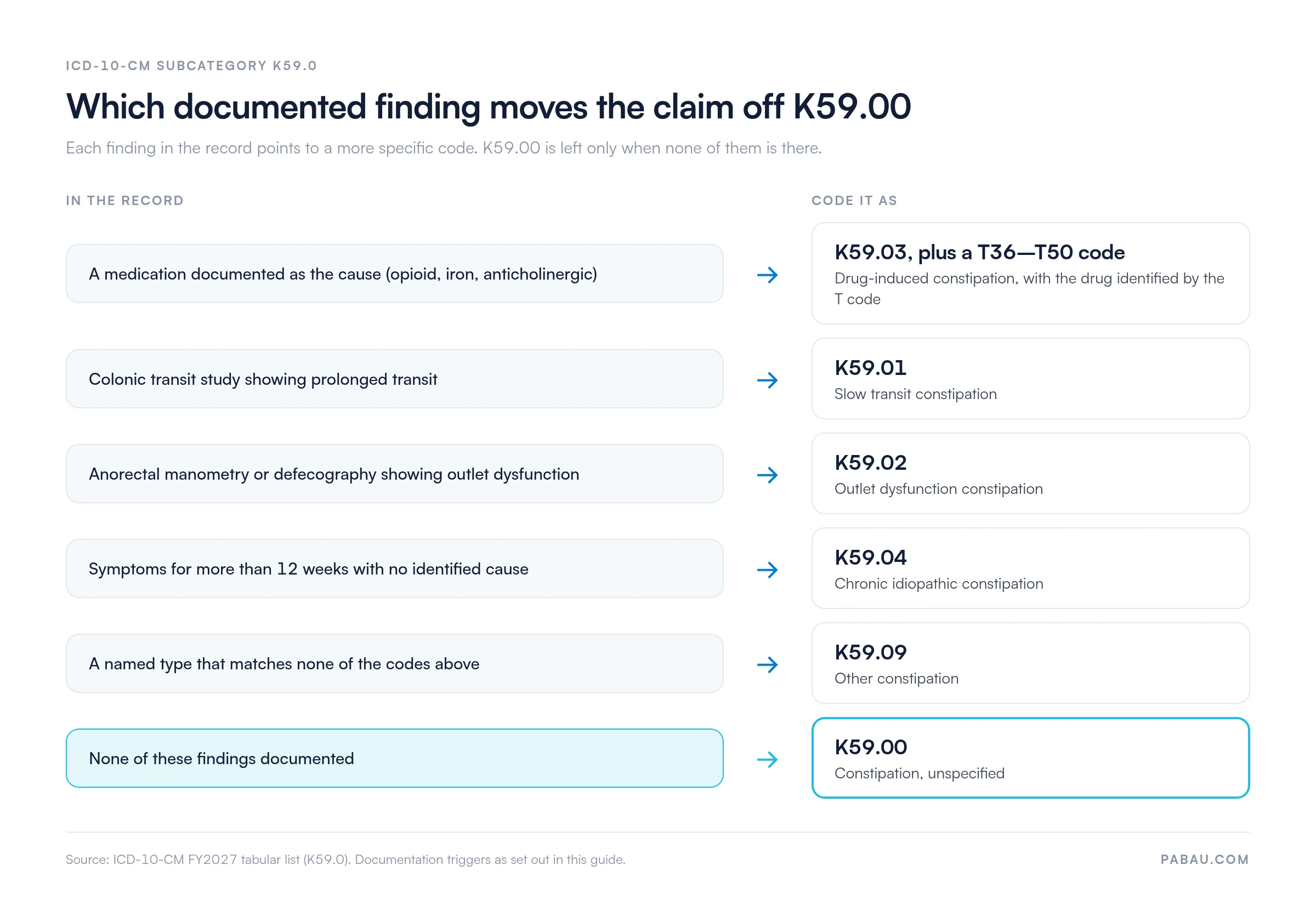
Coders reviewing constipation encounters should check these five elements on every note. A grasp of the wider medical billing processes helps coding teams tell clinicians which details a claim was missing. Over time, that feedback cuts how often K59.00 is the only defensible code.
Build a constipation coding prompt into your EHR template. It should capture duration in weeks, the Bristol Stool Scale score, constipating drugs, and any pending or completed study results. One structured note field answered at every GI visit gives coders what they need to move past K59.00.
Most practices code constipation from a visit note in one system and build the claim in another. The coder re-keys the diagnosis, and a missing authorization shows up weeks later as a denial.
In Pabau’s claims management software, the claim is built from the patient record that holds the note. Claims go out through the Claim.MD clearinghouse as CMS-1500 or 837P files, and eligibility checks run before the visit.
Prior authorization for manometry or colonoscopy is tracked on the case, with a warning when the code is missing.
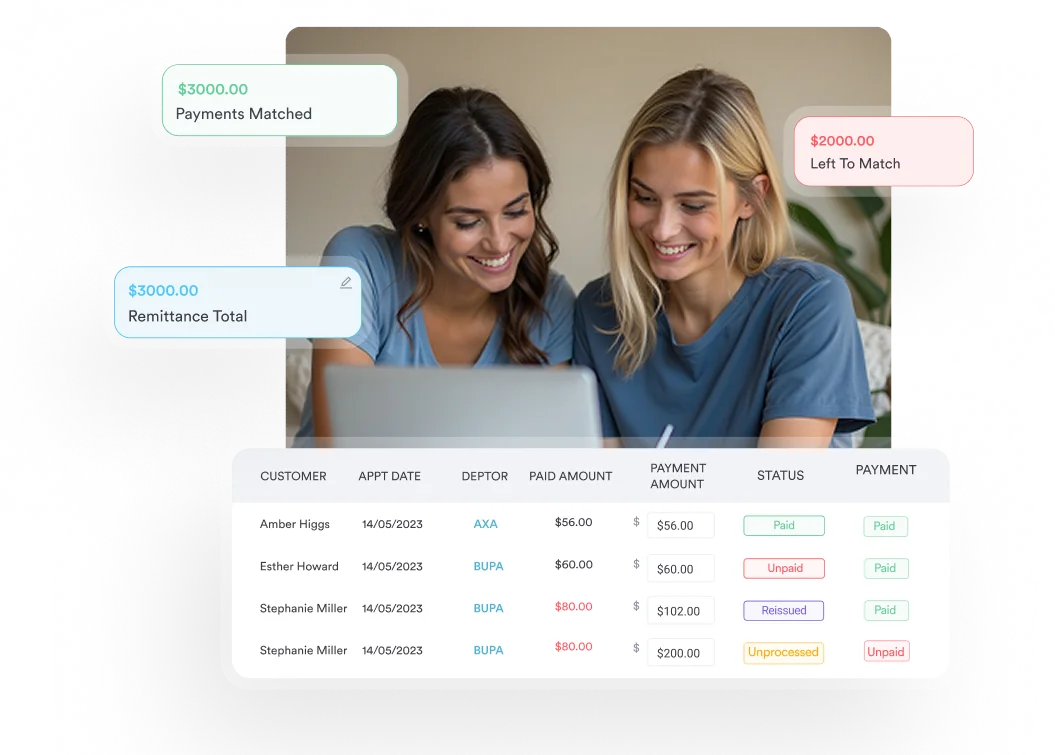
Electronic remittance advice posts back against that same record. A K59.00 denial is visible the day it arrives, next to the note that caused it, so the fix starts with the documentation.

Pabau builds claims from the patient record, sends them through Claim.MD, tracks prior authorization on the case and posts remittances back. See it with your own constipation workup.

Treat K59.00 as the code a record earns when it holds no more detail, never as the starting point. Most constipation claims that land on it could have carried a specific code if the note had recorded duration, medication or a test result. The fix sits with the clinician at the visit, well before the coder sees the claim.
The trade-off is a minute more documentation per GI visit against fewer unspecified-code denials and stronger audit files. Book a demo to see how Pabau keeps the constipation note and the claim on one patient record.

Need to understand how clearinghouse validation reduces GI claim denials? Pabau’s Claim.MD clearinghouse guide explains how eligibility checks and claim scrubbing work before a constipation claim reaches the payer.
Looking for guidance on how denial codes work after a K59.00 rejection? Electronic remittance advice (ERA) explained covers how to read CARC codes returned on denied constipation claims and what action each one requires.
Want to understand the full revenue cycle behind a GI diagnosis claim? Revenue cycle management for medical practices walks through how diagnosis coding connects to payment posting in gastroenterology billing workflows.
ICD-10 Code K59.00 is the billable diagnosis code for constipation, unspecified. Coders assign it when the record documents constipation but no subtype such as slow transit, outlet dysfunction, drug-induced or chronic idiopathic constipation. It sits in the K59 category (Other functional intestinal disorders) in Chapter 11 of ICD-10-CM and is valid for FY2027 claims.
Use K59.01 (slow transit constipation) when a colonic transit study result is in the medical record. Use K59.04 (chronic idiopathic constipation) when the record documents symptoms lasting more than 12 weeks with no identified cause. K59.00 applies only when the documentation establishes neither condition, and it is no shortcut for a sparse visit note.
Yes, K59.00 is valid as a primary diagnosis on Medicare claims, including office visits billed with 99213-99215. For high-cost GI procedures such as anorectal manometry (91122), colonoscopy (45378) or motility studies, some MAC jurisdictions apply Local Coverage Determinations. Those LCDs can require a documented workup ruling out organic causes, so check the relevant one before relying on K59.00 alone.
K59.00 applies when the type of constipation is unknown or undocumented. K59.09 applies when the record identifies a specific type that matches no named K59.0 code (K59.01-K59.04). Using K59.09 for uncharacterized constipation, or K59.00 for a named but unlisted type, is a coding assignment error.
No, because K59.00 is not used for drug-induced constipation at all. When a medication causes constipation, the correct code is K59.03, followed by the T36-T50 adverse effect code that identifies the drug. Using K59.00 when the offending medication is documented is a specificity error and a compliance risk.
K59.00 is the ICD-10-CM code for constipation NOS (not otherwise specified). “NOS” is clinical shorthand meaning the same as “unspecified”: the documentation has not characterized the type of constipation. K59.00 and constipation NOS refer to the same billing code.