ICD-10 Code J81.1: Chronic pulmonary edema
ICD-10 Code J81.1: Definition and code details ICD-10 code J81.1 is the billable...

Last Updated: Nov 16, 2026
Billable Code Specific Code
R26.81 is the billable ICD-10-CM code for unsteadiness on feet. It records documented balance impairment or postural instability when no confirmed underlying cause explains it.
The code sits in category R26, abnormalities of gait and mobility, in the symptoms chapter. Coders most often weigh it against ataxic gait (R26.0), difficulty in walking (R26.2), and other abnormalities of gait (R26.89). Physical therapists use it most on gait training and fall-prevention claims.
Let Pabau's smart automation suggest the right codes, reduce claim denials, and keep your practice compliant—effortlessly.
Automate repetitive tasks and focus on what matters most—your patients.
Reduce coding errors and ensure compliance with the latest regulations.
Clean claims, fewer denials, and faster reimbursements.
Powerful insights and reporting to help your practice thrive.
HIPAA compliant SOC 2 certified GDPR-compliant Trusted by 4,000+ clinics worldwide

ICD-10 Code R26.81 is the billable code for unsteadiness on feet, distinct from ataxic gait (R26.0) and difficulty in walking (R26.2).
As a symptom code, R26.81 isn’t the principal diagnosis once a confirmed cause, such as a vestibular or neurological diagnosis, is documented.
The note needs an objective gait assessment, a functional limitation statement and clinician attestation to show Medicare medical necessity.
Pabau’s practice management software sends therapy claims through the Claim.MD clearinghouse and checks patient eligibility before the visit.
ICD-10 Code R26.81 is a billable ICD-10-CM diagnosis code with the official descriptor “Unsteadiness on feet.” It carries over unchanged into CMS’s FY 2027 ICD-10-CM files, which took effect on October 1, 2026.
The code sits in category R26 (Abnormalities of gait and mobility), within Chapter 18 of the tabular list. That chapter covers symptoms and signs in codes R00 through R99.
Because R26.81 sits in Chapter 18, it follows the standard symptom-code rule. It isn’t assigned when a confirmed underlying diagnosis fully explains the gait disturbance. The CDC/NCHS ICD-10-CM web tool is the authoritative free lookup for confirming code descriptors and effective dates before submission.
The R26 category groups all abnormalities of gait and mobility under one parent. Coders most often confuse the subcodes because the clinical presentations overlap in documentation. The table below maps each active subcode to its descriptor and the clinical scenario that distinguishes it.
The AAPC Codify ICD-10-CM lookup shows the Excludes notes and cross-references for each R26 subcode. When the documented finding points outside R26 altogether, our ICD-10-CM diagnostic codes library covers the rest of the code set.
Picking the wrong R26 subcode is a frequent cause of documentation-driven denials in gait-disorder billing. Each subcode needs its own clinical description in the medical record. A note that says only “gait abnormality” or “unsteady” won’t support a specific one.
As a rule, the more specific the documented gait pattern, the further the code moves from R26.81. Unsteadiness on feet describes a symptom and names no gait pattern. The chart below runs the choice in the order a coder should ask it.
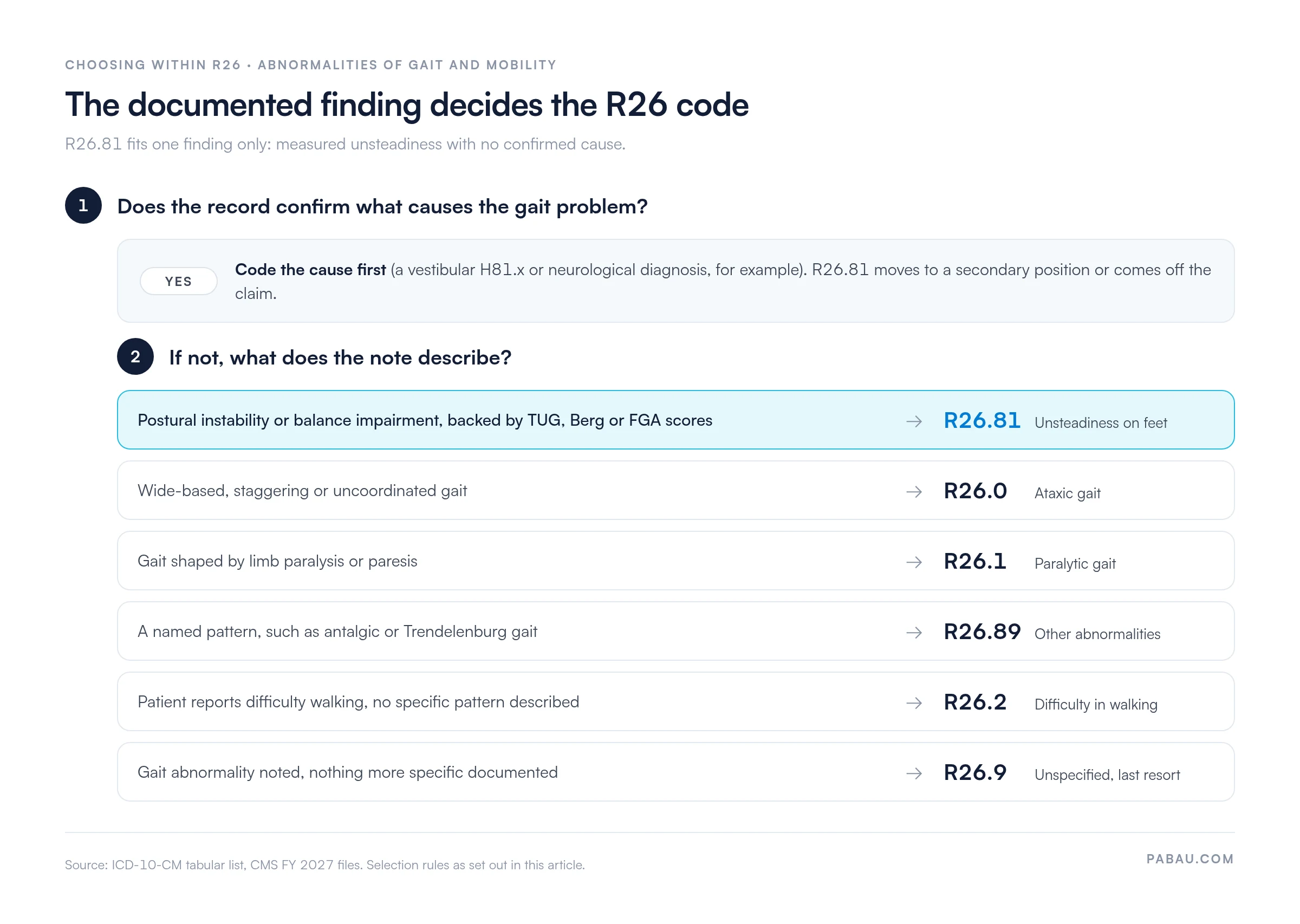
Section I.C.18 of the ICD-10-CM Official Guidelines governs symptom codes from Chapter 18. They may be the principal or primary diagnosis only when no confirmed underlying condition has been established.
The CMS ICD-10 codes page publishes the annual ICD-10-CM Official Guidelines for Coding and Reporting. Those guidelines govern every sequencing decision.
One common sequencing mistake is assigning R26.81 as principal when a vestibular or neurological diagnosis is clearly documented. Payers with active Local Coverage Determinations (LCDs) for therapy often auto-deny these claims. The trigger is a symptom code in the principal slot while an etiology sits in the same episode.
Run a pre-submission check on every R26.81 claim. Scan the clinical note for a confirmed vestibular, neurological or musculoskeletal diagnosis. If one is documented as the cause of the unsteadiness, sequence it first. Then move R26.81 to a secondary position, or remove it if it adds nothing.
Medical necessity for unsteadiness on feet claims rests on objective, measured documentation. A note reading “patient unsteady” with no assessment score won’t satisfy a payer. To support R26.81 and any paired CPT services, the clinical record should include each of these.
A clean claim for gait services needs each element above in the note before the claim is generated. Adding them after a denial is a retrospective amendment that payers scrutinize.
Physical therapy and rehabilitation claims pair R26.81 with procedure codes that reflect the intervention delivered. The tables below list the CPT codes most often submitted with R26.81, plus secondary ICD-10-CM codes that add clinical detail.
For physical therapy (PT) practices, R26.81 is one of the main diagnoses behind gait training claims billed with CPT 97116. Therapists can’t use it in place of a confirmed etiology code. They can use it as the principal diagnosis while the treating physician has yet to confirm what causes the balance impairment.
Functional limitation reporting, which used G-codes such as G8978 and G8979, was discontinued January 1, 2019. PT practices now report functional status through MIPS quality measures instead.
Denials for R26.81 claims concentrate around four correctable errors. Each maps to a specific documentation or coding fix.
After a run of R26.81 rejections, a review built on denial management workflows usually finds one cause repeating across providers. It’s often a missing balance score or the same sequencing error. Fix the note template or intake form, and that error stops reaching new claims.
Audit five recent R26.81 denials. Check each one for two root causes. Either the objective gait score is missing, or R26.81 was sequenced first despite a documented vestibular or neurological diagnosis. Fix the documentation checklist at the point of service, where the note is written.
Medicare and commercial payers evaluate R26.81 claims against their applicable LCDs. CMS publishes physical therapy LCDs through individual Medicare Administrative Contractors (MACs), and coverage criteria vary by jurisdiction. No single national coverage determination (NCD) covers gait training universally.
Key payer requirements that apply across most jurisdictions:
A grounding in medical billing fundamentals helps practice managers build documentation workflows around payer requirements before a denial occurs.
The WHO ICD classification framework underpins ICD-10-CM. The US clinical modification adds the extra detail, R26.81 included, that payers need for coverage decisions. Medical billing compliance processes built around the CMS guidelines and your contractor’s LCDs protect revenue when a gait-code audit arrives.
Many R26.81 denials start in the visit note and surface weeks later as a rejection. By then, the billing team is chasing a missing Berg score or a sequencing error long after the patient has left.
Pabau keeps the therapy note and the claim in the same patient record, so the biller works from what the therapist wrote. Its claims management software sends CMS-1500 claims through the Claim.MD clearinghouse, which reaches thousands of US payers.
Eligibility checks run before the visit, so the front desk confirms gait training coverage first. Electronic remittances post back to the same record, and secondary claims go out from there. A rejection shows up on the day it happens, while the note is still fresh.


Pabau sends R26.81 claims through the Claim.MD clearinghouse, checks eligibility before the visit, and posts remittances to the patient record. Fewer gait training claims come back for rework.

R26.81 earns its place on a claim only while the cause of the unsteadiness is still unknown. Once a vestibular, neurological or musculoskeletal diagnosis is confirmed, that code leads and R26.81 steps back or comes off.
So put the effort into the visit note. A balance score, a functional limitation statement and a sequencing rationale, written at the visit, are what keep an R26.81 claim from bouncing back.
Book a demo to see how Pabau keeps the therapy note and the R26.81 claim in one record, from eligibility check to remittance.

Need a clearinghouse for therapy claims? Claim.MD clearinghouse guide explains how electronic submission and eligibility checks reach thousands of US payers.
Is the gait pattern named in the note? ICD-10 code R26.89 covers antalgic, Trendelenburg and other named gait abnormalities.
ICD-10 Code R26.81 is a billable ICD-10-CM diagnosis code for unsteadiness on feet. It sits in category R26 (Abnormalities of gait and mobility), in Chapter 18 of the tabular list. It is used when postural instability or balance impairment is documented and no confirmed underlying etiology has been established. It is distinct from ataxic gait (R26.0), difficulty in walking (R26.2), and other named gait abnormalities (R26.89).
Yes, R26.81 is a valid, billable ICD-10-CM code confirmed in the CMS tabular list. It is a full-specification code, meaning it can be submitted on a claim without requiring a more specific subcode. Coverage for the services billed with R26.81 depends on the payer’s applicable LCD and the documented medical necessity.
Yes, R26.81 can be the principal diagnosis when no confirmed underlying condition explaining the unsteadiness is documented. Under ICD-10-CM Official Guidelines Section I.C.18, symptom codes from Chapter 18 may serve as the principal diagnosis during the workup phase. If a confirmed etiology is established, that code sequences first and R26.81 moves to a secondary position or is removed.
The most frequently paired CPT codes are 97116 (gait training, per 15 minutes), 97110 (therapeutic exercise), and the physical therapy evaluation codes 97161-97163. CPT 97112 (neuromuscular re-education) also appears regularly when vestibular or proprioceptive retraining is the intervention. Each service requires documented functional limitation and skilled-care justification to satisfy payer medical necessity requirements.
R26.81 (unsteadiness on feet) and R26.0 (ataxic gait) are both symptom codes under R26, but they describe different clinical findings. R26.0 applies when documentation describes a wide-based, staggering, or uncoordinated movement pattern characteristic of cerebellar or sensory ataxia. R26.81 applies when the documented finding is postural instability, balance impairment, or an inability to stand or walk without swaying. That note names no ataxia pattern. If a confirmed neurological diagnosis exists, neither code should serve as the principal diagnosis.
Medicare Part B may cover physical therapy services billed with R26.81. Coverage follows the Local Coverage Determination of the Medicare contractor where the service is provided. Coverage requires documented skilled PT need, objective functional limitation findings, a physician plan of care, and evidence of progress toward measurable goals. Prior authorization rules vary by Medicare Advantage plan and commercial payer, so verify them before starting an extended therapy episode.