ICD-10 Code J81.1: Chronic pulmonary edema
ICD-10 Code J81.1: Definition and code details ICD-10 code J81.1 is the billable...

Last Updated: Nov 16, 2026
Billable Code Specific Code
M62.82 is the billable ICD-10-CM code for rhabdomyolysis, the breakdown of skeletal muscle that releases creatine kinase and myoglobin into the blood. It covers nontraumatic causes such as exertion, drugs, heat and seizures, while traumatic rhabdomyolysis codes to T79.6.
The code sits in category M62, Other disorders of muscle. A complete claim usually adds a code for the cause and, when documented, codes for acute kidney injury (N17.-) and myoglobinuria (R82.1).
Let Pabau's smart automation suggest the right codes, reduce claim denials, and keep your practice compliant—effortlessly.
Automate repetitive tasks and focus on what matters most—your patients.
Reduce coding errors and ensure compliance with the latest regulations.
Clean claims, fewer denials, and faster reimbursements.
Powerful insights and reporting to help your practice thrive.
HIPAA compliant SOC 2 certified GDPR-compliant Trusted by 4,000+ clinics worldwide

M62.82 is the billable ICD-10-CM code for nontraumatic rhabdomyolysis, filed under M62.8, Other specified disorders of muscle.
Traumatic rhabdomyolysis is excluded from M62.82 and codes to T79.6-, so the mechanism of injury decides the code.
The cause sets the sequence: an adverse drug effect follows M62.82, while a poisoning or heatstroke code goes first.
Code AKI (N17.-), myoglobinuria (R82.1) and electrolyte disorders separately when the physician documents and manages them.
Pabau’s claims management software sends US claims through Claim.MD, with eligibility checks and electronic remittances on the patient record.
ICD-10 Code M62.82 is the billable ICD-10-CM diagnosis code for rhabdomyolysis, the breakdown of skeletal muscle that releases creatine kinase and myoglobin into the blood.
CMS’s 2027 ICD-10-CM files list it under M62.8 with one Excludes1 note, which sends traumatic rhabdomyolysis to T79.6. Use the table below to confirm the code details before you build the claim.
The CDC/NCHS ICD-10-CM web tool provides the authoritative tabular listing and any annual updates to M62.82 and its parent categories.
Rhabdomyolysis is the breakdown of striated (skeletal) muscle tissue, releasing intracellular contents into the bloodstream. M62.82 captures nontraumatic rhabdomyolysis. The code is used when the physician explicitly documents a rhabdomyolysis diagnosis, with or without the full clinical triad present.
Before assigning M62.82, confirm the record documents these clinical hallmarks:
M62.82 covers nontraumatic rhabdomyolysis from any cause, including exertion, drugs, toxins, heat and seizures. Traumatic rhabdomyolysis, such as muscle breakdown after a crush injury, codes to T79.6- instead.
Understanding the exclusion notations prevents the most common miscoding errors. An Excludes1 note means the two conditions are not reported together. An Excludes2 note means the excluded condition is not part of the code, but it may be coded additionally if the patient has both.
If the documentation describes traumatic rhabdomyolysis, such as muscle breakdown from a crush or blunt-force injury, M62.82 is not appropriate. Assign T79.6- with the 7th character for the encounter, then the specific injury code for the body region.
The etiology of rhabdomyolysis directly determines which additional codes belong on the claim. A wrong cause leaves the external cause or T-code missing or incorrect, which is a frequent reason these claims are denied.
Exertional rhabdomyolysis occurs when intense or prolonged physical exertion causes muscle fiber breakdown without a traumatic event. The physician note must state that rhabdomyolysis resulted from the physical activity. A note that the patient exercised before admission is not enough.
Assign M62.82 as the principal or primary diagnosis, then add an external cause code from category Y93 to identify the specific activity. Category Y93 is meant to be used with place-of-occurrence (Y92) and external cause status (Y99) codes, per the Official Guidelines on external cause coding.
The adverse effect versus poisoning distinction changes the sequencing order entirely. When rhabdomyolysis follows a drug taken correctly as prescribed, it is an adverse effect. M62.82 goes first, followed by the T-code for the adverse effect of the causative drug.
When rhabdomyolysis follows an overdose, misuse, or a drug taken with undetermined intent, it is a poisoning. The poisoning T-code is sequenced first, followed by M62.82.
Statins (antihyperlipidemic agents) are the most common drug trigger. Confirm the physician has documented both the specific drug and the circumstance (prescribed use vs. overdose). Then select the T-code and its 7th-character encounter designation (A, D, or S).
M62.82 rarely stands alone on a rhabdomyolysis claim. Acute kidney injury is the most dangerous and most commonly undercoded sequela. The chart below puts the cause, the sequence and the companion codes in one place.
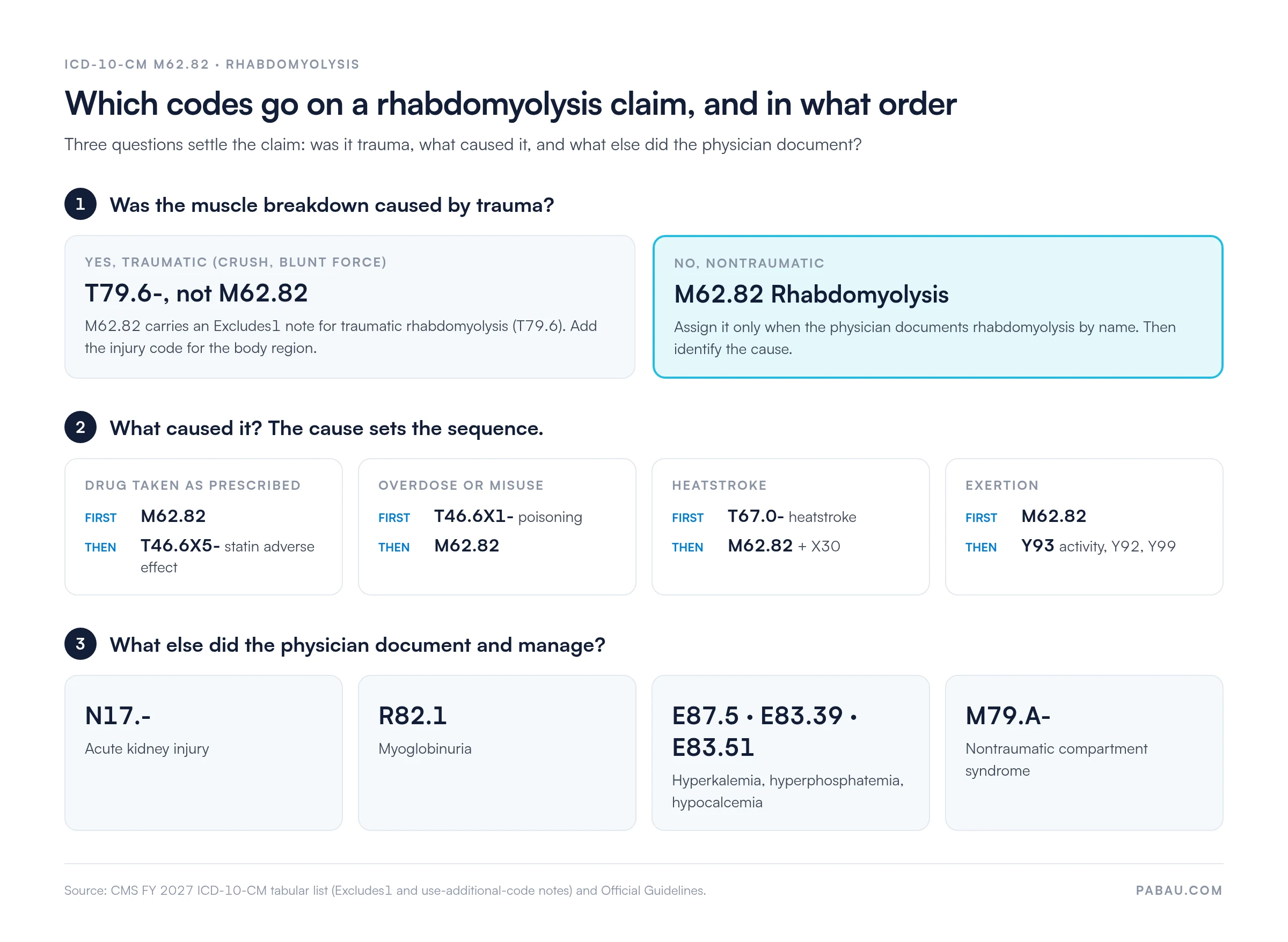
Run a companion-code audit before submitting any M62.82 claim. Confirm whether AKI, myoglobinuria, the causative drug or activity, and any electrolyte disorders are documented, and give each documented condition its own code.
Several codes cover overlapping muscle and urinary findings. The table below shows the documentation distinctions that determine the correct choice.
The GEM (General Equivalence Mapping) forward crosswalk maps ICD-9-CM code 728.88 directly to M62.82, a one-to-one approximate match. The rhabdomyolysis descriptor is essentially unchanged between the two code systems, so the crosswalk is a clean one.
The backward crosswalk (M62.82 to ICD-9) returns 728.88 as the only equivalent. Claims submitted before October 1, 2015 used 728.88, and all current claims use M62.82. For medical billing teams comparing longitudinal datasets, the mapping is reliable. Still, flag any GEM crosswalk as an approximate match in research contexts.
Payer requirements for M62.82 vary by plan and are updated at least annually. The following represents general patterns, so always verify with the individual payer’s current LCD (Local Coverage Determination) or coverage policy.
Rhabdomyolysis claims fail for a predictable set of reasons. Each one has a documentation fix that stops the denial before it starts.
Denial management workflows catch these patterns in aggregate. A monthly review of the top five denial reasons on M62.82 claims shows which documentation problems keep recurring, faster than working appeal by appeal. Our guide to medical billing denial codes explains the CARC and RARC codes that come back with these rejections.
A coder cannot assign M62.82 with confidence unless the physician note contains all of the following. Use this as a pre-submission checklist.
Complete documentation before submission supports both accurate coding and medical billing compliance. Structured clinical note templates help, because they prompt the physician for each element at the point of care.
A clean claim submission for M62.82 depends on the physician note containing the five elements above, not on the coder inferring missing information.
Query the physician before closing the encounter. Ask specifically whether the etiology (drug name, activity type, or precipitating event) is documented in the note. A single query at discharge substantially reduces M62.82 documentation deficiencies.
A rhabdomyolysis claim usually draws on three places: the physician note, the lab report and the billing system. Every hand-off between them is a chance for the etiology code, the CK value or the AKI diagnosis to drop out before the claim leaves.
Pabau, the practice management platform we build, keeps the clinical note and the claim on the same patient record. Its claims management software creates CMS-1500 and 837P claims and sends them through the Claim.MD clearinghouse, which connects to thousands of US payers.
Real-time eligibility checks show coverage problems before the claim goes out. Electronic remittance advice then posts against the same record, so a denied M62.82 claim is visible the day it returns.
Where a plan requires authorization for dialysis or an inpatient stay, the auth code and dates sit on the case. Pabau shows a warning when one is missing.

Pabau’s claims management software sends CMS-1500 and 837P claims through Claim.MD, checks eligibility in real time, and posts ERA remittances to the patient record. See how it fits your rhabdomyolysis billing workflow.

M62.82 takes seconds to find. Whether the claim pays depends on the note. It has to name the cause, the CK value and every complication the team managed. The coder then has to put those codes in the right order.
If you change one habit, make it the discharge query on etiology. A named drug, activity or event settles both the external cause code and the sequence. The cost is one extra question per encounter, against a claim that would otherwise come back for review.
Book a demo to see how Pabau keeps the physician note and the claim on one record for rhabdomyolysis encounters.

Submitting M62.82 claims through a clearinghouse? Claim.MD clearinghouse overview explains how the integration handles 837P transmission, ERA reconciliation, and eligibility verification for US practices.
Looking to understand the broader billing pipeline? Revenue cycle management guide maps the full RCM workflow from encounter through payment posting.
ICD-10 Code M62.82 is the billable ICD-10-CM diagnosis code for rhabdomyolysis, the breakdown of skeletal muscle that releases myoglobin and creatine kinase into the bloodstream. It sits under M62 (Other disorders of muscle) in the M60-M63 block and covers nontraumatic causes only. Traumatic muscle injury routes to injury codes instead.
The ICD-10-CM code for rhabdomyolysis is M62.82. It is the only specific billable code for this condition. The former ICD-9-CM equivalent was 728.88, which maps forward to M62.82 via the CMS GEM crosswalk files.
Yes, M62.82 is a valid, billable ICD-10-CM code and has been effective since October 1, 2015 (FY 2016). It carries no non-billable or header-code designation in the official tabular list. Confirm billable status annually against the CMS ICD-10-CM updates page since the code set is revised each fiscal year.
M62.82 should be reported with an external cause or T-code when the etiology is documented. The Official Guidelines use “should” rather than “must” for external cause coding in most nontraumatic settings. Even so, payers increasingly treat a missing etiology code as a denial trigger. Assign the appropriate Y93.xx activity code for exertional cases or the relevant T-code for drug-induced cases when the physician documents the cause.
Acute kidney injury (AKI) is coded with N17.9 (acute kidney failure, unspecified) or a more specific N17 subcategory when AKI is documented. It is reported as an additional code alongside M62.82. Sequencing depends on the reason for the encounter. If rhabdomyolysis was the admitting diagnosis, M62.82 is typically sequenced first. If AKI drove the encounter independently, it may qualify as principal diagnosis under the Official Guidelines.
Elevated creatine kinase (CK or CPK) is the primary laboratory marker. Thresholds cited in clinical literature commonly range from 5 to 10 times the upper limit of normal. The level a payer requires is LCD-dependent and varies by Medicare Administrative Contractor. Coders should not assign M62.82 based on a lab value alone; a physician must document the rhabdomyolysis diagnosis explicitly.
Yes, myoglobinuria (R82.1) is coded as an additional code when explicitly documented alongside rhabdomyolysis. It is not automatically excluded as integral to M62.82. If the physician notes dark urine and myoglobinuria in the record, assign R82.1 in addition to M62.82. Confirm this practice against the current Official Guidelines on signs and symptoms coding.