ICD-10 Code D64.9: Anemia, unspecified
ICD-10 Code D64.9: Code attributes and billable status ICD-10 Code D64.9 is the ...

Last Updated: Nov 10, 2026
Billable Code Specific Code
I21.4 is the billable ICD-10-CM code for Non-ST elevation (NSTEMI) myocardial infarction. It covers an acute MI with elevated cardiac biomarkers and no persistent ST-segment elevation on the ECG, confirmed in the physician's documentation.
Denials for this code often trace back to one of three documentation failures. The attending never wrote "NSTEMI" explicitly, or elevated troponin alone was treated as sufficient justification. Or the wrong code was used for a subsequent event within 28 days.
Let Pabau's smart automation suggest the right codes, reduce claim denials, and keep your practice compliant—effortlessly.
Automate repetitive tasks and focus on what matters most—your patients.
Reduce coding errors and ensure compliance with the latest regulations.
Clean claims, fewer denials, and faster reimbursements.
Powerful insights and reporting to help your practice thrive.
HIPAA compliant SOC 2 certified GDPR-compliant Trusted by 4,000+ clinics worldwide

ICD-10 code I21.4 is billable in the current FY2027 code set and sits in category I21, Acute myocardial infarction.
Coders cannot assign I21.4 from troponin values alone, because the attending physician must document NSTEMI explicitly in the note or discharge summary.
A new NSTEMI within 28 days of a prior acute MI is coded I22.2 (Subsequent non-ST elevation MI), not I21.4.
Pabau, the practice management platform we build, submits US claims through Claim.MD and runs eligibility checks and ERA remittances in the same workflow.
ICD-10 code I21.4 is a valid, billable ICD-10-CM code with the official descriptor “Non-ST elevation (NSTEMI) myocardial infarction.”
It sits in Chapter 9 (Diseases of the Circulatory System), block I20-I25 (Ischemic heart diseases) and category I21 (Acute myocardial infarction). The code has been effective since FY2016 and remains valid in the FY2027 code set, per the CMS ICD-10-CM update files.
Clinically, NSTEMI is defined by two simultaneous findings. Cardiac biomarkers (troponin I or troponin T) are elevated, showing myocardial injury, and the ECG lacks persistent ST-segment elevation. That ECG distinction separates I21.4 from the STEMI codes (I21.01 through I21.3). No sex or age edits apply to I21.4, and it is valid as a principal or secondary diagnosis depending on the encounter.
I21.4 is the correct code when a clinician has explicitly documented NSTEMI in the attending note, progress note, or discharge summary. That diagnosis rests on elevated cardiac biomarkers and an ECG without persistent ST elevation. The physician’s documentation is determinative, so coders do not interpret laboratory results or ECG tracings on their own.
Three conditions must all be present before I21.4 can be assigned:
Outpatient encounters: ICD-10-CM guidelines differ for outpatient settings. In outpatient coding, do not code a probable or suspected NSTEMI. Code the sign or symptom instead, such as chest pain or elevated troponin. I21.4 in an outpatient context requires a confirmed, documented NSTEMI diagnosis at the time of the visit.
Taken together, these rules work as a short sequence of checks, and the first one that applies decides the code.
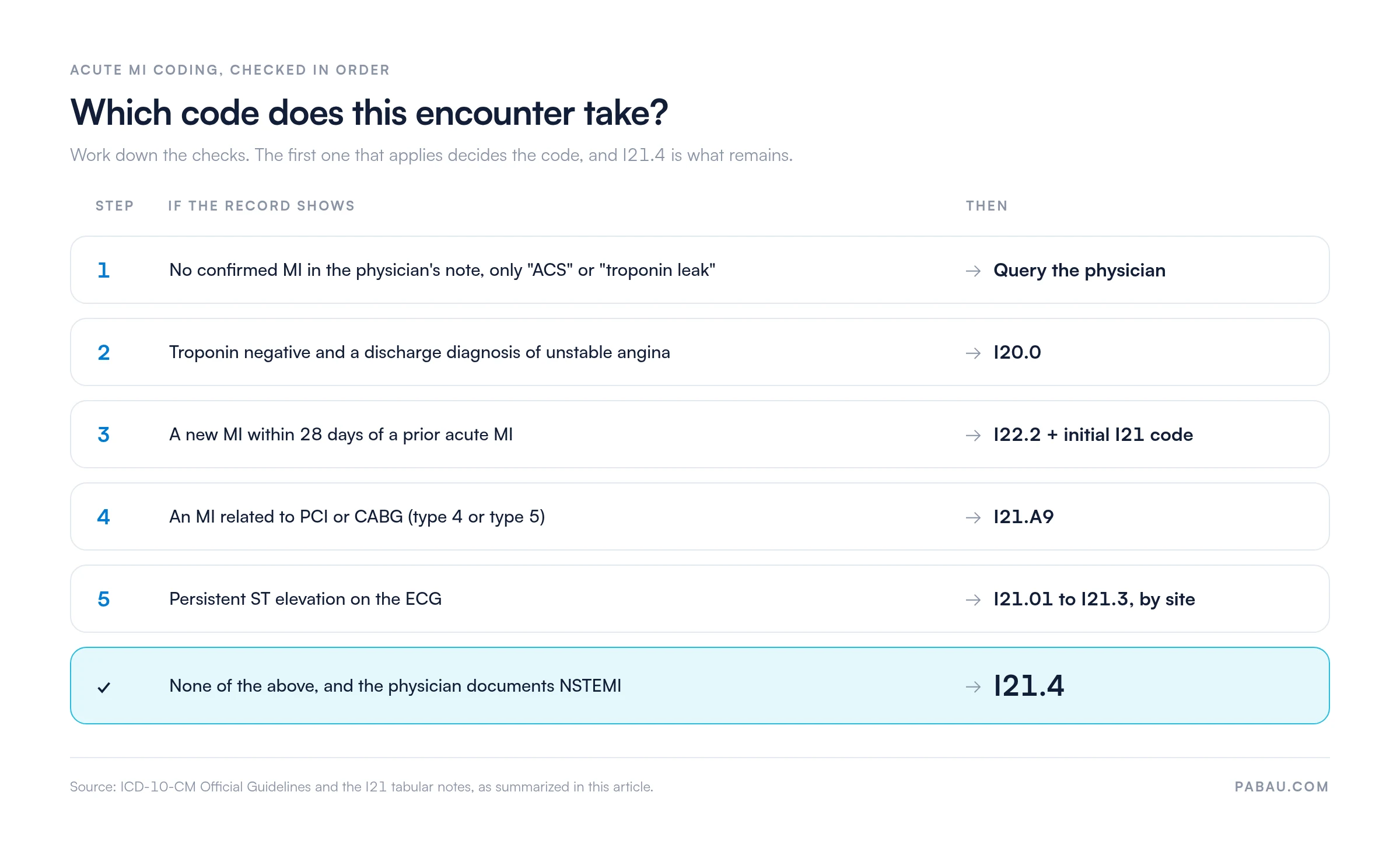
NSTEMI and STEMI describe the same clinical event, an acute myocardial infarction, but differ in ECG pattern and in the resulting ICD-10-CM code. STEMI codes carry site-specific subcategories (anterior wall, inferior wall, other sites) that NSTEMI does not. The choice therefore also sets how much site detail the record needs.
When the physician documents “MI” or “heart attack” without specifying STEMI or NSTEMI, the coder cannot select I21.4 unilaterally. A physician query is required. Per the ICD-10-CM coding guidelines and AAPC guidance, the distinction must come from the clinician, not from reading the ECG strip.
Unstable angina (I20.0) and NSTEMI present nearly identically in the emergency department, with chest pain, ECG changes, and an acute coronary syndrome workup. At the coding level, troponin separates them. NSTEMI requires troponin elevation, and unstable angina does not.
The inpatient guideline adds an important nuance. Under ICD-10-CM Section II.H, a patient admitted with “rule out NSTEMI” or “probable NSTEMI” can be coded I21.4 at the inpatient level. That holds when NSTEMI is still the documented diagnosis at discharge. If the workup is negative and the discharge diagnosis is “unstable angina,” code I20.0 instead of I21.4. Never assign I21.4 speculatively based on the admission impression alone.
The ICD-10-CM tabular list carries several instructional notes that govern how I21.4 is used alongside other codes. Missing them causes sequencing errors that payers flag on audit.
The following conditions are not included in I21.4 but can be coded alongside it when both apply:
When applicable, assign additional codes alongside I21.4 to capture the full clinical picture:
Before finalizing the I21.4 claim, scan the discharge summary for CAD, hypertension, and tobacco use. A missed secondary code is a common CDI audit finding, and an omitted CC or MCC can change DRG grouping and reimbursement.
A subsequent myocardial infarction occurring within 28 days of an initial AMI is coded I22.2, not I21.4. This is an explicit rule in ICD-10-CM Official Guidelines Section I.C.9.e. Misapplying I21.4 here is a sequencing error that payers catch through claims history lookups.
Three documentation signals indicate a “subsequent” event rather than an initial one:
Sequencing rule: I22.2 is sequenced first if the subsequent NSTEMI is the reason for admission. The still-active initial AMI code (I21.x) is listed as an additional diagnosis to show the ongoing episode of care. After 28 days, a new AMI is coded as a fresh I21.4, not a subsequent event.
Payers, particularly Medicare, expect a specific set of clinical documentation elements before accepting I21.4. A claim with the right code but weak documentation is as likely to draw a records request or denial as one with the wrong code.
The documentation checklist for a clean claim submission on I21.4 includes:
CDI specialists: A physician may document “ACS, NSTEMI component” or similar hybrid phrasing. That is generally sufficient to support I21.4 if troponin elevation and ECG findings are documented elsewhere in the record. When the phrasing is ambiguous, a formal physician query resolves it before coding and before billing.
Run a documentation query checklist before coding any NSTEMI encounter: Is ‘NSTEMI’ in the attending’s note? Is the troponin trend referenced? Is the ECG interpretation noted? Answering no to any one of these is a signal to query the physician rather than code from inference.
NSTEMI diagnosis coding generates a predictable set of denials. Understanding the patterns lets coders and billing teams flag problems before submission rather than manage them on appeal.
Practices that submit through the Claim.MD clearinghouse can check eligibility before NSTEMI claims reach the payer. A denial management workflow built for cardiac admissions cuts rework on these high-value claims. It should include an I22.2 timeline check and a documentation completeness screen.
For the remittance codes that accompany NSTEMI denials, see our medical billing denial codes reference. Matching each denial reason to its CARC code speeds the appeal and routing process.
Under Medicare’s inpatient prospective payment system (IPPS), NSTEMI claims coded with I21.4 group to MS-DRGs 280, 281, and 282. These cover acute myocardial infarction, discharged alive, with MCC, with CC, and without CC or MCC, respectively. The assignments are subject to annual CMS revision, so verify them against the current IPPS grouper for the fiscal year.
The DRG tier depends on whether the claim carries a major complication or comorbidity (MCC) or a complication or comorbidity (CC) code. That makes complete secondary-diagnosis coding a direct reimbursement variable. Capturing a documented MCC shifts an NSTEMI claim from DRG 282 to DRG 280, a meaningful reimbursement difference on a single inpatient encounter.
CMS requires that an inpatient NSTEMI admission meet medical necessity criteria. The clinical record should show that the presentation required inpatient monitoring and intervention rather than observation-level care. Ongoing chest pain, a troponin rise, hemodynamic instability, or high-risk ECG changes all support that case.
Medicare Administrative Contractors (MACs) may request records on NSTEMI claims that exceed regional charge thresholds or break from community patterns. Local Coverage Determination (LCD) requirements also vary by MAC region, so check the relevant MAC portal for current coverage guidance.
For practices managing electronic remittance advice at scale, tagging ERA denials by DRG and denial code shows NSTEMI-specific patterns across payers without manual chart review. The ResDAC documentation on ICD codes in Medicare files explains how I21.4 appears in claims data and research datasets.
Many NSTEMI denials trace back to the chart rather than the payer. Billing teams often find the missing “NSTEMI” wording or the uncoded CC only when the remittance comes back.
Pabau, the practice management platform we build, keeps the encounter, its diagnosis codes, and the claim on one patient record. US practices submit CMS-1500 (837P) claims through Claim.MD and run eligibility checks in the same system. Our cardiology claims software also posts ERA remittances and handles secondary claims.
The outcome is fewer surprises at remittance. When an ERA posts against an I21.4 claim, the payment or denial lands on the encounter’s record. The coder then starts any fix from the chart.

Pabau submits ICD-10-coded claims through Claim.MD, with eligibility checks and ERA remittances in the same workflow. Your cardiology team spends less time chasing denials and more time on patient care.

NSTEMI coding turns on one principle. The physician’s documented diagnosis drives code assignment, not the lab value or the ECG tracing.
Where I21.4 claims fail, the code is rarely the problem. They fail when the note leaves NSTEMI ambiguous, when the 28-day subsequent MI rule is missed, or when a CC or MCC goes uncaptured. Build the physician query, the timeline check, and the secondary-code scan into coding, and the claim leaves with its documentation in order.
The trade-off is a few minutes of review on every cardiac encounter, which costs far less than an appeal on a high-value inpatient claim. Book a demo to see how Pabau keeps NSTEMI claims, eligibility checks, and remittances on one record for your billing team.

Need a faster path through claim submission? Claim.MD clearinghouse overview explains how the integration handles 837P submission, eligibility checks, and ERA processing for ICD-10-coded cardiac claims.
Seeing recurring denial patterns? Medical billing fundamentals covers the revenue cycle from charge capture through payment posting, which helps when auditing NSTEMI denial root causes.
Putting the claim document together? Superbill guide walks through how ICD-10 codes, procedure codes, and payer identifiers come together in the document that feeds the claim.
Coding CAD alongside the NSTEMI? ICD-10 code I25.10 covers atherosclerotic heart disease of native coronary artery without angina pectoris.
ICD-10 code I21.4 is the billable ICD-10-CM diagnosis code for non-ST elevation myocardial infarction (NSTEMI). NSTEMI is an acute MI with elevated cardiac biomarkers and no persistent ST-segment elevation on the ECG. The code is valid in the FY2027 code set and can be a principal or secondary diagnosis once the attending physician confirms NSTEMI.
NSTEMI codes as I21.4, a single terminal code with no site subcategory. STEMI codes by documented site: I21.01, I21.02, I21.09 (anterior wall); I21.11, I21.19 (inferior wall); I21.21, I21.29 (other sites); I21.3 (unspecified site). The ECG finding drives code selection, with persistent ST elevation for STEMI and none for NSTEMI. Site specificity is required for STEMI codes but not for I21.4.
No. Troponin elevation alone does not support I21.4. The attending physician must document “NSTEMI” or “non-ST elevation myocardial infarction” as a confirmed diagnosis. Coders do not interpret laboratory values independently. If the note says “elevated troponin” or “troponin leak” without an explicit NSTEMI diagnosis, a physician query is required before assigning I21.4.
Use I22.2 (Subsequent non-ST elevation MI) when a new NSTEMI occurs within 28 days of a prior acute myocardial infarction of any type. After the 28-day window, a new NSTEMI is coded as I21.4 again. I22.2 is sequenced first if it is the reason for admission, with the still-active initial AMI code (I21.x) as an additional diagnosis.
No. Unstable angina (I20.0) and NSTEMI (I21.4) are distinct codes. The differentiator is troponin, because NSTEMI requires documented troponin elevation and unstable angina does not. Suppose a patient is admitted with possible NSTEMI and the troponin workup comes back negative. If the discharge diagnosis is unstable angina, code I20.0 rather than I21.4.
Five denial patterns recur on I21.4 claims. The first is an NSTEMI that was never explicitly documented, where the physician wrote only “ACS” or “elevated troponin.” The second is I21.4 used for a subsequent MI within 28 days, which should be I22.2. The third is CAD sequenced as the principal diagnosis instead of NSTEMI. The fourth is a type 4 or type 5 MI coded as I21.4 instead of I21.A9. The fifth is missing ECG and troponin trend documentation in the supporting record.