ICD-10 code Y83.0: Surgical operation with whole organ transplant
ICD-10 code Y83.0 names the transplant as the cause, not the problem ICD-10 code...

Last Updated: Nov 19, 2026
Billable Code Specific Code
F03.90 is the billable ICD-10-CM code for unspecified dementia, unspecified severity, without behavioral disturbance, psychotic disturbance, mood disturbance, and anxiety. It applies when the provider documents dementia but names no cause, no stage, and no behavioral, psychotic, mood, or anxiety disturbance.
F03.90 sits under subcategory F03.9 in category F03. A documented stage moves the code to F03.A, F03.B, or F03.C, and a documented disturbance moves it to a sibling such as F03.911 or F03.92. A named cause, such as Alzheimer's disease, takes the code out of F03 entirely.
Let Pabau's smart automation suggest the right codes, reduce claim denials, and keep your practice compliant—effortlessly.
Automate repetitive tasks and focus on what matters most—your patients.
Reduce coding errors and ensure compliance with the latest regulations.
Clean claims, fewer denials, and faster reimbursements.
Powerful insights and reporting to help your practice thrive.
HIPAA compliant SOC 2 certified GDPR-compliant Trusted by 4,000+ clinics worldwide

ICD-10 Code F03.90 is billable for dementia with no documented etiology, no severity stage, and no behavioral, psychotic, mood, or anxiety disturbance.
Use a more specific code when the note supports one, such as G30.x with F02.x for Alzheimer’s disease or F01.x for vascular dementia.
Documented agitation codes to F03.911 and other behavioral disturbance to F03.918, because F03.91 itself is a non-billable subcategory.
When the provider documents dementia and mentions no disturbance, the ICD-10-CM Index defaults to F03.90, so silence alone does not call for a query.
Some payers restrict unspecified codes as the primary diagnosis for certain services, so check the payer policy and keep cognitive test scores in the chart.
ICD-10 Code F03.90 is a valid, billable ICD-10-CM code for dementia with no documented cause, stage, or disturbance. Its official FY2027 descriptor reads “Unspecified dementia, unspecified severity, without behavioral disturbance, psychotic disturbance, mood disturbance, and anxiety.” The FY2027 ICD-10-CM Official Guidelines classify dementia by etiology and severity. When the note gives no stage, they direct coders to the unspecified-severity code.
F03 itself is a non-billable category. F03.90 is the billable code under subcategory F03.9, unspecified severity. The descriptor contains six distinct qualifiers, and each one describes what the chart does or does not document.
Per the CMS ICD-10-CM coding guidelines, coders must code to the highest degree of specificity the documentation supports. F03.90 is the least specific option in category F03, so it fits only when nothing in the provider’s note supports a more precise code.
F03.90 applies when a clinician has documented a confirmed dementia diagnosis but has not identified the underlying cause or type.
Included presentations:
Excluded presentations:
Coders cannot assign F03.90 from symptoms alone. If another part of the record names a cause, such as Alzheimer’s on the problem list, query the provider first.
The table maps chart wording to the right code. Unstaged Alzheimer’s, for example, codes as G30.9 with F02.80.
F03.90 and F03.91 are the two most commonly confused F03 entries. F03.91 is a non-billable subcategory that needs a sixth character: F03.911 for agitation or combativeness, F03.918 for any other behavioral disturbance.
Wandering is not a behavioral disturbance. Report it with the additional code Z91.83.
Each severity subcategory repeats the pattern. Final characters 0, 11, and 18 mark no disturbance, agitation, and other behavioral disturbance, while 2, 3, and 4 mark psychotic, mood, and anxiety. The grid below shows the full category.
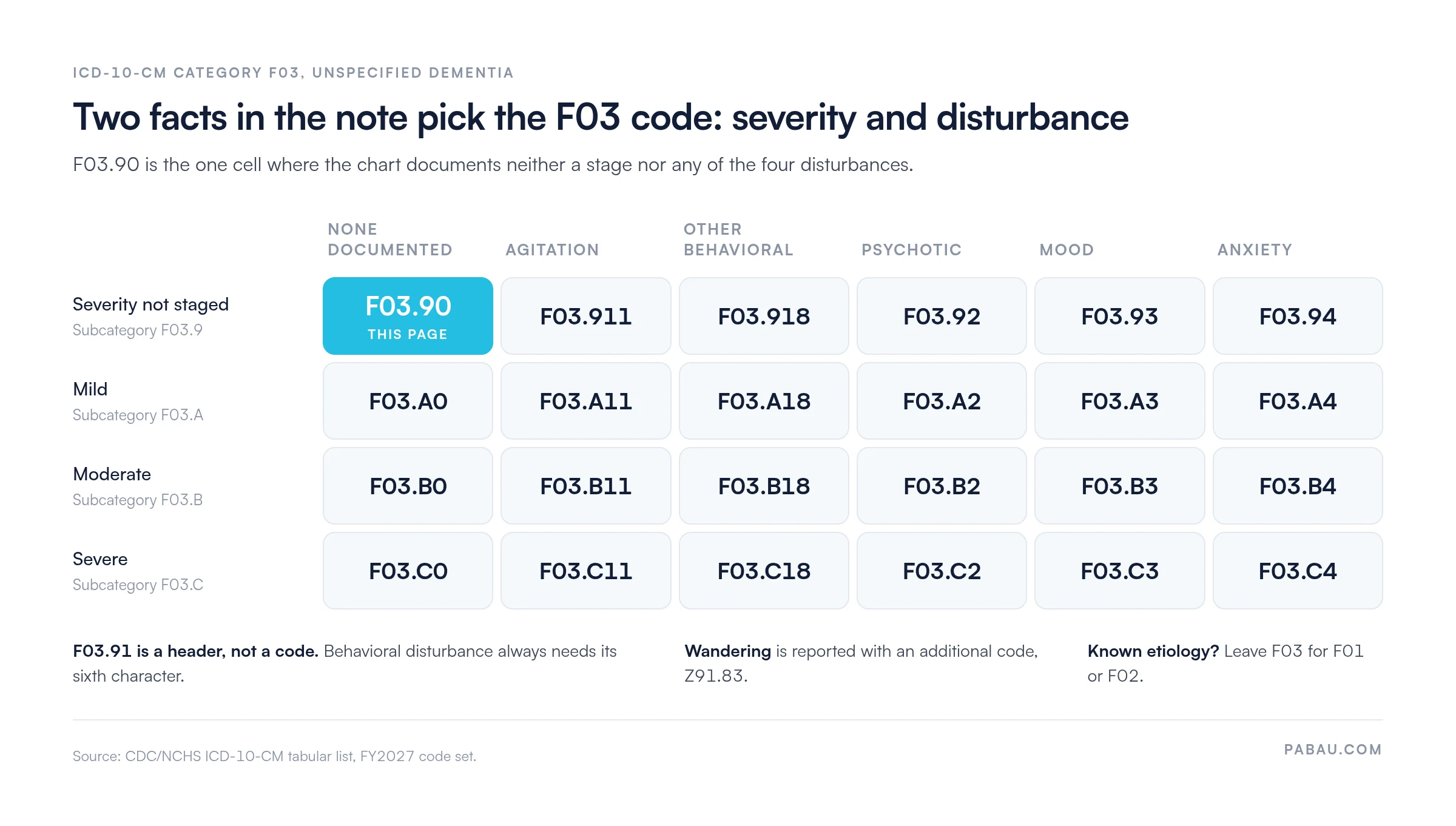
The CDC/NCHS ICD-10-CM web tool lists the full F03 hierarchy. Check it before defaulting to F03.90.
No official rule sets a documentation checklist for F03.90. The three points below are best practice, because each one maps to a qualifier in the descriptor.
Recording why the etiology is still open, such as a pending MRI or neuropsychological testing, is good practice. It helps the next coder and any auditor, although no guideline requires it.
Silence on disturbances does not call for a query by itself, since the Index default already covers it. A query makes sense when the record conflicts, for example when nursing notes describe agitation that the provider’s assessment never mentions. Good medical billing best practices treat documentation queries as part of the pre-submission workflow.
Before you assign F03.90, confirm three points in the note. It names dementia, it documents no disturbance, and it does not stage severity. If nursing or therapy entries contradict the provider, query before you code.
F03.90 can be the first-listed diagnosis when dementia is the main condition responsible for the encounter. Payer policies vary, though, and unspecified codes draw more scrutiny as primary diagnoses than specific codes do.
F03.90 works as the primary diagnosis at an outpatient visit to evaluate and manage the patient’s dementia, with no other condition chiefly responsible. It is secondary in an inpatient admission for a hip fracture in a patient with known unspecified dementia. There, the dementia is an additional diagnosis rather than the reason for admission.
Medicare coverage for dementia-related services billed with ICD-10 Code F03.90 is administered through CMS and interpreted locally by Medicare Administrative Contractors (MACs). No single national coverage policy governs all dementia services. LCDs vary by MAC jurisdiction and by the service billed alongside the diagnosis.
Denials on F03.90 cluster around three root causes: specificity, documentation, and sequencing. Knowing which denial reason code maps to each root cause speeds up appeals and prevents recurrence.
Structured denial management workflows that track denial reasons by diagnosis show when F03.90 is a repeat denial driver. The fix then happens at the documentation level, not in rework. A grasp of the full range of denial codes in medical billing helps coding teams route each denial to the right corrective action.
These four clinical vignettes show correct and incorrect F03.90 assignment. Each reflects a documentation scenario that commonly reaches a coder’s desk.
A 74-year-old presents with six months of progressive memory impairment. The physician documents “dementia, etiology pending further MRI and neuropsychological testing.” No behavioral, psychotic, mood, or anxiety symptoms are noted. Correct code: F03.90. The physician has confirmed dementia, documented no disturbance or stage, and noted that the etiology is pending further workup.
An 81-year-old established patient with a prior diagnosis of Alzheimer’s disease presents for routine follow-up. The chart reads “Alzheimer’s disease dementia, moderate stage, without behavioral disturbance.” Correct code: G30.9 + F02.B0. Use G30.0 only if the chart documents early onset. F03.90 is wrong because the etiology is specified, and using it here would be a specificity error.
A 68-year-old patient presents with complaints of forgetfulness. The physician documents “memory complaints, mild cognitive impairment suspected, refer for neuropsychological testing.” No dementia diagnosis is confirmed. Correct code: R41.3 (Other amnesia), or the code for the documented symptom. Outpatient guidelines do not allow coding a suspected diagnosis, so G31.84 waits until the physician confirms mild cognitive impairment. F03.90 cannot be assigned without a confirmed dementia diagnosis.
A 79-year-old with previously documented unspecified dementia presents with new-onset agitation and combativeness. The physician documents “unspecified dementia with behavioral disturbance, agitated.” Correct code: F03.911. F03.91 is a non-billable subcategory, and agitation takes the sixth character 1. F03.90 would be a misassignment here.
Practices working across documentation frameworks benefit from knowing how F03.90 maps between classification systems. These crosswalks are approximate. Official one-to-one mappings are not always available, and crosswalk tables may change with annual updates.
DSM-5 renamed dementia “major neurocognitive disorder,” but the clinical concept stayed the same. F03.90 remains the ICD-10-CM code payers accept for US billing when dementia has no documented etiology, severity, or disturbance.
Verify F03.90 is still active for each new fiscal year. ICD-10-CM codes update on October 1, and a code valid in FY 2026 may be revised, expanded, or deleted in FY 2027. Check the NCHS tabular list for the applicable fiscal year before coding.
Dementia coding touches several points in the revenue cycle beyond the initial diagnosis. Mapping the full workflow helps practices cut rework and raise first-pass acceptance rates.
Practices with high dementia caseloads benefit from revenue cycle management processes that connect documentation to claim submission. A clean claim checklist for unspecified dementia codes covers diagnosis specificity, disturbance documentation, and LCD compliance. It reduces rejections before submission instead of resolving them through appeals.
Once the code is right, a dementia claim still depends on eligibility, submission, and denial follow-up. In many practices, those steps live in separate portals and spreadsheets.
Pabau, the practice management and billing platform we build, connects to the Claim.MD clearinghouse. Your team can run eligibility checks before the visit, submit claims, and receive ERA remittance data in one system. Pabau’s denial-tracking claims management software keeps each denial and its adjustment reason code with the claim.
Coders still choose the code. What changes is where the remittance lands. A CARC 11 on an F03.90 claim comes back to the same record, where the coder can fix the documentation.
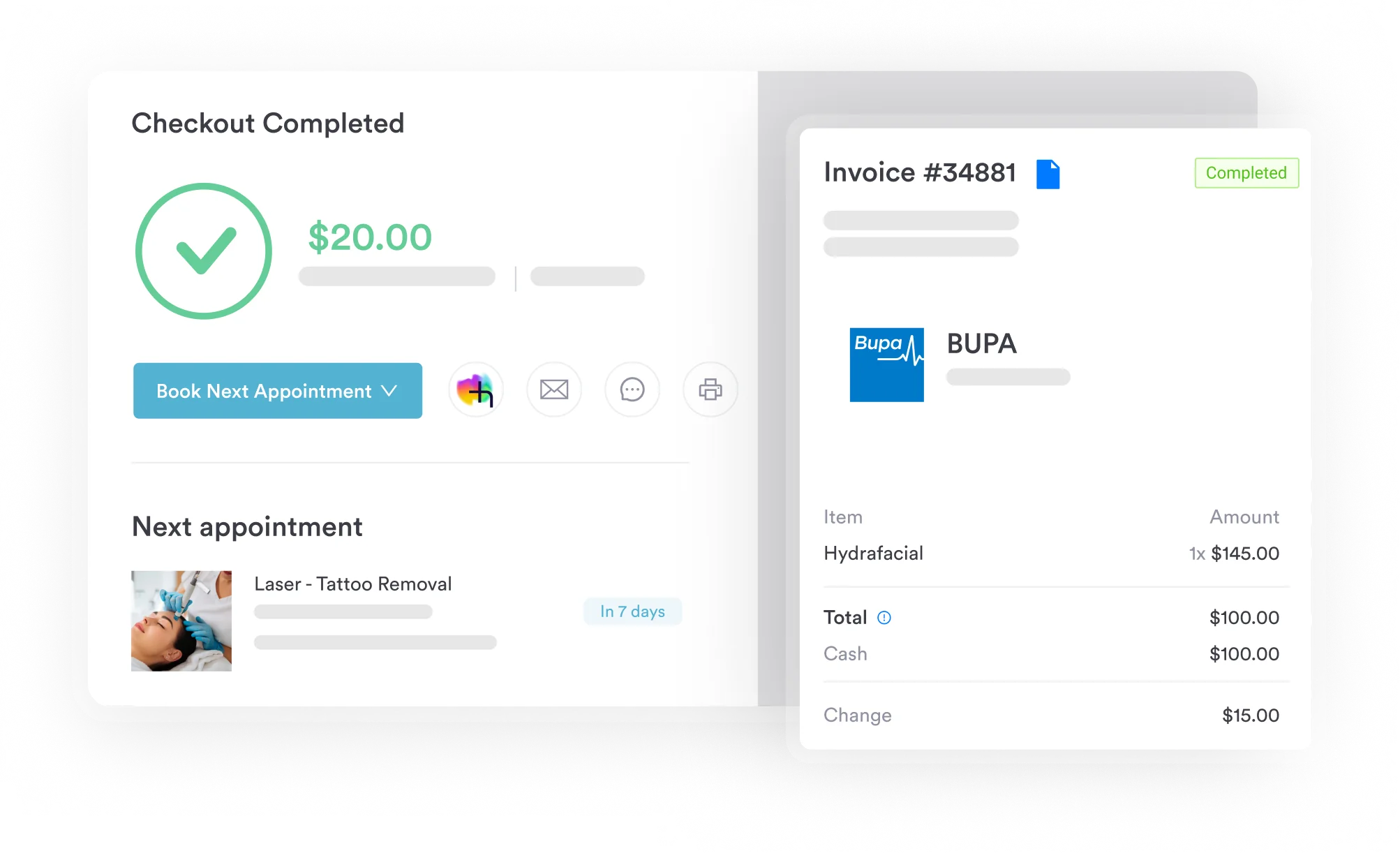

Pabau’s claims management software works with Claim.MD for eligibility checks, claim submission, and ERA remittance. Your coding team spends less time chasing denials and more time on documentation quality.

F03.90 is a code for what the chart leaves out. It fits confirmed dementia with no named cause, no stage, and no documented disturbance. Once the provider documents any of those, a more specific code takes over.
Read the whole record, not just the problem list, before you settle on F03.90. Where the record conflicts, query the provider. Where it is simply silent, the Index default stands and the claim can go.
Pabau ties Claim.MD eligibility checks, claim submission, and ERA tracking to the patient record, so denial follow-up starts from the claim itself. Book a demo to see how Pabau supports dementia billing from eligibility check to paid claim.

Documenting the cognitive testing behind the diagnosis? CPT code 96125 explains how standardized cognitive performance testing is billed.
Looking for guidance on managing dementia-related billing compliance? Medical billing compliance covers the documentation and payer rules that protect your practice from audit exposure.
Trying to improve claim acceptance rates across your practice? Insurance eligibility verification explains how pre-visit checks reduce denials tied to coverage and diagnosis mismatches.
ICD-10 Code F03.90 is the billable diagnosis code for unspecified dementia, unspecified severity, without behavioral disturbance, psychotic disturbance, mood disturbance, and anxiety. It applies when a physician has confirmed a dementia diagnosis but has not established the specific etiology or stage, and no disturbance is documented.
Use F03.90 when the provider’s documentation shows no behavioral, psychotic, mood, or anxiety disturbance associated with the dementia. F03.91 covers behavioral disturbance, but it is a non-billable subcategory. Code agitation or combativeness to F03.911 and other behavioral disturbance to F03.918. Wandering takes the additional code Z91.83.
Yes, F03.90 can be the primary diagnosis when dementia is the main reason for the encounter. However, some Medicare Administrative Contractors and commercial payers restrict unspecified codes as primary diagnoses for specific service types. Verify the applicable LCD for the MAC jurisdiction, and keep supporting cognitive test documentation in the chart before submitting F03.90 as the primary code.
No official rule sets a checklist, but three points support the code. The note should confirm a dementia diagnosis rather than symptoms, document no disturbance, and give no severity stage. When the note documents dementia and mentions no disturbance, the ICD-10-CM Index defaults to F03.90. A query is needed only when the record conflicts.