



CCSD code G5100: Bypass of duodenum billing guide
CCSD code G5100 bills a bypass that leaves the duodenum in place CCSD code G5100...

Last Updated: Oct 16, 2026
CPT Code 96125 is the billing code for standardized cognitive performance testing, charged per hour of a qualified health care professional’s time. That hour covers face-to-face test administration, scoring, interpretation, and the written report. Medicare paid roughly $102.87 per unit nationally in 2026, and the rate is identical in an office and in a hospital outpatient department. Physicians, neuropsychologists, speech-language pathologists, and occupational therapists can all report it, subject to payer credentialing rules.
What follows is the official descriptor, the 2026 rate, and its RVU components. It then covers provider eligibility, qualifying instruments, and the unit thresholds for partial hours. It closes with how 96125 differs from 96116, 96130, and 96132.

CPT Code 96125 covers standardized cognitive performance testing, billed per hour of professional time across administration, scoring, and interpretation.
Medicare paid about $102.87 per unit nationally in 2026, with no difference between facility and non-facility settings.
Eligible providers include physicians, neuropsychologists, speech-language pathologists, and occupational therapists, each subject to payer supervision rules.
One unit needs more than 30 minutes of documented professional time, and a second unit needs more than 90.
Pabau links session time logs, clinical notes, and claim submission in one workflow, reducing the reconciliation errors time-based codes invite.
The AMA defines 96125 as standardized cognitive performance testing (e.g., Ross Information Processing Assessment) per hour of a qualified health care professional’s time. That hour covers both face-to-face time administering tests to the patient and time interpreting these test results and preparing the report.
The billing details coders need up front are below.
Medicare reimburses 96125 under the Physician Fee Schedule at roughly $102.87 per unit nationally in 2026. The place of service does not change that figure. CY2026 assigns 96125 the same practice expense RVUs in a facility as in a non-facility setting. There is no office premium and no facility discount to plan around.
CY2026 carries two conversion factors. Clinicians who qualify as advanced alternative payment model participants are paid at $33.5675, which puts 96125 nearer $103.39. Geographic practice cost indices then adjust the figure by locality. Check the CMS lookup for your MAC region before you quote a patient or sign a payer contract.
Practice management software like Pabau submits 96125 claims through its Claim.MD clearinghouse integration, which reaches thousands of US payers. Real-time eligibility checks run before the encounter, so your team knows the expected reimbursement while the patient is still in the room.
The descriptor specifies “a qualified health care professional”, which the AMA and CMS read as covering several provider types. Payer credentialing and supervision requirements are not uniform, so verify your MAC’s local coverage determination (LCD) before billing.
Incident-to rules apply in outpatient settings when a non-physician provider bills under a supervising physician’s NPI. The supervising physician must be present in the suite, though not in the room, and must have initiated the plan of care. Document that arrangement explicitly. A missing credential or supervision note is one of the top reasons 96125 claims fail on audit.
The code requires a standardized instrument. Payer LCDs rather than the AMA decide which specific tools qualify, so confirm the accepted list with your MAC before billing. The instruments accepted most consistently across payers are below.
Informal screening questions, provider-designed checklists, and non-standardized observational tools do not qualify. Reaching for one of those is the fastest route to a 96125 denial. Practices that also report ADHD screening CPT codes should note that developmental instruments used in ADHD assessment usually fall under 96112 and 96113 instead.
96125 is billed per hour of professional time, and the descriptor covers interpretation and report writing as well as face-to-face testing. That second half is the most misread part of the code. The unit count turns on one number: total documented professional time.
Billable time components include:
Partial hour rules: a unit is attained once the midpoint of the hour is passed. One unit therefore needs more than 30 minutes of qualifying professional time, and a second unit needs more than 90. Time short of the next threshold cannot be rounded up into an extra unit. Record total professional time in minutes rather than hours, so the unit calculation is transparent to any payer review.
The thresholds, and the activities that feed them, sit together below.
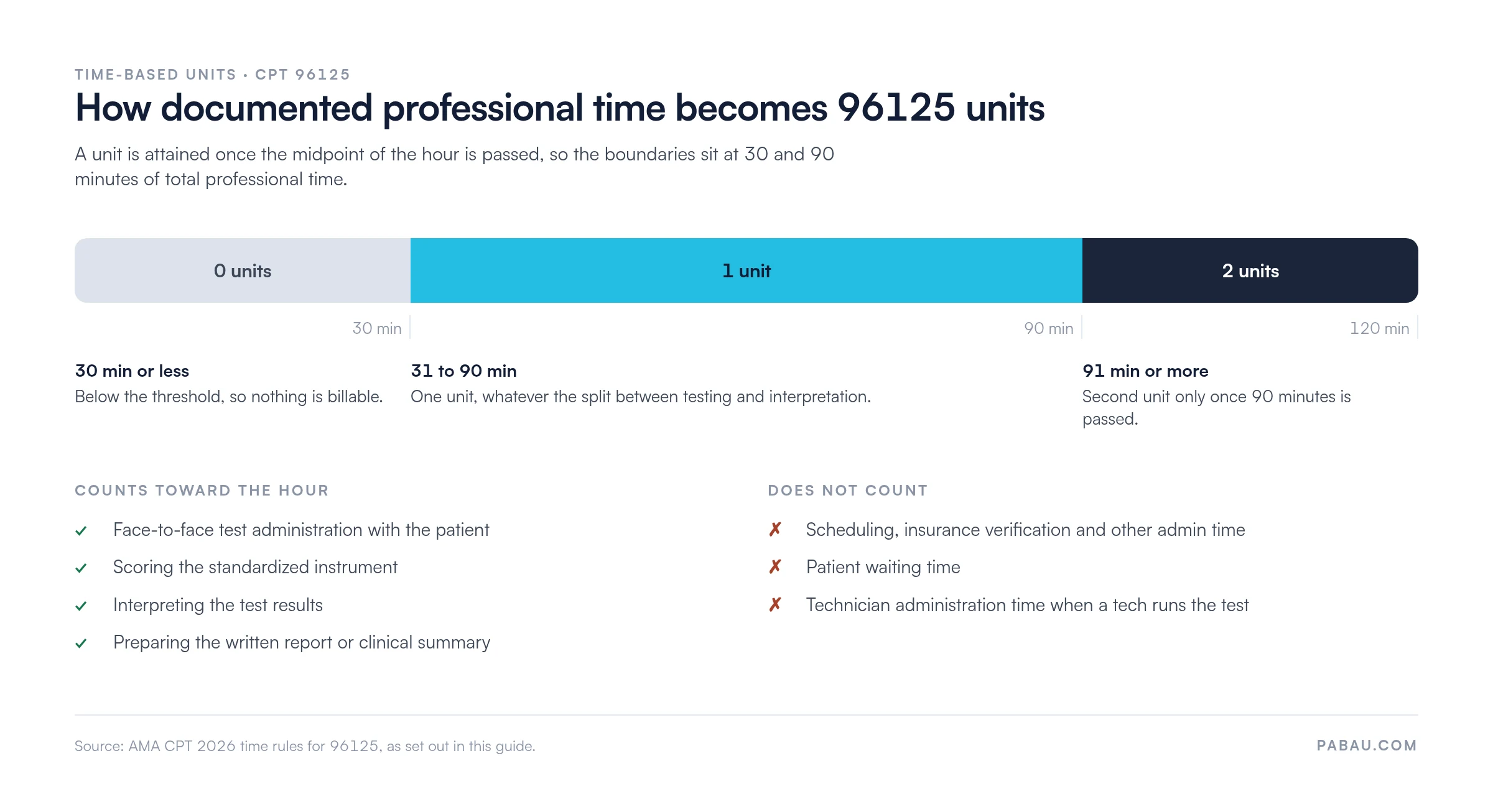
What does not count:
When a technician administers the test, only the supervising professional’s interpretation and report-writing time is billable under 96125. The technician’s face-to-face minutes do not count toward the hour.
Thin documentation is the primary cause of 96125 denials and the most common finding in MAC post-payment audits. Every submission needs these elements in the clinical record.
Treat that list as a pre-submission gate rather than a retrospective repair task. Claims that arrive without a named instrument or a time breakdown are flagged disproportionately often. Linking the clinical note directly to the claim at submission is the most reliable way to keep both on the record.
Document total professional time in minutes on every 96125 encounter note – not just hours. A note that says ‘1 hour of cognitive testing’ gives a payer auditor nothing to verify. A note that says ’35 minutes face-to-face administration, 30 minutes scoring and interpretation, total 65 minutes’ justifies one unit. It also shows the specificity that survives an audit.
Picking the wrong code from this family is the most expensive mistake in cognitive and neurobehavioral assessment. All four involve cognitive or behavioral evaluation, which is why they get confused. They differ on who administers the test, what it measures, and how the code is billed. The AAPC’s CPT code lookup carries the full descriptors; the operational differences are summarized below.
The bundling rule matters most: 96125 and 96116 cannot usually be billed on the same date of service by the same provider. CMS NCCI edits may apply, so check the current edit file before putting both codes on one claim.
Where 96130 turns out to be the correct code, the hours after the first bill separately. Its add-on 96131 covers each additional hour, attained once more than 30 minutes of that hour is spent.
Coverage for 96125 is not uniform. Medicare Part B covers the code when medical necessity is documented and the administering provider is enrolled. Your MAC’s LCD may add criteria on top of that. Those cover which diagnoses qualify, minimum instrument requirements, and how often the code may be billed in a coverage period.
Prior authorization is increasingly common for cognitive testing codes at commercial payers, and submitting without it is a fast route to denial. Checking eligibility and authorization in real time before the encounter catches the requirement while there is still room to act on it.
Telehealth eligibility for 96125 has widened since the COVID-19 public health emergency, but the rules keep moving as Congress renews the flexibilities. Medicare permits telehealth billing for 96125 in 2026 under certain conditions. Confirm current policy with your MAC before you bill it.
Confirm telehealth eligibility with each payer before the encounter. Then record the modality and the patient’s location in the clinical note.
The same errors turn up across 96125 audits and denial analyses, and each maps to a predictable rejection. Knowing the common denial codes in advance is the cheapest form of billing compliance available to a practice.
Build a pre-submission checklist that flags these six before the claim goes out. A system that catches a missing instrument name at the point the clinical note is completed saves far more than a reactive appeal process does.
Run a quarterly internal audit on all 96125 claims. Pull the last 20 and check each one for a named instrument, documented total time in minutes, a medical necessity statement, and provider credentials. This 30-minute audit catches the same errors your MAC’s post-payment review will find, except you find them first.
96125 creates one specific workflow problem. The session time log, the instrument name, the interpretation narrative, and the claim all have to agree with each other. In most practices those four things live in three different systems, and reconciling them is manual work nobody has time for.
Pabau, practice management software for health and wellness practices, holds them in one patient record. Session time is captured at the point of care. The clinical note carrying the instrument name and the interpretation narrative is attached to the encounter as it is written. Claims then go out through Pabau’s claims software for practices, with CPT and ICD-10 catalogues already loaded.
The audit trail linking time, note, and claim then builds itself. When a MAC asks which instrument was used and how the hour was spent, the answer is already in the record. Nobody has to assemble three exports first.

Pabau captures session time at the point of care and files it with the clinical note and the claim. Practices billing time-based CPT codes get one record to hand a payer instead of three.

96125 rewards practices that treat documentation as a clinical discipline rather than an administrative afterthought. Name the instrument, break the time down in minutes, state the medical necessity, and show the provider’s credentials. Do those four things and the code is straightforward to defend.
The rate leaves no room to absorb rework. At roughly $102.87 a unit, one appeal cycle costs more staff time than the claim is worth. The documentation has to be right at first submission.
Book a demo to see how Pabau ties session time, clinical notes, and 96125 claims together across a multi-provider practice.

Need to know what makes a claim pass first-pass review? Clean claim submission guide walks through the fields payers check before a claim is ever adjudicated.
Want the documentation rules behind the denial? Medical billing compliance sets out the record-keeping standards that time-based codes are audited against.
Chasing prior authorization for cognitive testing? Insurance eligibility verification explains how to catch authorization requirements before the appointment starts.
CPT Code 96125 is used for standardized cognitive performance testing, billed per hour of a qualified health care professional’s time. The hour covers both test administration and interpretation of results. Neuropsychologists, SLPs, and physicians use it to bill for formal cognitive assessments. Validated instruments such as the MoCA, MMSE, or RIPA qualify.
Eligible providers include physicians (MDs, DOs), neuropsychologists, speech-language pathologists, and occupational therapists, subject to payer-specific credentialing and supervision rules. Incident-to billing under a supervising physician is permitted in outpatient settings when the conditions for incident-to are met. Always verify your MAC’s LCD for provider eligibility criteria specific to your region.
The 2026 Medicare national average is about $102.87 per unit, and it is the same in a facility and a non-facility setting. CY2026 assigns 96125 identical practice expense RVUs in both places, so there is no office premium. Rates still vary by MAC locality, so verify your own figure with the CMS Physician Fee Schedule lookup.
Total billable time includes face-to-face test administration, scoring, interpretation, and report preparation. A unit is attained once the midpoint of the hour is passed, so one unit needs more than 30 minutes of qualifying professional time. A second unit needs more than 90 minutes. Time spent by a technician on administration (under supervision) counts only toward the technician’s role, not toward the supervising provider’s billable hour.



