ICD-10 code S61.201A: Open wound of left index finger without nail damage
ICD-10 code S61.201A covers a left index finger wound of unstated type ICD-10 co...

Last Updated: Oct 16, 2026
Billable Code Specific Code
M83.9 is the billable ICD-10-CM code for adult osteomalacia, unspecified. It applies when a physician documents softening of adult bone from defective mineralization but names no cause.
Coders reach for M83.9 when labs show abnormal bone metabolism and the note stops short of an etiology. A documented cause such as malabsorption or drug toxicity moves the claim to a more specific M83 subcode instead.
Let Pabau's smart automation suggest the right codes, reduce claim denials, and keep your practice compliant—effortlessly.
Automate repetitive tasks and focus on what matters most—your patients.
Reduce coding errors and ensure compliance with the latest regulations.
Clean claims, fewer denials, and faster reimbursements.
Powerful insights and reporting to help your practice thrive.
HIPAA compliant SOC 2 certified GDPR-compliant Trusted by 4,000+ clinics worldwide

M83.9 is a billable 2026 ICD-10-CM code for adult osteomalacia when the note documents no specific etiology.
The parent code M83 is non-billable, so always report a subcode such as M83.9 for reimbursement.
Documentation must include a physician diagnosis plus supporting labs (25-OH vitamin D, calcium, phosphate, ALP) to withstand payer audit.
Renal osteodystrophy (N25.0) and infantile or juvenile osteomalacia (E55.0) are Excludes1 conditions and never share a claim with M83.9.
Pabau’s claims management software surfaces code-edit conflicts before submission, so billers can request an addendum first.
ICD-10 code M83.9 is a specific, billable ICD-10-CM diagnosis code effective October 1, 2025 under the 2026 edition of ICD-10-CM. It maps to the official descriptor “Adult osteomalacia, unspecified”. The code sits in chapter M00-M99 (musculoskeletal system and connective tissue), block M80-M85 (disorders of bone density and structure), under category M83.
The CDC/NCHS ICD-10-CM web tool confirms M83.9 as a valid, reimbursable code in the current fiscal year. Codes and guidelines update on the CMS fiscal year cycle, so verify against the annual tabular list each October. Check the CMS ICD-10 codes page for the official 2026 edition tabular files.
Adult osteomalacia is a metabolic bone disease characterized by defective mineralization of newly formed bone matrix (osteoid). The result is soft, weakened bone in skeletally mature patients. Osteoporosis involves normal mineralization but reduced bone mass, whereas in osteomalacia the matrix forms and calcification fails.
The most common driver in US adults is vitamin D deficiency. Low vitamin D impairs calcium absorption from the gut and weakens the calcidiol and calcitriol signaling that mineralizes osteoid. Practices see osteomalacia most often in patients with malabsorption syndromes, limited sun exposure, or chronic kidney disease.
Bone pain (especially in the spine, pelvis, and legs), proximal muscle weakness, and an antalgic gait are the hallmark presentation. Pseudofractures (Looser zones) visible on plain radiographs are pathognomonic.
Labs typically show low serum 25-OH vitamin D, low or normal calcium, elevated alkaline phosphatase (ALP), and low phosphate. These findings in the chart are what support medical necessity when M83.9 or a more specific M83 subcode is reported.
Flag charts where ALP is elevated without a corresponding ICD-10 diagnosis for bone disease. Unexplained elevated ALP in an adult can point to osteomalacia. Getting the physician to document the diagnosis before you bill stops the claim returning as ‘unspecified condition, medical necessity not established.’
M83 is the non-billable parent category for all adult osteomalacia codes in ICD-10-CM. The parent cannot be submitted for reimbursement on its own, and payers reject it. Always report a specific subcode. The table below maps the full M83 family, and the wider ICD-10-CM code archive covers the neighboring categories.
Use M83.9 only after confirming that neither the clinical note nor the lab workup supports a more specific subcode. The ICD-10-CM Official Guidelines require the most specific code the documentation supports. If the physician has documented malabsorption as the underlying cause, M83.2 is correct and M83.9 is not.
The map below runs that decision from the documentation side, and marks the two conditions excluded from M83 outright.
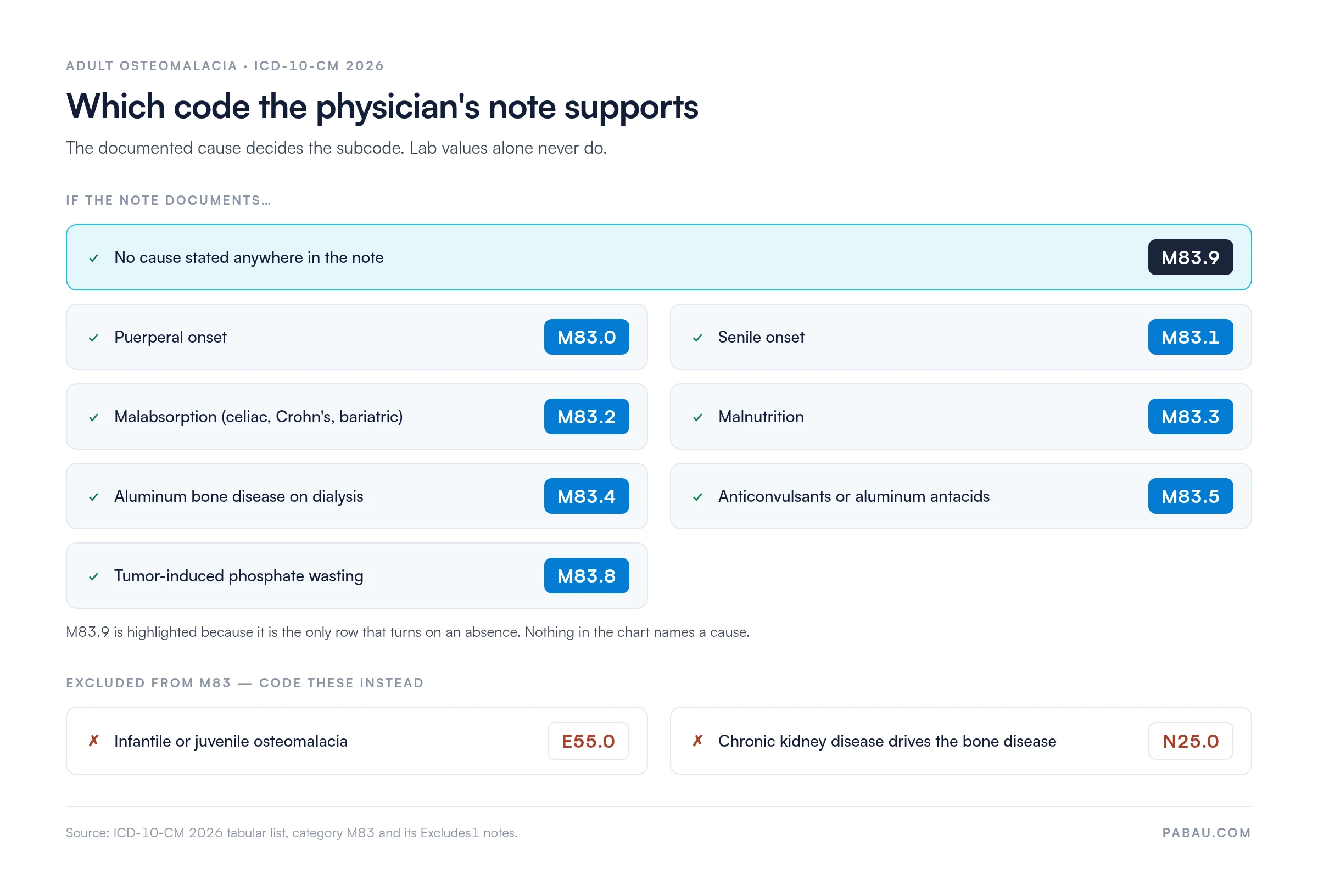
The ICD-10-CM Official Guidelines for Coding and Reporting govern the sequencing and use of M83.9. The Centers for Medicare and Medicaid Services (CMS) and the National Center for Health Statistics (NCHS) publish them each year. The core principle: Assign ICD-10 code M83.9 only when the physician documents adult osteomalacia without further specifying the cause.
M83.9 carries important coding directives that affect claim submission. Misreading these notes is the most common source of denials for this code.
Submitting a clean claim for M83.9 requires that these directives are satisfied before the claim leaves the practice. A single misapplied Excludes1 note returns as a CO-4 or CO-11 denial. Pabau, a practice management platform with built-in claims management software, surfaces code-edit conflicts at the encounter level. Billers can fix them before the claim goes out.
Medical necessity for M83.9 rests entirely on what the physician documents. Payers audit unspecified codes more often than specific ones, so the chart needs to show both the diagnosis and the supporting evidence. The following elements should appear in the clinical note before M83.9 is assigned.
Practices with a high volume of metabolic bone disease encounters benefit from structured documentation templates. The template prompts the provider for each element above while the note is still open. The AAPC ICD-10-CM code reference lists documentation tips and commonly billed-with codes for M83.9.
When M83.9 is the principal diagnosis on an inpatient claim, it groups under Medicare Severity Diagnosis Related Groups (MS-DRGs) in the musculoskeletal system. Knowing which DRG the claim lands in lets the billing team anticipate reimbursement before adjudication.
In outpatient settings, M83.9 submitted on a CMS-1500 or 837P claim is subject to medical necessity review under applicable Local Coverage Determinations (LCDs). Medicare requires documented clinical evidence of osteomalacia. The code alone does not guarantee reimbursement.
Medicaid policies vary by state. Reimbursement for associated services depends on the payer’s LCD for those CPT codes. Bone density scans, vitamin D lab panels, and IV bisphosphonate infusions all turn on whether M83.9 is listed as a covered diagnosis. A more specific M83 subcode may be covered where M83.9 is not.
A clearinghouse check before submission is the cheapest place to catch an Excludes conflict. Validating the 837P against payer edits costs nothing, while a denied claim costs the practice a rework cycle.
The ICD-10-CM alphabetic index routes several clinical and lay terms to M83.9. Knowing these alternate entry points helps coders confirm the code when a physician note uses non-standard terminology.
The qualifier “NOS” (not otherwise specified) in the alphabetic index routes to the unspecified subcode by convention. Coders who see “osteomalacia NOS” in a physician note should still query the physician. Supporting documentation may warrant a more specific M83 subcode.
The WHO ICD-10 browser shows the international parent classification from which ICD-10-CM M83.9 is derived. The US clinical modification adds the subcode detail the international version does not carry.
Several ICD-10 and CPT codes routinely appear on the same claim as ICD-10 code M83.9. The table below reflects common co-submission patterns; cross-reference the specific payer LCD before assuming coverage.
The most frequent coding errors around M83.9 involve confusing it with osteoporosis codes (M80/M81), vitamin D deficiency (E55.9), and renal osteodystrophy (N25.0). Each represents a distinct pathophysiology with different coding conventions. The decision table below provides the clinical documentation signals that determine which code applies.
The osteoporosis vs. osteomalacia distinction trips up coders because both conditions involve bone fragility and both can present with fractures. The critical difference: Osteoporosis bones have normal mineral content but low bone mass. In osteomalacia the mineral content of newly formed matrix is abnormal.
When the physician’s note uses “osteoporosis” and the DEXA shows a T-score below -2.5, M80 or M81 applies. When the note uses “osteomalacia” and labs show elevated ALP with low vitamin D, M83.9 applies. Getting this decision wrong invites an ADR (Additional Development Request) letter from Medicare.
When a chart contains both low DEXA T-score and elevated ALP with low vitamin D, query the physician before coding. Some patients have concurrent osteoporosis and osteomalacia requiring both M80/M81 and M83.9. Code both only when the physician explicitly documents both conditions. Never infer dual diagnoses from lab values alone.
The usual sequence runs backwards. The claim goes out with M83.9, the remittance comes back queried, and the biller chases an addendum weeks after the visit. By then the physician is reconstructing an encounter from memory.
Pabau, our practice management platform, keeps that check at the front. Charting, coding, and claim submission share one patient record. The code edit therefore runs against the note while the encounter is still open, so the biller sees the query before the claim leaves.
For a metabolic bone disease caseload that means fewer M83.9 claims going out on a note that could have supported M83.2 or M83.5. The practice bills the specific code the first time, and the documentation prompt does the querying instead of the payer.

Pabau’s integrated claims management flags code-edit conflicts before submission, tracks remittance outcomes, and keeps your metabolic bone disease billing compliant across payers.

ICD-10 code M83.9 is straightforward to assign when documentation states adult osteomalacia and names no cause. The risk sits in two places. The first is failing to query for a more specific M83 subcode when the chart supports one.
The second is misapplying the Excludes notes when renal osteodystrophy or infantile osteomalacia sits in the differential. Both are documentation problems before they are billing problems.
Practices can reduce M83.9 denial rates by building lab-documentation prompts into the encounter workflow. Running pre-submission code edits through the clearinghouse catches the rest. To see how a code edit reaches a biller before the claim goes out, book a demo with the Pabau team.

Need guidance on submitting ICD-10 claims electronically? Medical billing compliance essentials covers the documentation and submission standards that keep diagnostic code claims audit-ready.
Wondering how denial codes affect your M83.9 remittances? Denial codes in medical billing explains CARC reason codes and how to respond when a musculoskeletal claim is adjusted.
Looking for a broader overview of the claims submission cycle? Superbill documentation guide walks through how superbill data feeds into 837P claim generation for outpatient encounters.
ICD-10 code M83.9 is the billable ICD-10-CM diagnosis code for adult osteomalacia, unspecified. It applies when a physician documents bone softening from defective mineralization in an adult but names no underlying cause.
Yes. M83.9 is a specific, billable ICD-10-CM code valid for reimbursement purposes as of the 2026 edition (effective October 1, 2025). The parent code M83 without a subcode is non-billable and cannot be submitted on a claim.
Use M83.9 only when the physician documents osteomalacia without identifying an etiology. Use M83.2 for documented malabsorption, M83.3 for malnutrition, and M83.5 for drug causation. ICD-10-CM guidelines require the most specific code that documentation supports.
Osteomalacia (M83.9) involves defective bone mineralization, where the osteoid matrix fails to calcify. Osteoporosis (M80/M81) involves normal mineralization but reduced bone mass. They are distinct diagnoses and are not coded interchangeably. A DEXA T-score alone does not establish either diagnosis without a physician statement.
Infantile and juvenile osteomalacia (E55.0) is an Excludes1 condition and cannot be coded with M83.9 for the same encounter. Renal osteodystrophy (N25.0) is also an Excludes1 condition. Report N25.0 instead of M83.9 when chronic kidney disease drives the bone pathology.
Common co-submissions include CPT 77080 (DEXA bone density scan), 82306 (25-OH vitamin D lab), 84075 (alkaline phosphatase), and 83970 (PTH assay). Secondary ICD-10 codes E55.9 (vitamin D deficiency) and E58 (dietary calcium deficiency) are added when those conditions are co-documented.