ICD-10 Code Z86.73: Personal history of TIA
ICD-10 Code Z86.73: Definition, descriptor, and code hierarchy ICD-10 Code Z86.7...

Last Updated: Nov 20, 2026
Billable Code Specific Code
E53.8 is the billable ICD-10-CM code for deficiency of other specified B group vitamins. It covers a documented deficiency of biotin (B7) or pantothenic acid (B5). It also covers vitamin B12 (cyanocobalamin) and folate or folic acid deficiency when no anemia is documented.
Riboflavin (E53.0) and pyridoxine (E53.1) deficiencies have their own codes. Once the provider documents B12 deficiency anemia, the claim takes a D51 code instead, and folate deficiency anemia takes D52.
Let Pabau's smart automation suggest the right codes, reduce claim denials, and keep your practice compliant—effortlessly.
Automate repetitive tasks and focus on what matters most—your patients.
Reduce coding errors and ensure compliance with the latest regulations.
Clean claims, fewer denials, and faster reimbursements.
Powerful insights and reporting to help your practice thrive.
HIPAA compliant SOC 2 certified GDPR-compliant Trusted by 4,000+ clinics worldwide

E53.8 covers named B-vitamin deficiencies without a code of their own, such as biotin (B7) and pantothenic acid (B5).
Vitamin B12 or folate deficiency without anemia also codes to E53.8, because both are listed inclusion terms.
Once anemia is documented, B12 deficiency anemia moves to D51.- and folate deficiency anemia moves to D52.-.
Documentation must name the vitamin and include a dated lab value with its reference range to support medical necessity.
In Pabau, our practice management platform, US claims carry the diagnosis and procedure codes to payers through Claim.MD, with ERA remittances tracked.
ICD-10 code E53.8 is the billable ICD-10-CM code for “Deficiency of other specified B group vitamins.”
Its inclusion terms in the FY2027 ICD-10-CM tabular list are biotin, cyanocobalamin, vitamin B12, folate, folic acid and pantothenic acid deficiency. It sits in Chapter 4 (Endocrine, nutritional and metabolic diseases), under category E53.
“Other specified” means the provider has named the vitamin, and that vitamin has no dedicated E53 code. It doesn’t work as a catch-all for any B-vitamin problem. Without the vitamin named in the note, E53.8 behaves like an unspecified code, and payers query it.
E53.8 is a long-standing valid code. Check it against the current-year tabular list each October in the CDC’s ICD-10-CM browser. A new child code would replace it for that vitamin.
The rule turns on two questions. Which vitamin did the provider name, and is anemia documented? The table walks each common finding to its code.
Laid out side by side, the pattern is easy to remember. The named vitamin picks the code for most findings, and the anemia diagnosis picks it for B12 and folate.
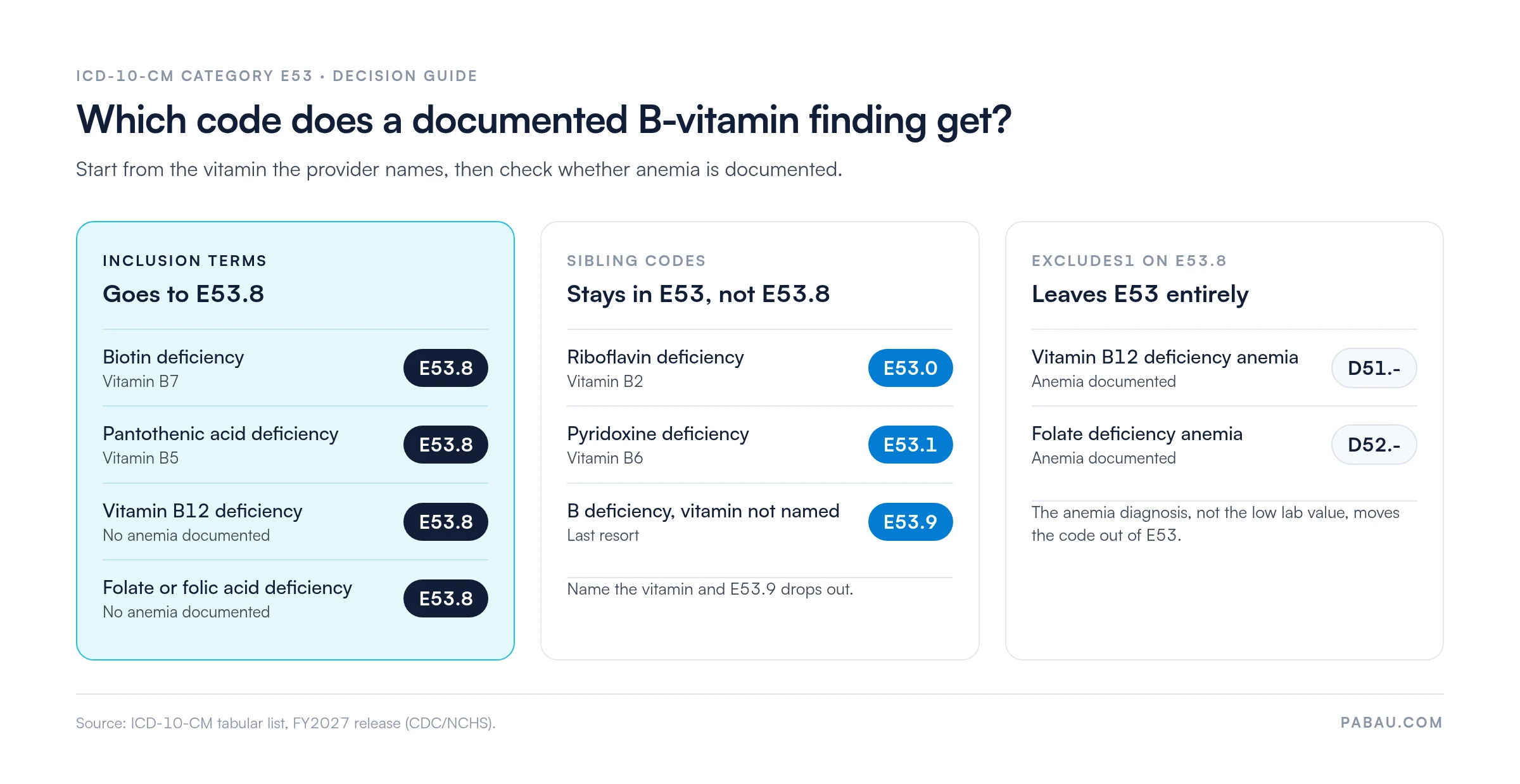
The notes that matter sit on E53.8 itself. One more sits on its parent category: sequelae of vitamin B deficiency go to E64.8, not E53.
The B12 split is where most coding errors start. A low B12 result with no anemia stays on E53.8. Once the provider documents B12 deficiency anemia, the claim takes the matching D51 child code, such as D51.0 for pernicious anemia.
Folate follows the same logic with a stricter note. Folate deficiency anemia is an Excludes1 on E53.8, so the two codes never appear together.
The E53 category runs from E53.0 to E53.9, and a wrong sibling is a common E53.8 error. The AAPC’s ICD-10-CM lookup shows each E53 code with its notes, which helps as a double-check before submission.
Treat E53.9 as a last resort. Payers often request records for unspecified deficiency codes, because the code alone doesn’t show medical necessity. Ask the provider to name the vitamin, then use E53.0, E53.1 or E53.8 as it fits. Keep E53.9 for notes that name no vitamin at all.
For E53.8 to hold up under payer review, the note has to do two things. It names the deficient vitamin, and it shows objective evidence of the deficiency.
Phrases like “nutritional deficiency” or “low B vitamins” don’t meet the “other specified” standard. Clean claim submission starts with the provider’s note, not the billing software.
Per CMS ICD-10-CM coding resources, the ICD-10-CM Official Guidelines ask for the code that reflects the condition to the highest degree of certainty. For E53.8, that means naming the vitamin rather than defaulting to E53.9.
Run a documentation audit on E53.8 claims every quarter. Pull denied claims and check whether each note names the vitamin and includes a lab value. If more than 20% lack the vitamin name, add a structured prompt to your EHR’s deficiency note template.
E53.8 can be the principal diagnosis or a secondary code, depending on why the patient came in.
The ICD-10-CM Official Guidelines (Section II) allow a deficiency code as principal when the deficiency is the chief reason for the visit. Getting this sequencing wrong ripples through the medical billing workflow at the DRG and RVU level.
When an underlying condition causes the deficiency, check whether the payer’s LCD wants that condition listed first. Some LCDs for infusion or supplementation services set the sequence explicitly, so verify the policy before you submit.
The CPT codes paired with E53.8 depend on the encounter: lab work, an office visit, nutrition counseling or IV supplementation. Pabau sends US claims through Claim.MD, our clearinghouse integration, with eligibility checks and ERA remittances.
The Claim.MD clearinghouse guide explains how a claim travels from the practice to the payer. A CPT that doesn’t fit the E53.8 diagnosis is a fast route to a denial.
A superbill template that lists E53.8 beside the lab codes ordered in the same visit cuts the chance of a mismatch. In Pabau’s claims management software, the practice records the diagnosis and procedure codes on the claim and submits it electronically.
Medicare coverage for services billed with E53.8 falls under Local Coverage Determinations (LCDs) and National Coverage Determinations (NCDs).
No single NCD covers all nutritional deficiency testing. Coverage depends on the service, the MAC jurisdiction and medical necessity.
When in doubt, check the LCD for your MAC jurisdiction via the CMS ICD-10 codes page. LCD numbers and effective dates change, and citing a retired LCD in an appeal is an avoidable error.
E53.8 denials repeat in predictable ways. Knowing the Claim Adjustment Reason Code (CARC) on each one lets your team fix the cause instead of resubmitting the same error. Keep a list of denial codes beside your work queue for nutritional deficiency claims.
Structured denial management processes that track E53.8 denials by reason, provider and payer show patterns faster than claim-by-claim review. One provider who leaves out lab values can drive most of the volume, so catch it in the audit, not the appeal.
Before you resubmit an E53.8 denial, check the CARC. CARC 50 means the payer judged the service not medically necessary. CARC 11 means the diagnosis is inconsistent with the procedure, so the CPT-ICD pairing failed. Fixing only the documentation won’t clear CARC 11. Correct the code pairing, then send a corrected claim rather than an appeal.
Most E53.8 rework starts with a detail someone could have caught at the front desk or the coding queue. Run these checks on every claim:
This worked scenario shows how a coder gets from a clinical encounter to E53.8. The provider’s wording in the assessment drives the code, and the coder’s job is to translate it into the most specific code available.
Subjective: A 38-year-old female presents with progressive fatigue over six weeks and diffuse hair thinning. She takes a high-dose raw egg white protein supplement daily. She recently read that raw avidin may impair biotin absorption. No prior nutritional workup.
Objective: Serum biotin 75 pg/mL (reference range 200-500 pg/mL). Hemoglobin 13.2 g/dL (normal). B12 level 490 pg/mL (normal). Mild seborrheic dermatitis noted perinasal.
Assessment: Biotin deficiency secondary to dietary avidin intake. No evidence of B12 deficiency, iron deficiency anemia or thyroid dysfunction.
Plan: Discontinue raw egg white supplementation. Initiate oral biotin 5,000 mcg daily. Recheck serum biotin in 8 weeks. Nutrition counseling referral placed.
The test for this note is simple. Could a payer reviewer find the named vitamin, an abnormal lab value with its date and the provider’s diagnosis? If yes, the claim is defensible. If any element is missing, it’s at risk before it reaches the clearinghouse.
ICD-11 places vitamin deficiencies in Chapter 5 (Endocrine, nutritional or metabolic diseases), under the undernutrition block, not under anemias.
Each vitamin there has its own code, with post-coordination options for severity and etiology. Confirm current entries in the WHO ICD-11 browser before you rely on a mapping.
Don’t use ICD-11 codes on US insurance claims. HIPAA-covered transactions still require ICD-10-CM. The ICD-11 mapping is useful for research and international reporting until CMS publishes a transition timeline.
Most E53.8 claims stall for the same reason. The lab value lives in one system, the note in another and the claim in a third. Someone has to stitch them together before submission.
US practices that switch on Labs in Pabau can order Quest tests from the patient record, and results import automatically. Labcorp results sync back too. The dated value then sits beside the note that names the vitamin.
From there, the practice records the diagnosis and procedure codes on the claim and submits it through Claim.MD. ERA remittances and denials come back to the same record, and prior authorization codes are tracked on the case. Your team can see which E53.8 claims were paid and which need a corrected resubmission.

Pabau keeps lab results, the provider’s note and the claim on one patient record. US claims go to payers through Claim.MD, and ERA remittances and denials come back to the same place.

E53.8 rewards a precise note. The provider names the vitamin, records a dated lab value and says whether anemia is present. Then the code choice is settled before the coder opens the chart.
The trade-off to remember is the B12 and folate split. E53.8 is correct for the deficiency alone, and a D51 or D52 code takes over once anemia is documented. Build that one question into your deficiency note template, and most E53.8 denials stop at the source.
Book a demo to see how Pabau keeps lab results, notes and E53.8 claims on one record.

Need to manage the full billing lifecycle for deficiency claims? What is revenue cycle management explains how practices close the distance between encounter and payment.
Seeing E53.8 rejections with CARC codes you don’t recognize? How the Claim.MD clearinghouse works shows how claims move from your practice to payers and back.
Billing the B12 level that sits behind an E53.8 claim? CPT code 82607 covers the vitamin B12 test, its fee schedule and its documentation.
Coding a vitamin D result in the same nutrition panel? ICD-10 code E55.9 explains when unspecified vitamin D deficiency applies.
Code the deficiency first, E53.8 when no anemia is documented. Add T38.3X5A, the adverse effect of oral hypoglycemic drugs, for the initial encounter. If anemia is documented, a D51 code replaces E53.8.
Start with O99.28-, endocrine, nutritional and metabolic diseases complicating pregnancy, with the character for the trimester. Then add E53.8 to name the folate deficiency. Chapter 15 codes take sequencing priority during pregnancy.
Both have their own categories outside E53. Thiamine deficiency codes to E51.-, which includes beriberi and Wernicke’s encephalopathy. Niacin deficiency, or pellagra, codes to E52.
No. A diagnosis code appears once per claim, even when the patient has two qualifying deficiencies, such as biotin and B5. Document both vitamins in the note, and E53.8 covers them together.