
Pabau Engage inbox

Pabau Engage is here: every patient conversation in one inbox.

Learn more
ICD-10-CM Code

ICD code D72.829 – Leukocytosis, unspecified

Billable Code Specific Code


Code Definition

D72.829 is the billable ICD-10-CM code for elevated white blood cell count, unspecified. Its inclusion terms are "Elevated leukocytes, unspecified" and "Leukocytosis, unspecified."

It sits in subcategory D72.82 (Elevated white blood cell count) and is valid for FY2027, October 1, 2026 to September 30, 2027. Use it when the provider documents a raised WBC count without naming the cell line or a specified elevation. A named subtype, such as lymphocytosis or bandemia, takes its own code instead.

Chapter
D50-D89 Diseases of the blood and blood-forming organs and certain disorders involving the immune mechanism
Category
D72 Other disorders of white blood cells
Group
D72.82 Elevated white blood cell count
Billable
Yes
Code also known as
elevated WBC, high white blood cell count, elevated leukocyte count, raised white cell count
Save time. Improve accuracy. Get paid faster.
Automate coding with Pabau

Let Pabau's smart automation suggest the right codes, reduce claim denials, and keep your practice compliant—effortlessly.

  • AI-powered code suggestions
  • Real-time compliance checks
  • Faster claims, fewer denials
Why practices choose Pabau
Save hours every week

Automate repetitive tasks and focus on what matters most—your patients.

Improve accuracy

Reduce coding errors and ensure compliance with the latest regulations.

Get paid faster

Clean claims, fewer denials, and faster reimbursements.

Grow with confidence

Powerful insights and reporting to help your practice thrive.

HIPAA compliant SOC 2 certified GDPR-compliant Trusted by 4,000+ clinics worldwide

Key takeaways

Key takeaways

D72.829 is the billable ICD-10-CM code for elevated white blood cell count, unspecified, and it’s valid for FY2027.

Use it for a raised WBC count with no specified cell line or cause, whether the note says “leukocytosis” or “elevated WBC.”

D72.828 is only for a specified elevation not classified elsewhere, while D72.820 to D72.825 cover named subtypes such as lymphocytosis and bandemia.

The provider must state the finding’s clinical significance, because a lab value alone doesn’t support the code.

Pabau handles eligibility checks, electronic claim submission and ERA remittances through its Claim.MD integration.

ICD-10 code D72.829 at a glance: Raised WBC, no named cell line

ICD-10 code D72.829 is the billable code for an elevated white blood cell count when the record names no cell line and no cause. It appears in the FY2027 ICD-10-CM code files CMS publishes for October 1, 2026 onward.

The table below gives the identifiers coders check most often.

FieldDetail
CodeD72.829
Official descriptorElevated white blood cell count, unspecified
Inclusion termsElevated leukocytes, unspecified; Leukocytosis, unspecified
Code typeBillable / specific, valid for claim submission
ICD-10-CM chapter3, Diseases of the blood and blood-forming organs and certain disorders involving the immune mechanism (D50-D89)
CategoryD72, Other disorders of white blood cells
SubcategoryD72.82, Elevated white blood cell count
Valid fiscal yearFY2027 (October 1, 2026 – September 30, 2027)
Applicable coding systemICD-10-CM (United States clinical modification)

Leukocytosis codes to D72.829 only when no cell line is named

Leukocytosis is a white blood cell (WBC) count above the laboratory’s reference range, usually found on a complete blood count (CBC). In adults, that range commonly tops out around 11,000 cells/µL.

In D72.829, “unspecified” means the record doesn’t name which cell line is raised or classify the elevation any further. The Alphabetic Index sends both “Leukocytosis” and “Elevated, white blood cell count” to D72.829. So the provider’s choice between those two phrases doesn’t change the code.

That makes the code a holding place for what the chart knows today. It isn’t the right choice when the note names a subtype with its own code, such as lymphocytosis (D72.820) or bandemia (D72.825).

It also drops out when a confirmed condition explains the raised count. Findings routinely associated with a confirmed disease aren’t coded separately (Section I.B.5).

Inclusions and exclusions: Where the D72 notes send other counts

These are the FY2027 tabular notes for D72.829 and the headings above it. Excludes1 notes on a parent code carry down to D72.829 as well.

Note typeConditionWhere the note sitsCorrect code
Inclusion termElevated leukocytes, unspecifiedD72.829D72.829
Inclusion termLeukocytosis, unspecifiedD72.829D72.829
Excludes1EosinophiliaD72.82D72.1-
Excludes1LeukemiaD72.8C91-C95
Excludes1BasophiliaD72D72.824
Excludes1Immunity disordersD72D80-D89
Excludes1Preleukemia (syndrome)D72D46.9
Excludes2NeutropeniaD72D70

Two notes catch coders out. The D72 category’s Excludes1 note lists basophilia and points it to D72.824, so a documented basophilia codes there and never to D72.829. The other is eosinophilia, because a raised eosinophil count goes to D72.1-, never to D72.82-.

Leukemoid reaction (D72.823) isn’t an Excludes1 note for D72.829. It’s a sibling code in D72.82, so documentation that names a leukemoid reaction simply codes there.

D72.829 vs D72.828: Specificity picks the code, not wording

The choice turns on how specific the documentation is about the cell line or the cause. Whether the provider wrote “leukocytosis” doesn’t decide it.

CodeOfficial descriptorWhen it appliesKey distinguisher
D72.820-D72.825Lymphocytosis (symptomatic), monocytosis (symptomatic), plasmacytosis, leukemoid reaction, basophilia, bandemiaThe note names the raised cell line or a leukemoid reactionA named subtype with its own code takes precedence
D72.828Other elevated white blood cell countA specified elevation that no other D72.82- code coversIndex entry “specified NEC,” for example nonleukemic myelosis
D72.829Elevated white blood cell count, unspecifiedA raised WBC count with no cell line or cause specifiedApplies whether the note says “leukocytosis,” “elevated WBC” or “high white count”
D72.819Decreased white blood cell count, unspecifiedA low WBC count (leukopenia), cause unspecifiedSits in D72.81, the opposite direction, so it’s never an alternative to D72.829
D72.10Eosinophilia, unspecifiedA raised eosinophil countExcluded from D72.82 (Excludes1), so raised eosinophils code here, not to D72.82-
D72.9Disorder of white blood cells, unspecifiedA WBC disorder with no direction documented, including abnormal leukocyte differential NOSUse only when neither a raised nor a lowered count is documented

Work down the table in order. If the note names a subtype, code the subtype. If it describes a specified elevation that no subtype code covers, D72.828 applies. If it describes a raised count and no more, D72.829 is correct. Query the provider when the differential points to a subtype the note doesn’t name.

The decision path below runs the same checks in the order a coder meets them, starting with the provider’s statement.
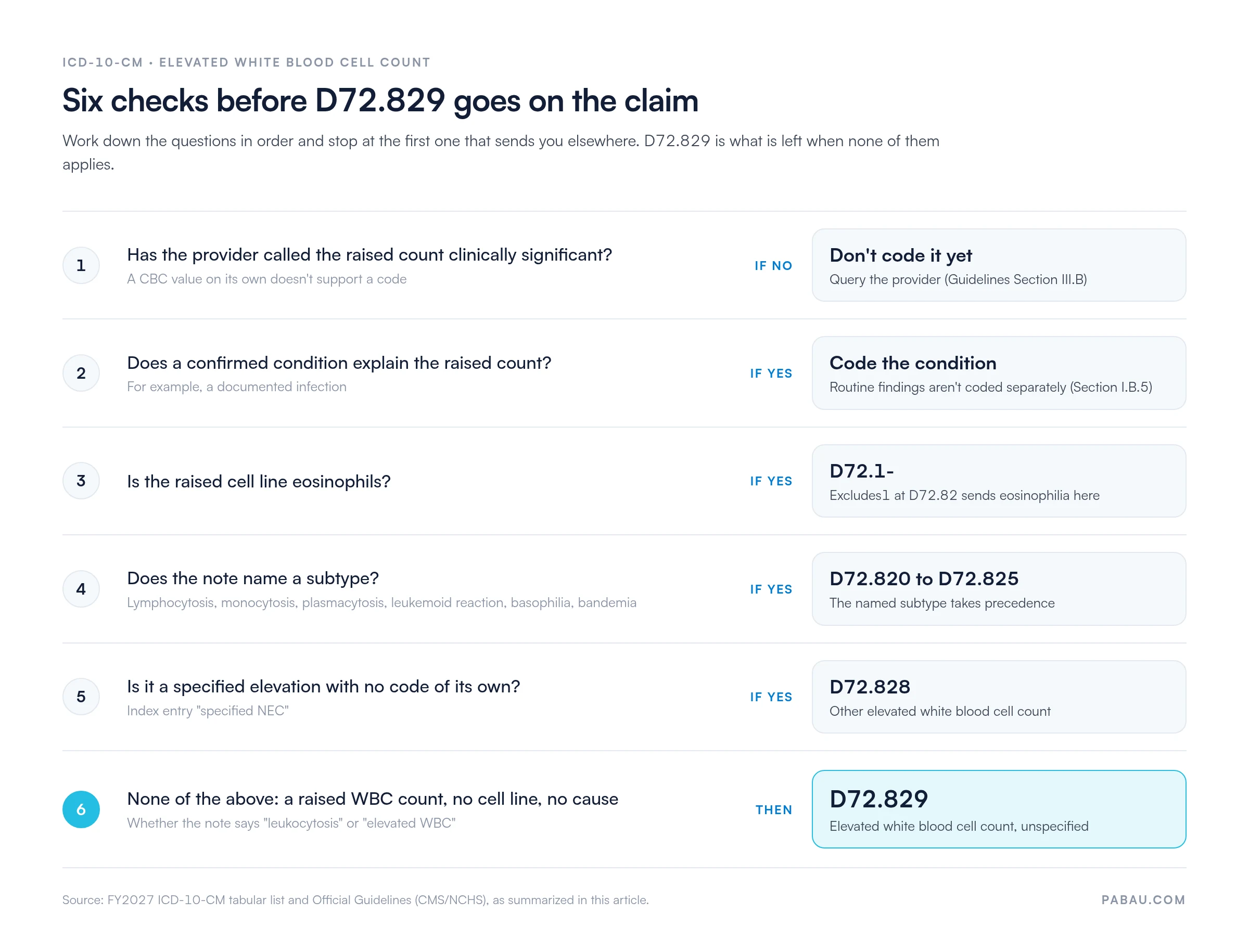
Six-step decision path for an elevated WBC count
Step 1 comes first because no code applies until the provider calls the count significant. Checks follow the FY2027 ICD-10-CM tabular list and Official Guidelines.

Three charts that support D72.829, and how to sequence each

All three notes below support D72.829. What changes between them is whether it’s listed first or second.

  • Scenario 1, abnormal CBC with workup ordered: A patient’s CBC shows a WBC of 13,500 cells/µL. The physician writes “elevated WBC, repeat CBC with differential,” and no cause is confirmed. D72.829 applies even though the note never says “leukocytosis.” List it first if the raised count is the focus of the visit.
  • Scenario 2, incidental finding on pre-operative labs: Pre-surgical bloodwork shows a raised WBC count. The surgeon notes “incidental leukocytosis, will monitor,” and surgery goes ahead. The condition that prompted surgery comes first, and D72.829 is a secondary code.
  • Scenario 3, follow-up for a known raised count: A patient returns to review a repeat CBC after an earlier raised result. The physician documents “leukocytosis, etiology under investigation.” D72.829 is first-listed because the raised count is the reason for the visit.

Sequencing note: Outpatient and physician-office coding follows Section IV of the guidelines, which uses the first-listed diagnosis. That’s the condition chiefly responsible for the visit. “Principal diagnosis” is the inpatient term from Section II. Once a cause is confirmed, code the cause, and drop D72.829 if the raised count is integral to it.

How a D72.829 claim moves from CBC to payment

D72.829 rarely travels alone. Its job is to justify a visit or a lab line, and the claim follows a predictable path for an outpatient encounter.

  1. The CBC results. The lab flags a WBC count above its reference range, and the result lands in the chart.
  2. The provider assesses it. The note names the raised count, says it matters and sets a plan, such as a repeat CBC with differential.
  3. The coder assigns the code. With no subtype or confirmed cause documented, D72.829 goes in box 21 of the CMS-1500 or its 837P equivalent.
  4. Each line points to it. The diagnosis pointer in box 24E links D72.829 to every line it supports, such as the visit or an in-office test.
  5. The payer runs its edits. Medicare checks lab lines against the Blood Counts NCD or a local LCD, while commercial plans apply their own policy.
  6. The remittance comes back. The 835 ERA shows the payment or a denial reason code, which tells your team what to fix.

Whoever bills the repeat test, it usually goes out as 85025 with a differential or 85027 without one. Make sure the lab order carries D72.829 too, or the lab’s own claim can stall on medical necessity.

Four things the note needs before D72.829 holds up

A lab value on its own doesn’t support D72.829. Abnormal findings are coded only when the provider indicates their clinical significance (Section III.B).

These four documentation elements support clean claim submission with D72.829:

  1. A documented raised WBC count: The CBC result, typically above 11,000 cells/µL in adults, appears in the record or is referenced in the note.
  2. A provider statement about the finding: The assessment names the raised count and shows it’s clinically significant. “Leukocytosis,” “elevated WBC” and similar wording all support D72.829, so the specific word isn’t required.
  3. No named subtype or confirmed cause: The note doesn’t name a cell line with its own code. No confirmed condition explains the elevation either, or that condition gets coded instead.
  4. A plan tied to the finding: Further workup, monitoring or treatment shows the finding shaped care. That supports medical necessity, which many payer policies look for.

HCC coding context: D72.829 isn’t a payment HCC in the CMS-HCC risk adjustment model. Mappings change, so confirm against the current one before relying on that. In risk-adjusted settings, still apply the MEAT criteria (Monitor, Evaluate, Assess, Treat) to show the finding was addressed. When documentation is ambiguous, follow AHIMA and ACDIS query practice rather than coding by inference.

Three guideline sections govern how D72.829 is used

Three parts of the FY2027 ICD-10-CM Official Guidelines for Coding and Reporting govern how D72.829 is assigned and sequenced. Sound ICD-10 billing compliance means applying all three consistently.

  • Section I.B.4-5, signs and symptoms: Signs and symptoms are acceptable codes when no related definitive diagnosis has been established. Findings routinely associated with a confirmed disease aren’t coded separately, so a raised count explained by a documented infection usually isn’t.
  • Section I.B.18, unspecified codes: Sign, symptom and unspecified codes have acceptable, even necessary, uses. Each encounter is coded to the level of certainty known, so D72.829 is accurate when no cell line is named.
  • Sections II and IV, sequencing: Inpatient coding selects a principal diagnosis (Section II). Outpatient and physician coding lists first the condition chiefly responsible for the visit (Section IV).

The CMS ICD-10 codes page publishes the annual coding guidelines as a free download. Check D72.829’s tabular notes each October, when the new code year takes effect.

Before you submit: A D72.829 checklist

Run through these six checks before the claim goes out. Each one heads off a denial covered further down.

  • The CBC result is in the chart or quoted in the note.
  • The provider’s assessment calls the raised count significant, in whatever words they use.
  • The differential, if one was run, doesn’t point to a subtype the note should name.
  • No confirmed diagnosis on this encounter explains the elevation.
  • D72.829 is listed first only when the raised count drove the visit.
  • The diagnosis pointer links D72.829 to each line it supports, and the lab order carries it as well.

Payers judge D72.829 by the service it supports

D72.829 is a billable terminal code, but payers don’t all treat it the same way. Submission requirements vary by payer type and jurisdiction.

Knowing the medical billing fundamentals matters here, because “unspecified” codes can draw closer documentation review.

  • Medicare: CMS has no National Coverage Determination (NCD) for D72.829 as a standalone diagnosis. Coverage for labs ordered for it follows the lab NCD, such as NCD 190.15 (Blood Counts), or a Local Coverage Determination (LCD). LCDs are issued by Medicare Administrative Contractors (MACs), so covered-diagnosis lists vary by jurisdiction.
  • Commercial payers: Check the Medicare LCD where the plan follows it, or the commercial payer’s own medical policy or covered-diagnosis list. Do it for the accompanying lab CPT codes before submission.
  • Prior authorization: D72.829 doesn’t trigger prior authorization on its own. Where it applies, prior authorization is linked to the procedure or service billed, so check each payer’s policy for specialty services ordered.

Pabau’s billing software connects to Claim.MD, so practices run eligibility checks and submit CMS-1500/837P claims electronically. ERA remittances come back the same way, so payments and denial reasons reach your team. Code selection stays with your coders.

Common D72.829 mistakes that end in denials

D72.829 denial patterns are predictable, and the same root causes appear across payer types. Sound denial management workflows catch most of them before submission.

Denial reasonRoot causeCorrective action
Unspecified code when a specific code is availableThe payer or auditor believes the record names a subtype, such as lymphocytosisCheck the note for a named cell line. If one is named, correct the code and resubmit. If none is, appeal with the provider’s assessment.
Insufficient documentationA lab value is present, but the note has no provider statement about its clinical significanceObtain a compliant provider addendum, then resubmit with it attached.
Code not supported for the billed serviceD72.829 isn’t on the covered list for the lab CPT code, under a Medicare NCD or LCD or the commercial payer’s policyCheck the policy. If D72.829 is listed, appeal and cite it. If not, query whether another documented diagnosis supports medical necessity.
Incorrect sequencingD72.829 is listed first when another condition was the main reason for the visitResubmit with the main reason for the visit as the first-listed diagnosis and D72.829 as a secondary code.
D72.828 reported for an unnamed elevationA raised count with no specified elevation was coded as D72.828Correct it to D72.829. D72.828 needs a specified elevation that isn’t classified elsewhere.

When appealing, attach the CBC result and the relevant part of the provider’s note. Show that no more specific code applied at that encounter. With Pabau’s claims tools for billers, ERA remittance data comes back through Claim.MD, so your team sees each denial reason against its claim.

Each denial also carries a claim adjustment reason code. Our guide to medical billing denial codes explains the common ones and how to respond to each.

Sibling codes in D72 that sit beside D72.829

D72.829 is one of several terminal codes in subcategories D72.81 and D72.82. Together they cover decreased and elevated WBC counts, with named subtypes for each direction.

CodeDescriptorNotes
D72.10Eosinophilia, unspecifiedExcluded from D72.82 by an Excludes1 note; raised eosinophils code here
D72.810LymphocytopeniaDecreased lymphocyte count, the opposite direction from D72.829
D72.818Other decreased white blood cell countSpecified decreases such as monocytopenia or plasmacytopenia
D72.819Decreased white blood cell count, unspecifiedIn D72.81, the opposite-direction subcategory; includes leukopenia
D72.820Lymphocytosis (symptomatic)Includes elevated lymphocytes; use when the lymphocyte rise is documented
D72.821Monocytosis (symptomatic)Raised monocyte count; Excludes1 infectious mononucleosis (B27.-)
D72.822PlasmacytosisRaised plasma cell count; needs specific documentation
D72.823Leukemoid reactionSibling code in D72.82, covering leukemoid reaction NOS and named cell-type forms
D72.824BasophiliaRaised basophil count; use when specifically documented
D72.825BandemiaBandemia without a diagnosis of specific infection; a confirmed infection codes to the infection
D72.828Other elevated white blood cell countOnly for a specified elevation not classified elsewhere, such as nonleukemic myelosis
D72.829Elevated white blood cell count, unspecifiedSubject of this article: a raised WBC count with no cell line or cause specified
D72.9Disorder of white blood cells, unspecifiedIncludes abnormal leukocyte differential NOS; use only when no direction is documented

The CDC/NCHS ICD-10-CM web tool lets coders browse the D72 tabular list by fiscal year. Use it to confirm descriptors, inclusion terms and exclusion notes against the current release.

How Pabau keeps D72.829 claims moving

Choosing between D72.829 and its siblings is the coder’s call. Getting the claim paid also depends on eligibility, clean submission and hearing quickly when a payer pushes back.

Pabau handles those steps through Claim.MD. Your team runs eligibility checks before the visit, then submits CMS-1500/837P claims electronically.
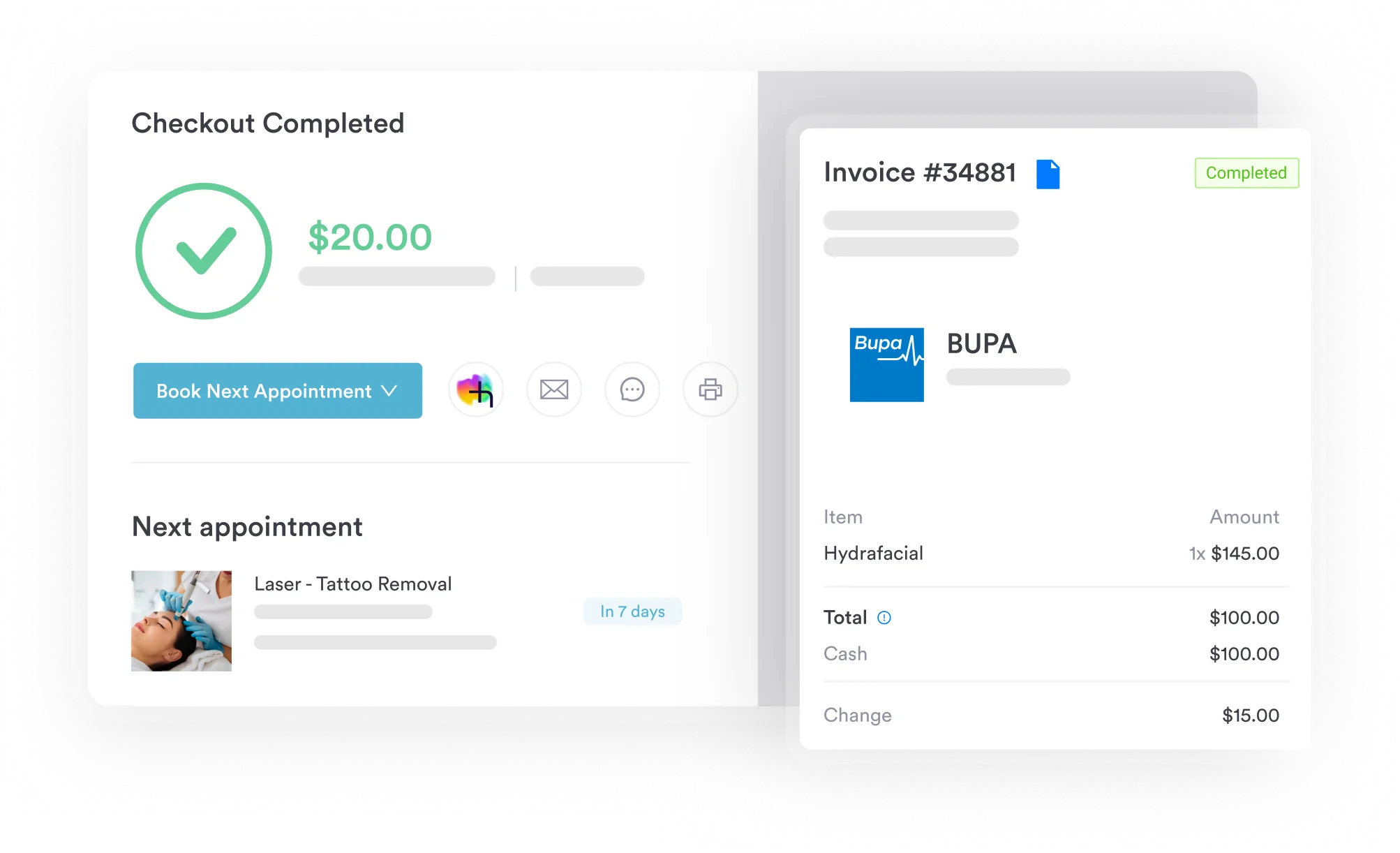
Pabau checkout screen beside a completed insurer invoice
Pabau shows the completed checkout beside the insurer invoice, so your billing team can match each D72.829 visit to what the payer was charged.

ERA remittances come back through Claim.MD, so payments and denial reasons sit against each claim. Your team can then decide what to correct and resubmit, without chasing paper remittances.

Manage D72.829 claims without the rework cycle

Pabau’s Claim.MD integration runs eligibility checks, submits CMS-1500/837P claims electronically and brings ERA remittances back to each claim. See how it fits your billing workflow.

Pabau claims management dashboard

Conclusion

Treat D72.829 as the code for what the chart knows today. A raised count with no named cell line and no confirmed cause belongs here, whatever word the provider chose.

The trade-off is that unspecified codes invite a second look. A clear statement of significance and a plan tied to the finding answer that look before a payer asks. Once a differential names a cell line, move to the subtype code at the next encounter.

Book a demo to see how Pabau runs eligibility checks, sends 837P claims and brings ERA remittances back to each D72.829 claim through Claim.MD.

Continue your research

Continue your research

Need a full picture of how clearinghouse submission works? Pabau’s Claim.MD clearinghouse guide walks through how electronic claims reach payers and how remittances come back.

Getting denials on lab-linked claims? Denial codes in medical billing explains the most common CARC denial codes and how to respond to each one.

Want to understand ERA remittance data? Electronic remittance advice explained covers how 835 ERA files carry denial reasons back to your practice management system.

Frequently asked questions

What was the ICD-9 code for leukocytosis?

ICD-9-CM used 288.60, Leukocytosis, unspecified. Claims have used ICD-10-CM since October 1, 2015, and D72.829 is its counterpart. Named elevations such as lymphocytosis had their own 288.6x codes, and they now map to the D72.82- subtypes.

How do you code steroid-induced leukocytosis?

Code D72.829 first, then T38.0X5- for the adverse effect of glucocorticoids, with the seventh character for the encounter. Section I.C.19.e.5.a puts the nature of the adverse effect ahead of the drug code. The provider has to link the raised count to the steroid.

Is leukocytosis in pregnancy coded to D72.829?

Not on its own. When a raised WBC count complicates a pregnancy, a code from O99.11- comes first, by trimester, and D72.829 follows to name the condition. Chapter 15 codes take sequencing priority under Section I.C.15.a.

Can you report D72.829 with sepsis?

Usually not. A raised WBC count is a routine finding in sepsis, so it isn’t coded separately once sepsis is confirmed (Section I.B.5). Bandemia follows the same logic, because D72.825 excludes a confirmed infection.

Does D72.829 need a CBC differential on file?

No. The code needs a documented raised count and a provider statement of significance. A differential still helps, because it shows which cell line is raised, and a named cell line moves the claim to its subtype code.


Avatar photo
Monika Lazarevska
Content Writer

Monika Lazarevska writes content for owners and healthcare professionals who want clear, no-fluff content that actually helps them run their practice better. With a background in storytelling and SEO, she knows how to make even the driest topics worth reading. Off the clock, you'll find her in a café somewhere in Europe, probably with a good book and an even better coffee.
×

