Professional development record
A professional development record is a structured log of a healthcare practition...

7
Last Updated: Oct 8, 2026

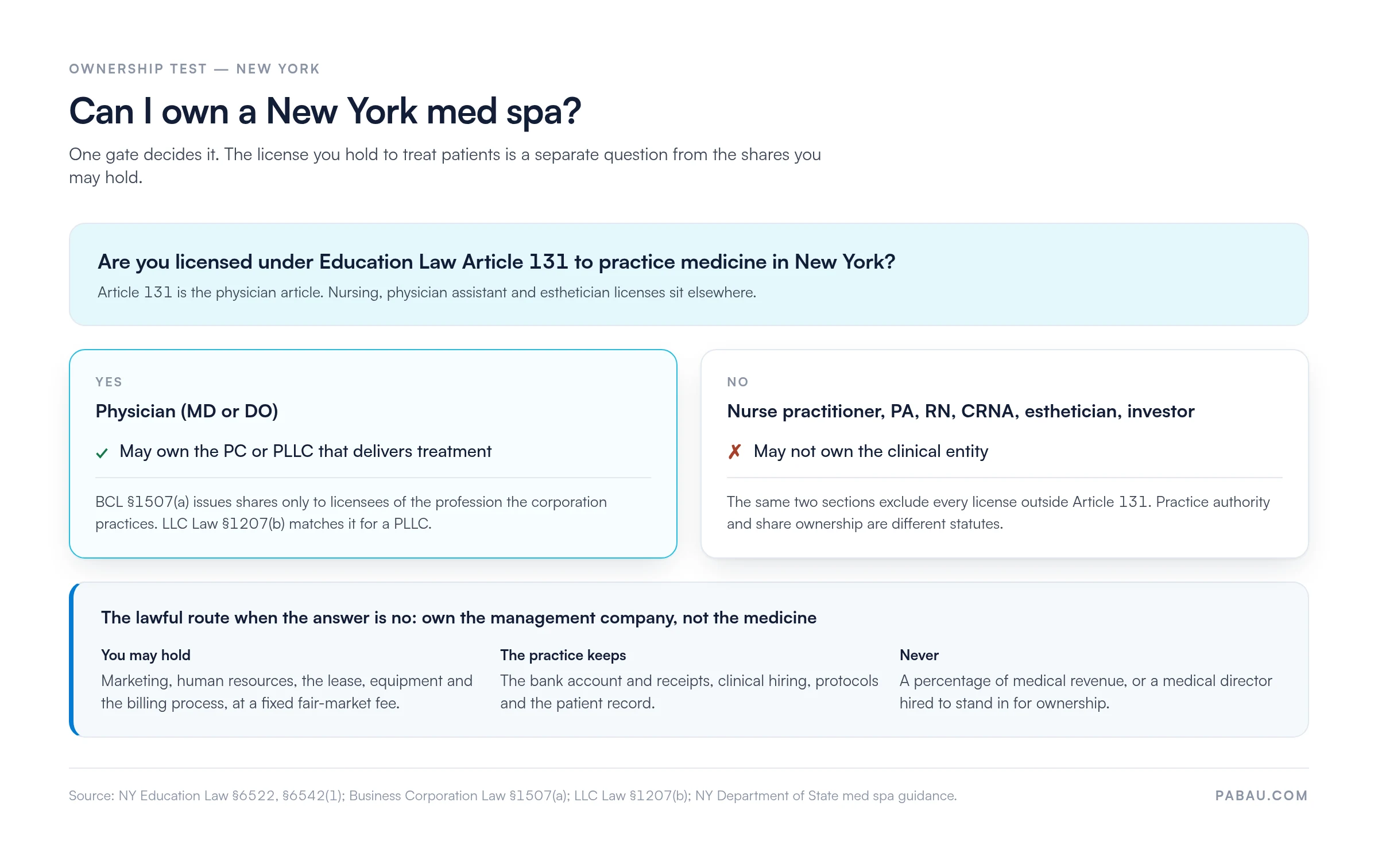
Only a physician licensed under Education Law Article 131 may own the New York entity that delivers med spa medicine.
Business Corporation Law §1507(a) and LLC Law §1207(b) restrict shares and memberships in a medical PC or PLLC to those physicians.
Scope is not shares: A nurse practitioner’s full practice authority at 3,600 hours governs treatment, not ownership.
Physician assistants, registered nurses, CRNAs, estheticians and outside investors are all barred from owning the clinical entity.
A non-licensee may own a management services organization at a fixed fair-market fee, never a percentage of medical revenue.
Hiring a medical director does not cure unlawful ownership, and unlicensed practice is a class E felony under Education Law §6512(1).
Who can own a med spa in New York? Only a physician licensed under Education Law Article 131 may own the entity that delivers medical treatments. For the physician who owns that entity, our comparison of medical spa systems covers injection charting and HIPAA compliance. Business Corporation Law §1507(a) and Limited Liability Company Law §1207(b) restrict the shares and memberships to physician licensees.
That one rule settles who can own a medical spa in New York for every other role. Nurse practitioners, physician assistants, registered nurses, CRNAs, estheticians and outside investors are all excluded from the clinical entity.
The confusion on this question comes from one place. Scope of practice and share ownership sit in different statutes, and many guides read them as one. Even the Department of State’s own consumer page says physician-only in one line and “physicians or nurse practitioners” in another.
Below, each license type gets a verdict, the statute behind it, and the lawful structure left when the answer is no.
Only a licensed physician may own the clinical entity in a New York med spa. Every other license type is limited to treating, directing or managing.
The table below carries a column most guides leave out. Ownership and the medical directorship are separate questions, and a nurse practitioner is the one role where the two answers differ.
| License type | May own the clinical entity | May serve as medical director | Statute or authority |
|---|---|---|---|
| Physician (MD or DO) | Yes | Yes | BCL §1507(a); LLC Law §1207(b); NY DOS |
| Nurse practitioner | No | Yes | LLC Law §1207(b); NY DOS |
| Physician assistant | No | No | Ed. Law §6542(1); BCL §1507(a); NY DOS |
| Registered nurse | No | No | BCL §1507(a); NY DOS |
| CRNA | No, by inference | No | Nursing licensure, not Article 131; NY DOS |
| Esthetician | No | No | DOS appearance enhancement licensure |
| Non-licensed owner or investor | No | No | BCL §1507(a) and §1508(a); LLC Law §1207(b) |
The directorship column comes from the Department of State, which names licensed physicians and nurse practitioners as the med spa medical directors. One New York health law firm goes further and states plainly that a physician assistant may not serve as medical director. No statute says so in those words, so treat that as a reading rather than a citation.
New York bars non-physician med spa ownership because owning the entity that delivers medicine counts as practicing medicine without a license.
Education Law §6521 defines the practice of medicine broadly. The definition covers diagnosing, treating, operating or prescribing for any human disease, pain, injury, deformity or physical condition. Neurotoxin injections, dermal fillers and most energy devices sit inside it.
Education Law §6522 then limits that practice to licensed persons. Education Law §6512(1) makes unlicensed practice a class E felony. The same subdivision reaches anyone who aids or abets an unlicensed person to practice a profession.
Those three sections are the whole answer on med spa ownership in New York. The corporate practice of medicine doctrine reads them together. A company that delivers medicine is practicing medicine, so the people holding it must be licensed to practice.
A New York med spa’s clinical entity must be a professional corporation or a professional limited liability company. A standard LLC cannot lawfully hold it.
That last point is worth sitting with, because most guides skip it. Business Corporation Law §1503(a) restricts a professional corporation to people authorized to render the service. LLC Law §1203(a) and §1207(b) do the same for a PLLC. A lay LLC offering medical services is unauthorized practice under §6512.
Here is the sequence for owning a med spa lawfully as the physician owner.
NYSED authorizes a professional limited liability partnership and a professional partnership on the same terms. Two of the law firms writing on this topic also list a registered LLP.
NYSED will not let a business corporation hire a licensee to deliver professional services at all. Entity choice and licensure run together, which is also why there is no single medical spa license to apply for in New York.
One health law firm puts formation at several weeks to several months. The same firm notes that a PLLC owner must publish a formation notice in a local paper. Neither figure comes from an agency, so plan around the sequence rather than the estimate.
Scope is not shares. A nurse practitioner’s full practice authority governs what they may do, not what they may own.
Education Law §6902(3)(b) is on the books, and it is generous. A nurse practitioner who has practiced more than 3,600 hours no longer needs physician collaboration, a written practice agreement or written practice protocols. That provision is in force until July 1, 2030, extended by Chapter 57 of the Laws of 2022.
Now read the entity statutes. Business Corporation Law §1507(a) issues shares only to individuals authorized to practice the profession the corporation practices. LLC Law §1207(b) says every member of a PLLC formed to provide medical services must be licensed under Article 131.
The scope statute and the entity statutes answer different questions. Scope of practice governs what you may do. The entity statutes govern what you may hold. So the honest answer is no. A nurse practitioner may not own the entity that delivers medicine-classed treatment.
That distinction is why the guidance on this question conflicts. The Department of State’s own consumer page contradicts itself inside a few paragraphs. One line reads “Physician practices are owned and operated by licensed physicians.” Another reads “Physician practices are owned, operated and staffed by licensed physicians or nurse practitioners.”
One point is genuinely unsettled, and pretending otherwise would not help you. A nurse practitioner may form a nursing professional corporation or PLLC.
Whether such an entity may lawfully deliver medicine-classed med spa services is not resolved by any statute, agency page or case we could find. Treat it as an open question for your own attorney, not as a route.
What is settled is the directorship. The Department of State names nurse practitioners in good standing as acceptable med spa medical directors, alongside physicians.
A physician assistant cannot open a med spa in New York, because the entity statutes restrict ownership to physicians licensed under Article 131.
The reasoning is short. Education Law §6542(1) lets a physician assistant perform medical services only under the supervision of a physician, and only within that supervising physician’s scope. A physician assistant therefore holds no Article 131 license of their own.
Without that license, Business Corporation Law §1507(a) and LLC Law §1207(b) exclude them from the share register. So a PA cannot open a med spa in New York, and the full job title changes nothing. A physician assistant may work in one, manage one, or own the management company beside it.
No New York authority addresses CRNA med spa ownership directly, but the entity statutes point one way. A CRNA is not licensed under Article 131.
A certified registered nurse anesthetist, known as a CRNA, is licensed through the nursing article of the Education Law. LLC Law §1207(b) requires every member of a medical PLLC to hold an Article 131 license. Business Corporation Law §1507(a) requires the same of a shareholder. Applied to a nursing license, both sections read as an exclusion.
That verdict deserves a caveat. The CRNA answer is an inference from the entity statutes, not a published ruling. No agency answer and no decided case addresses CRNA ownership of a New York medical spa.
Most published guides on this topic skip CRNAs entirely. If a CRNA is your license, the share-ownership test is what a New York health care attorney will apply.
A non-licensee may own the management company that runs a New York med spa’s business side, and never the clinical entity that delivers treatment.
A management services organization, or MSO, is a separate company that contracts with the physician-owned practice. An ordinary LLC is fine for an MSO, because the MSO delivers no medical service. What matters is the line between what it holds and what the practice keeps.
| Function | The MSO may hold it | The clinical entity must keep it | Why |
|---|---|---|---|
| Marketing and advertising | Yes | No | Non-clinical administration |
| Human resources for non-clinical staff | Yes | No | Non-clinical administration |
| Facility lease and equipment | Yes | No | Non-clinical asset |
| Running the billing process | Yes | No | Administrative task under written agreement |
| The bank account and the receipts | No | Yes | An MSO may not control the practice’s accounts |
| Hiring clinical staff | No | Yes | Clinical hiring stays with the licensee |
| Patient care and treatment plans | No | Yes | Practice of medicine, Ed. Law §6521 |
| Protocols and the patient record | No | Yes | Clinical judgment and the medical record |
The fee is where these arrangements usually fail. New York bars fee splitting between a professional entity and a non-licensee. The management fee therefore has to be fixed, or set at fair market value. A percentage of medical revenue is unlawful, and one New York compliance publisher grounds that in Education Law §6530(18) and (19) and 8 NYCRR §29.1(b)(4).
Few guides explain how fair market value actually gets set, so here is a method you can document.
Two Court of Appeals decisions explain why control matters more than paperwork. In State Farm v. Mallela (2005) the court held that insurers may withhold payment from a fraudulently incorporated medical corporation. That case had physicians on the filings and non-physicians running the business.
In Carothers v. Progressive (2019) the same court held that a willful, material failure to follow the licensing and incorporation statutes is enough. No finding of fraud is required.
So a nominal physician owner is the risk, not the fix. Our guide to the MSO for med spas walks through how the management agreement is usually drafted.
A registered nurse cannot own a New York med spa’s clinical entity. The lawful route splits the business in two, and puts the RN or the investor on the side that does not deliver medicine.
In New York practices we onboard, the split shows up first in small places. One is which entity’s name sits on the card terminal. Another is whose login signed the treatment note.
Step nine is the one owners skip, and it is the only step that produces evidence. Our comparison of medical spa EMR software is a reasonable place to start that choice.
Cost sits outside this question, and it deserves its own numbers. Our breakdown of med spa opening costs covers the build-out, equipment and staffing side.
A medical director satisfies New York’s supervision requirement and does nothing about ownership, because hiring a physician does not make a non-physician a lawful owner.
The requirement triggers on the service, not on the signage. Once a treatment meets the Education Law §6521 definition of practicing medicine, a New York-licensed physician has to stand behind it. The Department of State expects a medical director who is a physician or nurse practitioner in good standing, named with credentials on the business website.
What a directorship cannot do is launder the ownership. Education Law §6512(1) reaches anyone who aids or abets unlicensed practice, and the director would be the person aiding it. NYSED separately bars a business corporation from hiring a licensee to deliver professional services. The physician is the medical practice, and a contract does not move that.
The criminal exposure sits in Education Law §6512(1). Unlicensed practice, and aiding an unlicensed person to practice, are each a class E felony in New York.
The professional exposure sits with the physician who signed on. Public Health Law §230-a lets the Board for Professional Medical Conduct censure, suspend, limit, revoke or annul a license. It also allows a fine of up to $10,000 upon each specification of charges.
There is also no hiding behind the label. The Department of State requires any business marketing “med spa” services to be licensed as a medical facility or a medical practice. Offering the procedures triggers the same rule. Calling the business a wellness studio changes the marketing and not the rule.
Getting the structure right is one job. Showing that the structure is how the practice operates is the second job, and the one an inspector or an insurer tests.
In most med spas that evidence is scattered. Consent forms sit in a filing cabinet and injectable batch numbers live in a spreadsheet.
Before-and-after photos sit on a practitioner’s phone, and the supervising physician’s involvement exists only as a memory. Practice management software like Pabau pulls those into one patient timeline instead.
Pabau records every treatment against the practitioner who performed it. The consent form signed for that visit and the batch or lot number of the product sit on the same record.
Standing protocols and supervision sit in the same record. So the patient timeline answers the question a regulator actually asks. Was the licensed entity running the medicine, or the management company?
Pabau is software for med spas, and every subscription includes the clinical records, consent, inventory and reporting side together. That matters for a two-entity structure, because the clinical record has to stay under the licensed practice’s control rather than the MSO’s.

Pabau keeps consent forms, treatment notes, batch numbers and supervision on one patient timeline under the licensed entity. This gives a New York med spa owner an audit trail that shows the physician-owned practice delivered the medicine.

Your license decides the answer, and the entity statutes are where it gets decided. If you hold an Article 131 physician license, the PC or PLLC is yours to own. If you hold any other license, no amount of scope, seniority or clinical skill changes the share register.
The MSO route is the lawful path for everyone else, and it is a real business rather than a consolation prize. What it asks of you is discipline about the control lines. Keep the bank account, the clinical hiring, the protocols and the record with the practice, and price the management fee like a vendor would.
The trade-off worth remembering is that New York judges the arrangement you operate, not the one you documented. Owning a med spa here means being able to show, month after month, that the physician-owned entity ran the medicine. Book a demo to see how Pabau keeps that audit trail in one place for a New York med spa.

Wondering how another CPOM state handles the same question? Who can own a med spa in Texas compares the ownership rule and the MSO structure Texas allows.
Need the national picture before you commit to one state? Who can open a medical spa sets out how ownership rules shift from state to state.
Ready to bring in the physician your structure needs? How to hire a medical director covers the search, the agreement and the supervision duties.
Need the licensing side of a New York build? Medical spa license in New York covers the filings, the consents and the approvals a new practice needs.
Building the compliance side from scratch? Med spa compliance walks through documentation, staff credentials and the checks regulators run.
Not the clinical entity in New York. Full practice authority at 3,600 hours governs what a nurse practitioner may treat, not what they may hold. The entity statutes decide ownership, and they require an Article 131 physician license. A nurse practitioner may serve as medical director.
Not the entity that delivers treatment. New York limits who can own a medical spa to physicians licensed under Article 131. A registered nurse may treat inside that practice within scope, or own a management company alongside it.
Yes, but only the business around the medicine. A non-licensee may own the management services organization handling marketing, human resources, the lease and the billing process. Nursing licensure would not change that, because New York requires a physician’s license for the clinical entity.
No. In New York, only a physician licensed under Education Law Article 131 may open and own the entity performing medical treatments. Anyone else opens the management company beside it, and unlicensed practice is a class E felony under Education Law §6512(1).
The same people as anywhere else in the state. New York City adds no separate ownership rule for med spas. The Education Law and the entity statutes govern a Manhattan practice exactly as they govern one in Buffalo.