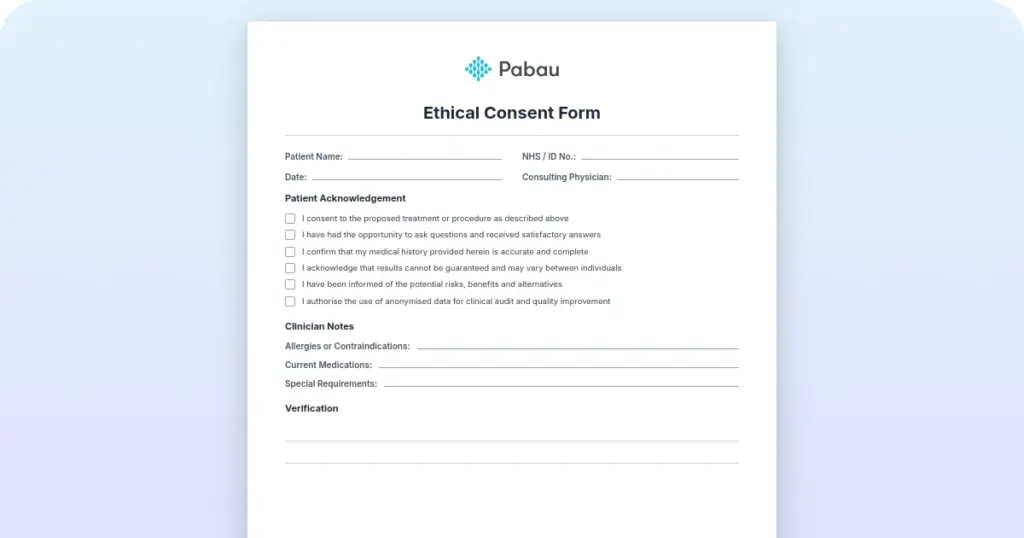
Ethical consent form: free template and what to add
An ethical consent form is a written record that a patient or participant agreed...

2
Last Updated: Oct 26, 2026

New York issues no medical spa license. Licensure attaches to the physician, the professional entity (a PC or PLLC), and every person who treats a patient.
Only a licensed physician may own a medical spa performing medical treatments. Education Law §6521 and §6522 make unlicensed practice a Class E felony under §6512.
A PC or PLLC needs a Certificate of Authorization from NYSED, and every shareholder or member must hold the required license.
Nurse practitioners with 3,600+ practice hours can treat patients without a written collaborative agreement. Whether that authority reaches ownership is unsettled.
A management services organization can run the business side, but never clinical decisions, and its fee can never be a percentage of revenue.
New York does not issue a medical spa license. There is no single application to file. Our ranking of the best medical spa software covers HIPAA compliance, which federal law governs rather than state licensing. The state licenses the physician, the professional entity, and every person who treats a patient, across three agencies.
So you are not filing one application. You are assembling a stack of registrations, each from a different body, with its own rule behind it.
This guide maps that stack. It covers who may own the business, who may treat patients, and what the state does when a practice gets it wrong.
For the step-by-step path to opening one anywhere, read our guide to starting a med spa. This is general information, not legal advice. Have a New York health care attorney review your structure.
No. New York issues no medical spa license, and the Department of State says so directly: no single agency licenses providers of med spa services.
What exists instead is a licensing stack with three parts. You need a physician-owned entity, a license for every provider who treats a patient, and the facility rules each treatment triggers.
That is what separates a medical spa from a day spa. A day spa sells massage, facials, and waxing under a cosmetology license. A medical spa sells medicine, and medicine in New York can only be practiced, or owned, by someone licensed to practice it.
New York medical spa laws are not gathered in one chapter. They sit across the Education Law, the Business Corporation Law, the Limited Liability Company Law, and the Public Health Law. Each agency below enforces only its own slice.
The State Board for Medicine and the State Board for Nursing both sit inside the same parent agency: the New York State Education Department. That surprises owners used to a state having one standalone medical board.
These requirements only make sense in sequence. Getting the entity right before you file anything else avoids redoing paperwork later.
Skipping the entity work and filing only a business registration is the sequence error that surfaces later. NYSED can refuse the Certificate of Authorization, and every treatment booked before it is unlicensed practice.
Documenting all of it falls to whichever system holds your patient records. Our comparison of medical spa EMR software covers how each one handles that.
File the Certificate of Authorization application before you sign a lease or order equipment. NYSED approval can take weeks to months, and no treatment can legally happen until it is issued. Treat it as later paperwork and you carry rent on a room you cannot use yet.
Only a licensed physician can own a New York entity that provides medical spa treatments like injectables, laser hair removal, or medical-grade peels. Our breakdown of New York ownership rules gives each license type its own verdict and statute, from physician assistants to outside investors.
Education Law §6521 defines the practice of medicine broadly enough to cover most medical spa treatments. Section 6522 restricts that practice to people licensed under Article 131, and §6512 makes practicing without that license a Class E felony.
The chart below sets out where each kind of owner lands, and the statute behind each answer.
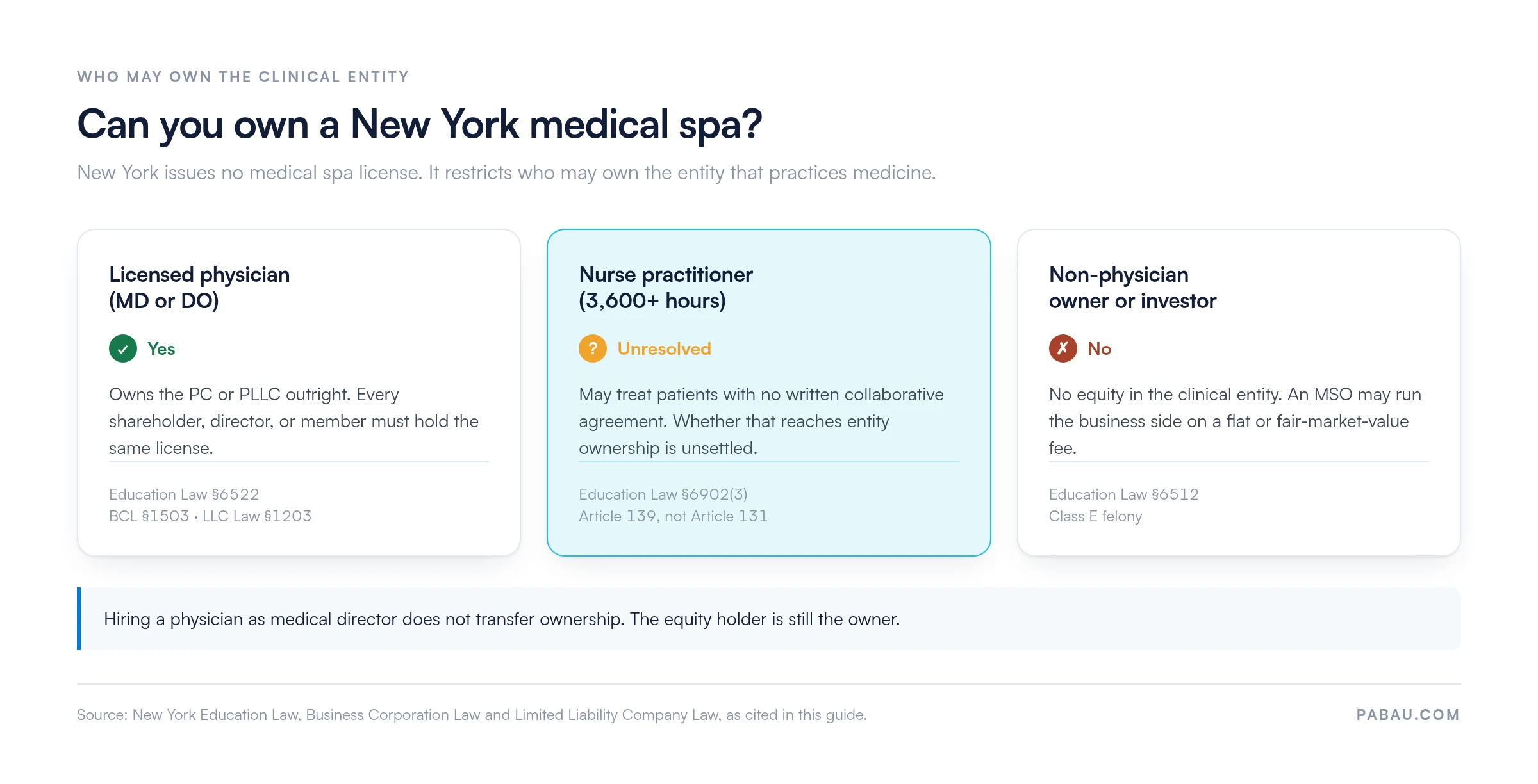
Each column gets its own section below, starting with the entity a physician owner has to form.
Business Corporation Law §1503 requires every shareholder, director, and officer of a medical PC to hold the license the corporation practices under. Limited Liability Company Law §1203 sets the same rule for a PLLC: every member must be licensed under Education Law Article 131 to practice medicine.
In practice, a non-physician co-founder cannot hold equity in the clinical entity, no matter how much of the business plan or capital they bring. NYSED also has to issue the PC or PLLC a Certificate of Authorization before it can legally operate.
Other states draw the line differently, so compare the med spa ownership rules before you open a second location.
New York law does not clearly say. Under the state’s Nurse Practitioners Modernization Act, an NP with more than 3,600 practice hours can treat patients without a written collaborative agreement. Education Law §6902(3) carries that authority through July 1, 2030, when a collaborative-relationship requirement is scheduled to return.
Full practice authority to treat patients is not the same as authority to own the entity that offers physician-level treatments. Nursing licensure under Article 139 does not fold into the practice of medicine that Article 131 governs.
An NP owning a medical spa that performs medical treatments sits in a legal gray area New York has not resolved by statute. Any owner considering this route should get a New York health care attorney’s opinion before filing.
A non-physician can legally run the business side of a New York medical spa through a management services organization, or MSO. The MSO has to stay out of clinical decisions.
It can handle marketing, billing, HR, and leasing the space. The physician-owned PC or PLLC stays responsible for every clinical call, including hiring and supervising clinical staff.
The MSO’s management fee has to be a flat rate or a fair-market-value charge for services rendered, never a cut of the medical spa’s revenue. A percentage-of-revenue fee reads as fee-splitting, which is illegal under New York’s physician conduct rules regardless of how the contract is worded.
Get the MSO’s management fee written up as a fair-market-value determination, not just labeled a flat fee. OPMC reads a percentage-of-revenue arrangement as fee-splitting however the contract is worded. A documented FMV analysis is what holds up when the fee structure gets questioned, and the flat-fee label alone will not.
New York has no published case or board precedent stating this as directly as some other states do. But the same statute that creates the ownership rule also answers this question. Education Law §6522 restricts the practice of medicine, and by extension its ownership, to licensed physicians — regardless of who is hired to supervise on paper.
A medical director title does not transfer ownership. If a non-physician holds the equity and decision-making control, hiring a physician to hold a director title does not change who legally owns the practice.
Filings rarely trigger an investigation. What New York regulators pursue is operational: who examined the patient, and who was licensed to treat them.
Yes, but only on a patient-specific order or protocol from a physician or nurse practitioner. A registered nurse cannot independently diagnose a condition or delegate a task to another provider. They also cannot decide on their own to perform a procedure like PDO thread lifting.
Keep the patient-specific order itself on file, not just a general staffing protocol. An OPMC review or malpractice claim asks for the written order tying one RN-administered treatment to one physician or NP decision. A standing protocol that does not name the patient cannot answer that.
New York licenses estheticians through the Department of State for non-medical services only: facials, waxing, and superficial peels. They cannot legally perform Botox, dermal fillers, microneedling, or medical lasers, regardless of on-the-job training.
New York does have a state tattooing and body-piercing statute, Public Health Law Article 4-A, but its statewide regulations are not yet fully implemented. In the interim, local rules largely govern permanent makeup and microblading. New York City has its own tattoo-license requirements, and no statewide permanent-makeup license exists.
The exposure runs from professional discipline to a felony charge, and it can reach more than the person who performed the treatment.
1. “Hiring a medical director lets a non-physician own the med spa.” No. Ownership still requires physician licensure under Education Law §6522. A hired medical director does not change who legally owns the entity.
2. “A nurse practitioner with full practice authority can own a medical spa outright.” Not established. Full practice authority under §6902(3) covers treating patients independently, not entity ownership under Article 131.
3. “A physician assistant can serve as medical director.” No. Article 131-B requires a PA to practice under a physician’s continuous supervision. A PA cannot hold the supervising role.
Every rule above becomes a documentation question during an investigation: who examined this patient, who ordered the treatment, who performed it. Practice management software like Pabau answers it. That is the job of software for med spas rather than a separate compliance binder.
Each provider’s license, certification, and renewal date live on their staff profile. A manager can confirm scope of practice before a booking is made. Role-based permissions mean an esthetician’s calendar only shows the services their license covers.
Consent forms, device settings, and treating-provider notes sit on one patient timeline — the documentation an OPMC investigation or a malpractice claim asks for first. Pabau Scribe, our AI scribe, drafts consultation notes from the conversation, so that record builds itself during the appointment.
Every Pabau subscription includes every feature, so a growing New York med spa never pays extra for compliance tooling.
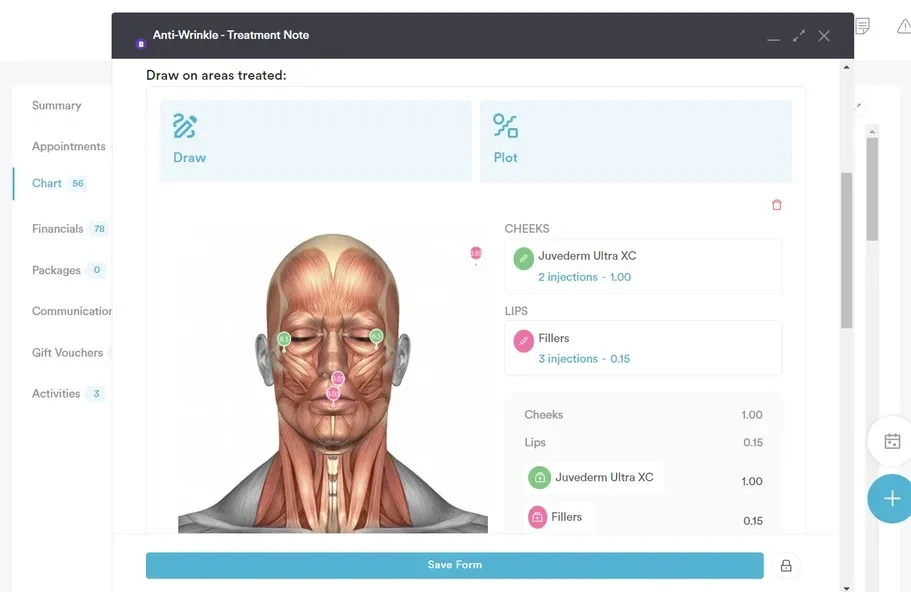

Pabau keeps provider licenses, patient-specific orders, consent forms, and treatment notes on one patient timeline, with role-based permissions and full audit trails. See how a New York med spa documents scope of practice in practice.

The question was never which medical spa license to apply for in New York. It is whether your ownership structure, provider licenses, and staffing scope match what each agency requires.
Get the entity right first — the statutes behind it are unforgiving, and every other requirement in this guide sits downstream of it. Book a demo to see how Pabau keeps that evidence in one place.

Who may own one outside New York? Our guide to med spa ownership rules covers how other states draw the line.
Staying compliant after you open? Our med spa compliance guide covers the checks and records that keep a practice out of trouble.
Ready to bring a physician in? See how to hire a medical director and what genuine supervision involves.
Opening a second location out of state? Compare the rules in our California med spa licensing guide, where ownership works differently.
Just getting started? Our complete guide to starting a med spa covers the costs and steps before you narrow in on any one state.
There is no single one. You need a physician-owned Professional Corporation or PLLC and a current license for every treating provider. Any esthetician on site needs a Department of State license.
Not as the owner of the clinical entity. New York restricts that ownership to licensed physicians under its corporate practice of medicine doctrine. Whether a nurse practitioner’s full practice authority reaches ownership is unsettled.
No. A PA must practice under a physician’s continuous supervision under Education Law Article 131-B, not own or independently direct a medical spa.
Costs vary by location, treatment menu, and build-out. NYSED’s Certificate of Authorization review alone can add weeks to months to your timeline, on top of entity formation, licensing, and equipment costs.
Given how unforgiving New York’s corporate practice of medicine rules are, most owners bring in a health care attorney to structure the PC or PLLC. That attorney also reviews the medical director and MSO agreements.
A medical spa physician is the licensed MD or DO who owns the clinical entity, or who serves as its medical director. They hold legal responsibility for every medical treatment delivered at the location.