Professional development record
A professional development record is a structured log of a healthcare practition...

7
Last Updated: Oct 8, 2026

Georgia repealed its corporate practice of medicine statute in 1982, but the restriction survives through the licensure statutes and the Professional Corporations Act.
A Georgia-licensed physician can own the professional corporation that delivers Botox, fillers, and laser treatment.
A non-physician can own the business side through a management services organization, but not equity in the clinical entity.
Nurse practitioner and physician assistant ownership is unresolved at the Georgia Composite Medical Board, and the board moved twice in May 2026.
A registered nurse can hold equity in the management company, but an RN can only treat on an individualized order.
Who can own a med spa in Georgia has two answers, because a Georgia med spa is usually two companies. Whichever company runs day-to-day operations will need staff reporting tools, which our guide to med spa management software compares across eight platforms. A Georgia-licensed physician owns the professional corporation that delivers the medicine. Beside it, a non-physician owns the management company.
That split decides your entity structure before you file a single form, so it comes ahead of every other decision. Get it wrong and you rebuild the company later, usually under a board complaint.
Nurse practitioner ownership is where published advice splits, and where Georgia itself has not landed. The state’s medical board moved twice on the surrounding rules in May 2026. Below is what each license type can hold, which path it takes, and where the law stops.
Only a Georgia-licensed physician can own a med spa’s clinical practice outright. Non-physicians own the business side through an MSO, and NP or PA ownership is unresolved.
That split comes from two places in Georgia law. O.C.G.A. §14-7-4 governs the professional corporation, and the licensure statutes in Title 43 decide who may practice medicine at all.
Section 14-7-4 says a professional corporation may practice a profession only through officers, employees, and agents licensed to practice it. At least one director and the president must hold that license.
For a med spa, the profession is medicine. Botox, dermal fillers, and laser resurfacing are medical acts, so the entity delivering them is practicing medicine whether or not the sign says spa.
A professional limited liability company works the same way. Under Title 14, Chapter 11, the members and managers of a medical PLLC must all be Georgia-licensed physicians.
Owning a med spa in Georgia therefore means owning one of two things. You hold the clinical entity, or you hold the med spa business around it. Plenty of first-time owners assume owning a med spa means holding both, and in Georgia it rarely does.
The short version of who can own a med spa in Georgia sits in the second column. One row is a clean yes, three rows are open questions, and two rows are settled noes. The third and fourth columns then decide how much structure you have to build around your license.
Those columns work as three sequential tests, and the field narrows at each one.
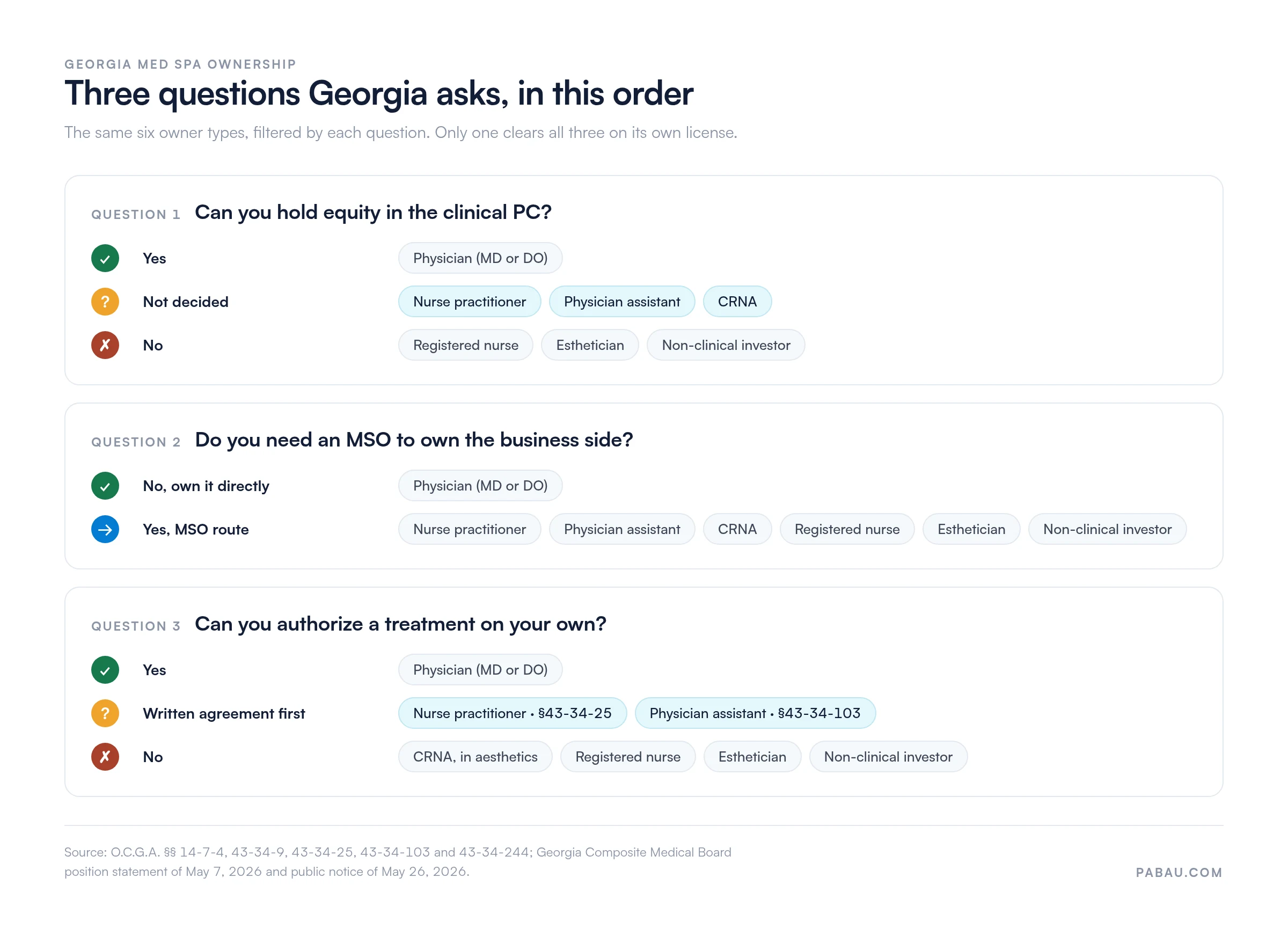
Yes, through a management services organization that owns the business while a physician-led professional corporation delivers the care. The non-physician holds no equity in that clinical PC.
Georgia used to say this plainly. Former O.C.G.A. §43-34-37 banned the corporate practice of medicine outright, and the legislature repealed it in 1982.
No single successor statute replaced it. The restriction now comes from three licensure sections, §§43-34-21(3), 43-34-22 and 43-34-26, which reserve the practice of medicine to individually licensed people. Alongside them, the Professional Corporations Act supplies the rest.
Two versions of this circulate, and neither survives the code. Georgia does not enforce a codified corporate practice ban, and the state has not thrown ownership open either. A non-physician can own a medical practice in Georgia, but not the entity that holds the license.
So the workaround is a management services organization, or MSO. A non-physician owns that MSO. That company holds the lease, the devices, the brand, and the staff contracts, then charges the physician-led PC a management fee.
The PC keeps the medical license, the clinical judgment, and the patient relationship. An MSO that starts setting treatment protocols or overruling a physician has stopped being a management company.
The fee is where these structures fail. O.C.G.A. §43-34-9 bars dividing a professional fee with an unlicensed person, and that ban runs separately from the ownership rules.
Price the management fee at fair market value and set it in advance. A percentage of revenue, a per-patient rate, or a per-procedure rate all read like a split professional fee.
So you can own a med spa without being a nurse, a physician, or any kind of clinician. What you cannot do is hold shares in the company that bills for the medicine.
O.C.G.A. §10-1-393.2 sits inside the Fair Business Practices Act and regulates prepaid membership contracts. The Georgia Attorney General’s office runs the filing regime, which is why that page keeps surfacing in searches about spa rules.
The Health Spa Act does not decide who may own a med spa. Instead, it covers cancellation rights and contract terms for businesses selling weight, fitness, or appearance memberships.
A facility wholly owned and operated by licensed physicians who practice medicine there is exempt outright. Nor does a pay-per-visit med spa ever trigger the Act, because there is no membership contract to file.
So the ownership question stays inside Title 43, where Georgia’s licensure statutes live.
Neither answer is settled. Georgia has no statute granting or denying NP and PA practice ownership, and the medical board has left the majority-ownership question open.
Two Georgia health-law firms read the statutes the same way. An APRN or PA can own a medical practice, and no code section says otherwise. The limits show up one layer down, in who supervises whom and who may pay whom.
One scope note first. What states can a NP own a med spa, and what states can a PA own a med spa, are fifty-answer questions. Georgia is the whole scope of this page. Our guides to Texas med spa ownership and Florida med spa ownership cover the two states closest in structure.
An NP can own a Georgia med spa in practice. The Georgia Composite Medical Board has never decided whether an NP may hold majority ownership while employing a delegating physician.
An APRN cannot employ their own delegating physician. That rule is what makes NP ownership awkward, because the owner has to buy supervision from someone the owner does not control.
Delegation itself runs on a nurse protocol agreement under O.C.G.A. §43-34-25. A physician delegates named medical acts to the APRN in writing. One physician at an accredited site may hold protocol or supervisory relationships with up to eight APRNs and PAs combined.
Three dates in 2026 changed the picture, and the order they came in matters.
On May 7, 2026, the GCMB issued a position statement on the delegating physician and APRN relationship. Delegating physicians would need annual on-site observation and quarterly chart review.
A delegating physician also could not take compensation from the APRN-owned entity for supervision, and generally could not be employed by the APRN being supervised. For an NP-owned med spa, that combination is the whole business model.
APRN and PA groups objected. Then, on May 26, 2026, the board published a public notice acknowledging significant questions and concerns, and reframed the statement as preliminary guidance pending review.
The board returned to it on June 4, 2026, and said the statement was meant to clarify a longstanding interpretation rather than create new policy. As of August 2026, the majority-ownership question is still open.
The honest answer to whether an NP can own a med spa in Georgia is that Georgia has not decided. Treat it as a live regulatory question, not a yes and not a no. A structure built on the May 7 wording may not match whatever the board eventually settles on.
No Georgia statute grants or denies a PA the right to own a medical practice. Whether a PA can own a med spa therefore sits in the same unresolved space as NP ownership.
What the code does cover is supervision. O.C.G.A. §43-34-103 requires a board-approved job description and periodic chart review by a supervising physician, sampled rather than complete.
A supervising physician generally cannot supervise more than four PAs. The eight-person cap in §43-34-25 counts APRNs and PAs together, so the two limits interact in any practice running both.
Anyone asking whether a physician assistant can open a med spa should plan around the same MSO structure an NP uses. The PA owns the management company, and a physician-led PC holds the clinical side and the supervising relationship.
A CRNA faces the same unresolved ownership question as any other APRN. CRNA scope centers on anesthesia and rarely extends to aesthetic injectables.
A CRNA licensed in Georgia is an advanced practice registered nurse, so the nurse protocol agreement in §43-34-25 applies the same way. The narrower question is what that protocol can cover.
A delegating physician cannot delegate outside the APRN’s own training and competence. So whether a CRNA can own a med spa in Georgia is the same open question, on a narrower scope of practice.
An RN can hold equity in a med spa’s MSO, but Georgia law does not let an RN authorize treatment. Every procedure needs an individualized order from a physician, NP, or PA, never a standing protocol.
Whether an RN can own a med spa in Georgia splits into two questions. Holding shares is a corporate question. Ordering a treatment is a licensure question, and Georgia answers the two separately.
The Georgia Board of Nursing’s position statement on cosmetic and aesthetic procedures is where practitioners get sent. An RN may perform Botox, dermal fillers, or laser treatment only after a prescriber has examined that patient and written an order.
A standing order does not cover the initial examination. Licensed practical nurses may not perform these procedures at all.
So a nurse working out how to open a med spa as a nurse is asking two questions. One is whether you can own the business, and the answer is yes through an MSO. The other is whether you can treat without a prescriber on the file, and the answer is no.
Whether an RN can open a med spa, and whether a nurse can open a med spa, get the same answer in Georgia. You can open it and own it, and you still need a physician, NP, or PA to authorize each treatment.
The wider question of what states can a RN own a med spa splits sharply by state. California treats nurse ownership differently from Georgia, and our guide to opening a med spa in California covers that route.
Ownership and treatment authority are separate questions in Georgia. Holding equity does not decide who is licensed to inject or run a laser.
Almost anyone in Georgia can form a company and sign a lease. Neither step grants any clinical authority.
Lasers have their own statute in Georgia. The Georgia Cosmetic Laser Services Act, O.C.G.A. §§43-34-240 to 43-34-253, regulates cosmetic laser services as a licensed activity. Claims that Georgia has no laser-specific law are out of date.
Section 43-34-244 creates two license levels. An assistant laser practitioner works under direct supervision. That level needs three board-approved laser or IPL course certificates, plus an existing license such as PA, LPN, RN, esthetician, or master cosmetologist.
A senior laser practitioner may supervise others, and §43-34-244 sets three requirements for that level:
The same board licenses both levels. Applications now run through the GCMB Licensure Gateway, which the board made mandatory in July 2025.
Neither level is a medical license. Both practitioners work inside the Act’s supervision structure.
Injectables run on a different track from lasers. Who may inject in Georgia breaks down like this:
Each of those authorities rests on a document, which is where ownership planning turns into paperwork.
Correct med spa ownership in Georgia rests on four documents. You need a Georgia-licensed medical director, a properly formed PC or PLLC, filed delegation paperwork, and a fair-market-value management agreement.
The same four documents look like this in checklist form, with two safeguards beside them:
Order matters more than owners expect. Name the medical director first, then form the entity, then file the delegation paperwork, and only then book a patient.
The medical director must oversee all medical services, not just appear on a contract. A paper medical director who never sets foot in the building is the arrangement that fails a board review.
Two items on that list are where practices we onboard usually come up short. The delegation paperwork is normally complete and filed. What goes missing is the record proving the delegating physician reviewed charts each quarter.
Owners often ask which license the business itself needs. No state medical license attaches to the business at all. Licenses attach to people, and the entity gets built around them.
Budget for the legal build as a line item of its own. Reported spend on attorneys and consultants to reach compliance runs $12,000 to $20,000 or more. That figure comes from practitioner reporting rather than a published study, so treat it as a planning number.
Every structure above produces paperwork somebody has to find again later. The protocol agreement, the delegating physician’s name, the prescriber’s order, the treatment note, and the quarterly chart review are five records about one appointment.
Practice management software like Pabau keeps them on one client record. Each treatment note carries the provider who performed the treatment and the prescriber who authorized it.
Your delegation chain becomes a field rather than a memory. Consent forms, before-and-after photos, and the order behind each injection attach to the same patient timeline.
A medical director can then review a day’s charts from one screen instead of walking between treatment rooms. When an MSO sits alongside a physician-led PC, records stay tied to the entity that delivered the service.
Pabau is made for med spas, so the calendar, client records, consent, payments, and reporting sit in one system. The audit trail builds itself while your team works.
If you are still comparing platforms, our guide to medical spa EMR software lines up the options aesthetic practices run on.

Pabau ties each treatment note to the provider who performed it and the prescriber who authorized it. Protocol agreements, chart reviews, consent forms, and photos sit on one client record.

Physician ownership is the clean answer in Georgia. A Georgia-licensed MD or DO can hold the clinical entity, the management company, or both, and no part of that structure has to be argued.
If you are not a physician, the MSO is the route, and the management fee is where it lives or dies. Price the fee at fair market value, set it in advance, and keep clinical decisions on the physician’s side of the wall.
NPs and PAs have a harder call. Do not commit capital on the strength of a blog’s yes. Georgia’s board moved twice in 2026 and still has not answered the majority-ownership question. Have a Georgia healthcare attorney read your structure before money moves.
A structure only holds if the records behind it do. Book a demo to see how Pabau keeps the protocol, the order, and the treatment note on one client record.

Structuring in Texas instead? Who can legally own a med spa in Texas? explains the majority-ownership rule Georgia has never written down.
Comparing Georgia with Florida? Who can own a med spa in Florida? Rules by license type covers a state with no corporate practice statute at all.
Looking at Arizona too? How to open a med spa in Arizona: Who can legally own one walks through ownership and setup in a third state.
Need the physician on your paperwork? How to hire a medical director for your med spa covers what to agree on before the contract is signed.
Building the compliance side? The ultimate medical spa requirements checklist lists the licenses, records, and policies an owner is responsible for.
Yes, a local one. Georgia cities and counties issue an occupational tax certificate, often called a business license, for each location you operate. That certificate is separate from any medical license, and zoning approval usually has to come first.
Only the business side. Holding equity in the clinical professional corporation requires a Georgia medical license, which leaves an out-of-state physician in the same position as a non-physician. They can own the management company and contract a Georgia-licensed physician for the clinical entity.
Yes, if every owner is a Georgia-licensed physician. A single PC or PLLC can then hold the lease, the devices, and the clinical license together. Add one non-physician owner and the structure has to split into two entities.
The clinical entity does, because it holds the license and the patient relationship. An MSO can host and administer those records under the management agreement. Spell out in that agreement who keeps custody if the two companies part ways.
Search the Georgia Composite Medical Board’s Licensure Gateway verification tool by name or license number. Confirm the license is active and unrestricted, then read the physician profile for disciplinary history. Do this before you sign, not after.