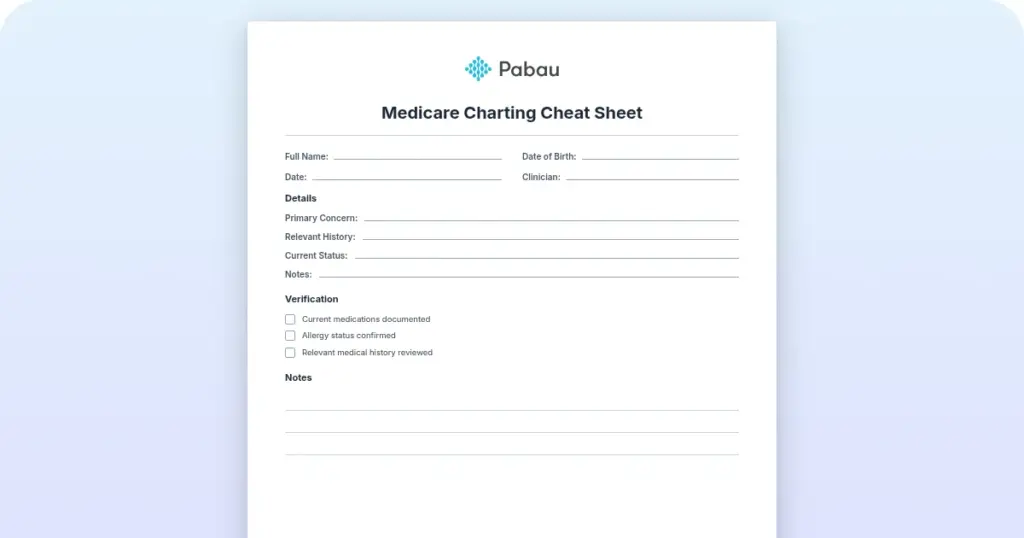
Medicare charting cheat sheet
A Medicare charting cheat sheet is a one-page reference that lists what Medicare...

3
Last Updated: Oct 21, 2026
The best TherapyNotes alternatives for therapy practices in 2026 are SimplePractice, TheraNest, Pabau, and Upheal.
SimplePractice is the strongest all-round pick for solo therapists and small groups, especially where telehealth carries much of the caseload. TheraNest has the lowest published price per therapist, and Upheal suits therapists who want AI-drafted session notes.
Pabau, the all-in-one practice management system we build, is the pick for practices adding services or locations beyond behavioral health. We compared all four on pricing, billing, documentation, telehealth, and how well each scales past a handful of clinicians.

1. SimplePractice — best overall pick for solo therapists and small groups that run much of their caseload over telehealth.
2. TheraNest — lowest published price per therapist, with unlimited patients on every plan.
3. Pabau — best fit for practices adding clinicians, services, or locations beyond behavioral health.
4. Upheal — AI-first option for solo therapists who want session notes drafted automatically.
Here is how the four alternatives compare on the criteria practices check first.
Ratings come from Capterra. Prices are list prices from each vendor’s own website in October 2026, before any promotions.
TherapyNotes is a behavioral health EHR built mainly for solo practitioners and small therapy practices. It offers therapy-specific note structures, US insurance billing, and scheduling. That focus is both its strength and its limit, and practices that leave it tend to cite the same friction points.
SimplePractice is the most polished TherapyNotes replacement for solo therapists and small groups that rely on telehealth.
SimplePractice is the most direct competitor to TherapyNotes in the solo and small group therapy market. It covers scheduling, clinical documentation, insurance billing, telehealth, and a client portal in one package. Reviewers consistently describe its interface as more polished than TherapyNotes’.
For therapists who want an upgrade without moving to a more complex platform, SimplePractice is the most common landing spot. Our SimplePractice vs TherapyNotes breakdown covers the head-to-head in more depth.
SimplePractice earns 4.5 out of 5 stars on Capterra. Reviewers praise the intuitive interface and strong telehealth integration. The most common complaints concern billing complexity for insurance-heavy practices and rising subscription prices.
| Plan | Price | Billing basis | Key inclusions |
|---|---|---|---|
| Starter | $49/month | One clinician | Core features |
| Essential | $79/month | One clinician | Starter plus a wider feature set |
| Plus | $99/month | One clinician | SimplePractice’s most complete solo plan |
| Plus (group) | $99/month + $74 per added clinician | Two to five clinicians | Group appointments, group telehealth, premium phone support |
| Plus (6+ clinicians) | Custom pricing | Six or more clinicians | Personalized onboarding and dedicated support |
These are SimplePractice’s standard monthly rates, and new accounts currently get 50% off for the first three months. Add-ons such as ePrescribe ($49/month plus an $89 setup fee) cost extra, as our SimplePractice pricing breakdown explains.
TheraNest is the budget pick for growing therapy groups, with per-therapist pricing and unlimited patients on every plan.
TheraNest, now part of Ensora Health, targets the same small-to-mid-size group therapy segment that TherapyNotes serves. Its plans are priced per therapist, start at $29 a month, and include unlimited patients. It covers progress notes, treatment plans, scheduling, insurance billing, and a client portal.
For practices that find TherapyNotes expensive at scale but don’t need a broader platform like Pabau, TheraNest is a credible option.
TheraNest holds a 4.4 out of 5 rating on Capterra. Reviewers appreciate the affordable pricing for group practices and the depth of its billing features. Common criticisms center on the dated interface and inconsistent support response times.
| Plan | Price | Billing basis | Key inclusions |
|---|---|---|---|
| Essentials | $29/month ($27 billed annually) | Per therapist | Unlimited patients |
| Advanced | $59/month ($54 billed annually) | Per therapist | Unlimited patients |
| Premier | $89/month ($82 billed annually) | Per therapist | Unlimited patients |
TheraNest publishes these prices on the Ensora Health website, and every plan includes unlimited patients. Annual billing lowers each tier slightly and includes one month free.
Pabau fits therapy practices that are adding clinicians, services, or sites and want one system to run all of them.
Pabau is an all-in-one practice management system for aesthetic, wellness, mental health, and multi-specialty practices. It brings patient records, clinical documentation, scheduling, and workflow automation into one platform. It is built for practices that have outgrown single-specialty, single-location tools.
For behavioral health practices adding allied health services or practitioners, Pabau handles operational complexity that a single-specialty tool like TherapyNotes isn’t built for. If you’re weighing it against our top pick, the Pabau and SimplePractice comparison sets the two side by side.
Pabau’s mental health EMR includes customizable note templates, treatment plans, and documentation that adapts across therapy disciplines. TherapyNotes ships DAP, SOAP, and BIRP templates designed for behavioral health. Pabau lets practices build their own template sets, which matters when mental health sessions run alongside physical therapy, occupational therapy, or wellness services.
According to Capterra reviewers, Pabau earns 4.7 out of 5 stars from 650+ verified reviews. Positive themes center on its feature set for multi-specialty practices and its scheduling tools. Reviewers who flag concerns most often cite onboarding time and the quote-based pricing process for larger teams.
| Plan | Price | Billing basis | Key inclusions |
|---|---|---|---|
| Starter | Contact us for pricing | One user | Full feature set, up to 100 patients |
| Solo | Contact us for pricing | One user | Full feature set, unlimited patients |
| Team | Contact us for pricing | Two to three users | Full feature set, unlimited patients |
| Medium | Contact us for pricing | Four to five users | Full feature set, unlimited patients |
| Group | Contact us for pricing | 6 to 15 users | Full feature set, unlimited patients |
| Enterprise | Contact us for pricing | 16+ users | Full feature set, multi-location |
Pabau doesn’t publish prices because they depend on your location and number of users. Plans differ only by user count, so a quote through a demo is the quickest way to see your figure.
Upheal suits solo therapists whose biggest problem is note-writing time, with a free plan to test it first.
Upheal centers its platform on AI-generated session notes. It records and transcribes sessions, then drafts progress notes for the clinician to review and approve. The aim is to cut the documentation burden that many therapists cite as their main source of burnout.
Upheal is a newer entrant with a smaller user base than the other platforms reviewed here. Its billing tools are less proven than those of TherapyNotes, SimplePractice, or TheraNest, so insurance-heavy practices should test them carefully. For solo therapists in private pay or hybrid models, Upheal’s AI notes address a problem that most established alternatives solve less directly.
| Plan | Price | Billing basis | Key inclusions |
|---|---|---|---|
| Free | $0/month | Per therapist | AI notes from text, dictation, and uploads, plus telehealth calls |
| AI Notes | $39/month | Flat fee | Unlimited AI notes, built-in telehealth, treatment plans |
| EHR | $1/session | Pay per session | AI notes plus invoicing, insurance billing, and a client portal |
| EHR Pro | $99/month | Flat fee | EHR plan plus AI Assistant Pro |
Upheal lists these prices on its own website. Insurance claims cost $0.30 each and card payments carry a 2.9% + $0.30 fee on top.
The table below compares TherapyNotes with the three full practice platforms on eight criteria practices weigh when switching. Upheal is covered in its own section, since AI documentation is its main selling point.
When evaluating TherapyNotes alternatives, separate your billing pain from your documentation pain. Practices frustrated by TherapyNotes pricing alone often do well with TheraNest. Practices frustrated by limited customization or multi-location management need a broader platform. Matching your specific friction points to each alternative’s strengths stops you switching to a platform with the same limits.
The right choice depends on which TherapyNotes limitation matters most to you. Here is a decision framework for the four most common scenarios.
For group practices, the key question is whether growth means more of the same or something new. If you’re adding more therapists and more behavioral health patients, TheraNest’s per-therapist pricing keeps costs predictable. If you’re adding service types or locations, Pabau covers services that neither TherapyNotes nor TheraNest is built for.
Pabau’s therapy practice management tools handle behavioral health and allied health under one system. On cost, list prices show how quickly per-clinician pricing diverges as you hire. At three clinicians, SimplePractice’s group plan costs $247 a month and TheraNest Essentials costs $87. At five, those figures reach $395 and $145.

On HIPAA compliance, all four platforms meet the requirements, so the question is implementation depth and documentation. The US Department of Health and Human Services’ HIPAA Security Rule guidance outlines the technical safeguards any EHR vendor serving US providers must address. Ask each vendor for its Business Associate Agreement (BAA) and its documentation of administrative, physical, and technical safeguards.
On billing, US insurance claims through a clearinghouse are standard among TherapyNotes competitors. What varies is how deep that integration goes. Practices with complex payer mixes or high denial rates should test how each platform ties clinical notes to claims. Incomplete documentation is a common denial trigger.
Practices leaving TherapyNotes are usually managing more than therapy notes. A second location brings separate calendars, and a new service line needs templates the EHR wasn’t built for. Reporting across sites often ends up in a spreadsheet.
Pabau puts scheduling, clinical notes, intake forms, billing, and reporting for every site and service in one system. Your team builds its own templates for each discipline. Patients book and complete their forms through the Client Portal before their first session, so your front desk spends less time chasing paperwork.
Switching starts with structured onboarding. A dedicated Client Coordinator guides your data migration, so patient records and appointment history move across before you go live. Every plan includes the full feature set, so adding a clinician or a site never means upgrading to unlock tools.

Pabau handles multi-practitioner scheduling, clinical documentation, billing, and automated workflows across every service type your practice offers, without stitching together separate tools.

Start with the limit TherapyNotes puts on your practice today, because each alternative here fixes a different one. If cost is the problem and your team is staying behavioral health only, TheraNest is the cheapest move. If you want a smoother telehealth and patient experience for a solo or small caseload, SimplePractice is the safest switch.
If notes are eating your evenings, test Upheal’s free plan before you commit. The trade-off to remember is that a behavioral-health-only system will hit the same wall if you add services or sites.
If that’s where your practice is heading, choose for the practice you’ll run in two years. Book a demo to see how Pabau runs scheduling, notes, and billing across every service and location in one system.

Want a deeper look at the top pick? SimplePractice review covers its features, pricing, and pros and cons in detail.
Comparing more options before you switch? SimplePractice competitors compared reviews seven platforms against the market leader.
Running a multidisciplinary practice? Jane App vs SimplePractice shows which EHR fits allied health teams better.
Mixing therapy with wellness or nutrition services? Practice Better vs SimplePractice compares the two for practices offering programs alongside sessions.
SimplePractice is the best all-round TherapyNotes alternative for solo and small group practices. TheraNest suits growing groups that want low per-therapist pricing, and Pabau suits practices expanding into new specialties or locations. Upheal suits solo therapists who want AI-drafted session notes.
Both TherapyNotes and SimplePractice are built mainly for solo and small group practices. SimplePractice generally scores higher for telehealth quality and ease of use, while TherapyNotes has a longer track record with US insurance billing. For groups above five clinicians, TheraNest or Pabau are typically the stronger options.
Yes, TherapyNotes is HIPAA compliant and provides a Business Associate Agreement (BAA) to covered entities. All four alternatives reviewed here (SimplePractice, TheraNest, Pabau, and Upheal) also maintain HIPAA compliance. When switching platforms, always request the new vendor’s BAA before migrating patient data.
SimplePractice is the strongest TherapyNotes alternative for telehealth-first practices, because video sessions sit inside its core workflow. Reviewers consistently rate its session experience above TherapyNotes’ built-in video. TheraNest and Pabau also include telehealth, and Pabau’s runs on top-up credits.
Yes, TherapyNotes includes US insurance billing with ERA (electronic remittance advice) and clearinghouse integration for claim submission. It is one of its strongest features for US-based therapists. If billing depth is your main concern, TherapyNotes and TheraNest are the strongest out-of-the-box US insurance options here.
SimplePractice and TherapyNotes are two of the most widely used EHR platforms among US therapists in private and group practice. TheraNest is also widely used by group practices. Market share shifts frequently as newer AI-first tools like Upheal enter the category.