Healthie pricing (2026): Every plan, add-on and fee in one table
Healthie pricing starts at $49.99 a month for the Essentials plan and runs to $1...

Last Updated: Nov 19, 2026
In Practice Better vs SimplePractice, SimplePractice fits therapists billing insurance, while Practice Better fits nutrition, functional medicine and coaching practices selling programs. The vendors say so themselves: SimplePractice’s homepage leads with therapists and insurance tools. Practice Better pitches journaling and online programs to wellness practitioners.
Neither one is built to run a medical line. Both sell e-prescribing as a paid add-on to a therapy- or coaching-first record. Below, every price is checked against each vendor’s own site, and the Treat–Pay–Prescribe test turns the choice into three questions.

SimplePractice fits therapists and mental health practices that bill insurance, and Practice Better fits nutrition, functional medicine and coaching practices that sell programs.
For one practitioner, Practice Better runs from free on Sprout to $99 a month and SimplePractice from $49 to $99, as of November 13, 2026.
For three clinicians, Practice Better’s Team plan lists at $205 a month and SimplePractice’s Plus plan at $247, before add-ons and usage fees.
The Treat–Pay–Prescribe test decides it: who you see, who pays, and whether a prescriber has to review and send anything.
Pabau, the practice management platform we build, keeps prescribing, labs and insurance claims in one patient record for practices adding a medical line.
SimplePractice is built for solo and group therapists billing insurance, while Practice Better is built for nutrition, functional medicine and coaching practices selling programs.
Whether you search Practice Better vs SimplePractice or SimplePractice vs Practice Better, the split shows in what each vendor puts first. SimplePractice’s homepage lists therapists, speech-language pathologists, occupational therapists and psychiatrists. SimplePractice reports over 250,000 practitioners on its platform.
So who uses Practice Better? Practice Better’s site names professions including dietitians, nutritionists, functional medicine practitioners, health coaches, naturopathic doctors and chiropractors, alongside mental health professionals. Practice Better says over 50,000 practitioners use it. Its signature tools are food journals, protocols and online programs that patients work through between sessions.
If your caseload is talk therapy only, our guide to therapy practice management covers the workflows SimplePractice is designed around. The table below shows where each platform’s design center sits, and where it stops.
Practice Better starts free on its Sprout plan and SimplePractice starts at $49 a month, with both topping out at $99 for one clinician.
Those are list prices, checked on November 13, 2026, on each vendor’s own site. The Practice Better Sprout plan is free for up to three active clients and one practitioner, so it suits a student or a brand-new practice.
So how much is Simple Practice per month? The three Simple Practice plans list at $49 (Starter), $79 (Essential) and $99 (Plus) for one clinician. New accounts that subscribe in the first 7 days of the trial get 50% off for 3 months.
3-clinician math: Practice Better Team $155 for two practitioners, plus $50 for the third, equals $205. SimplePractice Plus $99 for the first clinician, plus $74 × 2, equals $247. Prices checked November 13, 2026, in the Practice Better help center and the SimplePractice support center. List prices exclude taxes, promotions and usage fees.
Card processing and SMS or fax credits are usage-based and add to the bill on both platforms. SimplePractice charges 3.15% plus $0.30 per card payment. On Practice Better’s Professional plan, SMS reminders run on credits at $0.05 each.
For the tier-by-tier detail, see our breakdowns of Practice Better pricing and SimplePractice pricing. The second one walks through Simple Practice plans and pricing add-on by add-on.
Both platforms ship intake forms, progress notes and note templates. The difference is what the record is built to hold between sessions: treatment plans for therapy, or protocols and programs for nutrition and coaching.
Practice Better includes note templates, form templates and workflow automations on every plan, including Sprout. The automations trigger documents by appointment type or patient stage, so intake paperwork goes out without a manual send. From the Professional plan, Practice Better adds client protocols, lifestyle recommendations and branded PDFs.
SimplePractice lets every plan customize intake forms. Progress note and treatment plan templates are customizable only on Essential and Plus, and Starter gets limited template access. Essential and Plus also include Wiley Treatment Planners, research-based templates for treatment planning that suit standard therapy documentation.
SimplePractice’s plan-by-plan feature guide lists no patient programs, food journals or protocols. A therapist will not miss them. A dietitian building a 12-week program will.
Practice Better’s AI Charting Assistant costs $10 to $40 per practitioner monthly, while SimplePractice’s Note Taker costs $35 per clinician monthly.
Practice Better moved to tiered pricing in its September 9, 2026 release notes. The tiers are 20 hours for $10, 60 hours for $20 and 120 hours for $40, then $0.02 a minute. A clinician recording 20 hours a month pays $10 on Practice Better and $35 on SimplePractice.
SimplePractice also sells Care Aide, which bundles Note Taker with Session Sidekick, Treatment Planner and Client Summaries. Care Aide costs $59 a month for the account owner and $49 for each additional clinician. Both SimplePractice add-ons are free for 30 days, per the SimplePractice pricing page checked November 13, 2026.
SimplePractice files insurance claims inside its own platform from $0.39 per claim, while Practice Better submits them through a linked Claim.MD clearinghouse account.
Since October 1, 2026, SimplePractice charges the same per-claim rate on every plan, per its insurance pricing update. The free monthly claims that Essential and Plus used to include ended on that date. Rates drop with volume:
A therapist filing 120 claims a month pays $46.80 in claim fees on Insurance Essentials. Insurance Navigator adds benefits verification, an AI Claim Assistant, EOB uploads and phone access to insurance specialists. Manual insurance status checks cost $0.15 each on Starter and Essential.
Practice Better creates superbills and CMS-1500 claims on every plan, including Sprout. Electronic submission, eligibility checks and ERA tracking need the Claim.MD integration, which Practice Better’s plan table lists from the Professional plan. Claim.MD is Practice Better’s only integrated clearinghouse, and the practice opens that account with Claim.MD directly.
Without Claim.MD, Practice Better still exports claims, including as an Office Ally text file. Those claims are submitted elsewhere, and their ERAs are not tracked in Practice Better. That detail comes from Practice Better’s insurance billing FAQ.
The rule of thumb is simple. If insurance is most of your revenue, SimplePractice keeps the whole claims loop on one bill. If patients mostly self-pay and a few want superbills, Practice Better covers it without a clearinghouse.
Both platforms include video sessions in their paid plans, but only SimplePractice runs group telehealth natively. Practice Better routes group video through Zoom. If telehealth is your main channel, compare it alongside dedicated telehealth software as well.
SimplePractice includes Telehealth by SimplePractice on Starter, Essential and Plus, with no limits on session length or number of appointments. Sessions have waiting rooms, screen-sharing and whiteboards. Group telehealth comes with Plus, or with Essential through a $20 monthly add-on.
Practice Better Telehealth is one-on-one only, on every paid plan, and patients join through the Client Portal. Group sessions need the Zoom integration, the Professional plan or higher and a paid Zoom account, per Practice Better’s telehealth guide.
SimplePractice takes online appointment requests on every plan. Starter sends reminders only for telehealth appointments, while Essential and Plus send text, email or voice reminders for every session. The website booking widget is a Plus feature.
Practice Better adds a public booking page and widgets from Starter, plus packages that book several sessions at once. That suits a 6- or 12-session program sold up front. SMS reminders start on Professional with paid credits, and Plus includes 750 a month.
Practice Better’s Team plan and SimplePractice’s Plus plan are each vendor’s only route to multiple clinicians, and both charge per added clinician.
Practice Better Team supports up to 200 practitioners, with team scheduling, shared patient access and unlimited admin users at no extra fee. SimplePractice Plus adds billers, schedulers and supervisors free, but practice managers cost $39 a month each.
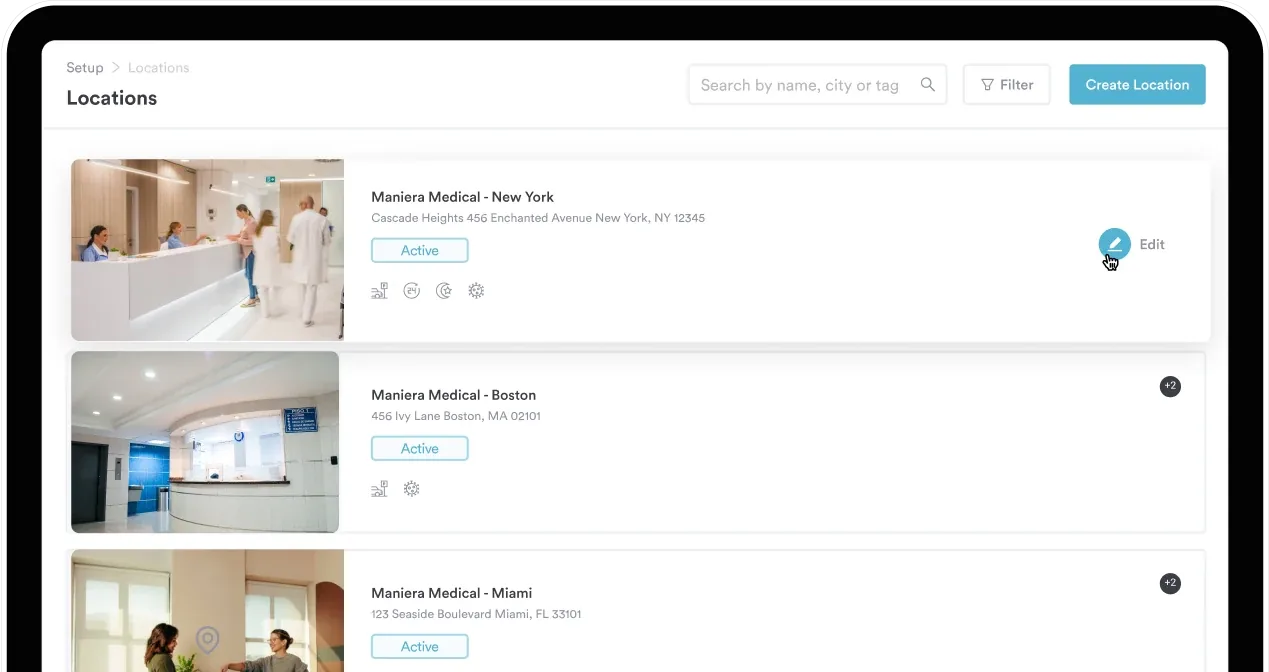
Practice Better supports unlimited office locations from Starter, but neither vendor’s plan guide covers room scheduling or per-site reporting. Groups running several sites usually need multi-location practice management that keeps each location’s calendar and team in one account.
Both platforms support HIPAA and sign a business associate agreement, but only Practice Better offers signed agreements for Canadian privacy law and the GDPR.
HIPAA is the US law that protects patients’ health information, and HHS administers its privacy and security rules. In Canada, PIPEDA covers private-sector organizations that handle personal information in commercial activity. Ontario, New Brunswick, Nova Scotia and Newfoundland and Labrador have their own health information laws, per the Office of the Privacy Commissioner of Canada.
In the EU, the General Data Protection Regulation has applied since May 25, 2018. The OPC and EU pages were checked on November 13, 2026.
Practice Better says it is built to support HIPAA, PIPEDA, PHIPA and GDPR requirements. Its security and privacy guide lets practitioners sign a HIPAA BAA, a GDPR Data Processor Agreement or a Canadian processing agreement on any plan. Practice Better stores all account data in the United States, on AWS.
SimplePractice describes itself as fully HIPAA compliant. Its guide for Canadian practices makes no PIPEDA or PHIPA claim and points practices to legal advice. SimplePractice’s data servers are all in the United States too.
The two portals do different jobs between appointments. SimplePractice’s portal handles paperwork, messages and booking. Practice Better’s client portal is where patients log meals, follow protocols and work through programs.
Practice Better includes daily food and lifestyle journals, a food database and goal tracking for nutrients, water and weight. From the Professional plan, Practice Better connects Oura, Garmin Connect, Google Health, Apple Health and Cronometer. A dietitian sees sleep, activity and food logs beside the chart, instead of asking for them at the visit.
SimplePractice’s Client Portal covers document completion, online appointment requests and, from Essential, secure messaging. Plus adds client announcements to every patient at once. SimplePractice’s plan guide lists no wearable connections, and SimplePractice offers no public API.
For a therapist running intake, session and note, the lighter portal is less to configure and less to explain. For a coach whose results depend on what patients do between sessions, Practice Better’s portal is the product.
SimplePractice reviews on Capterra pull in both directions. One reviewer credits it with organizing appointments, records, billing and payment processing. Another, running an all-virtual practice, kept Google Meet as a telehealth backup and found the subscription a financial strain.
The table sets the features that decide most purchases side by side, using each vendor’s own plan guide.
Run the Treat–Pay–Prescribe test: therapists billing insurance should pick SimplePractice, and program-led wellness practices should pick Practice Better, unless a prescriber is involved.
The Treat–Pay–Prescribe test asks three questions in order. The first two pick the platform, and the third tells you whether either one is enough.
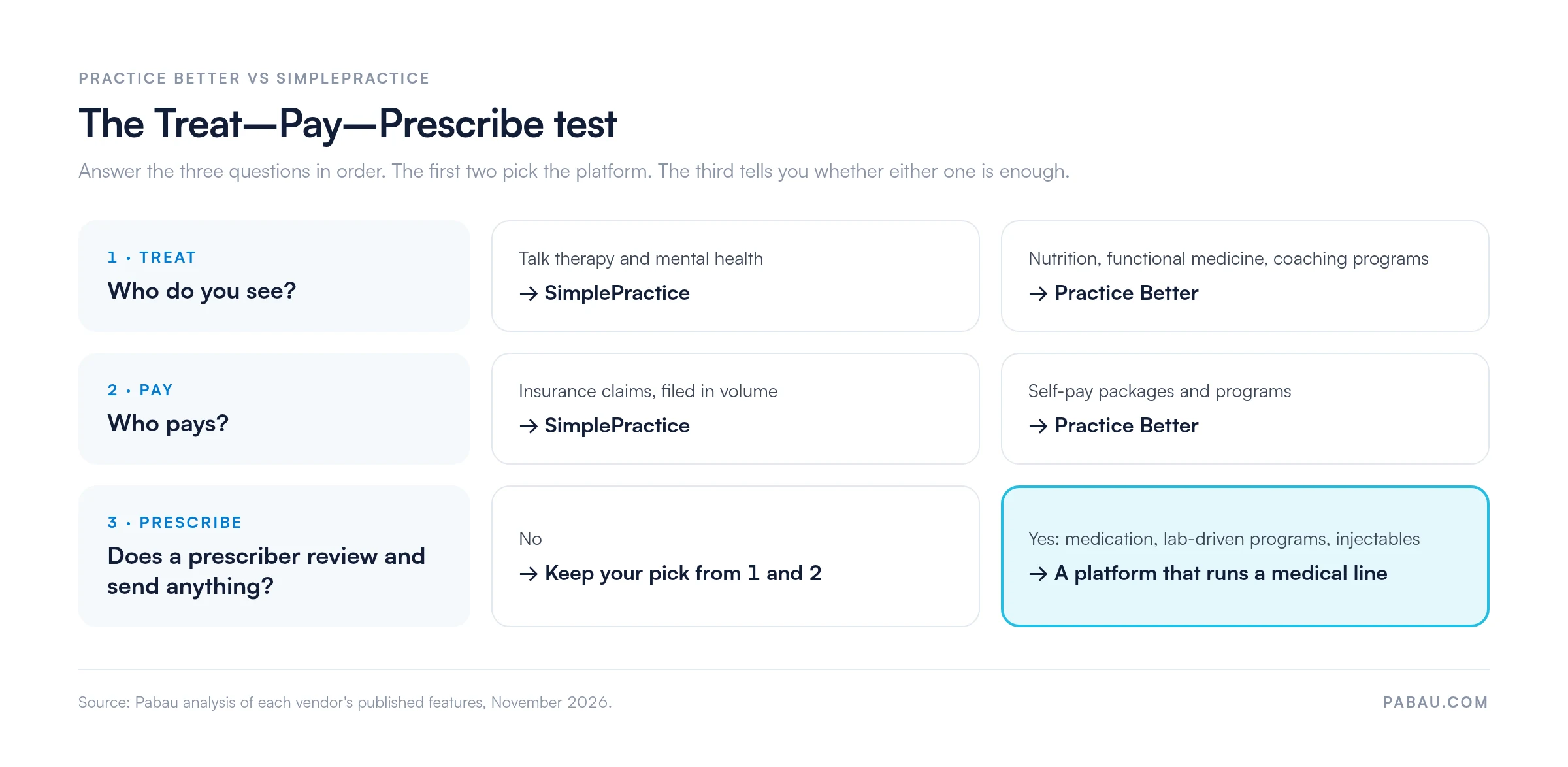
Talk therapy and mental health sit at SimplePractice’s design center, from Wiley Treatment Planners to telehealth on every plan. Nutrition, functional medicine and coaching sit at Practice Better’s, with food journals, protocols and programs. A mixed practice should pick the platform that fits most of its sessions.
If insurance claims arrive in volume, compare the claims workflow and the per-claim fee. SimplePractice files in-platform from $0.39 a claim, while Practice Better needs a Claim.MD account. If patients pay for packages and programs themselves, Practice Better’s packages, programs and superbills do more of the work.
Medication, lab-driven programs and injectables all need a prescriber to review and approve something. Both Practice Better and SimplePractice sell ePrescribe as a $49 monthly add-on, bolted onto a record built for sessions and notes. Healthie charges $40 a month per prescribing clinician for the same add-on, as our Healthie pricing guide sets out. The prescriber step is where a coaching- or therapy-first tool stops being enough, and a platform that runs a medical line is worth a look.
If you want other options in the same space, our roundup of Practice Better alternatives covers the Healthie vs Practice Better question too. For other pairings, browse our software comparisons.
We hear the same question from practices moving off therapy- or coaching-first tools: where will the prescriber’s approval live? Today it often sits in an ePrescribe add-on, with lab results in a separate portal and claims in a third system.
Pabau runs booking, charting, consent forms, payments and memberships for practices that offer aesthetics, hormone therapy, weight loss and longevity care in one system. The therapy or nutrition work keeps running in the same record. Here is how the practice records the medical line in Pabau:
Pabau handles self-pay, memberships and insurance billing in one system, in the US, UK and Australia. Every Pabau plan includes the core features, and add-ons enhance the experience. Telehealth and Pabau Scribe, our AI scribe, run on usage-based credits. Pabau is rated 4.7 on G2 and 4.7 on Capterra.
Pabau sets new practices up through structured onboarding rather than a free trial, so prescribing, labs and billing are configured with the team before go-live.

If your practice is adding a medical line, Pabau keeps prescriptions, lab results and insurance claims in the same patient record as booking and charting. Book a demo to see that workflow end to end.

If your week is talk therapy paid by insurers, choose SimplePractice and budget for per-claim fees from day one. If your week is nutrition or coaching sold as packages, choose Practice Better. Expect its client caps to push you up a plan as you grow.
The trade-off worth remembering is the third question. A practice that will add prescribing, labs or injectables within a year will outgrow both, and switching later costs more than choosing once. Book a demo to see prescribing, labs and claims working in one patient record.

Weighing SimplePractice against a group-friendly EHR? Jane App vs SimplePractice compares scheduling, billing and multi-practitioner setup for allied health teams.
Want a lower-cost option than SimplePractice? Carepatron vs SimplePractice sets the two side by side on price, telehealth and documentation.
Billing insurance at volume? SimplePractice vs TherapyNotes looks at which therapy EHR handles claims and notes better.
Thinking about an insurance network instead of software alone? SimplePractice vs Alma explains how a credentialing network differs from running your own practice software.
Leaving TherapyNotes? Best TherapyNotes alternatives for therapy practices ranks the options therapists switch to most.
The main difference is who each platform is built around. SimplePractice is built for therapists and mental health practices that bill insurance, with telehealth on every plan. Practice Better is built for dietitians, health coaches and functional medicine practitioners, with client journals, protocols and online programs.
Practice Better costs less for a small group at list price. Its Team plan comes to $205 a month for three practitioners, against $247 on SimplePractice’s Plus plan, as of November 13, 2026. SimplePractice is still the better group fit if most of your revenue comes from insurance claims.
Yes, Practice Better creates superbills and CMS-1500 claims on every plan, including the free Sprout plan. Electronic submission, eligibility checks and ERAs need its Claim.MD integration, which runs on a separate Claim.MD account. Without it, claims are exported and submitted outside Practice Better.
Practice Better says it supports HIPAA, PIPEDA, PHIPA and GDPR requirements. Practitioners can sign a HIPAA business associate agreement, a GDPR Data Processor Agreement or a Canadian processing agreement from their settings. Practice Better stores account and client data in the United States, on AWS.
Yes, you can move from SimplePractice to Practice Better. Practice Better offers a Migration Concierge Service that helps established practices with file transfers, data migration and account setup. Its free trial runs 14 days, or 30 days on the Team plan, so you can test the move first.
Yes, both sell AI note-taking as an add-on. Practice Better’s AI Charting Assistant costs $10 to $40 per practitioner a month, by hours recorded. SimplePractice’s Note Taker costs $35 per clinician a month, so Practice Better is cheaper unless you record over 60 hours a month.
Yes, SimplePractice suits a solo clinician doing their own claims and calendar, because claim filing, reminders and telehealth sit in one account. Pick Essential over Starter if you want text and email reminders for in-person sessions. Electronic claims cost from $0.39 each on top of the plan.