Health appraisal form
A health appraisal form is a record a licensed provider signs to document someon...

2
Last Updated: Oct 13, 2026

SimplePractice suits solo therapists who want polished scheduling, telehealth, and a strong client portal in one place
TherapyNotes leads on clinical documentation and insurance billing, especially for SOAP and DAP note workflows
SimplePractice is cheaper for one clinician at $49 a month, and TherapyNotes costs less from the second clinician on
Both platforms price per clinician and are sold only to licensed mental health professionals
Practices offering aesthetics, wellness, or multi-specialty services alongside therapy should consider Pabau instead
SimplePractice vs TherapyNotes is the shortlist most therapists end up with, and the two products are less alike than their feature lists suggest. Both are electronic health record (EHR) platforms sold only to licensed mental health professionals.
The short answer: TherapyNotes is the stronger documentation and billing system, while SimplePractice is the better front desk. That call is worth getting right, because moving later means re-enrolling with every payer and re-importing your client records.
This guide covers price at each team size, note templates, and the claim workflow. It also covers telehealth, support, and the point where a therapy-only EHR stops fitting a practice.
That one line settles the decision for most practices. TherapyNotes was built around the clinical record, so notes, co-signing, and claims feel native. SimplePractice was built around the client, so scheduling, video, and the portal feel effortless.
The table below shows where each choice costs you something.
SimplePractice is a practice management platform for therapists, counselors, psychologists, and social workers. Its reputation rests on the client portal, which handles self-scheduling, intake forms, and secure messaging in one place.
The platform also includes video sessions, automated appointment reminders, and billing tools that cover electronic claims, electronic remittance advice (ERA) processing, and superbills. Solo practitioners can set the platform up without technical help, which is a large part of the appeal.
TherapyNotes is a mental health EHR with clinical documentation at its core. It ships specialty-specific templates for SOAP notes, DAP notes, treatment plans, and progress notes. Co-signature and supervisor review are built in, which matters to group practices and training programs.
Its billing module covers electronic claims, clearinghouse submission, and ERA processing. Reviewers rate it as one of the more stable platforms in behavioral health, though the interface looks dated next to SimplePractice’s.
SimplePractice is cheaper for one clinician, and TherapyNotes is cheaper from the second clinician on. Both price per clinician, so the ranking depends entirely on team size.
Here is what each vendor publishes today.
Solo plans run from $49 to $99 a month depending on the tier. Group practices of two to five practitioners pay $99 for the first clinician and $74 for each additional one.
TherapyNotes raised these rates for billing cycles after December 1, 2025. Note the third row. Several features that SimplePractice folds into its subscription are billed on top here, so the headline price is not the whole bill.
Run the numbers at the size you expect to be, and the picture changes shape. The chart below does that math at one, three, and five clinicians.
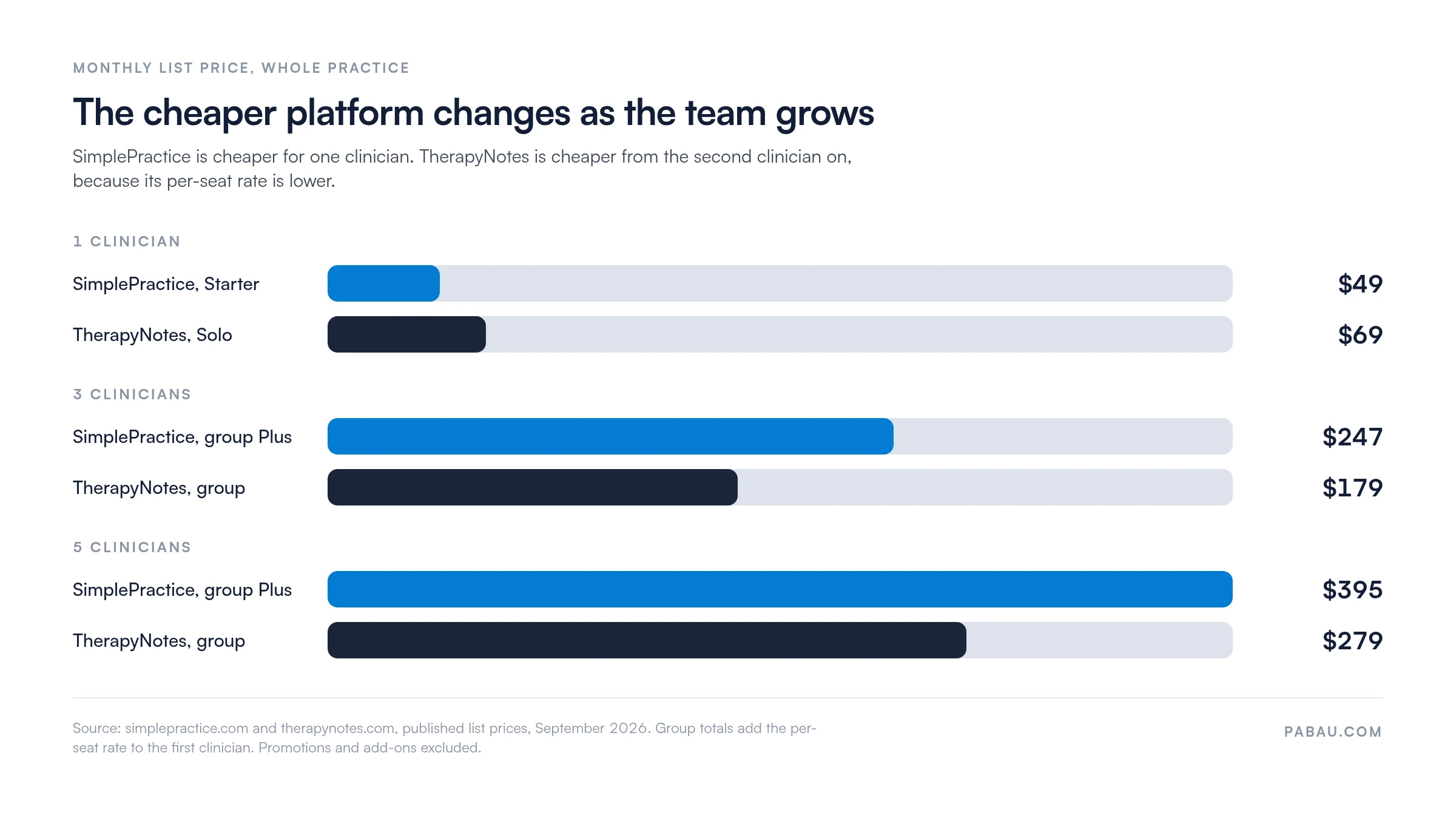
A five-clinician group pays about $116 a month more on SimplePractice at list price. Discounts move that number, so check current promotions on both sites. Our breakdown of SimplePractice pricing walks through each tier and what sits behind the add-on fees.
Price the add-ons before you compare plans. E-prescribing, appointment reminders, and per-claim fees can add more to your monthly bill than the difference between the two subscriptions. Then run the same math at the team size you expect in 18 months.
Documentation is the sharpest contrast between the two. TherapyNotes was built documentation-first, and its template library covers SOAP notes, DAP notes, psychotherapy notes, treatment plans, progress notes, and discharge summaries.
Each one is structured around behavioral health workflows rather than adapted from a general medical template.
SimplePractice has solid templates and lets you customize them. Reviewers still describe the out-of-the-box experience as less specialty-specific, which means more setup work before your notes match how you write.
So if audit readiness and documentation quality drive your risk, TherapyNotes is the safer choice. SimplePractice holds its own for general outpatient therapy, then trails as documentation needs get more specific.
Both platforms follow the same path, and both submit electronically through a clearinghouse. Knowing the steps tells you where each one saves you clicks, and where a denial usually starts.
TherapyNotes keeps that chain tight. Because billing sits alongside the clinical record, creating a claim from a signed note takes very few manual steps. SimplePractice covers the same ground with an interface that first-time billers find easier to read.
None of these are platform features. They are the five fields that send claims back, whichever system you use, and both platforms will happily submit a claim that fails them.
High claim volume across several payers favors TherapyNotes, which reviewers praise for ERA matching and denial tracking. A solo therapist doing their own billing between sessions usually gets on faster with SimplePractice.
One rule applies to both. Each platform needs a signed HIPAA Business Associate Agreement (BAA), and each payer enrollment has to be redone when you move. That paperwork is the slowest part of any switch.
These three features are why therapists switch to SimplePractice, and reviewers rarely cite clinical dissatisfaction as the reason. Each one removes a task from the front desk.
SimplePractice’s calendar is clean, handles recurring appointments, and connects to the portal so clients book inside the hours you set. Automated text and email reminders come as standard, which cuts no-shows without anyone chasing.
TherapyNotes schedules perfectly well. Recurring appointments work and reminders are available, but the calendar is functional rather than pleasant to use.
SimplePractice runs video sessions inside the platform. Clients click a link, join in a browser, and never download an app. TherapyNotes added telehealth later, and reviewers call it usable rather than smooth.
Both meet HIPAA requirements for video sessions and cover them under the BAA. Neither needs a separate video tool, which keeps the compliance picture simple for a solo practitioner.
SimplePractice’s portal is its standout feature. Clients book, complete intake forms, sign consent documents, view invoices, and message securely through one login. Clinicians and clients both rate it highly.
TherapyNotes offers a portal with intake forms, secure messaging, and self-scheduling, though it feels less refined. For comparison, practice management software like Pabau offers client portal software for a broader range of practice types. It does not carry the mental-health-specific workflow these two ship with.
Most solo practitioners describe being functional on SimplePractice within a day or two. The setup wizard walks new users through configuration, and it assumes no technical confidence.
TherapyNotes asks more of you upfront, particularly around billing setup and note configuration. Once configured, users describe it as efficient and dependable. Group practices with admin staff absorb that learning curve easily, while solo therapists feel it.
Support is TherapyNotes’ quiet advantage. Reviewers consistently mention fast email replies and staff who know the product, and phone support is available during business hours.
SimplePractice’s support draws more mixed feedback. Live chat and email are available, though response times slip during busy periods. The help center is extensive, which covers most questions, but a stuck claim on a Friday is not a self-service problem.
TherapyNotes is the better fit for most groups, on both counts. Supervisor co-signing is built in, which training programs and licensed-associate supervision depend on. Its group rate is also lower per seat, as the chart above shows.
SimplePractice’s group plan still covers team scheduling, shared resources, and multi-clinician billing. Groups choose it when the client-facing side matters more than supervision workflows.
Review scores land close together, and the complaints are more useful than the ratings. SimplePractice users praise the client experience and criticize price and support. TherapyNotes users trust the notes and billing, then criticize how the product looks.
SimplePractice holds 4.6/5 from 2,700+ verified reviews on Capterra and 4.4/5 from 140+ reviews on G2. Praise clusters around the portal and telehealth. Our full SimplePractice review digs into what those reviewers report after a year of use.
TherapyNotes earns 4.7/5 from 870+ reviews on Capterra and 4.6/5 from 80+ reviews on G2. Reviewers name documentation quality, billing accuracy, and support as the reasons they stay.
The full list repeats the pattern from the sections above. Both cover the basics, and the differences show up in documentation, supervision, and integrations.
Answer these honestly and the choice usually makes itself. Three or more answers pointing the same way is your platform.
Choosing badly costs less than switching badly. Most of the pain in a migration comes from five predictable places, and all of them are avoidable with two weeks of planning.
Run both systems in parallel for one billing cycle if you can. It costs a month of double subscription, and it catches the enrollment problems before they hold up your income.
If payer enrollment is what holds you back, a membership model moves that work off your desk. Alma’s credentialing network submits your payer applications and follows up on status, inside a flat monthly membership fee.
Neither platform sweeps the board, because they optimize for different jobs. SimplePractice takes experience, telehealth, and the portal. TherapyNotes takes documentation, billing, support, and group economics.
Solo therapists who care about the client experience should lean toward SimplePractice. Documentation-heavy practices, supervision-led groups, and insurance-first billing operations should lean toward TherapyNotes.
Both platforms serve licensed mental health professionals and nobody else. That focus is exactly why they work so well for therapy-only practices, and it becomes a ceiling the moment your services widen.
Say you add IV therapy, functional medicine consultations, or aesthetic treatments alongside counseling. Neither platform handles multi-room scheduling, treatment photos, aesthetic consent forms, or stock control. They were never built to.
Pabau covers that wider ground from one system. It runs scheduling across rooms and practitioners, clinical records with photo capture, intake forms, payments, and marketing. Our therapy practice management platform keeps the counseling side intact while the rest of the practice runs beside it.
If we belong on your shortlist, our side-by-side comparisons put Pabau against SimplePractice and the rest of the field. And if you are strictly a therapy practice billing insurance, SimplePractice or TherapyNotes will serve you better. We would rather say so than sell you the wrong tool.

SimplePractice and TherapyNotes are purpose-built for mental health. If your practice also spans aesthetics or wellness, Pabau runs it from one platform. Scheduling, clinical records, billing, and patient communication sit in the same system.

Choose by the work that eats your week. If that work is notes and claims, TherapyNotes earns its price back, and the setup time is the cost of entry. If it is booking, reminders, and clients who want to handle their own admin, SimplePractice will feel lighter every day.
Whichever you pick, price it at next year’s headcount and keep the old system running through one full billing cycle. Those two habits prevent most of the regret people report after switching.
And if your practice has already grown past therapy alone, one platform across every service beats two that half-talk to each other. Book a demo to see how Pabau handles scheduling, clinical notes, and billing for a multi-specialty practice.

Wondering who else competes with SimplePractice? SimplePractice competitors lines up the platforms therapists shortlist most often, and what each one is good at.
Weighing a lighter, cheaper option? Carepatron vs SimplePractice compares the two on price, note-taking, and client management.
Running nutrition or wellness services alongside therapy? Practice Better vs SimplePractice covers where each platform fits a mixed caseload.
Is booking your biggest frustration? Acuity Scheduling vs SimplePractice weighs scheduling depth against clinical features.
Both sell e-prescribing as a paid add-on rather than including it. SimplePractice lists ePrescribe at $49 a month, plus an $89 one-time setup fee. TherapyNotes also prices ePrescribe separately from the subscription. Budget for it if a prescriber works in your practice.
SimplePractice, in most cases. With no claims to chase, the client experience matters more than billing depth. Its portal covers booking, intake, card payments, and superbills for clients who file themselves. TherapyNotes’ strongest features sit in the insurance workflow you would not use.
Yes, both platforms let you export client data before you close the account. Ask what format the notes arrive in, because historical notes often export as PDFs rather than structured records. Export first, since access ends when the subscription does.
Yes. SimplePractice’s iOS and Android apps review better and cover scheduling, notes, and messaging between sessions. TherapyNotes has a mobile app too, though reviewers treat it as a companion to the desktop version rather than a replacement.
Not always. SimplePractice includes automated email and text reminders in its plans. TherapyNotes prices reminders as an optional feature on top of the subscription, alongside electronic claims and ePrescribe. Add those lines to your quote before comparing monthly costs.