GLP-1 diet plan
A GLP-1 diet plan is a structured eating framework for patients taking semagluti...

2
Last Updated: Oct 13, 2026
The receptive one word picture vocabulary test is a norm-referenced assessment of a person’s single-word receptive vocabulary. The person being tested points to one of four pictures that matches a spoken word. According to the American Speech-Language-Hearing Association (ASHA), standardized vocabulary assessments like this are foundational tools. They help identify language disorders, monitor developmental progress, and guide intervention planning.
The test requires no verbal response from the person being assessed. That makes it particularly useful for evaluating children and adults who have limited speech output. This guide explains what the receptive one word picture vocabulary test measures and how it is administered. It also covers how scores are interpreted and when the test belongs in a broader language evaluation.

The receptive one word picture vocabulary test (ROWPVT) measures single-word receptive vocabulary using a picture-pointing task requiring no verbal response.
Two editions are in active clinical use: ROWPVT-4 from Academic Therapy Publications and ROWPVT-5 from WPS/Pearson. Both are normed from age 2;0 through older adulthood.
Scores are reported as standard scores (mean 100, SD 15), percentile ranks, age equivalents, and confidence intervals; a score below 85 typically warrants further evaluation.
The ROWPVT measures only single-word receptive vocabulary and should never be used alone to diagnose a language disorder. It is one component of a comprehensive evaluation.
The receptive one word picture vocabulary test measures a person’s ability to understand individual spoken words. They select the corresponding picture from an array of four. It isolates receptive vocabulary from expressive language, because the person being tested never has to speak. That distinction matters clinically. A child who struggles to name objects might still score within normal limits on the ROWPVT. Their word knowledge is intact even when retrieval or articulation fails. Conversely, a child who appears articulate may score low, signaling a receptive vocabulary deficit that casual conversation would mask.
The test covers a wide semantic range, including concrete nouns, action words, descriptors, and more abstract concepts that increase in difficulty as the assessment progresses. It is not a test of reading, grammar, sentence comprehension, or connected language. Clinicians evaluating autism and speech delay use it to strip away the confounding influence of syntax and phonology. What is left is a clean measure of word knowledge.
Receptive vocabulary refers to words a person understands when they hear them. Expressive vocabulary refers to words a person can produce spontaneously. These two systems often develop together, but they can diverge sharply in children with language disorders, autism spectrum disorder, or hearing impairment. The ROWPVT’s companion test, the Expressive One-Word Picture Vocabulary Test (EOWPVT), asks the person to name each picture aloud. Administering both tests gives the clinician a receptive-expressive vocabulary profile. A large discrepancy between the two scores is itself a diagnostic signal worth investigating.
Two editions of the test are currently in active clinical use, and both are normed from early childhood through older adulthood. Understanding which one a report references still matters, because the normative samples, publication dates, and publishers differ.
When writing or reviewing a clinical report, always note which edition was administered. Adult coverage is not the dividing line between the two. The ROWPVT-4 already carried adult norms, and the ROWPVT-5 updated the normative sample and extended it slightly further into older adulthood. The narrower 2;0 to 18;11 range that still circulates online belongs to the older ROWPVT-2000, the third edition. Comparing scores across editions without acknowledging the normative difference can still produce misleading longitudinal conclusions.
Administration is straightforward but requires training in standardized testing procedures. The clinician presents a stimulus book containing plates of four color pictures. For each plate, they say a single target word aloud and ask the person to point to the picture that matches. No reading is required, no writing, and no spoken response. The task is purely receptive.
Administration typically takes 10 to 20 minutes depending on the person’s age and cooperation. The test is untimed. The clinician waits as long as the person needs before moving on. Practice management software like Pabau lets speech-language pathology practices attach assessment records and session notes directly to a patient’s file. The score then reaches the record the same day it is obtained.

Check your scoring manual’s starting age tables before each administration. Starting a 7-year-old at the same item as a 4-year-old wastes time and increases test anxiety. Using the correct entry point keeps sessions efficient and produces more reliable basals.
The receptive one word picture vocabulary test produces several types of derived scores from a single raw score. Each serves a different clinical purpose, and understanding the difference prevents over-interpretation or misuse in reports. One habit carries across every norm-referenced assessment. Always report the confidence interval alongside the point estimate.
Age equivalents are the most misunderstood score type. A 9-year-old with an age equivalent of 6;3 is not functioning “like a 6-year-old” in any global sense. They simply earned the same raw score that the average 6;3-year-old earned in the normative sample. Age equivalents have poor statistical properties and should never be used alone for eligibility or diagnostic decisions. Standard scores with confidence intervals are the preferred metric for clinical reporting.
Publisher manuals for the ROWPVT provide descriptive classification labels tied to standard score ranges. The table below reflects the classification system typical of norm-referenced language tests with a mean of 100 and SD of 15. Always verify against your specific edition’s technical manual, as terminology can vary slightly.
Many school districts and early intervention programs set the eligibility threshold for language services at a standard score of 77 or 78. That is roughly 1.5 standard deviations below the mean. Others require scores below 70. Always check your state or district’s specific eligibility criteria rather than applying a single universal cut-off.
Those thresholds are closer together than they look in prose. The chart below puts each one on the same scale as the classification bands.
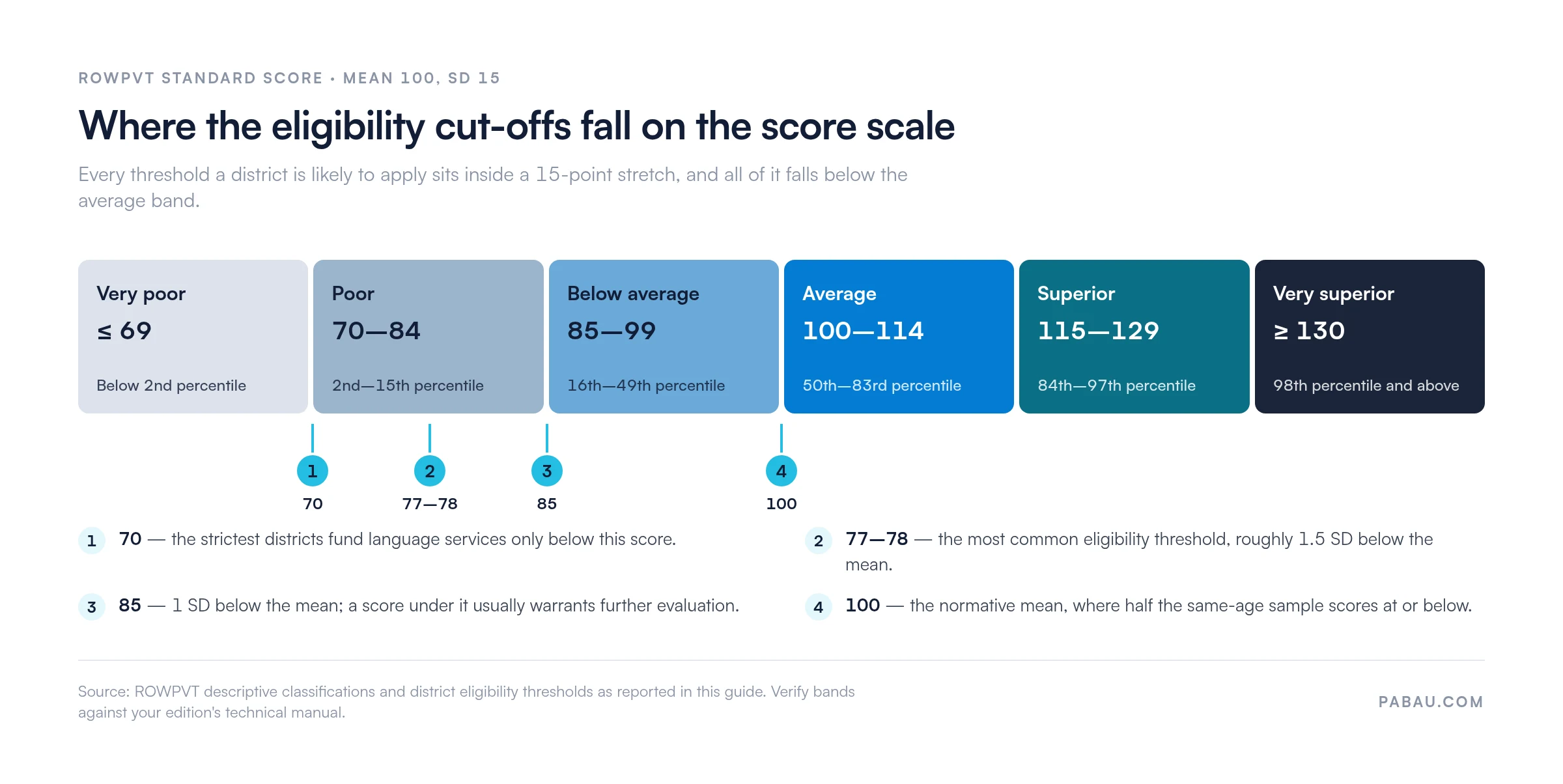
A score sitting close to a cut-off calls for clinical judgment and supplementary assessment before any eligibility decision is recorded.
The receptive and expressive one word picture vocabulary test pair is designed to be administered together. Both use the same set of pictures in the same stimulus book. On the ROWPVT, the clinician says the word and the person points. On the EOWPVT, the clinician shows the picture and the person names it. Only the task format changes, yet that change is what exposes the distance between what a person understands and what they can say. Clinicians use that distance when diagnosing language disorders and planning treatment.
Clinicians who track assessment scores across sessions need one reliable place to keep them. Good medical records management supports side-by-side score entry across testing dates. That cuts transcription errors and makes longitudinal comparisons easier to produce for IEP and progress reports.

The ROWPVT-4 Spanish Bilingual Edition (SBE) was developed by Academic Therapy Publications to address the need for a normed vocabulary assessment for bilingual Spanish-English speakers. The normative sample for the SBE was drawn from bilingual Spanish-English speakers in the United States. Scores can therefore be compared against same-age bilingual peers rather than monolingual English norms.
That distinction is critical. Using standard English ROWPVT norms with a bilingual child systematically underestimates their vocabulary knowledge, because bilingual children typically distribute vocabulary across two languages.
The SBE is normed from age 2;0 to over 70, a narrower span than the standard ROWPVT-4’s. Administration follows the same picture-pointing format. Clinicians should be fluent or have supervised training in Spanish administration to ensure accurate pronunciation and naturalistic delivery of stimulus words.
The bilingual normative sample’s composition and generalizability limits are documented in the technical manual. Disclose them in any clinical report that uses SBE scores for eligibility decisions.
The receptive one word picture vocabulary test is most commonly administered by speech-language pathologists (SLPs). Psychologists and special education diagnosticians with appropriate training also use it. An SLP caseload typically combines screening, diagnostic evaluation, and progress monitoring. The ROWPVT serves each of those roles, depending on how it is used. Settings include:
The American Academy of Pediatrics (AAP) recommends developmental surveillance at every well-child visit and standardized screening at 9, 18, and 30 months. The ROWPVT is more comprehensive than a brief screening tool. It fits naturally into referral workflows when a primary care screen flags a vocabulary concern.
A practice that evaluates regularly also needs somewhere to schedule re-evaluations and store protocols. Our comparison of speech therapy practice software looks at how the main systems handle assessment records and recall.
The ROWPVT is a well-established tool with a clear scope. Knowing where it fits and where it stops is as important as knowing how to administer it.
A broader workup may also need behavioral data the ROWPVT does not collect. The Conners rating scales gather parent, teacher, and self-report ratings of inattention and hyperactivity.
The ROWPVT measures only single-word receptive vocabulary. It does not assess:
A child can score in the average range on the ROWPVT and still have a significant language disorder affecting sentence comprehension or discourse-level processing. Pair it with measures that cover what it skips, including an articulation test for speech-sound production. Comprehensive language evaluation requires multiple measures across multiple domains, and a structured evaluation protocol keeps any one of them from being omitted from the workup.
In most speech-language pathology practices the ROWPVT is scored on paper. The standard score, percentile rank, and confidence interval are then retyped into a report template. The protocol goes into a filing cabinet. A year later, the clinician running the annual review has to find it before they can say whether vocabulary has moved.
Pabau stores the whole evaluation against the patient’s file instead. Custom clinical forms hold the basal, the ceiling, the derived scores, and the clinician’s observations. Our therapy practice management software keeps those records beside the appointment history and the recall schedule. A re-evaluation opens with the previous scores already on screen.
That removes the search before every IEP meeting. It also turns longitudinal comparison into reading two rows, rather than reconciling two paper protocols scored months apart by different clinicians.

Pabau helps speech-language pathology practices track assessment records, manage patient files, and automate documentation workflows. Clinicians spend more time with patients and less time on admin.

Reach for the ROWPVT when you need a clean reading of word knowledge without asking the person to speak. Report the standard score with its confidence interval, name the edition you administered, and keep age equivalents out of the eligibility decision.
The trade-off is scope. A 10-minute picture-pointing task says little about grammar, narrative, or how a child follows a two-step direction. The score earns its weight only beside measures that cover those domains, which is why a low result is a referral, not a finding.
Book a demo to see how Pabau keeps assessment scores, session notes, and re-evaluation dates in one patient record.

Exploring how autism affects communication and early language? Autism and speech delay examines the relationship between autism spectrum disorder and receptive and expressive language development.
Need to assess speech-sound production alongside vocabulary? Articulation test explains how articulation screening works and how to read the results.
Deciding whether a late talker needs therapy? Therapy for speech delay sets out the treatment options and the referral thresholds behind them.
Writing up the evaluation afterwards? SOAP notes for speech therapy gives you a documentation structure built for assessment and treatment sessions.
Assessing an adult with acquired language loss? Western Aphasia Battery template covers the subtests and scoring used in aphasia evaluation.
The Receptive One Word Picture Vocabulary Test measures a person’s single-word receptive vocabulary. The person points to one of four pictures that matches a spoken word. It assesses word knowledge without requiring any verbal response, which distinguishes it from expressive vocabulary tests. That makes it suitable for individuals with limited speech output.
Both current editions span early childhood through older adulthood. The ROWPVT-4 is normed from age 2;0 to over 80. The ROWPVT-5 reaches beyond age 85. The narrower 2;0 to 18;11 range belongs to the older ROWPVT-2000, not to either current edition. Always specify the edition when reporting scores, because age-based norm tables differ between versions.
The raw score is the total number of correct responses between the basal and ceiling. That raw score is then converted using age-based norm tables in the technical manual. The conversion produces a standard score (mean 100, SD 15), a percentile rank, an age equivalent, and a confidence interval. Standard scores and confidence intervals are the preferred metrics for clinical reports.
On the ROWPVT, the clinician says a word and the person points to the matching picture. On the EOWPVT, the clinician shows a picture and the person names it. Both tests are co-normed on the same sample. Score discrepancies between them can therefore be evaluated statistically, showing whether vocabulary difficulties are primarily receptive, expressive, or both.
Yes. The ROWPVT-4 Spanish Bilingual Edition (SBE), published by Academic Therapy Publications, was normed on bilingual Spanish-English speakers in the United States. It is normed from age 2;0 to over 70, a narrower span than the standard ROWPVT-4. Scores can be compared against bilingual peer norms rather than monolingual English norms.
No. The ROWPVT measures only single-word receptive vocabulary and should never be used as the sole basis for a language disorder diagnosis. A low score is a referral flag that warrants a comprehensive evaluation. That evaluation should cover grammar, sentence comprehension, expressive language, and other domains before any diagnostic conclusion is drawn.
Administration typically takes 10 to 20 minutes, varying with the person’s age and cooperation. The test is untimed, so the clinician waits for each response without imposing a time limit. Younger children and those with significant delays may require slightly more time due to basal establishment.