Journal prompts for mental health
Journal prompts for mental health are guided questions that help people process ...

2
Last Updated: Oct 13, 2026
The Conners scale for ADHD is a standardized rating questionnaire that measures inattention, hyperactivity-impulsivity, oppositional behavior, and learning problems in children, adolescents, and adults.
Parents, teachers, and the patient each complete a version of it. The responses convert to age-adjusted T-scores that show how far a symptom sits from the norm.
It screens and monitors; it does not diagnose. Psychologist C. Keith Conners developed the scale in the 1960s, and the current Conners 4th Edition (Conners 4) is the version most practices buy today. A diagnosis still needs a clinical interview, a developmental history, and direct observation alongside the scores. Many practices run administration through mental health EMR platforms so completed forms land in the patient record automatically.
This guide covers the versions and who each one is for, how scoring works, and where the scale is weak. It also lists the free alternatives and links a template you can use this week.
A ready-to-use assessment form covering presenting concerns, symptom ratings across the inattention and hyperactivity domains, baseline scores, and space to track progress against clinical thresholds. Print it for parents and teachers, or send it as a digital intake form.
Download template
The Conners scale measures inattention, hyperactivity-impulsivity, oppositional behavior, and learning problems across parent, teacher, and self-report forms.
It screens and tracks symptoms. A diagnosis still requires a clinical interview, developmental history, and observation.
Five versions are in common use, each validated for its own age band and rater. The Conners 4 covers ages 6 to 18 on the parent and teacher forms.
Raw scores convert to age-adjusted T-scores. A score of 60 is elevated, and 65 or above is clinically significant.
When parent and teacher scores disagree, that difference is itself a finding worth recording rather than an error to average away.
The Conners scale for ADHD is a family of rating questionnaires that quantify ADHD symptom severity from more than one perspective. C. Keith Conners developed it, and Multi-Health Systems (MHS) publishes and maintains the current editions. The items map onto the ADHD symptom domains set out in the DSM-5-TR.
The scale gives you a number, not a diagnosis. What it produces is a severity baseline you can re-measure after a medication change or a term of classroom support. Diagnosis still rests on clinical judgment, a developmental and family history, observation, and ruling out other explanations for the behavior described.
According to the Centers for Disease Control and Prevention (CDC), around 11% of school-age children in the United States have been diagnosed with ADHD. At that prevalence, a general pediatric or mental health caseload carries several assessments a month. A repeatable scoring routine then matters more than the choice of instrument.
Five versions are in common use. They differ on the patient’s age band and on who fills the form in. Those are the two choices the clinician has to get right. The Conners 4 is the current edition. It added autism spectrum disorder (ASD) screening items and shortened administration, and its age bands start later than the older revised forms.
Two figures in that table decide most of the practical work, so they are worth seeing side by side. The first is where each form’s age band starts and stops. The second is how long the form takes to complete.
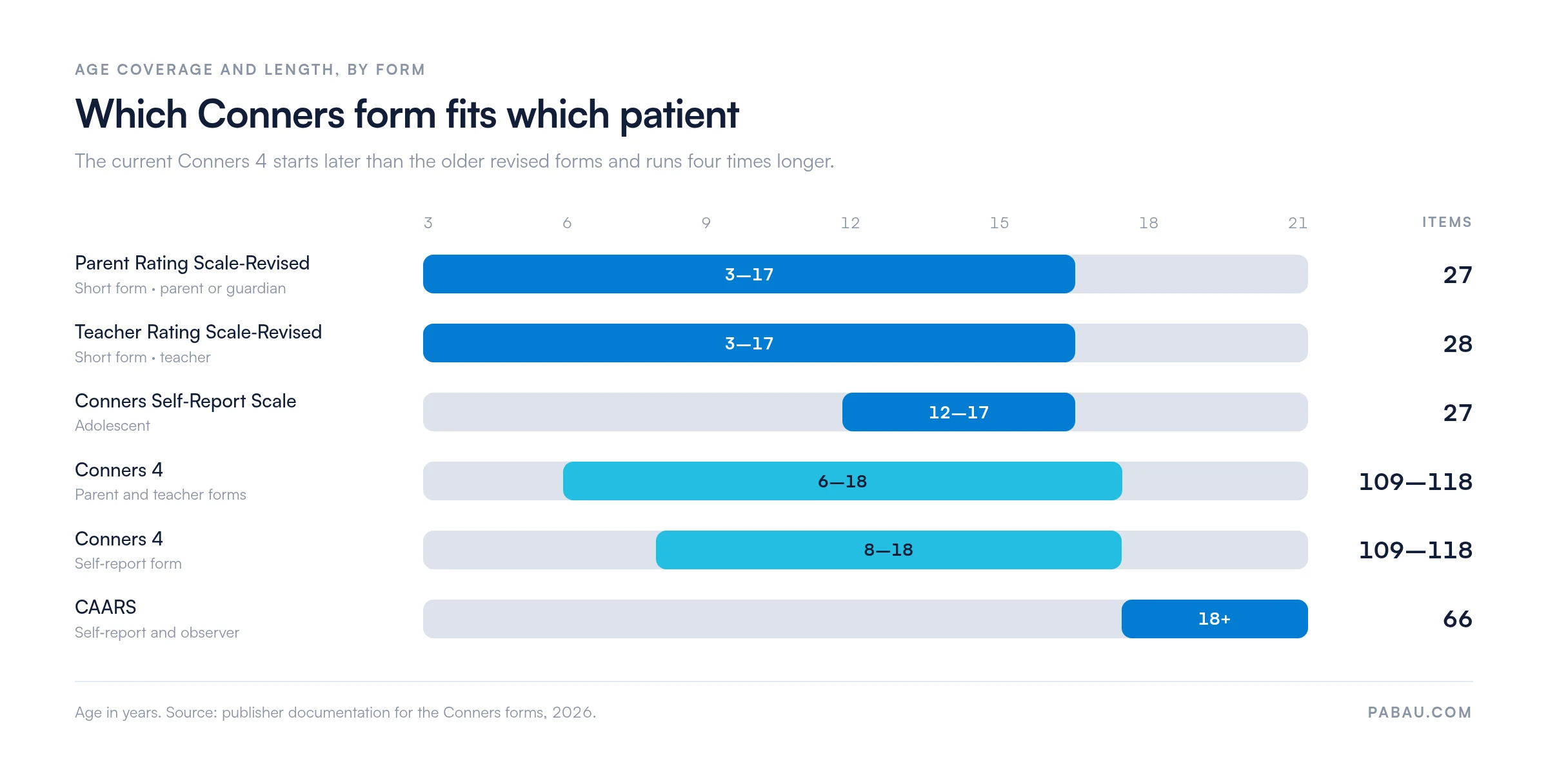
Collecting from parents, teachers, and the child at once is the accepted standard. It shows how symptoms present at home, at school, and in the room with you. Psychology practice software sends each rater their own form and pulls the returns into one summary, which removes most of the chasing.
The parent and teacher forms are the ones you will meet most often in primary care, pediatric neurology, and school psychology. Parents usually complete theirs at home. Teachers complete theirs at school and return it by email, which is where the timeline tends to slip.
Both cover the same symptom domains, worded for their setting. Each item uses the same 0-3 frequency scale. The anchors are 0 for not at all, 1 for just a little, 2 for pretty much, and 3 for very much.
The CAARS is the adult version, written for self-assessment and observer rating in patients aged 18 and over. Adults can complete it alone. An observer rating from a partner, relative, or close colleague adds detail on how the symptoms land day to day.
Adult presentation tends to differ from childhood presentation. Inattention often outweighs visible hyperactivity, and difficulties with organization, time management, and emotional regulation come to the front. The CAARS items are written around those adult patterns.
The questionnaire resolves into five subscales. Record the overall index score and each subscale T-score, because two children with the same index can have completely different profiles underneath it.
The Conners 4 also added autism spectrum disorder (ASD) screening items, which reflects how often the two conditions appear together. Reported co-occurrence sits somewhere around 30% to 50%. Those items help you spot a child who should be referred for a dual assessment rather than an ADHD assessment alone.
Scoring runs in five steps: sum the item responses, convert raw scores to T-scores, plot them, read them against the cutoffs, and compare raters. Digital forms handle the arithmetic. The reading stays with the clinician.
Step five is the one that gets rushed, and it carries the most information. A child who scores 70 at school and 52 at home is pointing at the classroom. The demand, the seating, or the fit of the work is worth asking about. Averaging those two numbers throws the finding away, so record both profiles and write down what you think the difference means.
One elevated T-score does not confirm ADHD. Recent bereavement, disrupted sleep, anxiety, an undetected learning disability, and oppositional behavior all push scores up on their own. Treat a high score as the start of a conversation rather than the end of one.
Limited word comprehension is one of the explanations that conversation should cover. A receptive vocabulary test checks which spoken words a person understands, using a picture-pointing task that needs no verbal reply.
Published sensitivity and specificity estimates for the Conners forms run between roughly 74% and 90%, depending on the version and the cutoff used. Those are respectable numbers for a screening instrument, and they are not diagnostic accuracy figures. Four limitations shape how much weight a score can carry.
All four point the same way for documentation. The score belongs in the record with the reasoning that surrounded it. A clinician reading the file in two years can then see why the conclusion was reached.
The Conners editions are proprietary, so cost and licensing push plenty of practices toward other instruments. Choose on setting, appointment length, and whether you are screening broadly or confirming a suspected case.
The Vanderbilt is the common first move in pediatrics. It is free, it follows American Academy of Pediatrics guidance, and it covers much of the same ground in fewer items. Where the assessment needs to sit inside a wider diagnostic workup, psychiatric evaluation templates carry the rating scale alongside the history and mental state examination.
Most of the delay in an ADHD assessment comes from waiting on a teacher form, so the workflow matters as much as the instrument. Send every rater their form at the point of booking and give a named return date. One line on how the results will be used is usually enough.
Automated reminders do the chasing after that. ADHD clinic software can trigger the parent and teacher requests as soon as the appointment is confirmed. A second reminder goes out a few days before the visit. Digital forms also rule out the two failure modes of paper, which are missing items and handwriting nobody can read.
At the visit, review the profiles with the family and ask what was happening at home and at school during the rating month. Name the alternative explanations you considered. Then write the reasoning into the record, not just the number. Software for therapy practices keeps the forms, the scores, and that note in one patient file, which is what makes the next review quick.
In most practices a Conners assessment is three separate chases. Someone emails the parent a PDF, posts or emails a copy to the teacher, prints a third for the adolescent, then waits. The returns arrive by different routes on different days and get scored by hand. They end up as attachments the next clinician has to open one by one.
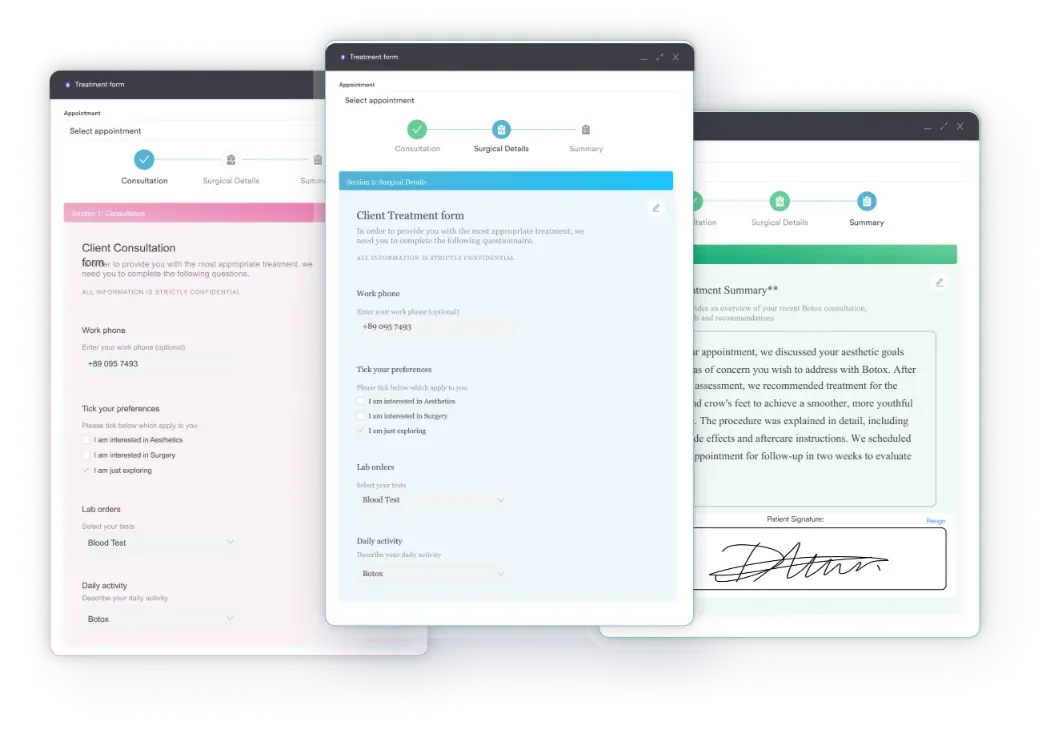
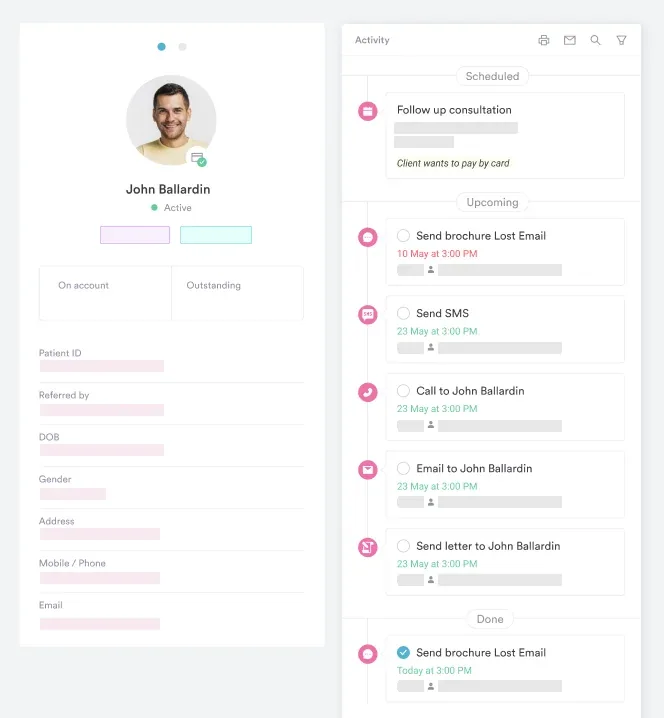
Pabau is practice management software that replaces that with one sequence. You send each rater their own version of the form as a digital intake link. Automated reminders follow up on whoever has not returned it. Completed responses write straight into the patient record, so the parent, teacher, and self-report profiles sit together before the appointment starts.
From there the scores stay attached to the clinical note that interpreted them. A repeat assessment after a medication change lands beside the baseline, not in a separate folder. Every subscription includes forms, records, reminders, and reporting, so none of this sits behind a higher tier.

Pabau sends parent, teacher, and self-report forms as digital intake links and chases the ones still outstanding. Each completed scale files against the patient record with the note that interpreted it. Your ADHD assessments arrive complete and scored before the appointment starts.

Pick the form by the patient’s age and by who can realistically complete it. Then hold the result to what it is, which is a severity measure you can repeat. A single elevated T-score earns a longer conversation, not a diagnosis.
The part worth changing in most practices is not the instrument but the record. Where parent and teacher profiles disagree, write down what you think the difference means. That sentence is the one a colleague will need at the next review. Scores age badly on their own and well alongside reasoning.
Download the template above to standardize how your practice runs and files these assessments. Book a demo to see how Pabau collects multi-rater scales and keeps them with the clinical note that explains them.

List Item #1
List Item #2
No. The Conners forms are proprietary instruments published by Multi-Health Systems (MHS), and the current editions are licensed rather than free. Free alternatives cover similar ground, including the NICHQ Vanderbilt Assessment and the SNAP-IV rating scale.
Yes. The Conners Adult ADHD Rating Scale (CAARS) is written for patients aged 18 and over, in self-report and observer formats. Adult presentation differs from childhood presentation, so the wording and the norms are adjusted accordingly.
The Conners 4 parent and teacher forms are validated for ages 6 to 18. The self-report form covers ages 8 to 18. A younger child falls outside those bands, so the older revised forms or another instrument are the options there.
ADHD maps to ICD-10-CM codes F90.0 for the predominantly inattentive type, F90.1 for the predominantly hyperactive or impulsive type, and F90.2 for the combined presentation. Clinicians code the presentation the full clinical picture supports, not the scale score on its own.
The Vanderbilt is shorter, free, and quick enough for a busy primary care appointment. The Conners forms are longer and more detailed, with separate parent, teacher, and self-report versions and their own normative data. Many pediatric practices screen with the Vanderbilt and reach for the Conners when they need more depth.
Send each rater their own digital form, set a return date, and let automated reminders chase the outstanding ones. Practice management systems score the returns and compile the parent, teacher, and self-report profiles into a single summary before the appointment.