GLP-1 diet plan
A GLP-1 diet plan is a structured eating framework for patients taking semagluti...

2
Last Updated: Oct 13, 2026
A lung cancer genetic test is a laboratory analysis of cancer cells or blood that identifies the gene mutations driving tumor growth.
NCCN and ASCO guidelines both call for comprehensive biomarker testing in every patient with non-small cell lung cancer (NSCLC) at diagnosis. Without those results, the oncology team chooses treatment blind while a matched targeted drug may already exist. This guide covers what the test detects, who needs it, how the sample is collected, and how practices keep testing on schedule.

A lung cancer genetic test reads tumor DNA for actionable mutations that guide targeted therapy, which is a separate job from inherited risk testing.
Every patient with NSCLC needs comprehensive biomarker testing at diagnosis, covering EGFR, ALK, ROS1, KRAS G12C, PD-L1 and six further markers.
Somatic testing reads the tumor’s acquired mutations and guides treatment. Germline testing reads inherited DNA and informs family risk.
A negative liquid biopsy does not rule out an actionable mutation, so tissue sequencing stays the reference standard.
Practice management software like Pabau tracks specimen status, turnaround times and result delivery in the same system as the chart.
A lung cancer genetic test is a molecular analysis that looks for mutations, fusions, or other alterations in the DNA of cancer cells. It can also read circulating tumor DNA carried in the blood. These alterations drive the cancer’s growth, so identifying them tells an oncologist which targeted drugs have a chance of working.
Two different test types share the same name, and the distinction matters clinically:
Most patients with lung cancer need somatic testing. Germline testing is recommended in specific circumstances, such as a strong family history or a never-smoker presentation in a young patient.
Somatic testing analyzes the tumor’s acquired mutations, while germline testing looks at inherited DNA present from birth. The table below shows the key differences at a glance.
A positive EGFR result on somatic testing does not mean the patient carries a germline EGFR variant. Almost every EGFR mutation found in a lung tumor is acquired. A germline EGFR T790M variant has been described in families with hereditary lung cancer, but confirming it takes separate germline testing.
Every patient newly diagnosed with NSCLC should have comprehensive biomarker testing, regardless of stage, smoking history, or histology. This is the recommendation from the National Comprehensive Cancer Network (NCCN) and ASCO. Stage IV patients have the most urgent need because treatment decisions are immediate. Stage I to III patients benefit too, because mutation data informs adjuvant therapy choices and surveillance planning.
Germline testing is appropriate when any of the following apply:
Small cell lung cancer (SCLC) does not routinely benefit from biomarker-directed targeted therapy, though PD-L1 testing is sometimes performed. Check the current NCCN guidelines before ordering for SCLC, because the evidence base is still moving.
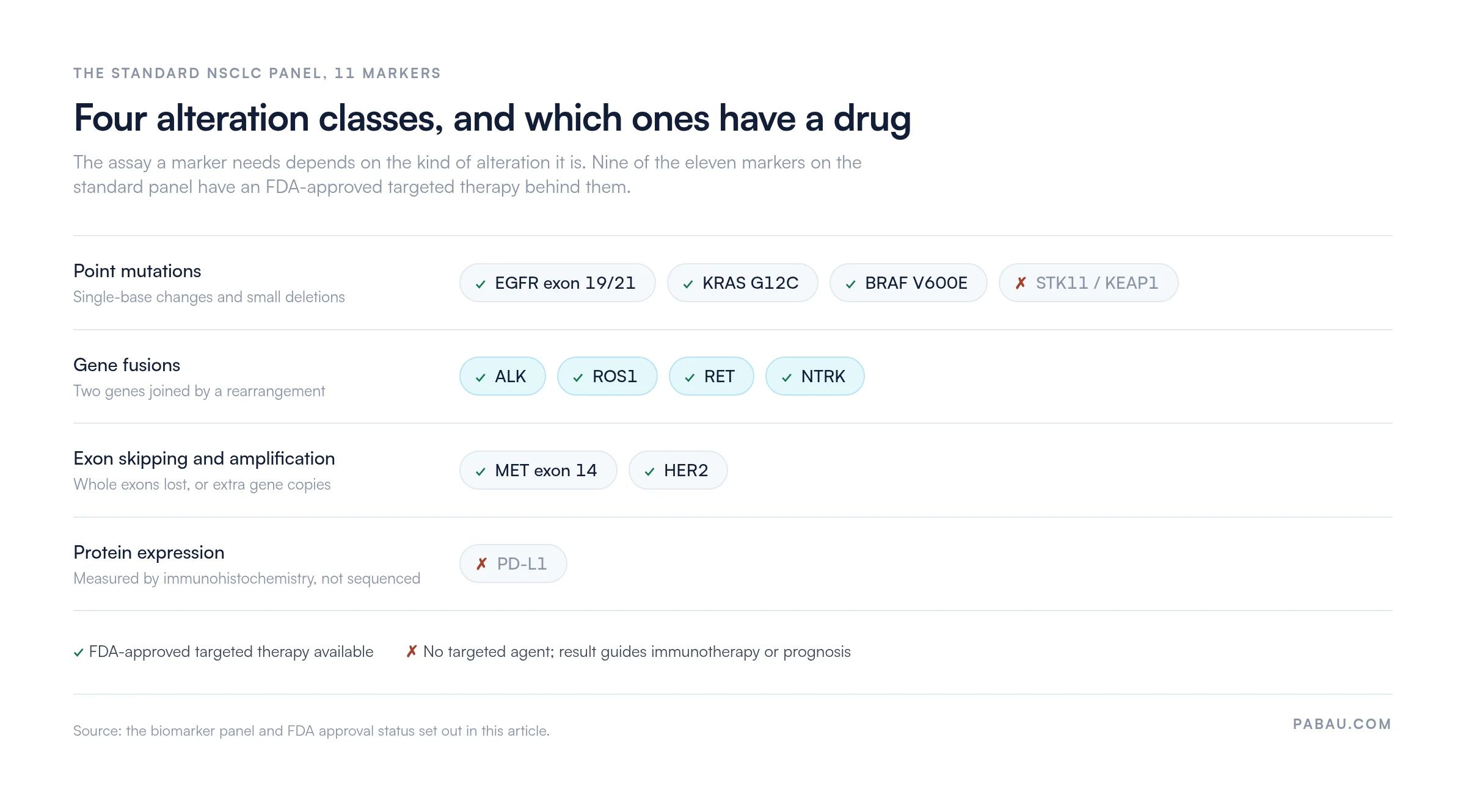
Comprehensive biomarker testing covers point mutations, gene fusions, insertions and deletions, amplifications, and protein expression. The table below maps the standard markers to their alteration type and therapy options. It follows Lung Cancer Research Foundation guidance and verified FDA approvals.
PD-L1 is not a targetable oncogene in the same sense. It predicts immunotherapy response rather than directing a small-molecule drug. EGFR-mutated tumors should generally not receive first-line immunotherapy alone even when PD-L1 is highly expressed, because targeted therapy performs better.
Grouped by the kind of alteration involved, the panel makes the assay requirement clearer, and it shows how much of the panel is currently actionable.
Two sample collection methods support lung cancer genetic testing. Tissue biopsy remains the reference standard, and liquid biopsy is the alternative when tissue is insufficient or repeat testing is needed.
Whichever route the sample takes, someone has to know where it is. Pabau’s lab management software logs specimen status, flags pending results, and tracks turnaround inside the same system used for scheduling and clinical notes.
Next-generation sequencing (NGS) is the recommended approach for comprehensive biomarker testing because it analyzes hundreds of genes at once from a single tumor specimen. Sequential single-gene testing takes longer, uses more tissue, and risks running out of sample before all relevant markers are assessed.
NGS panels such as FoundationOne CDx and Guardant360 detect point mutations, fusions, insertions, deletions, copy number alterations, and tumor mutational burden (TMB) in one run. NCCN and ASCO both recommend NGS as the preferred method for NSCLC biomarker testing.
Results fall into three broad categories, each with a different clinical implication.
Results should always be discussed in a multidisciplinary team (MDT) setting, not in isolation. Oncologist, pathologist, and, where relevant, genetic counselor input shapes the final treatment recommendation.
Most lung cancer is not hereditary, but a subset of patients carry germline variants that raise their risk. Hereditary panels test genes including STK11, associated with Peutz-Jeghers syndrome, TP53, associated with Li-Fraumeni syndrome, and germline EGFR T790M in rare families.
The American Cancer Society’s guidance on genetic testing for cancer risk sets out when germline testing is appropriate. It also covers what the results mean for patients and their relatives. Key considerations:
Genetic counseling is recommended before and after germline testing, as ASCO guidelines and the National Cancer Institute’s genetic testing fact sheet both set out. Somatic testing does not usually require counseling, though a clinical genetics referral may be appropriate when somatic results suggest a possible germline origin.
That conversation needs a record. A structured medical consent form captures what was explained, what the patient agreed to, and who was present. That record matters most when germline implications are raised for the first time.
What a genetic counseling session typically covers:
Access to certified genetic counselors (CGCs) varies by geography and institution. Telehealth genetic counseling is increasingly available and suits most pre- and post-test discussions.
Coordination is where biomarker testing usually loses days. Specimen ordering, lab liaison, turnaround tracking, result receipt and patient notification each add a handoff, and every handoff can push the treatment start date back. Reflex biomarker ordering belongs inside the diagnostic pathway rather than sitting beside it as a separate administrative task.
Practices that standardize this see fewer specimens sent without adequate tissue and fewer patients lost between diagnosis and the results discussion. The workflow changes that make the difference are specific:
Pabau, our practice management platform, holds all of that in one place. The patient records system stores the test result, the MDT discussion, and the reasoning behind each treatment decision. The next clinician reading the chart can see why the plan was chosen.

Time your current biomarker pathway stage by stage, from the decision to test through to the MDT discussion. The longest delay usually sits between the specimen arriving at the lab and the report reaching the requesting clinician. That stage is where an automated workflow trigger buys back the most days.

Pabau lets oncology and respiratory practices log lab orders, track specimen turnaround, trigger follow-up when a report lands, and keep clinical records together. See how it handles a biomarker testing pathway.

Biomarker testing is now part of the NSCLC diagnosis itself, not an optional extra ordered later. The practical question has moved from whether to test to how fast the result gets back and who acts on it.
Two decisions carry most of the weight. Choose the sample route deliberately, remembering that a negative liquid biopsy still leaves tissue sequencing on the table. And agree in advance who orders the panel, so testing never waits on a conversation between specialties.
Pabau’s lab management and automated recall features track specimens, receive results, and trigger patient follow-up in one system. Book a demo to see how it handles a complex diagnostic pathway end to end.

Documenting an oncology care plan alongside the test result? Cancer nursing care plan sets out the assessments, interventions and review points worth recording.
Need to put a confirmed diagnosis in writing for a patient or employer? Diagnosis letter from a doctor shows what belongs in the letter and what to leave out.
Still tracking consent and results across paper and email? Clinical documentation software compares what the main systems do with structured records.
A lung cancer genetic test is a molecular analysis of cancer cells or circulating tumor DNA. It identifies the gene mutations, fusions, or alterations driving tumor growth. Those results guide treatment selection by showing which targeted therapies, immunotherapy, or chemotherapy regimens suit the individual patient.
All patients with non-small cell lung cancer (NSCLC) should have comprehensive biomarker testing at diagnosis, per NCCN and ASCO guidelines. Small cell lung cancer patients do not routinely benefit from biomarker-directed targeted therapy, though PD-L1 testing is sometimes performed. Testing at every stage is now standard, because mutation data informs treatment selection and surveillance planning alike.
Somatic testing analyzes acquired mutations in the tumor itself and guides treatment. Germline testing analyzes inherited mutations present in every cell of the body and informs hereditary cancer risk for the patient and their relatives. Most lung cancer patients require somatic testing. Germline testing is recommended in specific circumstances such as young onset, never-smoker status, or a significant family history.
A liquid biopsy is a blood test that detects circulating tumor DNA (ctDNA) shed by cancer cells. Biomarker analysis can therefore run without a tissue sample. It is used when tumor tissue is insufficient, the biopsy site is inaccessible, or rapid reassessment is needed at progression. A negative liquid biopsy does not rule out an actionable mutation, because sensitivity is lower than tissue next-generation sequencing.
Coverage varies by payer, plan, and geography. In the US, Medicare covers FDA-approved companion diagnostic tests and, in many cases, comprehensive NGS panels for advanced cancer. Private insurer coverage of comprehensive biomarker testing has expanded but is not universal. Patients should verify coverage with their insurer before testing, and practices should document medical necessity clearly to support reimbursement claims.
A comprehensive panel typically covers EGFR, ALK, ROS1, KRAS G12C, BRAF V600E, MET exon 14 skipping, RET, NTRK, HER2, and PD-L1. Most panels also report tumor mutational burden (TMB), and some add STK11 and KEAP1. Next-generation sequencing (NGS) panels analyze all of these from a single specimen, which is why they are preferred over sequential single-gene testing.