What is a business associate agreement (BAA)?
A business associate agreement (BAA) is the contract HIPAA requires between a he...

Last Updated: Oct 6, 2026
Physician compensation models decide how a physician’s work turns into pay, and the choice shapes recruiting, retention and margins for years. The five core models each pay for something different. Salary pays for time, fee-for-service and RVU-based models pay for volume, collections-based models pay for cash, and value-based pay rewards quality.
Hybrid models are now common. They pair a guaranteed base salary with a productivity bonus and, often, a quality bonus. Get the formula wrong and you overpay low producers, lose strong ones, or sign a plan that fails a fair market value review. Below, you’ll see how each model calculates pay, where it breaks, and what to check before signing.

Physician compensation models include pure salary, fee-for-service, RVU-based, collections-based and value-based pay, and each one rewards something different.
Hybrid plans are now common, pairing a guaranteed base salary with a productivity bonus tied to wRVUs or collections.
Under the Stark Law, compensation arrangements involving designated health services referrals must meet an exception, which typically requires fair market value.
Most pay disputes trace back to vague contract terms, such as an undefined wRVU threshold, conversion factor or quality metric.
Practice management software can supply per-clinician revenue and activity data, which you then use in your compensation calculations.
Five models cover most physician pay arrangements in the US. Each one gives a different answer to a simple question: what is the practice paying for? It might be time, volume, collected cash, quality, or a mix of these.
A pure salary pays a fixed annual amount, however many patients the physician sees. It dominates hospital employment and academic medicine, where institutional goals outrank individual output. The physician gets a predictable income. The practice gets budget certainty but loses the built-in push toward higher clinical volume.
Under fee-for-service, pay is tied to the number and type of services billed. The practice collects from payers and patients. The physician then receives a direct share of collections, or a salary set from expected volume.
That rewards seeing more patients and coding at the right complexity level. The weak spot is cash flow. A poor payer mix, a high denial rate or a slow commercial payer can cut income with no change in clinical work.
RVU-based physician compensation pays for the relative value units a physician generates. Each CPT code carries a work RVU (wRVU) value that reflects the time, skill and intensity it takes. The formula is simple: wRVUs generated × conversion factor ($ per wRVU) = compensation.
The CMS Physician Fee Schedule sets national wRVU values and updates them every year. Practices set their own conversion factor, usually benchmarked against MGMA specialty data.
Take a hospitalist who generates 4,200 wRVUs in a year at $52 per wRVU. The productivity component comes to $218,400. At the same conversion factor, a dermatologist and a family physician with equal totals earn the same. Their work looks nothing alike, which is both the model’s fairness and its blind spot.
Collections-based compensation pays physicians a percentage of the revenue the practice collects. The base can be gross charges or net collections after adjustments. Net collections is the more common base, because gross charges include write-offs nobody will ever pay.
Billing accuracy, denial rates and payer contract terms all flow straight into the physician’s pay. Many of those sit outside the physician’s control. Strong patient collections help, but a Medicaid-heavy panel or weak billing operations still shows up in the paycheck.
The percentage itself varies by specialty, market and overhead. Benchmark it against current MGMA data for your specialty rather than a rule of thumb.
Value-based compensation ties part of physician pay to quality metrics, patient outcomes and cost of care.
For Medicare-participating physicians, the best-known version is CMS’s Merit-based Incentive Payment System (MIPS). MIPS scores physicians on quality, cost, improvement activities and promoting interoperability, then adjusts their Medicare payments.
Commercial value-based contracts follow similar logic with different metrics, often HEDIS scores and patient satisfaction. Pure value-based pay is rare. It usually sits on top of salary or RVU pay as a quality bonus, sized by the payer contract.
Expect a delay, too. Quality is scored after the performance period closes, so the bonus can arrive long after the work that earned it.
Pure models are getting rarer. Hybrid models are now common, combining a guaranteed base salary, a productivity component and, often, a quality bonus. The base gives the physician income security, while the bonus keeps an incentive for strong performance.
Here is an illustrative hybrid structure for a family medicine physician:
Say this physician logs 4,800 wRVUs and hits 80% of the quality target. Pay works out to $140,000 + ($48 × 800) + $12,000 = $190,400. The breakdown below shows how much of that total was guaranteed before the year started.
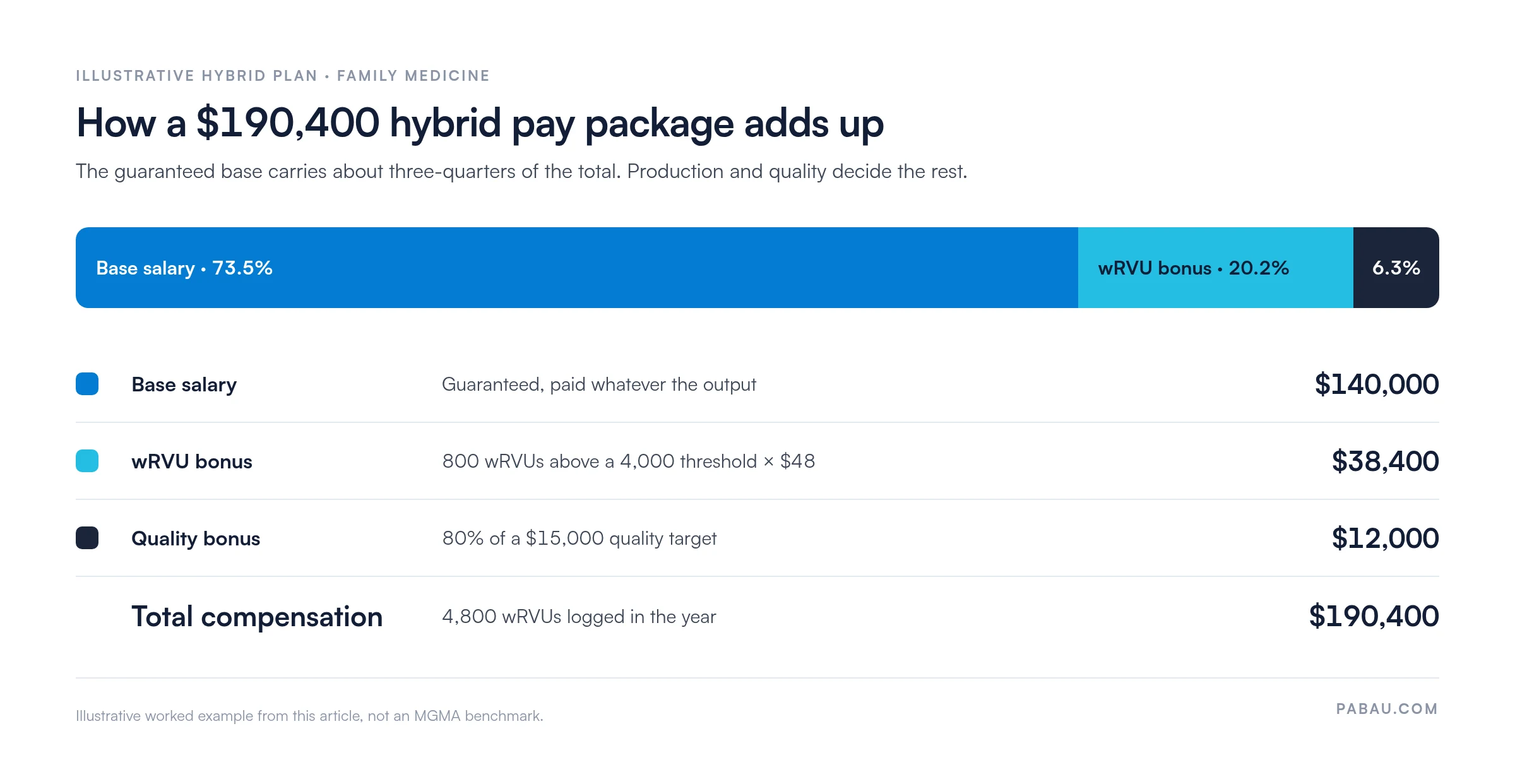
The contract should define three things clearly: the wRVU threshold, the conversion factor and the metrics behind the quality bonus. Vague wording on any of them is a common source of compensation disputes.
On paper, the formula is one line. In practice, each part of it is paid on a different clock:
The approved bonus then runs through payroll as supplemental pay, so your healthcare payroll software needs to handle variable, periodic amounts cleanly.
Three things trip this process up. Late charge entry pushes wRVUs into the wrong period. Visits shared with a nurse practitioner or physician assistant need a crediting rule, or two clinicians claim one encounter. And production figures pulled by hand from separate systems are easy to dispute.
The employment structure changes how any compensation model plays out. Employed (W-2) physicians are paid after the practice covers overhead, malpractice coverage and benefits. Independent contractors (1099) carry those costs themselves. To make up for it, they usually get a higher gross rate.
DHS stands for designated health services, such as clinical lab work and imaging, and FMV for fair market value.
A 1099 physician earning $350,000 gross faces roughly $32,000 in self-employment tax (the 12.4% Social Security portion stops at the annual wage base). That comes before income tax. Malpractice premiums come on top, and they vary widely by specialty and claims history.
So a W-2 physician on a lower salary, with employer-paid benefits and malpractice cover, may come out ahead. Model total compensation, including all of those costs, before comparing offers. Talk to a tax professional as well. IRS classification rules are strict, and misclassification penalties fall on the practice.
The same model produces very different results across specialties, because wRVU values, procedure volumes and overhead all vary. Procedural specialties generally earn more under productivity pay, since their procedures carry higher wRVU values. Here’s how that plays out by specialty:
MGMA’s provider compensation data is one of the most widely used references for setting physician pay in the US. It reports median, 25th, 75th and 90th percentile figures by specialty, practice type and region.
The benchmarks only help once you track the same measures inside your own practice. Regular practice management reports give you that internal side of the comparison. From there, a practical approach looks like this:
Run your percentile comparison every year, not just at contract renewal. MGMA data shifts from year to year. A physician hired at the 60th percentile three years ago may now sit below the median in your market. Catching that drift early reduces retention risk.
No single model suits every practice. The right one depends on five variables, and each points you in a different direction.
Most compensation arguments start long before the first bonus is paid. These are the usual culprits:
Whether you’re the practice owner or the physician, run through this list before anyone signs:
Restrictive covenants deserve a separate read, since the enforceability of physician non-compete agreements varies by state. If any item is missing, ask for it in writing. Physicians should have a healthcare attorney review the contract, and practices should get legal sign-off before finalizing a plan.
In many practices, the compensation calculation starts with exports. Someone pulls billing, scheduling and payment data into a spreadsheet, then matches it to each physician. Every manual step adds room for error, and the physician has no easy way to check the result.
Pabau, the all-in-one practice management system we build, keeps appointments, invoices and treatment records in one place. Pabau’s reporting segments revenue, appointment volume and treatment activity by individual clinician. That supplies the per-clinician revenue and activity data you then use in your compensation calculations. The wRVU mapping is done outside Pabau.
Claims management tools support claim submission and tracking, which matters when pay depends on collections. Timesheet tracking records scheduled hours alongside billing activity. Physicians can follow their own schedules on Pabau GO, our iOS app for practitioners. Bonus conversations then start from figures both sides can trace.

Pabau’s reporting breaks down revenue, appointments and treatment activity by clinician. That gives you clean inputs for whichever compensation model you run.

Pick the model that rewards what your practice needs most, then write it down precisely. Salary suits stable, team-based care. Productivity pay suits practices that want volume and can measure it. A hybrid splits the difference, which is why it has become common.
Remember the trade-off. Every productivity element adds a measurement job. If your data can’t stand up to a physician’s questions or a fair market value review, a simpler plan will serve you better.
Pabau supplies the per-clinician revenue and activity data you then use in your compensation calculations, while wRVU mapping is done outside Pabau. Book a demo to see how clinician-level reporting can feed your next compensation review.

Negotiating a physician employment contract? Physician non-compete agreements explains which restrictive covenants hold up and what to push back on.
Need payroll that handles bonuses and mixed pay types? Best healthcare payroll software compares platforms built for clinical teams.
Preparing for a pay negotiation? The negotiation worksheet helps you set goals, options and final terms before the meeting.
Deciding between solo and group practice? Group practice vs private practice breaks down how each model affects income and control.
Considering outsourcing the business side? What is an MSO in healthcare covers how management services organizations work and the compliance rules around them.
It’s a revenue-minus-expenses model. Each physician keeps the collections they generate, minus their share of practice overhead. It rewards high producers strongly. It also exposes each physician to their own payer mix and slow months, so it suits established independent physicians more than new hires.
A tiered conversion factor raises the dollar rate per wRVU as production crosses set thresholds. For example, wRVUs above the 75th percentile might earn a higher rate than those below it. Tiers reward top producers, but the top rates still need a fair market value review.
It depends on the contract. Under a pure guarantee, base pay continues and no bonus is paid. Some contracts add a reconciliation, or true-up, clause that lowers future base pay or asks for repayment. Read that clause closely before signing.
Not automatically. A 1099 physician earning $350,000 gross pays both the employer and employee halves of FICA. That’s 15.3% up to the Social Security wage base, and 2.9% above it. They also fund their own malpractice, health insurance and retirement. That can leave less take-home pay than a W-2 physician earning $280,000 with employer-provided benefits.
It varies widely by specialty, staffing model, facility costs and payer mix, so there’s no single right figure. Compare your own ratio against MGMA cost data for your specialty. Track overhead as a share of collections, not billed charges, so the comparison holds up.