CMMC compliance checklist
A CMMC compliance checklist lists every security practice a Department of Defens...

Last Updated: Oct 6, 2026

A HIPAA compliance policy documents how your practice protects protected health information (PHI) and meets federal requirements.
Covered entities and business associates must address three core rules. Those are the Privacy Rule, the Security Rule, and the Breach Notification Rule.
Required policies include access controls, workforce training records, risk assessments, business associate agreements, and annual policy reviews.
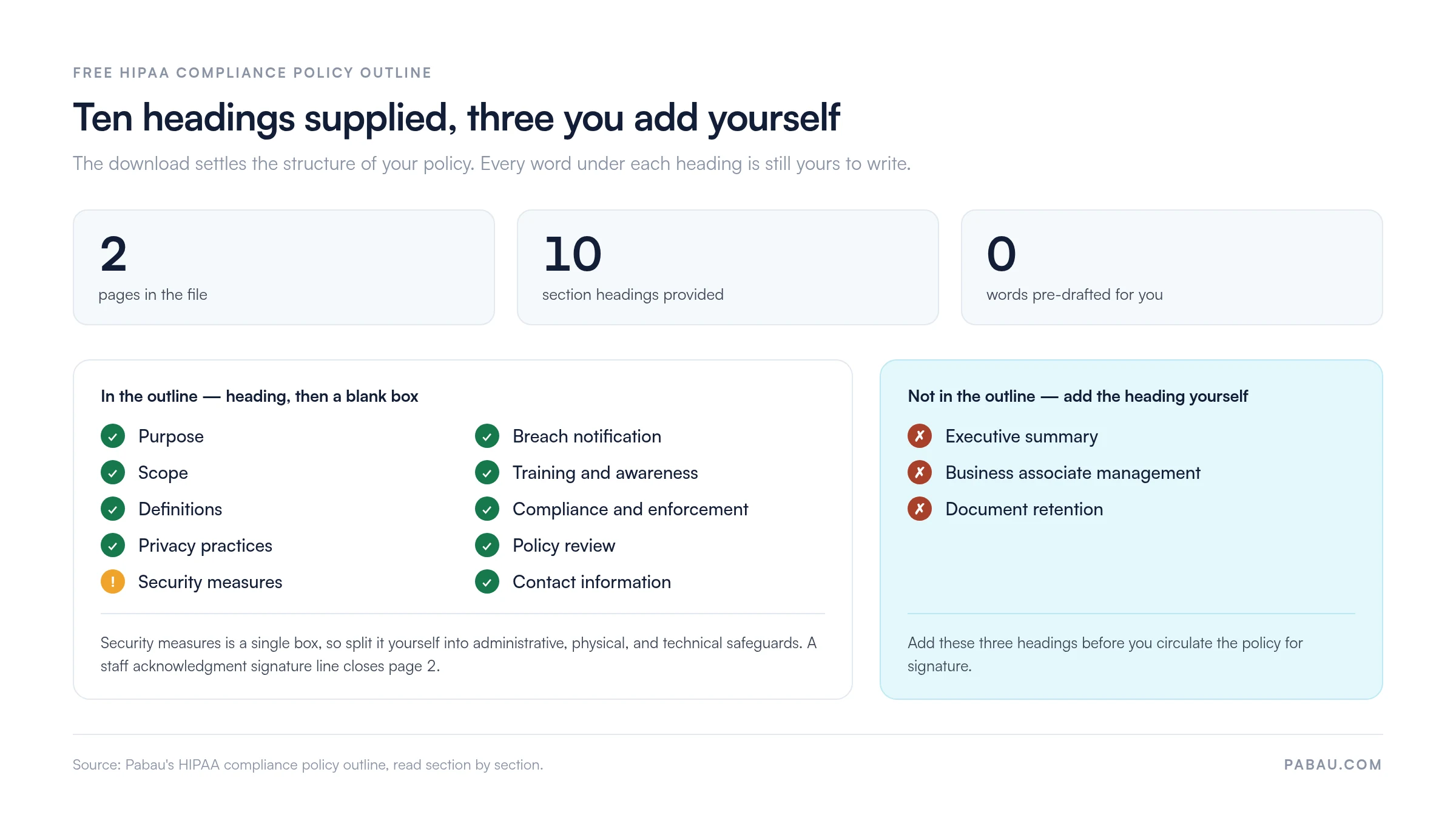
The download is a two-page starter outline. It supplies ten section headings and blank space, so your practice still drafts every word.
Practice management software like Pabau embeds technical safeguards into daily operations through audit logs, role-based access, and encrypted records.
A two-page starter outline with ten headed sections: purpose, scope, definitions, privacy practices, security measures, breach notification, training, enforcement, policy review, and contacts. Each section is blank, so your practice drafts the wording that matches how it runs.
Download templateHealthcare practices handle sensitive patient information every day, from medical histories to insurance details to treatment plans. HIPAA is the federal law that governs how you safeguard that data. Knowing HIPAA exists and complying with it are two different jobs.
The outline above hands you ten section headings. Three sections a complete policy needs are missing from it, and every word under each heading is still yours to write. This guide walks the three HIPAA rules your policy must cover. Then it shows what the download does and does not give you.
A HIPAA compliance policy is a written document covering the rules, procedures, and safeguards your practice applies to protected health information (PHI). It is a framework covering how staff handle data, who can access it, what happens after a breach, and how you answer regulators.
Think of it as your practice’s playbook for data protection. Instead of each staff member deciding how to handle patient records, a compliance policy creates consistency. Staff know where sensitive data lives, who can open it, how it gets transmitted, and what a violation costs.
The Office for Civil Rights (OCR) enforces HIPAA at the federal level. It expects every covered entity and business associate to keep documented compliance procedures on file. Policies must be reviewed annually and updated whenever your operations change.
Every covered entity and every business associate needs one. HIPAA sorts the organizations it binds into those two categories.
A solo practice, a multi-location group, and a healthcare technology vendor all sit under the same expectation. If you handle PHI electronically, you need a documented policy on file.
Every HIPAA compliance policy covers three regulatory pillars: the Privacy Rule, the Security Rule, and the Breach Notification Rule. None of the three is optional. Together they form the foundation of federal compliance.
The Privacy Rule (45 CFR Part 164 Subpart E) governs how healthcare organizations use and disclose patient health information. Your policy must define:
The Security Rule (45 CFR Part 164 Subpart C) requires three categories of safeguards for electronic PHI (ePHI): administrative, physical, and technical. A HIPAA compliance policy must detail how your organization implements each one.
Not every safeguard is mandatory. The rule separates required specifications, which you must implement, from addressable ones, which you assess and implement where reasonable. Encryption and audit logging sit at the center of EHR security, so document how your system handles both.
The Breach Notification Rule applies when unsecured PHI is accessed, acquired, used, or disclosed without authorization. Your policy must set the notification timeline, which runs without unreasonable delay and no later than 60 days. It must also name who gets told. That means affected patients and the Department of Health and Human Services (HHS). Media notice is required when more than 500 residents of one state or jurisdiction are affected. Every decision you reach gets documented.
The Security Rule mandates specific written policies. These are regulatory requirements rather than suggestions, and your practice must document and enforce each one.
Before you can write effective security policies, you need to know which risks your organization carries. The Security Rule requires a formal security risk analysis (SRA). That is a documented review of where PHI lives, who can access it, what could go wrong, and how you prevent it.
An effective HIPAA security risk analysis follows five steps:
The result is a written risk assessment that anchors your policy. It justifies every security control you put in place and shows the OCR that you took security seriously.
Your policy is only as strong as your team’s understanding of it. The Security Rule requires that every staff member receive HIPAA training, that the training be documented, and that refreshers happen annually.
Your policy must specify:
If a vendor processes PHI on your behalf, you need a signed Business Associate Agreement (BAA) with them. That covers your billing company, your EHR provider, your cloud storage vendor, and even your document shredding company. The BAA is your legal protection and their compliance commitment.
Your policy must document:
The work breaks into eight steps. The outline above hands you the section structure, and the wording under each heading comes from how your own practice runs.
Use digital forms to track staff acknowledgment of the policy. Have each employee sign a form confirming they have read and understood it. That signed record becomes part of your documentation trail.
A complete HIPAA compliance policy covers the sections below. Treat this as your drafting checklist, and keep the supporting evidence for each section on file.
The file above is a starter outline, not a finished policy. It runs to two pages and holds ten headed sections, each with an empty box underneath. No policy wording is pre-drafted, so downloading it saves you the structure work and none of the writing.
Three sections a complete policy needs are absent from the outline: an executive summary, business associate management, and document retention. Add those headings before you circulate the document. The last page carries a signature line, so staff can acknowledge the policy once you have written it.
HIPAA compliance needs maintenance. Your policy must be reviewed at least annually. Update it whenever your practice changes, whether that means new software, new vendors, staff turnover, expanded services, or a physical relocation.
Your policy should include:
Writing the policy is the first job. Showing that your team follows it every day is the harder one. Practice management software like Pabau embeds HIPAA safeguards into the workflow your staff already use, so the evidence accumulates as they work.
Compliance features that carry the documentation load include:
Compliance management software turns HIPAA from a checkbox into an operational habit. An audit request becomes a report you run, not a search through folders.

Pabau logs every record access, limits patient data by staff role, and keeps your compliance evidence in one place. Your team follows the policy you wrote without adding paperwork to the day.

A HIPAA compliance policy only protects you if it describes how your practice works. The outline above saves you the structure work, and that is the smaller half of the job. The judgment calls about access, training, vendors, and breach response are yours, and the OCR reads them as yours.
So draft it once, have counsel review it, then keep it alive. Annual review, version control, and training records are what turn a written policy into a defensible one.
The practices that stay compliant are usually the ones whose systems record the work automatically. Book a demo to see how Pabau keeps your HIPAA evidence current while your team gets on with patient care.

Drafting the patient-facing half of your paperwork? HIPAA privacy policy template covers the disclosure rules your compliance policy points to.
Need the notice you hand to patients? Notice of Privacy Practices template gives you the patient-facing document the Privacy Rule requires.
Moving your records off paper first? How to run a paperless practice that stays HIPAA compliant walks through the digital safeguards your policy has to describe.
Wondering what happens after a slip? What to do if you violate HIPAA sets out the reporting steps your breach section should mirror.
Writing the document retention section? How long to keep medical records gives you the retention periods to name in the policy.
No. It gives you ten headed sections with blank space under each one, so you write the policy content yourself. You also need to add an executive summary, business associate management, and document retention. Split the security measures box into administrative, physical, and technical safeguards.
Civil money penalties are tiered by culpability and adjusted for inflation each year, so check the current figures with HHS. Minimums start in the low hundreds of dollars per violation, and the annual cap for one violation type runs into the millions. A breach without documented policies also costs you patient trust.
Yes. HIPAA applies to every covered entity, whatever its size. A solo therapist with one staff member still needs policies documenting how PHI is protected, how access is controlled, and how breaches are handled.
At minimum, annually. Update it sooner whenever your practice adds systems, vendors, staff roles, or services. After a security incident or an audit finding, update it without delay and fix the weakness it exposed.
Yes. Business associates such as billing companies, software vendors, and IT contractors must hold their own written policies for safeguarding PHI. Their BAAs with healthcare organizations require it.
The Office for Civil Rights (OCR) within the Department of Health and Human Services (HHS) investigates HIPAA complaints and enforces the law. OCR can conduct audits, impose fines, and require corrective action plans.
A HIPAA compliance policy is your internal operating manual for protecting PHI. A Notice of Privacy Practices is what you hand patients, explaining their rights and how you use their information. You need both.