GLP-1 diet plan
A GLP-1 diet plan is a structured eating framework for patients taking semagluti...

2
Last Updated: Oct 13, 2026

The hand elevation test is a 2-minute provocative test where the patient elevates both hands above the head to screen for carpal tunnel syndrome (CTS)
A positive result reproduces or worsens paresthesia (numbness, tingling, or pain) in the median nerve distribution within two minutes
Original research published in 2001 reported sensitivity of ~75% and specificity of ~98.5%, outperforming Phalen’s test on specificity
Nerve conduction studies (NCS) remain the gold standard for confirming CTS; the hand elevation test guides triage, not diagnosis alone
Most clinicians reach for Phalen’s test by default when they suspect carpal tunnel syndrome.
Yet one of the best-performing provocative tests in the CTS toolkit rarely gets the same attention. The hand elevation test delivers a specificity of approximately 98.5% in its original validation study, making false positives far less likely than with Phalen’s or Tinel’s alone.
For practitioners ordering a CTS workup, that distinction shapes every referral decision that follows. This guide covers how to perform the hand elevation test accurately, how to read the result, and how it fits alongside other provocative tests and electrodiagnostic confirmation.
The hand elevation test (HET) is a provocative clinical maneuver used to screen for carpal tunnel syndrome, the most common peripheral nerve entrapment disorder. It was first described by Ahn in 2001 (published in the Annals of Plastic Surgery) and has since been validated in multiple independent studies.
The test works by increasing carpal tunnel pressure through positional change. Elevating the arms above the head reduces venous return and alters fluid dynamics within the tunnel, which temporarily compresses the median nerve and reproduces symptoms in affected patients.
Unlike Phalen’s test (wrist flexion) or Tinel’s sign (percussion), the hand elevation test does not require precise wrist positioning or percussion technique. That simplicity makes it easier to standardize across examiners, which matters in busy outpatient or MSK settings where test reproducibility directly affects diagnostic consistency.
The hand elevation test is most useful during an initial CTS assessment when the diagnosis is uncertain. Clinically, consider it for patients who present with:
The test is less appropriate when shoulder pathology limits overhead elevation, when the patient has bilateral severe CTS (both hands are symptomatic at rest, making provocation interpretation difficult), or when an acute injury is present.
Accurate technique is essential. Deviations from the standard protocol affect both the sensitivity and specificity figures cited in the literature.
The full procedure takes approximately three to five minutes including setup and documentation. That time investment compares favorably to nerve conduction testing and is appropriate as a triage tool before referral decisions.
Interpretation hinges on two variables: symptom location and timing.
Positive hand elevation test: The patient reports reproduction or worsening of numbness, tingling, or pain in the median nerve distribution (thumb through radial ring finger) within two minutes of elevation. A positive result increases the clinical probability of CTS and typically warrants further workup or a treatment trial, depending on severity and clinical context.
Negative result: No symptoms in the median nerve territory within two minutes. A negative result reduces the clinical probability of CTS but does not rule it out, particularly in early-stage disease where nerve compression may be intermittent. The test’s 75% sensitivity means roughly one in four CTS cases may not trigger a positive response.
Ambiguous or atypical results: Symptoms appearing in a non-median distribution, or pre-existing numbness that does not change during elevation, require careful documentation and should not be counted as positive. Bilateral symptom onset at the same time in a patient with bilateral CTS can make laterality assessment difficult.
Use safer clinical note-writing practices to record the exact distribution, onset timing, and bilateral vs. unilateral findings for every HET you perform. Vague documentation (“patient reported tingling”) is inadequate for medico-legal purposes and fails to support downstream coding or referral justification.
The diagnostic accuracy data comes primarily from Ahn’s 2001 study (PubMed PMID 11216604). A 2012 study by Ma and Kim (PMC3539082) corroborates the test’s strong diagnostic performance, though it reported somewhat different values (sensitivity ~87%, specificity ~89%) rather than reproducing Ahn’s original figures.
When interpreting these numbers, apply standard sensitivity vs specificity logic: a highly specific test rules in disease when positive, and a highly sensitive test rules it out when negative.
The hand elevation test’s high specificity makes it particularly valuable for ruling in CTS in settings where avoiding unnecessary NCS referrals is a priority.
When a positive hand elevation test aligns with a consistent symptom history and thenar wasting or weakness confirmed on manual muscle testing, the clinical picture is strong enough to justify a treatment trial in most guidelines.
For a broader perspective on interpreting diagnostic scoring systems, the same principle applies: specificity limits false positives, and sensitivity limits missed cases.
No single provocative test is sufficient to diagnose CTS in isolation. Understanding when to choose the hand elevation test over Phalen’s, Tinel’s, or Durkan’s requires knowing where each test performs best.
Phalen’s test requires the patient to hold both wrists in full flexion for up to 60 seconds. It is highly familiar to most clinicians and has good sensitivity, but its specificity is notably lower than the hand elevation test.
Patients with conditions like De Quervain’s tenosynovitis, which is confirmed separately with Finkelstein’s test, or wrist arthritis can produce false positives on Phalen’s. The hand elevation test is often preferred when specificity matters more than sensitivity.
Tinel’s sign involves percussing the carpal tunnel at the wrist to provoke distal paresthesia. It carries the highest examiner variability of the four tests and is now considered a weaker standalone test, though it retains value in combination. Its sensitivity ranges from 50-73% across studies, making it unreliable as a primary screening tool.
Durkan’s compression test applies direct pressure over the carpal tunnel for 30 seconds. It achieves strong specificity (83-90%) and reasonable sensitivity, but requires consistent thumb pressure application that can be difficult to standardize. Consider Durkan’s and the hand elevation test together when you want two high-specificity tests to increase diagnostic confidence before NCS referral.
These provocative tests complement one another rather than replacing each other. Comparing these tools parallels the reasoning behind structured clinical decision tools in musculoskeletal assessment: each rule has a specific sensitivity/specificity profile, and combining them improves the overall clinical picture.
Clinicians using physical therapy practice management software that supports templated assessments can standardize how each test result is recorded across a multi-practitioner team. Pairing provocative tests with a functional measure like the alternate hand wall toss test adds an objective coordination baseline when symptoms affect hand use.
A timed pick-up test covers the sensory side of the same question, recording how quickly a patient handles small metal objects by touch alone. Clinicians use it as a carpal tunnel baseline before surgery and an outcome measure after decompression.
A modified hand elevation test (MHET) protocol has been described in the literature, most notably in a 2018 study. Rather than changing how symptoms are scored, the modification changes the position itself: the patient adds full bilateral wrist flexion on top of the standard overhead arm position, combining the hand elevation test with a Phalen-like maneuver.
The goal is to accelerate the ischemia that provokes median nerve symptoms, so a positive or negative result is reached sooner than with the standard two-minute hold.
Key differences from the original protocol include:
Reported accuracy for the modified test is lower than Ahn’s original figures: roughly 75-77% sensitivity and 64-68% specificity. It has not been validated in studies as large as the original Ahn study, so it is best treated as a faster screening option rather than a replacement. For standard triage and initial assessment, the original two-minute protocol remains the evidence base.
Document the exact onset timing during the hand elevation test, not just positive or negative. Onset under 60 seconds with rapid symptom resolution on lowering is a clinically meaningful pattern that supports both CTS diagnosis and severity staging, and it adds precision that a binary result cannot provide.
A single positive or negative hand elevation test rarely settles the diagnosis. The evidence-based approach uses the post-test probability framework: start with pretest probability based on history and demographics, then apply test results to update your clinical picture.
A practical combination for high-confidence CTS assessment:
The same logic applies across musculoskeletal special tests generally. Reviewing a test like the foot stress fracture test shows the same pattern: multiple validated tools, used systematically, reduce diagnostic uncertainty more reliably than any single measure.
The hand elevation test is not suitable for every patient or clinical context. Awareness of its limitations prevents over-interpretation.
Shoulder or cervical pathology: Patients with rotator cuff tears, frozen shoulder, or cervical radiculopathy may be unable to fully elevate their arms. Forced elevation in these cases is uncomfortable and may produce non-CTS symptoms that confound the result. Screen for shoulder range of motion before administering the test.
Pre-existing bilateral paresthesia: In severe bilateral CTS, both hands may already be symptomatic at rest. Detecting a change during elevation becomes unreliable. This is where baseline symptom documentation before the test starts is critical.
False positives in thoracic outlet syndrome: Overhead elevation can also compress the brachial plexus in thoracic outlet syndrome (TOS). TOS symptoms typically involve the ulnar distribution rather than the median, but mixed cases exist. Confirm symptom location precisely to avoid misattribution.
Mechanical ulnar-sided wrist pathology: Instability at the distal radioulnar joint can also cause ulnar-sided pain and clicking. Where the ulnar head feels loose, run the DRUJ instability test before attributing symptoms to nerve compression.
Patient compliance: Two minutes is longer than most patients expect. Some lower their arms early due to discomfort, fatigue, or misunderstanding the instruction. An early arm drop without symptom reproduction should be noted as an incomplete test rather than a negative result.
Using standardized clinical documentation tools within a consistent workflow reduces these confounds over time by making the comparison between initial and follow-up assessments more meaningful. Documenting these edge cases carefully is also essential in occupational therapy documentation settings where CTS assessment frequently intersects with workplace injury claims.
For practices managing hand and upper-limb assessments at volume, the bottleneck is rarely the clinical test itself. It is the documentation that follows.
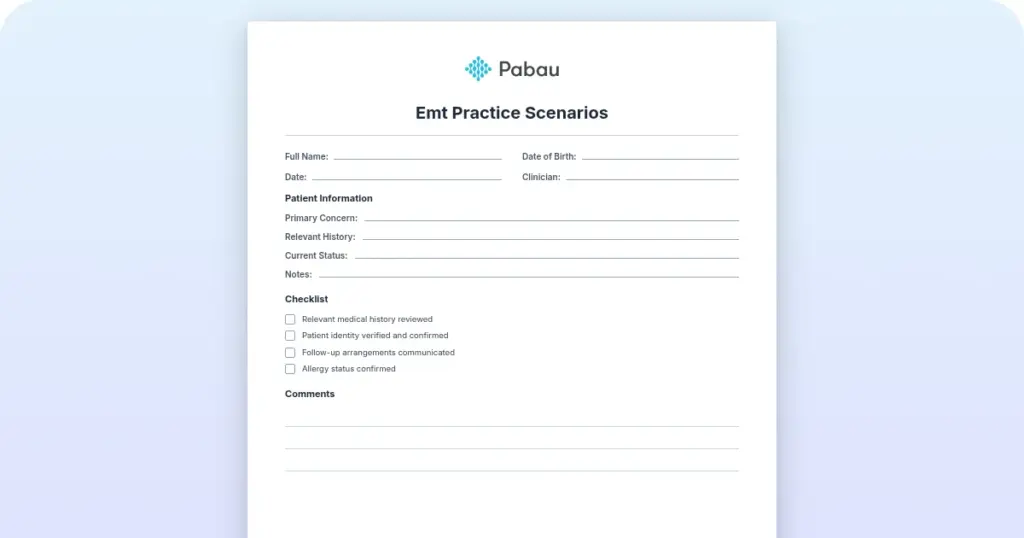
Recording bilateral hand elevation test findings, onset timing, symptom distribution, and comparison with Phalen’s or Durkan’s across multiple patients in a session requires structured templates that capture all relevant fields without adding minutes to each encounter. Practice management software like Pabau builds that structure directly into the patient record.
Pabau’s digital clinical forms let practices build templated CTS assessment forms that capture HET findings, provocative test combinations, and referral decisions in a structured, searchable format. Results feed directly into the patient’s record, avoiding the transcription step that introduces errors in handwritten notes.
Clinicians working in physical therapy environments can also link assessment outcomes to automated recall workflows for follow-up appointments. Those looking for time-saving features in documentation-heavy specialties will find the structured template approach meaningfully reduces per-patient admin burden.

Assessment results stored in patient records within Pabau are time-stamped and auditable, which matters when CTS findings support referral to a surgeon or form part of a workplace injury claim. Book a demo to see how the assessment documentation workflow operates in a real clinical environment.

The hand elevation test is underused relative to its diagnostic performance. Its 98.5% specificity makes it one of the most reliable ways to rule in CTS at the bedside, yet many clinicians default to Phalen’s or Tinel’s by habit.
Adding the hand elevation test to your standard CTS workup, combined with Durkan’s compression test for a second high-specificity data point, produces a significantly stronger clinical picture before you consider nerve conduction studies.
Precise technique, exact symptom location, and onset timing are what separate a useful result from an ambiguous one. Document all three every time, and keep that documentation consistent across every practitioner on the team.

Assessing upper body strength in older adults? Arm curl test gives a free score sheet and normative reference for adults ages 60 to 94.
Building out your bedside special-tests toolkit? The lever sign test is another fast provocative test worth adding alongside the hand elevation test, this time for anterior cruciate ligament assessment.
Need a way to map pain location? Back pain location chart gives a standardized framework for mapping and recording where patients feel pain.
The hand elevation test is a provocative clinical maneuver used to screen for carpal tunnel syndrome (CTS) by temporarily increasing pressure within the carpal tunnel. Elevating both hands above the head for two minutes reproduces paresthesia in the median nerve distribution in patients with CTS, helping clinicians determine whether further electrodiagnostic testing is warranted.
A positive hand elevation test is defined as reproduction or worsening of numbness, tingling, or pain in the median nerve distribution (thumb, index finger, middle finger, and radial half of the ring finger) within two minutes of bilateral arm elevation above the head. Symptoms appearing in the ulnar distribution do not constitute a positive result for CTS.
The hand elevation test has a reported sensitivity of approximately 75% and specificity of approximately 98.5% based on Ahn’s original 2001 study. A separate 2012 study reported somewhat different values (sensitivity ~87%, specificity ~89%) but still supports the test’s strong overall accuracy. Its specificity is notably higher than Phalen’s test or Tinel’s sign, meaning a positive hand elevation test is a strong indicator of CTS with a low false-positive rate.
Phalen’s test has similar or slightly higher sensitivity (68-80%) but substantially lower specificity (59-73%) compared to the hand elevation test. The hand elevation test is preferred when ruling in CTS is the priority, since its higher specificity reduces false positives. Combining both tests increases overall diagnostic confidence more than using either alone.
Nerve conduction studies (NCS) should follow when clinical probability remains high despite a negative or equivocal hand elevation test, when thenar muscle wasting or weakness is present, when a conservative treatment trial has failed, or when objective severity grading is needed before surgical referral. NCS remain the gold standard for CTS diagnosis confirmation per AAOS guidelines.
The modified hand elevation test (MHET) adds full bilateral wrist flexion to the standard overhead arm position, combining the hand elevation test with a Phalen-like maneuver to provoke median nerve symptoms faster. Reported accuracy is lower than Ahn’s original protocol, at roughly 75-77% sensitivity and 64-68% specificity, so it works best as a faster screening option rather than a replacement for the standard test.