GLP-1 diet plan
A GLP-1 diet plan is a structured eating framework for patients taking semagluti...

2
Last Updated: Oct 13, 2026

The Finkelstein test is the primary clinical provocation test for diagnosing De Quervain’s tenosynovitis, a stenosing inflammation of the first dorsal compartment tendons at the wrist.
The original Finkelstein maneuver differs from the Eichhoff variation: in the true test, the examiner grips the thumb and passively deviates the wrist; most practices perform the Eichhoff but label it Finkelstein.
Reported sensitivity and specificity vary across studies and the underlying evidence is limited; intersection syndrome, basilar thumb arthritis, and scaphoid pathology can all produce false positives.
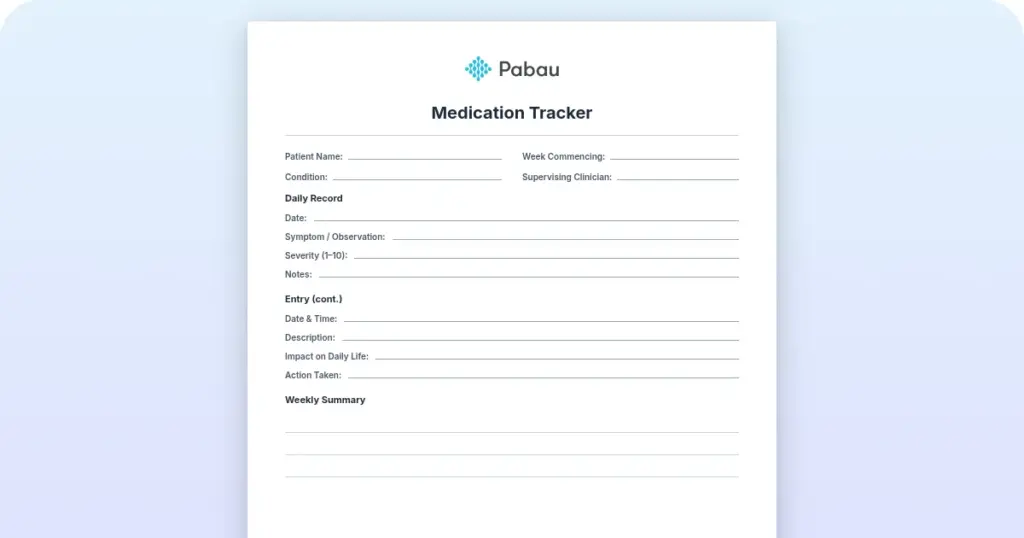
Pabau’s digital clinical forms and structured client records let practitioners log special test findings, link them to a treatment plan, and track outcomes without leaving the platform.
Radial-sided wrist pain is one of the most common musculoskeletal presentations in physical therapy, sports medicine, and occupational health practices. Without a reliable provocation test, distinguishing De Quervain’s tenosynovitis from intersection syndrome, basilar thumb arthritis, or a scaphoid injury is largely guesswork.
The Finkelstein test addresses this directly: a simple, reproducible maneuver that stresses the tendons of the first dorsal compartment and reproduces the patient’s pain when De Quervain’s is present. This guide covers how to administer it correctly, how to interpret the result, and where clinical documentation fits into the diagnostic workflow.
The Finkelstein test is a provocative clinical maneuver designed to reproduce pain along the abductor pollicis longus (APL) and extensor pollicis brevis (EPB) tendons by placing them under tensile load. A positive finding strongly supports a diagnosis of De Quervain’s tenosynovitis, also described as stenosing tenosynovitis of the first dorsal compartment.
Use it when a patient presents with radial-sided wrist pain, tenderness at or near the radial styloid, and pain with pinching or gripping activities. It is especially indicated for:
Practitioners using physical therapy EMR software can pre-populate indication checklists within the patient record, ensuring the indication is documented before the test is performed. This matters for audit trails and clinical governance.
Understanding why the Finkelstein test works starts with the anatomy it stresses. The first dorsal compartment of the wrist is a fibro-osseous tunnel at the level of the radial styloid, through which two tendons travel together in a shared synovial sheath:
In De Quervain’s tenosynovitis, the synovial sheath surrounding both tendons becomes inflamed and thickened. The tunnel itself undergoes fibrous stenosis. When the wrist is ulnar-deviated with the thumb held in flexion, both tendons are stretched over the radial styloid, reproducing sharp pain at the first dorsal compartment.
Practitioners routinely document compartment-specific findings, coded separately as ICD-10 M65.4, to differentiate first, second, and third dorsal compartment pathology in the same patient record.
The original Finkelstein maneuver is examiner-driven. Many clinicians inadvertently perform the Eichhoff variation instead (covered in the next section). To perform the classic Finkelstein test correctly:
Document the finding immediately: location of pain (radial styloid, first dorsal compartment, distal forearm), the degree of ulnar deviation at which pain occurred, and whether the pain was sharp or dull. Structured digital clinical forms with pre-set fields for orthopedic special tests make this faster and more consistent than free-text notes.

This is one of the most clinically significant confusions in wrist assessment. The two maneuvers differ in a fundamental way: who performs the ulnar deviation and how the thumb is positioned.
The mislabeling matters clinically. Because the Eichhoff test involves active thumb flexion by the patient, it also recruits intrinsic thumb muscles, which can compress the first carpometacarpal (CMC) joint and produce pain in patients with basilar thumb arthritis rather than De Quervain’s. This raises the false positive rate.
Brunelli (2003) argued that both the Finkelstein and Eichhoff maneuvers share the same underlying mechanical flaw, and proposed an alternative provocation test, now known as the Brunelli test, to work around it. NCBI StatPearls outlines the distinction between the original Finkelstein maneuver and the Eichhoff variation in more detail. If your documentation records “Finkelstein positive” without specifying technique, the finding is ambiguous for any clinician reviewing the record later.
A positive Finkelstein test is defined as the reproduction of sharp or severe pain at the radial styloid and along the first dorsal compartment during passive ulnar deviation. Mild discomfort alone is not a positive finding: pain must be clearly reproduced and ideally match the patient’s presenting complaint.
Grade the positive finding by severity and location to support clinical decision-making:
A positive Finkelstein test is not a standalone diagnosis. It should be correlated with patient history, symptom duration, tenderness on palpation of the first dorsal compartment, and, where indicated, ultrasound or MRI findings.
Practitioners using occupational therapy software serving hand therapy caseloads often document bilateral Finkelstein results, grip strength, and pinch strength alongside the test finding, creating a richer functional baseline for outcomes tracking.
Document both the technique used (Finkelstein vs Eichhoff) and the bilateral comparison result every time. A unilateral positive with no contralateral comparison complicates insurance audits and MDT handovers.
Reported sensitivity and specificity for the Finkelstein test vary across studies, and the underlying evidence is limited. NCBI StatPearls describes the reliability data behind the test as sparse, so any specific percentage should be read as a rough estimate rather than a fixed clinical threshold. Specificity is generally considered lower than sensitivity: the test cannot reliably exclude conditions that produce pain in the same anatomical region through a different mechanism.
What this means in practice: some studies suggest a negative Finkelstein test is more useful for ruling out De Quervain’s, while a positive result alone is less useful for confirming it, given the weaker evidence on specificity. Either way, the result must be integrated with the full clinical picture.
The Finkelstein test cannot distinguish between De Quervain’s and several conditions that produce overlapping pain in the same region. Before committing to a De Quervain’s diagnosis, consider these key differentials:
Practitioners working in manual therapy settings, often billing under CPT 97140, frequently encounter intersection syndrome as the most common De Quervain’s mimic. The anatomical landmark is key: if the patient’s pain sits 4-6 cm proximal to the radial styloid, the second dorsal compartment is the likely culprit, not the first. The same structured approach applies to other provocation workups, like the hip flexor strain test.

Pabau gives physical therapy, sports medicine, and hand therapy practices structured clinical forms, automated follow-up workflows, and a shared patient record that keeps every assessment finding connected to the care pathway that follows it.

Most clinical references focus on how to perform the Finkelstein test rather than when not to. That omission is itself a clinical risk. Before administering it, screen for:
Documenting that a contraindication screen was completed before the test is as important as documenting the result. Physiotherapy clinic compliance requirements in most jurisdictions expect a record of clinical reasoning, not just test outcomes. That rationale sits in the assessment note, not in the patient’s memory.
A positive Finkelstein test finding is only useful if it flows cleanly into the next stage of care. In practice, that means the documentation step needs to happen in the same session, not at the end of the day.
A structured documentation workflow looks like this:
Pabau’s structured patient records and automated clinical workflows support exactly this sequence: the assessment note links to a treatment plan, consent documentation attaches to the same record, and a follow-up appointment can be triggered automatically from the outcome review date set in the initial note.
For multi-disciplinary practices where a physical therapist assesses and a hand surgeon or primary care physician reviews, that shared, continuous record removes the need to repeat the history at each handover. Clinicians in physiotherapy clinic management environments describe this continuity as one of the biggest time-savers in their documentation workflow.

A confirmed De Quervain’s diagnosis following a positive Finkelstein test typically follows an escalating management pathway. Most patients respond well to conservative care before any procedural intervention is considered.
Postpartum patients present a specific management consideration: corticosteroid injections require caution in breastfeeding mothers, and splinting compliance is often lower due to infant care demands. Writing clinical notes that capture these patient-specific factors supports better shared decision-making across the care team.
Referral triggers for orthopedic or hand surgery opinion include failure of two corticosteroid injections, recurrence within 3 months, or clinical suspicion of a separate EPB subsheath requiring surgical division. Practices managing these pathways within allied health systems benefit from a referral letter generation function linked directly to the assessment record.
Radial wrist pain is common. Getting the diagnosis right is not. The Finkelstein test remains the cornerstone clinical tool for identifying De Quervain’s tenosynovitis, but its value depends on performing it correctly (original Finkelstein vs Eichhoff), interpreting it in the context of differential diagnoses, and documenting the result in a way that drives the next clinical decision.
Pabau’s structured clinical records let physical therapy and hand therapy teams log orthopedic special test findings, link them directly to treatment plans, and automate outcome review reminders without any manual chasing. If you want to see how that documentation workflow fits your practice’s setup, book a demo and we’ll walk you through it.

Assessing a suspected ACL tear alongside other orthopedic special tests? Lever sign test for ACL tears covers the procedure and interpretation for another key knee provocation test.
Need another shoulder or rotator cuff provocation test for your assessment toolkit? Resisted external derotation test explains how to perform and interpret this related special test.
Choosing software built for a podiatry practice? Podiatry practice management software compares platforms built for SOAP notes, ICD-10 coding, orthotics tracking, and insurance claims.
The Finkelstein test is a clinical provocation test used to diagnose De Quervain’s tenosynovitis, a stenosing inflammation of the abductor pollicis longus and extensor pollicis brevis tendons in the first dorsal compartment of the wrist. It reproduces the patient’s radial-sided wrist pain by placing those tendons under tensile load through passive ulnar deviation.
In the original Finkelstein test, the examiner grips the patient’s thumb and passively deviates the wrist ulnarly while the patient remains relaxed. In the Eichhoff variation, the patient actively tucks the thumb into a closed fist before the deviation is applied. The Eichhoff version is more commonly performed today but is frequently mislabeled as “Finkelstein” in clinical settings, which matters because the active thumb flexion in the Eichhoff test can produce false positives in patients with basilar thumb arthritis.
Yes. The most common causes of a false positive Finkelstein test are intersection syndrome (pain 4-6 cm proximal to the radial styloid), basilar thumb (CMC) arthritis, scaphoid pathology, and Wartenberg syndrome. Because specificity is lower than sensitivity, a positive finding should always be correlated with the full clinical picture and palpation findings before a De Quervain’s diagnosis is confirmed.
The Finkelstein test is contraindicated when a scaphoid fracture is suspected (snuffbox tenderness following trauma), during an acute inflammatory joint flare, following recent wrist surgery before surgical clearance, and during the healing phase of a distal radius fracture. Applying passive ulnar deviation force in any of these situations risks displacement, aggravation, or structural damage.
Yes. De Quervain’s tenosynovitis, often called “mommy’s wrist,” is significantly more prevalent in postpartum women. Hormonal changes during and after pregnancy reduce tendon sheath tensile resistance, and the repetitive wrist and thumb loading of infant lifting and carrying creates mechanical irritation to the first dorsal compartment. New mothers are among the highest-risk groups for a positive Finkelstein test result.
Referral to a hand surgery or orthopedic specialist is appropriate when conservative management (splinting and physical therapy) has failed after 6-8 weeks, when two corticosteroid injections have not produced lasting relief, when there is recurrence within 3 months of injection, or when clinical findings suggest a separate EPB subsheath requiring surgical release. Suspected scaphoid fracture or acute joint pathology warrants urgent imaging referral regardless of the Finkelstein result.