Free model waiver form + what it is and when your practice needs one
A model waiver form is a signed document that lets a healthcare practice use a p...

7
Last Updated: Sep 29, 2026

In the US, only licensed medical professionals may inject Botox, because it is a prescription-only drug.
Physicians, nurse practitioners, physician assistants, dentists, and RNs working under delegation are the eligible provider types.
Scope of practice varies by state, so NPs inject independently in full-practice states but need physician oversight in restricted ones.
Estheticians, cosmetologists, and medical assistants cannot legally inject Botox in any US state, whatever training they hold.
Practice management software like Pabau stores provider credentials, delegation agreements, and consent forms in one place.
Botox is a prescription drug, so who may inject it is a licensing question before it is a clinical one. One unlicensed injection can trigger a state board investigation, fines, and in serious cases criminal charges. Likewise, an expired delegation agreement or a missing consent form carries the same exposure.
This guide is written for the practice owner or manager deciding how to staff a Botox service. It covers each licensed provider type, the supervision rules attached to it, and where state law changes the answer. Finally, the last section covers how to verify an injector’s credentials before you hire or delegate.
Who can inject Botox in the United States comes down to licensure and scope of practice. Because Botox (onabotulinumtoxinA) is an FDA-approved prescription-only medication, administering it counts as practicing medicine. As a result, only providers with prescriptive authority, or those working under valid delegation from such a provider, can legally perform injections.
The eligible provider types, in most states:
Estheticians, cosmetologists, and medical assistants do not appear on this list, and no state makes an exception for them. The chart below then sets each provider type against what state law asks for before the injection is legal.
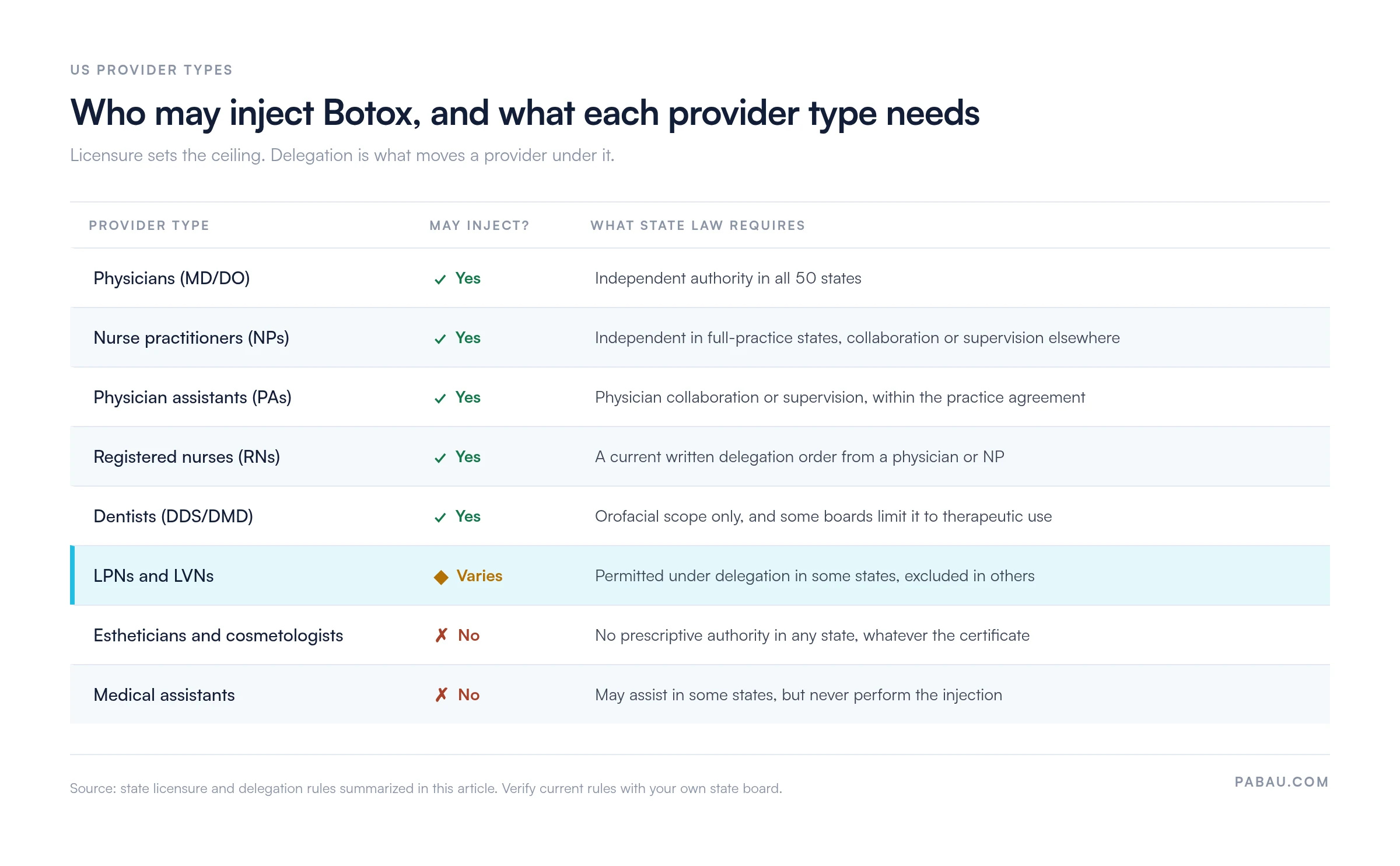
Botulinum toxin is classified as a prescription drug under federal law. The FDA’s drug approval framework requires that prescription medications be ordered and administered by licensed prescribers. In other words, administering Botox without prescriptive authority, or without a valid order from someone who has it, is practicing medicine without a license.
This matters for practice owners because the liability does not stop with the injector. If an owner sets up the business so that an unlicensed or out-of-scope provider performs injections, the owner faces the same legal exposure. In fact, state medical boards, nursing boards, and in some states the attorney general’s office can all take action.
Each provider type has a different authority level and different supervision requirements. So here is how each one works in practice.
Medical doctors and doctors of osteopathy have full independent prescribing and administration authority in all 50 states. They can prescribe Botox, order it, and administer it without any supervision or delegation structure. Beyond that, a physician in a med spa may also serve as the medical director who oversees and enables the delegation chain for other providers.
The American Association of Nurse Practitioners (AANP) sorts NP practice authority into three tiers. In full-practice states, NPs can prescribe and administer Botox independently, with no physician oversight required. In reduced-practice states, NPs must hold a collaborative agreement with a physician.
In restricted-practice states, NPs require direct physician supervision. In short, whether nurses can do Botox independently depends almost entirely on which of these three tiers their state falls into.
PAs practice under physician supervision or collaboration in most states. A PA can administer Botox where it falls within the scope defined in their collaborative practice agreement. Since 2021, many states have updated their PA practice acts to reduce mandatory supervision. Even so, a collaborating physician relationship is still the norm for PA-administered Botox services.
RNs can inject Botox in most states, but only under a valid delegation order from a physician. Some states also let an NP with prescribing authority issue that order. The delegation must be specific, written, and current. Even so, an RN who injects without a valid order is out of scope regardless of their training or experience.
LPN and LVN eligibility is the most variable area in Botox administration law. Some states permit LPNs to administer injectables under delegation, and others exclude them outright. Texas, for example, restricts LVN injection authority more tightly than it restricts RNs. Check the current rules with your state nursing board before you assign any injection duties to an LPN. Boards revise this guidance often, so a staffing policy written two years ago may no longer hold.
Dentists (DDS/DMD) can administer Botox in most states within their orofacial scope of practice. Some state dental boards limit use to therapeutic purposes such as jaw clenching, TMJ, and facial pain, while others allow cosmetic use. So verify with your state dental board before you add dental-administered Botox to a mixed-provider model.
No. Estheticians cannot legally inject Botox in any US state. Botox is a prescription medication, so administering it requires prescriptive authority or a valid delegation order from someone who has it. Instead, esthetician licensure covers skincare procedures and topical treatments, not the administration of prescription injectables.
This applies to cosmetologists as well. A cosmetology license gives no prescriptive authority, whatever Botox training certificates a private company has issued. The certificate proves the person attended a course. Still, it does not change their legal scope of practice.
Similarly, the same logic applies to medical assistants. They are generally unlicensed under state law and cannot administer prescription injectables independently. Some states allow medical assistants to assist with injections under narrow conditions, but they cannot perform the injection itself.
Delegation is the mechanism that allows an RN, and in some states an LPN, to legally perform Botox injections. It requires a supervising physician, or an NP with prescribing authority where that is permitted, to issue a written order. In short, that order names the delegated provider and authorizes them to perform the procedure.
Key elements of a valid delegation structure:
Your practice’s compliance checklist should cover all four. Many states also require the medical director to review a share of patient charts regularly. In other words, that review is what separates active oversight from supervision in name only.
Who may hold the medical director role matters here too. In some states only a physician can occupy it for delegation purposes. However, in others, an NP with full practice authority can supervise and delegate to RNs.
For multi-location med spas, delegation gets more complex. Separating business ownership from clinical oversight can help, but the delegation chain must still be state-compliant at each location.
No single national standard sets who can inject Botox. State medical boards, nursing boards, and dental boards each set the rules, and those rules change. The table below sums up key patterns across states with active med spa markets. So always verify current rules with the relevant state board before you set up a delegation model.
Texas has some of the most detailed delegation rules in the country. Texas med spa laws require specific written protocols and define how often the supervising provider must review delegated procedures. So, if you operate in Texas, read the Medical Practice Act and the Texas Nursing Practice Act together.
Two separate questions often get mixed up here. What does state law require, and what does good practice require?
What the law requires: A valid state license within your scope of practice, and either prescriptive authority or a current delegation order. In short, that is the legal minimum. A Botox certification from a private training company does not create legal authority. Instead, it adds to the authority that licensure already provides.
What good practice requires: Hands-on training in facial anatomy, injection technique, complication recognition, and management of adverse events. For RNs and other delegated providers, the supervising physician or NP is often expected to verify clinical skill before the delegation order is issued.
Certification from a private training program is not a legal requirement in most states. Even so, it is still widely expected by supervising providers, and by patients who vet their injectors. Here is the typical pathway for a licensed provider adding Botox to their practice:
For medical directors reviewing a potential injector’s credentials, the same steps apply in reverse. Verify licensure, review the training certificate, confirm the delegation order is current, and file the paperwork under that provider’s profile.
If you are a patient or a practice owner vetting a potential injector, three checks cover the fundamentals:
Practices hiring a medical director should apply the same checks to the director role itself. A medical director in name only is a liability, not a compliance solution. If they never review charts and never issue current delegation orders, their name on the paperwork protects nobody. In fact, state boards have become much better at spotting shell medical director arrangements.
Tracking who may inject, under what authority, and with which documents signed is a compliance job as much as a clinical one. Instead, most practices run it on spreadsheets and shared drives. But that holds only until a delegation order expires mid-month, or a board audit asks for the full documentation trail.
Practice management software like Pabau closes that loop. Purpose-built med spa software stores provider credentials, tracks license expiration dates, and attaches delegation agreements to each provider profile. As a result, when a patient books a Botox appointment, the treating provider’s current qualifications surface alongside the booking.
Digital consent forms then make sure Botox-specific consent is completed, signed, and timestamped before every treatment. That gives you the audit trail a state board expects to see, so an inspection becomes a search rather than a scramble.

The Botox treatment note template in Pabau’s library is a practical starting point. Each completed form links back to the patient record and to the treating provider’s profile, so the two halves of an audit sit together.
Run a quarterly credential audit before a state board does. Pull every delegated provider’s file and check delegation order dates, license renewal dates, and malpractice coverage. Flag anything expiring within 90 days and resolve it before an appointment is booked against it. Pabau’s provider profiles hold all of this centrally, so the audit takes minutes rather than hours.

Pabau helps aesthetic practices track provider qualifications, manage digital consent forms, and maintain the documentation trails state boards expect. See how it works for your team.

The legal rule is short. Only licensed professionals acting inside their scope, or providers under a current delegation order, may inject Botox. However, the difficulty is that 50 states answer the scope question differently, and they revise their answers often.
So treat the answer as something you re-check, not something you learn once. Then set a review date against every delegation order and license in the building. If you cannot show a board who injected, under whose authority, and with what consent, the certificates on the wall will not help.
Pabau keeps that record in one place, attached to both the provider and the patient. Book a demo to see how it fits an aesthetic practice’s injection workflow.

Need a framework for how delegation works in a multi-provider med spa? MSO structures for med spas covers how ownership and clinical oversight can be legally separated across locations.
Considering adding LPN staff to your injection team? Hiring LPNs for your med spa walks through what to verify before assigning clinical duties.
Want the full compliance picture for your med spa? Med spa compliance requirements covers the regulatory landscape beyond injection staffing.
Want a checklist you can work through before an inspection? Medical spa compliance checklist sets out the documentation a state board asks to see.
Wondering what a cosmetology license actually permits? Cosmetology license in California explains the scope limits that keep injectables out of reach.
Physicians (MD/DO), nurse practitioners, physician assistants, and dentists may inject Botox, subject to their state’s scope rules. Registered nurses may inject under a valid delegation order, and dentists are limited to their orofacial scope. Each provider type carries its own licensure and supervision requirements.
Yes, in most states, but only under a valid written delegation order from a supervising physician. Some states also allow a nurse practitioner with prescribing authority to issue that order. An RN who injects without a current order is outside their scope of practice, regardless of training.
No. Estheticians cannot legally inject Botox in any US state. Botox is a prescription-only medication, so administering it requires prescriptive authority or a delegation order from a licensed prescriber. Esthetician licensure does not include prescriptive authority, and a private Botox certification course does not add it.
It depends on the state. Some states permit LPNs to perform injections under delegation, and others exclude them outright. Texas restricts LVN injection authority more tightly than RN authority. Always check the current rules with your state nursing board before you assign injection duties.
Nurse practitioners can inject independently in states that grant full practice authority. Registered nurses cannot inject independently anywhere in the US. They always need a delegation order. Confirm your state’s NP practice tier on the AANP state practice environment map before you structure an injection team.