The best CRM for nutritionists depends on how many practitioners you run and whether you bill insurance. First, we compared seven platforms. Overall, Pabau, the practice management platform we build, is a strong fit for nutrition practices with two or more practitioners. Specifically, it puts booking, intake, notes and billing in one system. Pabau users on G2 report that once it is set up, it automates routine tasks and cuts the admin of running a practice.
However, the other picks serve narrower needs. Practice Better suits coaches selling structured programs, while Carepatron’s free plan suits a solo practitioner starting out. Meanwhile, Healthie and SimplePractice are built around US insurance billing for registered dietitians. Finally, That Clean Life and Nutrium are the picks when meal plans are your core service.
Key takeaways
1. Pabau — best all-in-one platform for multi-practitioner nutrition practices that want booking, notes, billing and claims in one system.
2. Practice Better — best for nutrition coaches who sell structured multi-week programs.
3. Healthie — built for US registered dietitians who need HIPAA-compliant telehealth and insurance billing.
4. Carepatron — the lowest-cost start, with a free plan for a single practitioner.
5. That Clean Life — a meal plan builder to pair with a CRM, rather than a CRM itself.
6. SimplePractice — mature insurance billing for US dietitians in solo and small-group practices.
7. Nutrium — purpose-built nutrition software with meal plans and measurement tracking for solo nutritionists.
Found our content helpful?
Best CRM for nutritionists in 2026 at a glance
So the seven platforms below cover the main nutrition practice models, from a solo coach to a multi-staff practice. Next, here is how they compare before the full reviews.
Platform
Best for
Standout feature
Starting price
Pabau
Multi-practitioner nutrition and wellness practices
Automated workflows, digital intake forms, clinical notes, insurance claims
Nutritionists wanting a purpose-built all-in-one tool
Anthropometric tracking, meal planning, client mobile app
From ~$15/month (10-client plan, billed yearly)
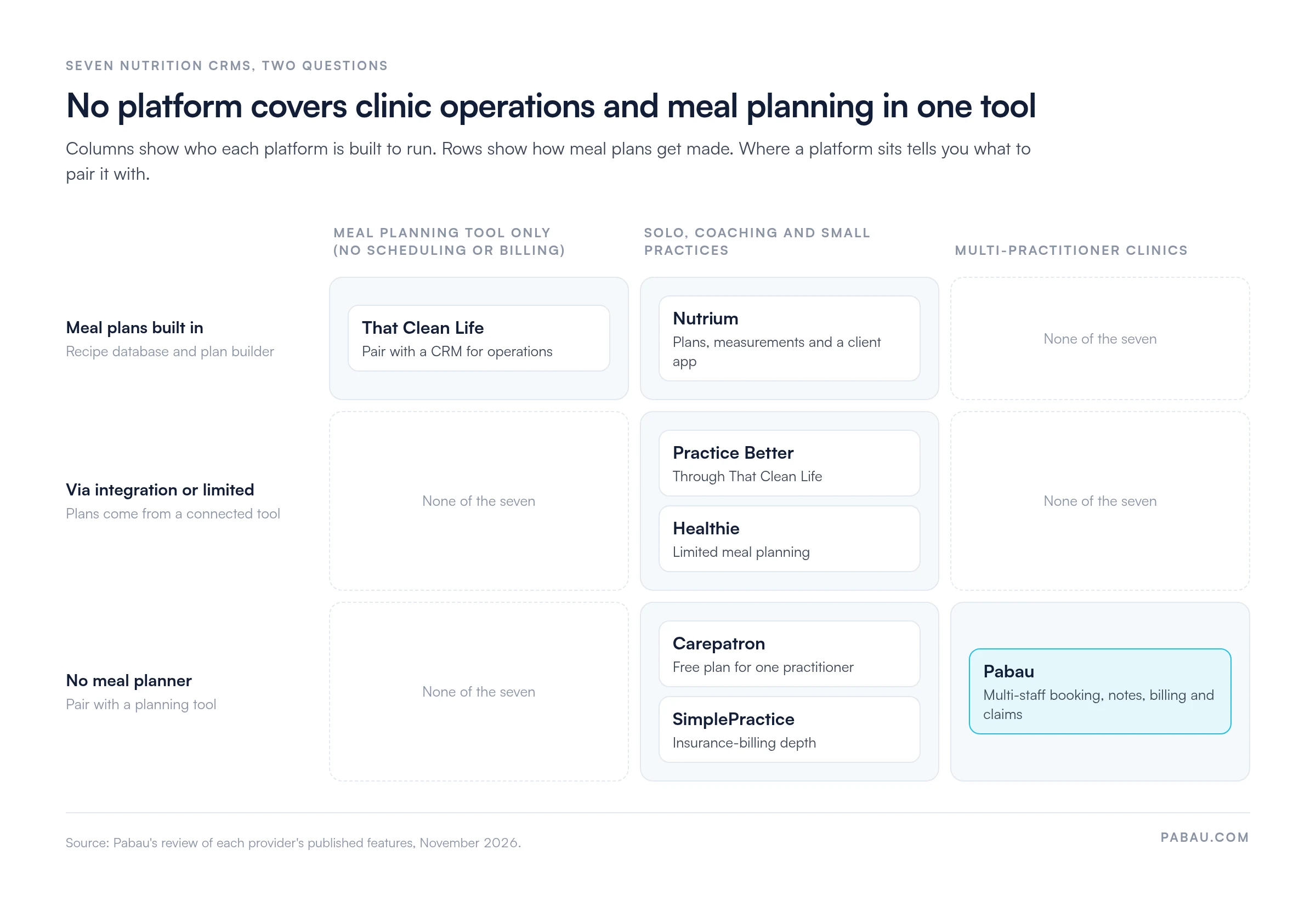
In fact, the bigger split is between running a practice and building meal plans. Thus, the grid below shows where each platform lands on those two questions.
Pabau is the only platform here built for multi-practitioner practices, so it pairs with a meal planner such as That Clean Life. Placements follow each provider’s published features as of November 2026.
What is a CRM for nutritionists, and what should it do?
A CRM for nutritionists is a patient management and practice operations platform. It covers the whole patient lifecycle, from first inquiry and intake through appointments, notes, billing and re-engagement. A sales CRM, however, tracks leads and deals. Meanwhile, a nutrition platform handles health history intake, session notes, dietary assessment data and secure messaging with patients.
In nutrition practice, however, the lines between a CRM, an EMR and a practice management system blur. Most nutrition professionals need parts of all three at once. Meal planning tools such as That Clean Life and Nutrium focus on the content side of the work instead of the operational workflow. The Academy of Nutrition and Dietetics, the professional body for US registered dietitians, is a useful reference on practice standards.
Must-have features for nutrition CRM software
Patient records with health history: Searchable profiles with dietary history, medical background, allergies, and also goal tracking across sessions
Online booking and calendar: Self-booking for patients, with automated confirmations and reminders, so fewer patients miss visits
Digital intake forms: Customizable health history, dietary assessment and consent forms completed before the first appointment
Invoicing and payment processing: Invoices, online payments, packages and subscriptions, so you need no separate billing tool
Telehealth: Integrated video consultations, so remote sessions run in the same platform as the patient record
HIPAA/GDPR compliance: Data encryption and BAA availability in the US, while audit trails cover protected health information
Patient portal: A secure space for booking and messaging, and also form completion and document access
Automation: Reminder sequences, follow-up emails and recall workflows, so routine tasks run without manual work
Key features to look for in nutrition practice management software
Yet not every nutrition practice needs the same feature set. For example, a solo nutritionist has different priorities from a group running coaching programs or a dietitian who bills insurance. Therefore, these are the categories that matter most when you evaluate a CRM for nutritionists.
Best CRM and practice management software for nutritionists
In short, these seven platforms cover the full range of nutrition practice models. Moreover, each review covers scheduling, billing, compliance, telehealth, nutrition tools, the patient portal, automation and pricing. Still, Pabau is a strong fit for multi-practitioner nutrition practices. However, the other six serve specific use cases where their strengths make them the better choice.
1. Pabau — best all-in-one CRM for multi-practitioner nutrition practices
Rating/5★★★★★Top pick
The bottom line
Pabau runs booking, intake forms, notes, billing and insurance claims for a multi-practitioner nutrition practice in one system.
Who it’s for
Multi-practitioner nutrition and wellness practices
Weight management and metabolic health practices
Integrative practices adding nutrition to other services
Multi-staff calendars, online booking and automated reminders
Intake forms and session notes on one patient record
Insurance claims in the US, UK and Australia
What doesn’t
No built-in meal plan builder or recipe database
Telehealth and SMS run on usage credits
No published list prices
Specifically, Pabau works as the CRM at the center of a multi-practitioner nutrition practice. It runs the workflow from first booking through intake, session notes, automated follow-up, billing and reporting, without a separate tool for each job.
Also, it suits practices where the clinical team and the front desk need to work in the same system. For example, a practice with two or three practitioners needs shared calendars, notes per session, intake forms completed before consultations, reminders and invoicing. Pabau therefore keeps each of those on the same patient record.
Pabau also handles insurance billing through claims management. Additionally, US claims run through Claim.MD, and US e-prescribing runs through DoseSpot.
Key features
Patient records: Longitudinal records with health history, session notes and measurements, so documents sit in one searchable profile
Digital intake forms: Customizable digital intake forms for health history, dietary assessment and consent, which patients then complete before the appointment
Online booking: Patient self-booking through an online booking system with live availability across practitioners and locations
Automated reminders and workflows:Automated appointment reminders, recall sequences and post-consultation follow-ups, so routine messages run without manual input
Telehealth: Integrated video consultation software for remote sessions, which then link to the patient record and booking
Invoicing, payments and claims: Invoicing, online payments, packages, deposits, and also insurance claims in the US, UK and Australia
Multi-location support: Central management across locations, while each site keeps its own calendars, reporting and staff management
GDPR compliance: Data encryption and consent management, while audit trails support UK and EU health data requirements
Where Pabau shines
Multi-practitioner scheduling: One calendar view across every practitioner, so self-booking and reminders cut no-shows
Operational automation: Recall workflows, follow-ups and rebooking sequences run on their own, so the team spends less time on admin
Clinical notes: Assessment, goal-setting and progress notes stay linked to each patient, so the whole history with the practice stays in view
Billing in the same system: Invoicing, payments, packages, deposits and insurance claims sit beside scheduling and records, so staff never switch tools
Scalable across locations: A nutrition group opening a second or third site runs them, since no separate system is needed per site
Where Pabau falls short
No meal plan builder: Pabau has no recipe database, and it also lacks a meal plan tool. Practices that deliver structured meal plans then pair it with a planning platform
Usage-based costs: Telehealth and SMS run on usage credits on top of the plan, so check them against your session volume
HIPAA and BAA: US practices with HIPAA obligations should therefore contact Pabau about BAA requirements before committing
Who Pabau is best for
Multi-practitioner nutrition and wellness practices, since they need a full operational platform
Weight management and metabolic health practices, because they need structured intake, notes and billing in one system
UK and European nutrition practices, since they need GDPR-compliant data handling
US practices billing insurance through Claim.MD, while also taking private-pay services
Integrative health practices, because they combine nutrition with other services across several practitioners
Customer reviews
“It works well for managing appointments, communicating with patients, storing patient information, and generating reports, all in one place.”
Pabau review on G2
“After setup, it’s genuinely helpful and cuts down a lot of the admin involved in running a business. It automates many tasks and makes note-keeping straightforward.”
Pabau review on G2
Pricing
Plan
Price
Notes
Solo
Book a demo for a quote
One user, unlimited patients
Team
Book a demo for a quote
Two to three users
Medium
Book a demo for a quote
Four to five users
Group
Book a demo for a quote
Six to 15 users
Enterprise
Book a demo for a quote
16+ users, multi-location
Pabau publishes no list prices, so each plan is quoted in a demo. However, telehealth and SMS run on usage credits on top of the plan, and the Care Plus add-on makes telehealth free.
2. Practice Better — best CRM for nutrition coaching programs
Rating/5★★★★★
The bottom line
Practice Better is built around structured coaching programs, with meal plans delivered through its That Clean Life integration.
Who it’s for
Nutrition coaches selling multi-week programs
Solo and small-team coaching practices
Coaches who want a client app with food journaling
Program builder with enrollment and group check-ins
Client portal with habit tracking and food journaling
That Clean Life integration for meal plans
What doesn’t
Scheduling comes second to program delivery
Fewer multi-practitioner tools than a full practice platform
Not built for insurance billing
Practice Better is a practice management platform built for nutrition and health coaches. In fact, its standout feature is structured program delivery. Coaches build multi-week programs with sessions, resources, meal plans and habit tracking, then enroll clients through the portal. For a coach running eight- or twelve-week programs, that structure is therefore easier to work with than a general CRM.
It also integrates with That Clean Life. Coaches can build meal plans there, then deliver them through Practice Better’s client portal.
Key features
Group coaching programs: Structured multi-week program delivery, with client enrollment, resource sharing and also group check-ins
Client portal: Client-facing app and portal, so clients get habit tracking, food journaling and program content
Meal plan integration: Native integration with That Clean Life, so meal plan creation and delivery stay in one workflow
Scheduling and telehealth: Built-in appointment booking, and also video consultations
Invoicing and packages: Program packages and subscriptions, and also online payment collection
Mobile app: Practitioner and client mobile apps, so both sides work on iOS and Android
Where Practice Better shines
Structured group and individual program delivery, but most CRM platforms do not offer it
Habit tracking and food journaling in the client portal also keep clients engaged between sessions
The That Clean Life integration also makes meal plan delivery part of the coaching workflow
Where Practice Better falls short
Scheduling and calendar management come second to program delivery, so it suits high-volume appointment practices less well
Multi-practitioner features are, however, more limited than a full practice platform like Pabau
Not designed for insurance billing workflows, so insurance-based practices look elsewhere
Who Practice Better is best for
Nutrition coaches, because they run structured multi-week coaching programs
Solo or small-team practices, since they focus on program-based service delivery
Pricing
Plan
Price
Notes
Starter
~$25/month billed yearly
~$35/month billed monthly
Professional
~$59/month billed yearly
~$69/month billed monthly
Plus
~$89/month billed yearly
~$99/month billed monthly
Team
~$145/month billed yearly
~$155/month billed monthly
Practice Better’s only free plan is a student plan capped at three clients, so practicing coaches start on a paid tier.
3. Healthie — best CRM for dietitians and telehealth-focused practices
Rating/5★★★★★
The bottom line
Healthie is built for US registered dietitians who need HIPAA-compliant telehealth and insurance billing in one platform.
Healthie is built for registered dietitians and nutrition professionals in the United States. First, its main differentiator is HIPAA-compliant infrastructure. Accordingly, telehealth, clinical documentation and insurance billing are designed around the requirements US dietitians face. The HHS Office for Civil Rights enforces HIPAA for practitioners handling protected health information, so Healthie’s BAA availability addresses that directly.
Healthie also integrates with wearables and lab ordering. As a result, it is relevant for functional dietitians who use data beyond the consultation itself.
Key features
HIPAA-compliant telehealth: Native video consultations with BAA coverage, and also secure session documentation
Insurance billing support: Superbills and ERA/EOB reconciliation, and also third-party billing workflows for US dietitians
Intake forms and patient portal: Digital health history intake and secure messaging, and also a self-service portal
Wearable and lab integrations: Connects with wearable health data and lab ordering platforms, so patient monitoring continues between visits
Group sessions: Group telehealth and program delivery, while individual consultations continue alongside
Where Healthie shines
HIPAA compliance and BAA availability therefore make it a defensible choice for US dietitians handling protected health information
Insurance billing workflows are also built into the core product for US dietitians
Wearable and lab integrations also add data that a nutrition practice can act on
Where Healthie falls short
A US-centric feature set therefore makes it less suitable for UK or European practices and their GDPR workflows
Multi-location and multi-staff management is, however, less developed than a full practice platform
No free plan, but only a 14-day trial of the Plus tier
Who Healthie is best for
US-based registered dietitians billing insurance, or working with clinically complex patients because they need HIPAA documentation
Dietitians running virtual practices, since they need telehealth inside their compliance workflow
Pricing
Plan
Price
Notes
Essentials
~$45/month billed yearly
~$49.99/month billed monthly
Plus
~$115/month billed yearly
~$129.99/month billed monthly
Group
From ~$135/month billed yearly (~$149.99 monthly)
Plus $50 per added clinician
However, Healthie has no free plan, and new accounts get a 14-day trial of the Plus tier.
4. Carepatron — best free CRM for solo nutritionists
Rating/5★★★★★
The bottom line
Carepatron's free plan gives a solo nutritionist records, scheduling, telehealth and online booking at no cost.
Who it’s for
Solo nutritionists starting out
Practitioners testing a CRM before paying
Small teams on a per-user budget
PricingFree; paid from ~$31/user/monthPlus, billed yearly
Free plan capped at 100 appointments and 1GB storage
No dietary assessment templates or meal planning
Less automation depth than a practice platform
Carepatron is a healthcare CRM with a capable free plan, so it is the lowest-cost start for a solo nutritionist. Specifically, the free tier includes patient records, scheduling, telehealth, online booking and online payments. Still, it is capped at 100 appointments and 1GB of storage.
But the tradeoff is capability at scale. The free tier works for one practitioner with a modest patient list, while unlimited appointments and team features sit on the paid plans.
Key features
Free plan: Patient records, scheduling, telehealth, online booking and online payments at no cost, though within the plan’s limits
Patient records: Profiles with health history and notes, and also document storage
Appointment scheduling: Online booking with calendar management, and also reminders
Invoicing: Invoices and online payments, while paid plans add unlimited appointments and storage
Document storage: Secure file management, and also clinical notes
Where Carepatron shines
The free plan also covers enough to run a solo nutrition practice without an upfront software cost
Simple onboarding, since there is no lengthy setup process
Where Carepatron falls short
Automation, reporting and multi-practitioner workflows are still limited compared to a full practice platform
No nutrition-specific features, because dietary assessment templates and meal plan integration are missing
The free plan’s 100-appointment and 1GB storage limits become a constraint once the practice grows
Who Carepatron is best for
Solo nutritionists or dietitians who want structured patient management at no cost while building their practice
Practitioners testing whether a dedicated CRM improves their workflow, since they can pay for software afterward
Customer reviews
“It has made my practice so much easier; I can focus on fully being present with my patients. I recommend it to my colleagues and friends.”
Carepatron review on Capterra
“My biggest issue was that I was on a “free” plan but after about 3 weeks of using it for 4 clients, it told me that I was significantly above the limit for the memory storage. It was only giving me the option to upgrade.”
Carepatron review on G2
Pricing
Plan
Price
Notes
Free
$0/month
100 appointments and 1GB storage
Plus
~$31/user/month billed yearly
Solo and growing practices
Advanced
~$39/user/month billed yearly
Larger teams and practices
Meanwhile, Carepatron prices its paid plans per user. Additionally, yearly billing saves 20% on the monthly rate.
5. That Clean Life — best for nutrition planning and meal plan delivery
Rating/5★★★★★
The bottom line
That Clean Life builds branded meal plans from a recipe database, and it pairs with a separate CRM for operations.
That Clean Life is a nutrition content platform built around a recipe database and a meal plan builder. For example, nutritionists use it to build branded meal plans, generate shopping lists and deliver protocols through a patient-facing portal. It solves the content problem, while the other platforms here run the practice itself.
In fact, many nutrition practices run That Clean Life alongside a CRM. Scheduling, intake, billing and notes stay in the CRM, while meal plans are built and delivered in That Clean Life. In addition, its integration with Practice Better makes it a natural add-on for coaches on that platform.
Key features
Recipe database: A large library of nutritionist-approved recipes, so meal plans get built quickly
Meal plan builder: Drag-and-drop plan creation with nutrient analysis, and also automatic shopping lists
Branded portal: Patients open their meal plans in a white-labeled portal that also carries the practice’s branding
Program templates: Pre-built nutrition protocol templates, so common goals start from a ready draft
Practice Better integration: Native connection with Practice Better, so delivery happens within coaching programs
Where That Clean Life shines
Meal plans come together faster and also look more professional than plans built in a word processor or spreadsheet
Nutrient analysis is built into the plan builder, so there is no separate tracking tool to run
Where That Clean Life falls short
Not a practice management CRM, so it has no scheduling, invoicing or clinical notes beyond meal plan delivery
Requires a separate platform for every other practice management function, so costs and logins multiply
Cost adds up once combined with a full CRM subscription
Who That Clean Life is best for
Nutritionists who already have a CRM, since they need only a dedicated meal planning and delivery tool
Coaching practices on Practice Better, because they want native meal plan delivery
Pricing
Plan
Price
Notes
Starter
~$30/month
10 shares
Plus
~$60/month
Billed monthly
That Clean Life lists no team plan and no free trial on its pricing page.
6. SimplePractice — best for dietitians billing insurance
Rating/5★★★★★
The bottom line
SimplePractice gives US dietitians in small practices a mature insurance billing workflow with HIPAA-compliant telehealth.
SimplePractice is a practice management platform widely used by US healthcare practitioners, including registered dietitians who bill insurance. First, its insurance billing covers superbill generation, ERA/EOB processing and claim submission. Indeed, it is one of the most developed billing workflows in this comparison.
The platform also includes HIPAA-compliant telehealth, digital intake forms and a patient portal. Consequently, it is a reasonably complete option for dietitians in clinical or insurance-based practice.
Key features
Insurance billing: Superbills and ERA/EOB reconciliation, and also claim submission with integrated billing workflows
HIPAA-compliant telehealth: Native video sessions with compliant hosting, and also documentation
Digital intake forms: Pre-built and also customizable intake and consent forms
Patient portal: Appointment booking and secure messaging, and also document sharing
Documentation: Progress notes and treatment plans, and also session records with customizable templates
Where SimplePractice shines
Insurance billing also covers superbills, ERA/EOB and claim submission in one workflow
HIPAA compliance is well documented and also widely trusted by US clinical practitioners
An established platform with a large user base, and also strong support resources
Where SimplePractice falls short
Built mainly for therapy and mental health practices, so dietary assessment templates are less developed
Multi-location and multi-practitioner management is still more limited than a full practice platform
Not optimized for the operational scale of a larger nutrition practice, so growth may need another platform
Who SimplePractice is best for
Registered dietitians in the US, since they bill third-party insurance payers
Solo or small-group dietitian practices, because they need HIPAA-compliant telehealth and documentation
Customer reviews
“Overall experience with it value for money.Its telehealth,appointments management and patient record keeping features makes work more organized.”
SimplePractice review on Capterra
“At the time, I was running an all-virtual private practice and it became very frustrating very fast, and I ended up resorting to Google Meets on a constant basis as a backup. The high subscription ultimately ended up becoming a financial strain.”
SimplePractice review on Capterra
Pricing
Plan
Price
Notes
Starter
~$49/month
Solo dietitians starting out
Essential
~$79/month
Dietitians with active insurance billing
Plus
~$99/month
Practices with calendar, billing and telehealth needs
SimplePractice offers 50% off the first three months, and the standard monthly rate applies after that.
7. Nutrium — best for nutritionist-specific workflow
Rating/5★★★★★
The bottom line
Nutrium puts meal planning, measurement tracking and a client app in one tool built for solo nutritionists.
Limited multi-practitioner and multi-location tools
Less automation and financial reporting depth
No listed team plan
Nutrium is purpose-built nutrition software that combines meal planning, anthropometric tracking and practice CRM features in a single tool. Most general CRM platforms need a separate meal planning add-on, while Nutrium builds that workflow in. Patients open their plans, track progress and log food in a dedicated mobile app, so the back-and-forth between sessions shrinks.
The tradeoff is that Nutrium is optimized for individual nutritionists rather than multi-practitioner operations. Ultimately, it is a strong single-practitioner tool. Furthermore, its multi-staff calendars, operational automation and financial reporting are less developed than a platform like Pabau.
Key features
Meal planning: Built-in meal plan creation with nutrient analysis, and also recipe integration
Anthropometric tracking: Body measurements and weight tracking, and also progress monitoring across sessions
Client mobile app: Patients open meal plans, log food and chat, and also track progress from iOS and Android
Video consultations: Native video calls, and also Zoom and Google Meet integrations
Invoicing: Billing, and also payment collection
Appointment scheduling: Calendar, and also online booking
Where Nutrium shines
Meal planning and anthropometric tracking are part of the core product rather than a separate tool
The client app for food logging and progress tracking also keeps patients accountable between sessions
Where Nutrium falls short
Multi-practitioner and multi-location management is still limited compared to a full practice platform
Automation depth and financial reporting still fall short of a practice management system like Pabau
No team plan appears on its pricing page, so a growing group should confirm options with Nutrium
Who Nutrium is best for
Solo nutritionists, since they need meal planning, measurement tracking and a CRM in a single purpose-built tool
Practices, because meal plans and body composition tracking are central to the service
Pricing
Plan
Price
Notes
Up to 10 clients
~$15/month billed yearly
~$25/month billed monthly
Unlimited clients
~$25/month billed yearly
~$39–49/month billed monthly
Nutrium prices its plans by the number of clients you manage, but it lists no team plan.
Head-to-head feature comparison of nutrition CRM platforms
Next, this table covers the main purchase decisions across all seven platforms. Features follow each provider’s published product information as of 2026, so confirm current availability before you buy.
Feature
Pabau
Practice Better
Healthie
Carepatron
That Clean Life
SimplePractice
Nutrium
Online booking
✅
✅
✅
✅
❌
✅
✅
Digital intake forms
✅
✅
✅
⚠️ Basic only
❌
✅
⚠️ Verify at nutrium.com
Invoicing and payments
✅
✅
✅
✅ Online payments on free plan
❌
✅
✅
Insurance billing
✅ US, UK and Australia
❌
✅
❌
❌
✅
❌
Telehealth
✅
✅
✅
✅ Free plan
❌
✅
✅
HIPAA compliance
⚠️ Ask Pabau about a BAA
⚠️ Verify at practicebetter.io
✅
⚠️ Verify at carepatron.com
⚠️ Verify at thatcleanlife.com
✅
⚠️ Verify at nutrium.com
GDPR compliance
✅
⚠️ Verify
⚠️ US-focused
⚠️ Verify
⚠️ Verify
⚠️ US-focused
⚠️ Verify
Meal plan builder
❌
⚠️ Via That Clean Life integration
⚠️ Limited
❌
✅
❌
✅
Patient portal
✅
✅
✅
✅
✅
✅
✅
Workflow automation
✅
⚠️ Basic
⚠️ Basic
❌
❌
⚠️ Basic
❌
Multi-location
✅
✅
⚠️ Limited
❌
❌
❌
❌
Group sessions
⚠️ Verify with Pabau
✅
✅
❌
❌
❌
❌
Free plan available
❌
❌
❌
✅
❌
❌
❌
Pro Tip
Not sure whether you need a CRM, an EMR or a practice management system? In nutrition, the labels overlap. Test each platform against five daily workflows: booking, intake, session notes, billing and follow-up. If it covers all five without workarounds, the label matters little. What counts is whether it replaces your spreadsheets and disconnected tools.
Do nutritionists need a dedicated CRM or a practice management system?
In fact, most nutritionists searching for a CRM need a practice management system. The CRM label also gets used loosely in nutrition for any tool that manages patient relationships. Day-to-day needs therefore span scheduling, documentation, billing and compliance as well as communication.
In contrast, a sales CRM, like Salesforce or HubSpot, handles contacts and communication pipelines. It does not handle booking, clinical notes, HIPAA data handling or invoicing, whereas a practice management system covers all four. Hence, every platform in this review is a practice management system. Practice Better and Healthie lean toward patient engagement, while Pabau and SimplePractice lean toward operational workflow.
So ask whether a tool handles the clinical record, the booking and the billing, or only communication and lead tracking. For most nutrition practices, then, a full practice management system beats a sales CRM adapted for health use.
Which CRM for nutritionists is right for you? A quick decision guide
Ultimately, the right platform depends on your practice model, location and what you need the software to do. For this reason, this scenario map covers the most common buyer profiles among nutrition professionals.
Your situation
Best platform
Why
Multi-practitioner nutrition or wellness practice
Pabau
Multi-staff scheduling, digital forms, clinical notes, billing and GDPR-compliant data handling on one platform
US multi-practitioner practice billing insurance and private pay
Pabau
US claims through Claim.MD and e-prescribing through DoseSpot, alongside multi-staff booking and notes. Ask Pabau about BAA requirements.
Solo nutrition coach running structured programs
Practice Better
Group program delivery, meal plan integration and a client portal built for coaching workflows
US registered dietitian billing insurance
Healthie or SimplePractice
HIPAA compliance, BAA availability and insurance billing workflows built for solo and small dietitian practices
Solo nutritionist starting out with a small budget
Carepatron
Free plan covers patient records, booking, telehealth and notes with no upfront cost
Nutritionist who needs meal plan creation and delivery
That Clean Life or Nutrium
Built-in recipe database and meal plan builder, which most general CRM platforms lack
Weight management or metabolic health practice
Pabau
Structured intake forms, clinical notes, measurement tracking and automated recalls for ongoing patient relationships
How to choose the right nutrition CRM software
Therefore, these five questions should anchor your evaluation. So answer each one before you shortlist platforms.
What is your practice model? For instance, a solo coach running programs needs different software from a four-practitioner nutrition practice. Pick a platform that fits your current team size and service model, rather than the one you hope to reach.
Do you bill insurance? If yes, then the shortlist narrows. First, Healthie and SimplePractice are built around US insurance billing for dietitians. Pabau also files insurance claims in the US through Claim.MD, and in the UK and Australia. However, Practice Better, Carepatron, That Clean Life and Nutrium are built mainly for private-pay workflows.
Where are your patients located? UK and EU practices need GDPR-compliant data handling, while US practices handling PHI need HIPAA compliance. Pabau is also a strong fit for UK and EU practices. Meanwhile, Healthie and SimplePractice are the usual choices for US practices that need a BAA.
Do you deliver meal plans as a core service? But no general CRM fully replaces a dedicated nutrition planning tool. If meal plans are central to your offer, then budget for two platforms. Run operations in a CRM, then build content in That Clean Life or Nutrium.
How many practitioners are on your team? Solo practitioners, though, can often start on a free or low-cost tier. Conversely, practices with two or more practitioners need a platform built for multi-staff scheduling, notes and reporting. Pabau’s weight management clinic software covers weight and metabolic practices, while the core platform covers general nutrition practices.
How Pabau runs a multi-practitioner nutrition practice
A growing nutrition practice often runs on a booking app, a forms tool, a patient spreadsheet and separate invoicing. Each new practitioner also adds another calendar to reconcile and more intake forms to chase by email.
Instead, Pabau puts those jobs on one patient record. Patients book online, complete intake and consent forms before the visit, and then get automated reminders. Meanwhile, practitioners write session notes against the same record, and the front desk invoices, takes payment or files the insurance claim.
Overall, the result is fewer handoffs between tools and one history for each patient, whichever practitioner they see. Also, for practices tracking weight and metabolic outcomes, Pabau’s metabolic health EMR charts vitals, weight and lab trends on that record.
Run your nutrition practice from one patient record
Pabau handles booking, digital intake forms, session notes, automated reminders, billing and insurance claims in one platform. See how it works for nutrition and wellness practices.
First, choose your nutrition CRM by the job that costs you the most time today. If that job is coordinating several practitioners, then start with Pabau. If it is selling coaching programs, then start with Practice Better. If it is US insurance billing as a solo dietitian, then start with Healthie or SimplePractice.
Also, plan for meal planning separately, whichever you pick. Nutrium is the one practice tool here with meal plans built in, but it is designed for a single practitioner. A growing practice usually runs a CRM and a planner side by side, so check how the two connect before you sign.
Book a demo to see how Pabau handles booking, notes, billing and claims for a nutrition practice with more than one practitioner.
Continue your research
Running a weight management practice too?Best EMR for weight loss clinics compares nine platforms for weight loss and hormone practices.
Need a handout for patients with diabetes?Diabetes exchange list is a free template you can share after a consultation.
Building meal plans for PCOS?7-day PCOS diet plan is a free downloadable plan to adapt for your patients.
Frequently asked questions
What is the best CRM for nutritionists?
Finally, Pabau is a strong fit for multi-practitioner nutrition practices that need booking, notes, billing and claims in one system. Practice Better suits coaching programs, while Healthie or SimplePractice suit US dietitians billing insurance. Lastly, Carepatron suits a solo practitioner on a tight budget.
Do nutritionists need a CRM?
Yes, most nutrition practices benefit from a CRM or practice management platform. In fact, running records, scheduling, intake, billing and follow-up across spreadsheets creates avoidable admin and compliance risk. A dedicated platform, however, keeps those tasks in one system.
Is there HIPAA-compliant CRM software for dietitians?
Yes. Healthie and SimplePractice both offer HIPAA-compliant platforms with Business Associate Agreements for US registered dietitians. However, US practices considering Pabau should ask Pabau about BAA requirements. UK and EU dietitians working under GDPR can also look at Pabau, which is built for GDPR-compliant health data handling.
What is the difference between a CRM and an EMR for nutritionists?
First, a CRM manages patient relationships, communication and scheduling. However, an EMR, or electronic medical record, manages clinical documentation and health history. Most nutrition platforms combine both, so the difference is mainly which layer gets more emphasis.
What software do nutrition coaches use to manage clients?
Nutrition coaches most often use Practice Better, Healthie or Pabau, though the choice depends on their service model. Practice Better suits structured programs, while Healthie suits dietitians with telehealth and insurance needs. Finally, Pabau suits practices with several practitioners. Some coaches also add That Clean Life for meal plans.