Blood type O food list
A blood type O food list sorts foods into what people with type O should eat, li...

Last Updated: Oct 6, 2026
A diabetes exchange list is a meal planning system that groups foods by equivalent nutritional value. Patients and clinicians can swap any food for another in the same group without moving blood glucose much.
The American Diabetes Association (ADA) and the Academy of Nutrition and Dietetics built the lists together. They turn carbohydrate counting into a visual framework that works across type 1, type 2, and gestational diabetes care.
This template gives endocrinologists, primary care clinicians, registered dietitians, and practice teams a ready-made structure for diabetes consultations. Build it into your digital intake forms so it carries your practice logo and follows your protocols. It then stays in the patient record for every follow-up visit.
A ready-to-use template for diabetes meal planning covering starch, fruit, vegetable, milk, meat, and fat exchanges with serving sizes and carbohydrate counts per exchange.
Download template
Each food exchange carries a predictable amount of carbohydrate, protein, fat, and calories, which makes blood glucose easier to predict.
Eight groups cover starch, fruit, vegetable, milk, meat, fat, sweets, and free foods, so nobody has to memorize every food.
Exchange lists work on their own and alongside carbohydrate counting, depending on the patient’s learning style and clinical goals.
Practice management software like Pabau lets you share the completed template through the patient portal and see who has read it.
The exchange system solves a practical problem. Patients with diabetes have to manage carbohydrate intake, and memorizing the carbohydrate content of every food is not realistic. The lists group foods into categories where one item substitutes for another, because their nutritional profiles are nearly identical.
One starch exchange always carries roughly 15 grams of carbohydrate, 3 grams of protein, and 80 calories. That holds whether the patient picks one slice of bread, 1/3 cup of rice, or one small potato. Patients can then mix and match by preference and availability, while daily carbohydrate totals stay stable.
Clinicians and registered dietitians usually introduce the system in three steps.
Store the downloaded template in your client record system so it stays available at every follow-up visit. Patients often need a reminder about portion sizes, or about which foods belong in each group.
The lists divide foods into eight standardized groups. Each group has predictable macros per exchange, and you can adjust portion sizes to suit the patient.
Carbohydrate is the column that drives the daily target, and it separates the groups more sharply than a four-column table shows.
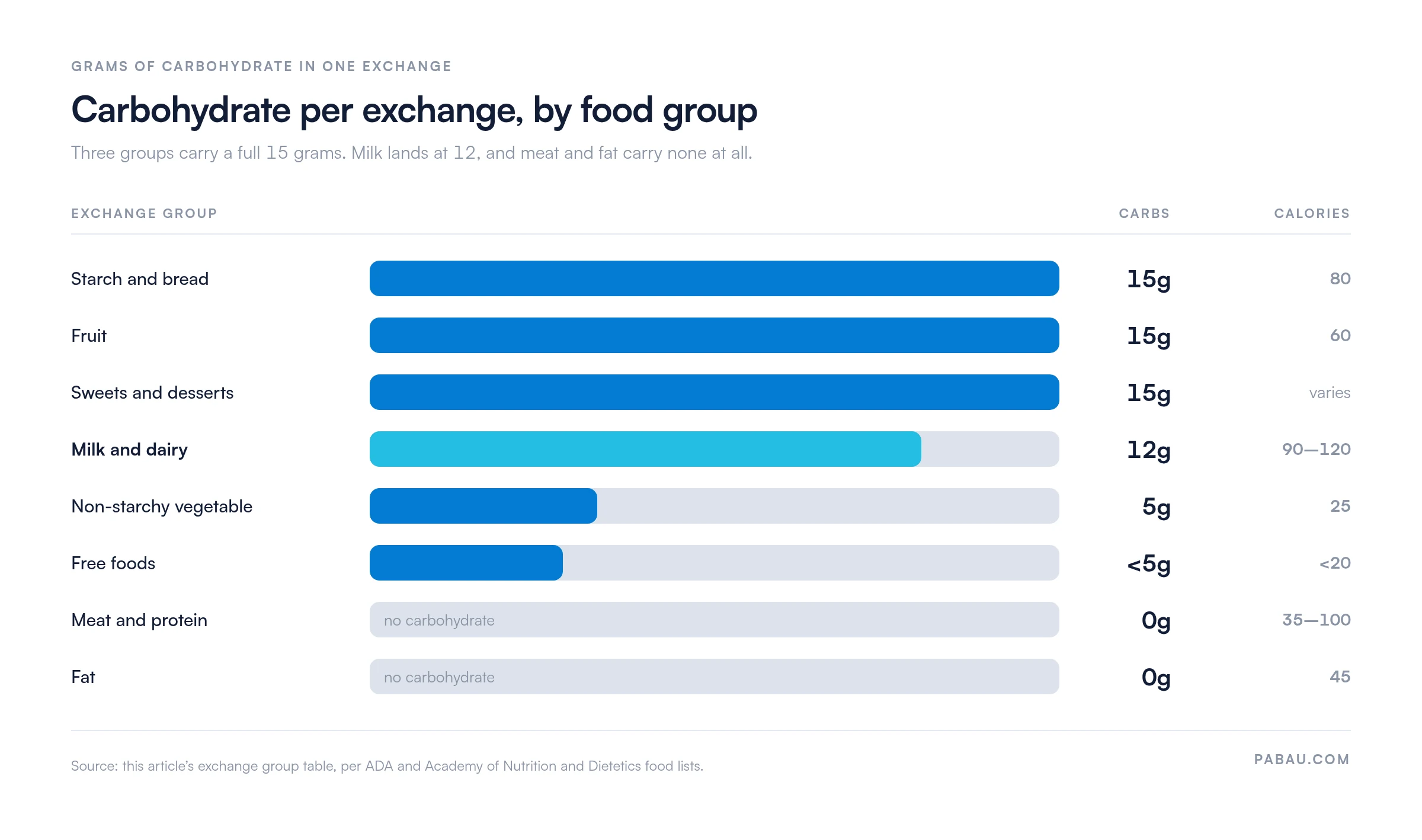
Three groups land on a full 15 grams, milk sits at 12, and meat and fat contribute none. A patient can eat generously from the meat and fat lists and still hold their carbohydrate target.
The meat group is the one that catches people out. Every meat exchange carries 7 grams of protein and no carbohydrate, but the calories move with the fat content.
Most printable charts give the meat group a single calorie figure. A patient working to a calorie target as well as a carbohydrate target needs the tier. Put all four on the copy you hand out.
A shared framework also helps when several clinicians see the same patient. Practices running a metabolic health EMR can hold one exchange plan per patient, so the advice does not change between appointments.
Endocrinologists, family medicine clinicians, and primary care practices managing type 2 diabetes at scale get the most from it. Registered dietitians use it in first consultations to establish portion awareness. Nurses and medical assistants lean on it to reinforce carbohydrate targets during follow-up calls.
Weight-loss programs cover the same conversation dozens of times a week. Good weight loss clinic software stores patient education beside the treatment plan, so nobody hunts for the current version before a consultation.
The template also supports gestational diabetes care in obstetric practices. Targets there need individualization by an obstetric-qualified dietitian, so treat the structure as a starting point rather than a prescription.
The ADA endorses both methods, and they suit different patients. Exchange lists work for people who prefer simple categories and visual structure, with no label reading required.
Carbohydrate counting suits type 1 patients on insulin therapy, where dose-to-carb ratios need exact numbers. It also fits patients who are comfortable tracking in detail.
Many clinicians teach exchange lists first to build carbohydrate awareness, then move motivated patients on to counting as their diabetes gets more complex. The exchange list stays useful as a reference either way.
After downloading the template, shape it around your workflows. Add your practice logo and contact details at the top. Note the local food staples your patients actually buy, because a list full of unfamiliar foods gets ignored.
Build separate versions for type 1, type 2, and gestational diabetes, since each carries a different carbohydrate target. Then hand the right version out at the right appointment.
Send it ahead of the visit where you can. A patient who has already read the list spends the appointment asking questions, rather than meeting the idea for the first time.
Free foods carry fewer than 5 grams of carbohydrate per serving and fewer than 20 calories. Common examples are non-starchy vegetables such as spinach, lettuce, tomatoes, cucumbers, and broccoli. Sugar-free condiments and unsweetened drinks like water, tea, and black coffee also qualify.
Patients often ask whether free foods are unlimited. The answer is broadly yes, though portion awareness still applies. A large salad with full-fat dressing carries calories and fat even when its carbohydrate count stays low.
List the free foods your practice recommends on the template, so patients have a checklist to shop and prep from.
The exchange list earns its keep when it sits with the rest of the record. Store it beside blood glucose logs, A1C trends, and complication screening results, so the whole picture opens in one place.
At the next visit, open the plan from last time and ask what worked and what got in the way. Record revised targets against recent labs or medication changes in the same file. Dietary management then reads as one thread across months and years.
Pair the template with a blood glucose log so the patient brings readings and meals to the same review. Together they show whether the assigned exchanges are holding.
Most practices email the template as an attachment or print it at the front desk. The copy the patient takes home then lives outside the record. At the next visit nobody can say which version they got, or whether they read it.
Practice management software like Pabau handles it differently. You attach the exchange list to the patient’s file as a digital form and send it through the patient portal before the appointment. The completed version saves straight back to the record, and you can see when it was opened.
That leaves the clinician one place to work from. Targets, readings, and the version the patient is using all sit together. Any team member can then pick the conversation up without starting over.

Attach the exchange list to the patient’s file, send it through the patient portal before the visit, and see who has read it. The completed form saves back to the record.

Exchange lists have outlived a lot of nutrition advice because they ask the patient to learn eight groups instead of a whole food database. Hand out the template, set the daily target, and the rest of the conversation gets easier.
The trade-off is precision. A patient on insulin who needs dose-to-carb accuracy will outgrow the lists, and that is a good problem to have. Start here, and move them on when their questions get more specific.
Where the template lands in your workflow matters as much as the list itself. Book a demo to see how Pabau sends diabetes education out before the visit and files the completed copy in the patient record.

strongNeed the companion food list?/strong a href=https://pabau.com/templates/type-2-diabetes-diet-food-list/Type 2 diabetes diet food list/a groups everyday foods by their effect on blood glucose.
strongWant to translate A1C into daily numbers?/strong a href=https://pabau.com/templates/a1c-conversion-chart/A1C conversion chart/a converts A1C results into estimated average glucose for patient conversations.
strongReviewing medications at the same visit?/strong a href=https://pabau.com/templates/diabetes-medication-list/Diabetes medication list/a gives you a structure for recording what the patient takes and when.
strongSupporting a plant-based patient?/strong a href=https://pabau.com/templates/vegan-diabetes-meal-plan/Vegan diabetes meal plan/a shows how the same carbohydrate targets work without animal products.
The exchange list groups foods with similar carbohydrate content, so patients pick any food from a list. Carbohydrate counting asks patients to read labels and calculate the exact grams in each portion. Exchange lists are simpler for patients new to diabetes. Carb counting gives type 1 patients the precision that insulin dosing needs.
Yes. The ADA now emphasizes individualized nutrition therapy, but exchange lists remain a valid and widely taught tool. They suit initial diabetes education and patients who prefer structure over detailed tracking. Many clinicians teach both methods, depending on the patient’s learning style and how complex their diabetes is.
A registered dietitian sets the number from the patient’s weight, activity level, medications, and clinical goals. Type 2 targets typically run from 130 to 180 grams of carbohydrate per day, or roughly nine to 12 starch exchanges. Individualization matters, so defer specific recommendations to the dietitian or physician managing that patient.
Yes, but only with targets set by an obstetric-qualified registered dietitian. Gestational carbohydrate targets differ from type 2 targets, and pregnancy calls for more frequent blood glucose monitoring. The structure still helps, provided your obstetric team keeps clinical oversight of the plan.
The official publication is Choose Your Foods: Food Lists for Diabetes, developed jointly by the American Diabetes Association and the Academy of Nutrition and Dietetics. It is available through the ADA and through most registered dietitian offices. The template above gives you the framework, and the official publication carries the current food lists and serving sizes.