Medical office supplies list: Free checklist + reorder rules
A medical office supplies list is the checklist a practice uses to stock its exa...

5
Last Updated: Oct 2, 2026

The four-gate compliance check decides whether a UK weight management clinic may open: CQC registration, prescribing rights, the supply route, and advertising law.
CQC registration is conditional, not automatic, and it turns on prescribing at a physical location under a registered medical practitioner.
A Patient Group Direction does not cover GLP-1 supply in most private settings, so you need a prescriber or a Patient Specific Direction.
Naming Mounjaro, Wegovy or Ozempic in a public advert breaches CAP rule 12.12 and the Human Medicines Regulations 2012.
NICE sets BMI 35 or above with one comorbidity for Mounjaro, and those thresholds govern NHS funding rather than private prescribing.
Running a weight management clinic business in the UK comes down to four gates: CQC registration, prescribing rights, the supply route, and advertising law. Clear all four and you can treat patients. Fail one and the service is unlawful, however strong the demand looks.
This guide works each gate in the regulator’s own wording, with the fees attached to it. The four gates below are UK law. Practitioners who want to start a weight clinic in the United States face state-level equivalents instead.
Two claims circulate widely in this sector and both are wrong. A Patient Group Direction does not authorize GLP-1 supply in most private settings. Naming Mounjaro in a public advert is unlawful, not merely risky.
A weight management clinic delivers medically supervised weight treatment, covering prescribing, dietetic and behavioral support, under a named prescriber rather than selling diet products.
Three different service shapes get the same label in the UK. Dietetic coaching, prescriber-led in-person programs, and online prescribing all market themselves as a UK weight loss clinic. Only some of them prescribe, and prescribing is what pulls a service into regulation.
Patients searching for an obesity clinic mostly want the medicine. That single fact sets the shape of the business, because the medicine decides the regulator, the staffing and the marketing rules.
One UK training provider describes the optimal service as a therapeutic package delivered by a multidisciplinary team on the Chronic Care Model. Its roster names a physician with pharmacotherapy expertise, a nurse practitioner, a dietitian, an exercise physiologist and a psychologist. That provider publishes no evidence for the model, so treat it as one operator’s practice.
The same provider puts weight loss medical programs on three legs: an individualized low-calorie diet, structured exercise, and psychotherapy. Its enrollment conversation covers prior weight strategies, past program experience, and barriers to change. Its vocabulary rule is worth copying anyway. Use BMI, weight and excess weight, and drop morbidly obese, fat and unhealthy.
No published source offers a shared taxonomy for these services, so the table below reconciles the model lists two sector pages use. The third column is the one that decides your build.
UK weight loss companies cluster in the middle two rows, because neither carries the cost of a physician-led premises. The one round-up that publishes price bands lists mostly London addresses. London operators therefore set the price expectation your own quote gets measured against.
Four gates decide whether a UK weight management clinic is lawful: CQC registration, who may prescribe, the supply route, and what you may advertise.
The gates run in sequence, and each one has its own pass condition.
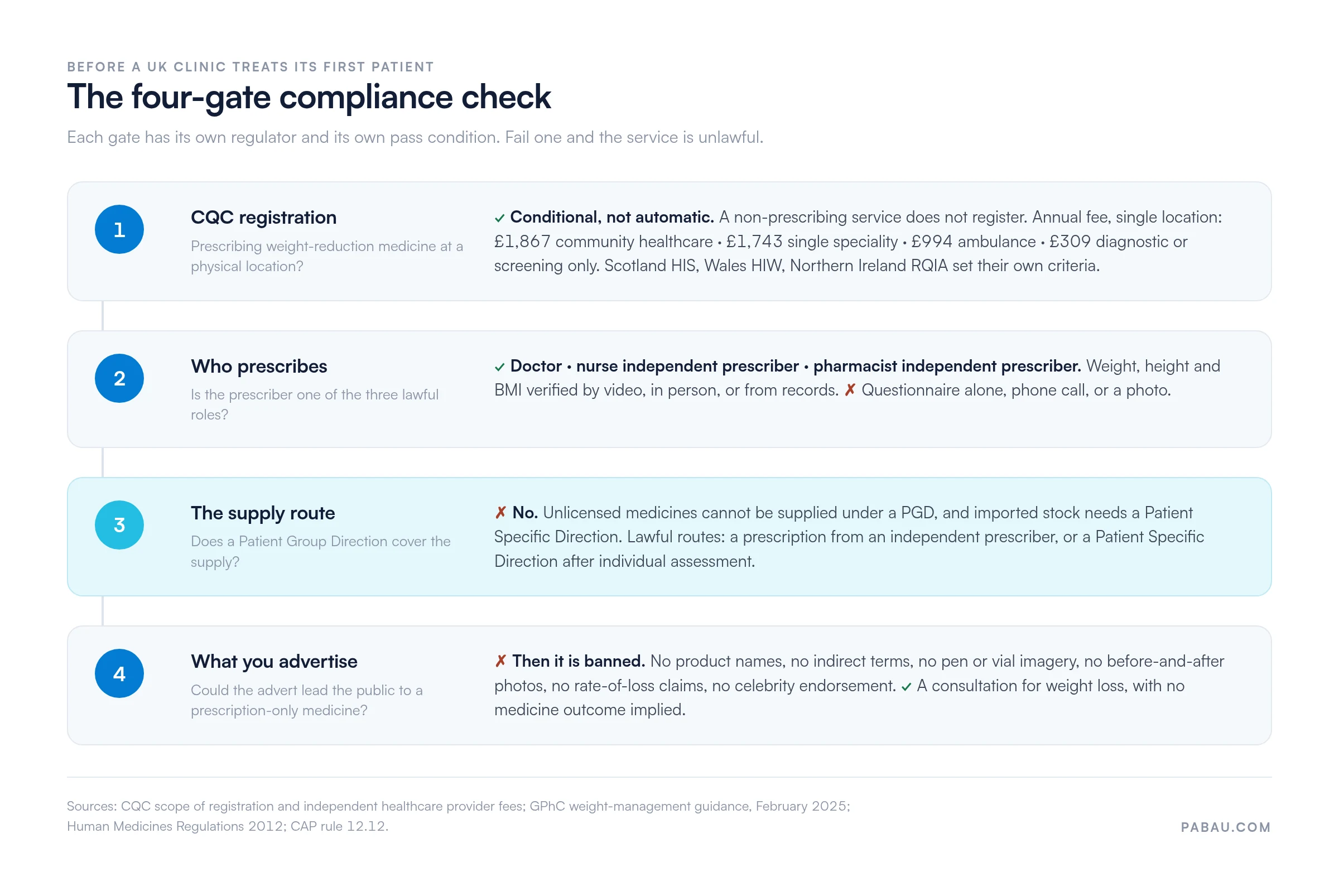
CQC registration is conditional, not automatic. Registration applies when a clinic prescribes weight-reduction medicine at a physical location, by or under a registered medical practitioner.
The Care Quality Commission, known as the CQC, sets that test in its scope of registration guidance for slimming clinics, updated on 29 January 2025. The activity covers advice or treatment in a physical location rather than a remote website service. A non-prescribing clinic, in the CQC’s words, will not need to register.
Online services, and clinics where a nurse or pharmacist independent prescriber does the prescribing, fall under a different regulated activity. The CQC assesses those as treatment of disease, disorder or injury. The registration question is therefore which activity applies, not whether one does.
Regulation is not uniform across the UK, and that catches operators out. Healthcare Improvement Scotland regulates independent healthcare in Scotland. Healthcare Improvement Scotland brought pharmacists and pharmacy technicians into its independent clinic definition on 19 June 2024.
Healthcare Inspectorate Wales and the Regulation and Quality Improvement Authority cover Wales and Northern Ireland. Their criteria differ from the CQC’s, so an English registration does not carry across the border.
The CQC publishes its annual fees per location in an independent healthcare fee schedule. Community healthcare costs £1,867 a year, and a single speciality costs £1,743. Ambulance services pay £994, and a provider registered only for diagnostic or screening procedures pays £309. The fee scheme has applied since 1 April 2019 and remains valid until further notice.
The CQC publishes no application fee, so treat any figure you see quoted for it as unverified. Registration is not optional in practice either. Stevenage Magistrates fined an unregistered slimming clinic £5,000, with £5,699 in costs, under the Health and Social Care Act 2008.
Only a doctor, a nurse independent prescriber, or a pharmacist independent prescriber may prescribe prescription-only weight-loss medicines in the UK.
The General Pharmaceutical Council, known as the GPhC, states those three roles in its public guidance on weight-loss medications. A registered nurse without an independent prescribing qualification is not one of them. Neither is an aesthetic practitioner working alongside a prescriber who never sees the patient.
GPhC guidance from February 2025 treats questionnaire-only online prescribing as high-risk. A prescriber cannot base the decision on an online questionnaire alone. The prescriber must independently verify the person’s weight, height or BMI.
Four verification routes qualify: a video consultation, an in-person appointment, the person’s clinical records, or contact with another healthcare provider. A phone call would not be appropriate. Photographs or pre-recorded video alone are insufficient. Identity must be verified to digital standards, and patients must be asked about eating disorders.
So the widely repeated shortcut of a questionnaire plus a photo does not comply. An insurer’s sign-off on a remote consultation risk assessment appears nowhere in that guidance, and it does not replace verification.
No. A Patient Group Direction does not cover GLP-1 supply in most private weight management settings, so the medicine needs a prescriber.
A Patient Group Direction, or PGD, rests on Schedule 16 of the Human Medicines Regulations 2012. Sixteen professions may supply under one, including nurses, pharmacists, pharmacy technicians, paramedics and dietitians. Membership of that list is not the obstacle here.
The obstacle is the medicine. The regulations do not allow unlicensed medicines to be supplied or administered under a PGD. Imported medicines must be prescribed, or specified using a Patient Specific Direction. In Scotland, gov.uk states that PGDs can only be set up for use in independent hospitals and hospices, which excludes clinics.
Whether a private English clinic may authorize a PGD at all stays unverified, because gov.uk names no non-NHS permission for it. Two supply routes are clear. A prescription from a doctor, nurse independent prescriber or pharmacist independent prescriber is one. A Patient Specific Direction after individual assessment is the other.
Prescription-only medicines may not be advertised to the public, and every weight-loss injectable is a prescription-only medicine.
Two instruments set that rule. Regulation 284 of the Human Medicines Regulations 2012 governs publication. A person may not publish an advertisement likely to lead to the use of a prescription-only medicine. CAP rule 12.12, enforced by the Advertising Standards Authority, or ASA, repeats the prohibition for advertisers. Exceptions exist only at regulations 291A and 292.
The list below is what the ASA treats as advertising a prescription-only medicine.
One route stays open. You may advertise a consultation for weight loss. The advert must not indicate a prescription-only outcome, and it must not link to a page showing a pen. The only exemption covers inner pages of your own website, not the homepage and not a landing page you link to proactively.
The ASA rules on this regularly. It ruled against Chequp Health Ltd twice in 2025, on 9 July and 17 December, and against The Angel Clinic on 11 January 2023. A joint ASA and GPhC enforcement notice went to all 13,214 GPhC-registered pharmacies. The ASA’s July 2025 update reported 99% compliance across its February to June 2025 monitoring period.
Sector marketing advice that names Ozempic, Wegovy and Mounjaro as brands to promote is therefore advising a breach. Build the campaign around the consultation and the clinical oversight instead.
NICE sets BMI 35 or above with one comorbidity for Mounjaro, and 35 or above, or 30 to 34.9 on specialist referral, for Wegovy.
Those thresholds drop for several ethnic groups. The National Institute for Health and Care Excellence, known as NICE, applies a reduction of usually 2.5 kg/m². The adjustment covers people from South Asian, Chinese, other Asian, Middle Eastern, Black African or African-Caribbean backgrounds.
Read these appraisals for what they are. Both govern NHS funding and specialist delivery, not the conditions of a private prescribing license. A private prescriber who departs from them needs clinical justification for doing so, recorded in the notes.
The scale behind the thresholds is 3.4 million eligible people in England. Screening on a self-reported figure is where a private service gets caught. Run a body mass index assessment in the room, and record who measured it.
The NHS weight management program offers the same medicines free through a four-tier pathway. A private clinic therefore competes on access and waiting time rather than on the medicine.
The tiers run in order. Tier 1 is prevention and Tier 2 is lifestyle support. Tier 3 is a specialist multidisciplinary service, and Tier 4 is complex obesity care including bariatric surgery. Tier 4 is reachable only by referral from Tier 3, with no direct route from primary care.
Typical Tier 3 entry is a BMI of 35 or above with comorbidities, or 40 or above without them. Prior Tier 2 participation is usually required, unless BMI is 50 or above. NHS weight management services are commissioned locally by integrated care boards, so a single national threshold is unverified. Quote the local criteria, not a national number.
The NHS-funded service sits at Tier 3, behind that referral gate. NHS England funds at least 220,000 people over three years against an eligible population of 3.4 million. Private weight loss services compete for the difference, and they compete on speed rather than on price.
NICE restricts Wegovy to a specialist weight management service providing multidisciplinary management, and caps treatment at two years.
That wording in TA875 is a staffing instruction as much as a clinical one. A private operator claiming to run a specialist weight management service needs the dietetic and behavioral input to back the claim. Prescribing alone does not make a service specialist.
The only firmly sourced cost figures for a new UK weight management clinic are the CQC’s fees, from £309 to £1,867 a year.
Reliable published pricing for these services is scarce. The confidence column below says so line by line, rather than presenting a round-up’s estimate as a benchmark.
The Bupa figure is the number a new entrant gets compared against, so it belongs in your pricing model. It cannot go in your advertising. Pricing for a service only available with a prescription-only medicine is on the ASA’s banned list from Gate 4.
Premises carry costs nobody prices publicly either. One UK training provider specifies scales accurate for the heaviest patients, large blood pressure cuffs, and suitably sized armless chairs to preserve dignity. That provider publishes no figures for any of it.
The revenue side deserves the same scrutiny as the fees. Our breakdown of weight loss clinic revenue works through the recurring-program arithmetic behind those monthly bands.
Gate 2 creates a documentation job as well as a clinical one. Every consultation needs verified height, weight and BMI, a verified identity, and an eating-disorder screening answer on the record.
Free-text notes make that evidence hard to find later. Practice management software like Pabau captures the verification fields as structured data at the point of care. Purpose-built weight clinic software then reports on them, so your team does not rebuild the picture by hand.
In the practices we onboard, the record that slips is the review, not the first consultation. Pabau schedules the next review against the patient record, so a four-week check does not depend on a member of staff remembering it.
A weight loss clinic EMR that holds prescribing, forms, photographs and review notes in one record also shortens an inspection. An inspector asks how you verified eligibility, and the answer sits in the patient timeline.
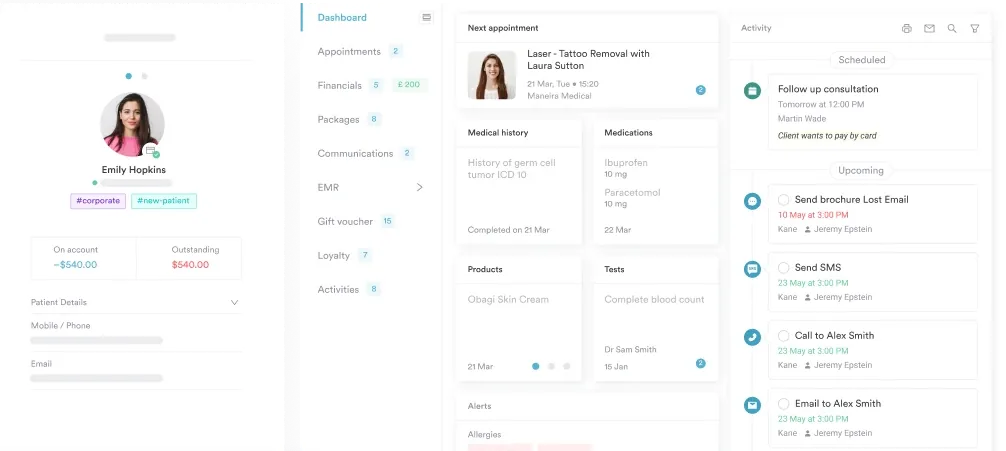

Pabau captures verified height, weight and BMI in structured fields, then recalls each patient at the review point your program sets. Your prescribing evidence stays in the client record instead of a spreadsheet.

Demand is not the constraint on this business. The four-gate compliance check is, and each gate settles a decision you would otherwise make on instinct.
Work them in order. Registration decides your premises. Prescribing rights decide your first hire. The supply route decides your pharmacy relationship. Advertising law decides your entire marketing plan, which is why it belongs in the plan rather than at the end of it.
The trade-off worth remembering is that the cheapest models to run are the ones the GPhC watches hardest. A remote service with no premises still needs verified measurements and a documented review cycle. Book a demo to see how Pabau keeps that verification and review evidence in the client record.

Need the demand numbers behind the sector? GLP-1 statistics collects the prescribing and uptake figures a business plan has to stand on.
Deciding what sits alongside the prescription? Lifestyle versus pharmacologic interventions compares the two approaches for metabolic health, which is the substance of a specialist service.
Screening for metabolic risk at intake? The glucose tolerance test explains how the result reads and where it belongs in an eligibility assessment.
Comparing platforms before you commit? Top 7 weight loss clinic software reviews the options on documentation, prescribing and reporting depth.
A weight management clinic assesses BMI and weight-related comorbidities, prescribes through a named prescriber, and reviews each patient on a set cycle. Weight loss medical programs usually wrap dietetic and behavioral support around the prescription. Each review is documented, because the prescribing decision has to be defensible later.
Private supply is lawful through a doctor, a nurse independent prescriber, or a pharmacist independent prescriber. A Patient Specific Direction can also cover administration after an individual assessment. A Patient Group Direction cannot cover it in most private settings, and unlicensed or imported stock never falls under one.
Registration depends on the model. Prescribing weight-reduction medicine at a physical location, by or under a registered medical practitioner, triggers the slimming clinics activity. A non-prescribing service does not register at all. Providers in Scotland, Wales and Northern Ireland register with HIS, HIW and RQIA instead, under different criteria.
No. CAP rule 12.12 bars advertising prescription-only medicines to the public, and indirect terms such as skinny jab or GLP-1 are treated the same way. Pen imagery, before-and-after photographs and rate-of-loss claims also breach it. Inner pages of the practice’s own website are the only exemption.
NICE sets 35 kg/m² with at least one comorbidity for tirzepatide, and 35 kg/m², or 30 to 34.9 with specialist referral, for semaglutide. Thresholds fall by about 2.5 kg/m² for several ethnic groups. Those appraisals govern NHS funding, so a private departure needs recorded clinical justification.