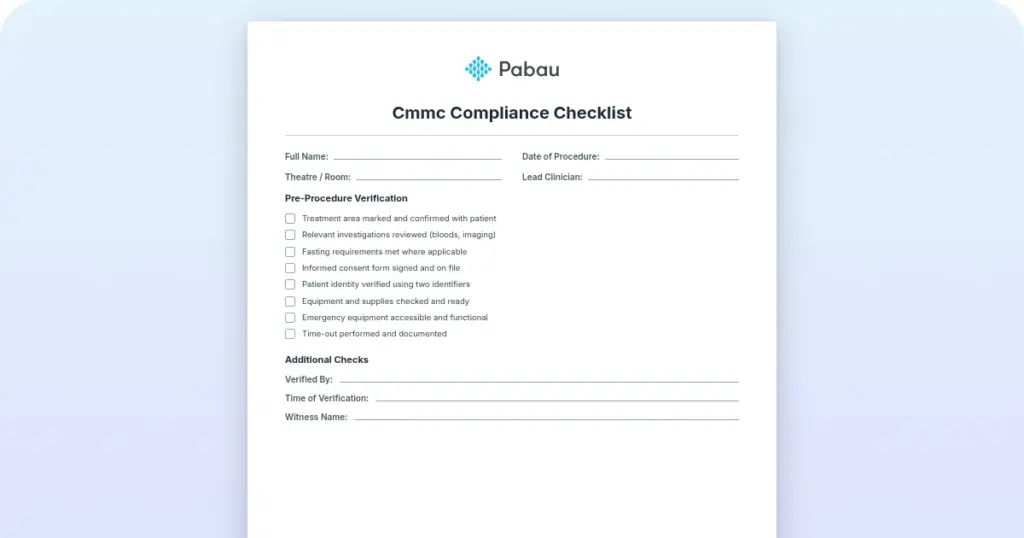
CMMC compliance checklist
A CMMC compliance checklist lists every security practice a Department of Defens...

Last Updated: Oct 6, 2026

In short, Texas med spas answer to three state regulators: the Texas Medical Board, the Texas Board of Nursing, and the Texas Department of Licensing and Regulation.
Non-surgical cosmetic procedures are legally the practice of medicine in Texas, so Botox, filler, and laser treatments need a physician’s delegation.
Texas’s corporate-practice-of-medicine rule blocks non-physicians from owning a med spa’s medical side, which is why most owners use a management services organization (MSO) structure instead.
Jenifer’s Law, now Texas Occupations Code Chapter 172, took effect September 1, 2025, but it only covers elective IV therapy.
Notably, a TDLR esthetician license covers skin care like facials, not injections or prescription-strength treatments, which still require a physician’s delegation.
To start, three different state agencies have a say in what a Texas med spa can do. None of them is the “medical spa board” people go looking for, because that board doesn’t exist. See our comparison of medical spa software for the operational side those agencies leave alone, from scheduling to payments.
The Texas Medical Board (TMB) decides who can perform a cosmetic procedure and under what delegation. Meanwhile, the Texas Board of Nursing (BON) sets what a registered nurse (RN) or licensed vocational nurse (LVN) can do inside that delegation. Finally, the Texas Department of Licensing and Regulation (TDLR) licenses the estheticians doing the non-medical side.
Get the delegation wrong and the consequences reach past paperwork. For example, Texas treats an improperly delegated Botox injection as the unlicensed practice of medicine. As a result, that exposes the injector, the delegating physician, and the business to board discipline.
First, this guide walks through what each regulator requires and what changed in the last two years. It also corrects where popular explanations of “Jenifer’s Law” get the scope wrong.
A medical spa is a business that blends spa-style services with procedures that only a licensed provider can perform. That second half is what pulls it into medical regulation. Specifically, under Texas Medical Board rule, a non-surgical medical cosmetic procedure is legally the practice of medicine. Either way, that holds whether it’s injected, applied with a laser, or delivered some other way.
That single classification is why a med spa can’t operate like a day spa with a doctor’s name on the door. In other words, every procedure in that category traces back to a physician who developed the protocol, or reviewed and signed off on it.
A facial or a basic peel doesn’t carry that requirement. By contrast, Botox, dermal fillers, most laser treatments, and prescription-strength peels do.
The Texas Health Spa Act has nothing to do with medical spas. Instead, it regulates gyms. Specifically, Texas Occupations Code Chapter 702 defines a “health spa” as a business selling memberships for exercise facilities like gyms, pools, and fitness studios. In fact, it’s enforced through registration with the Texas Secretary of State, not the Texas Medical Board.
The name overlap trips up a lot of searches, and it matters because the two laws protect against different risks. Specifically, the Health Spa Act is a consumer-protection statute about membership contracts and refunds. Indeed, it says nothing about who can inject Botox or run a laser. If you’re opening a medical spa, check the TMB’s delegation rules instead.
The Texas Medical Board regulates who can perform a cosmetic procedure and under what delegation, because performing one is legally practicing medicine. In turn, the Texas Board of Nursing sets what an RN, LVN, or advanced practice registered nurse (APRN) can do once a physician delegates to them.
Overall, the map below shows which question each agency answers, and the rule it answers under.

In fact, none of the three licenses substitutes for another. A TDLR esthetician license doesn’t authorize a medical procedure, and a TMB delegation doesn’t override BON’s nursing scope. Likewise, a nursing license doesn’t let someone administer a treatment the delegating physician hasn’t approved. In short, the table below sets out who can do what, and under which rule.
| Provider | Injectables (Botox, filler) | Laser and energy devices | Elective IV therapy | Governing rule |
|---|---|---|---|---|
| Physician (MD/DO) | Yes, unrestricted | Yes, unrestricted | Yes, unrestricted | Tex. Occ. Code §155.001 |
| Physician assistant | Yes, under written delegation | Yes, under written delegation | May prescribe/order under physician supervision | 22 TAC §§169.26–169.27; Tex. Occ. Code Ch. 172 |
| APRN / nurse practitioner | Yes, under written delegation | Yes, under written delegation | May prescribe/order under physician supervision | 22 TAC §§169.26–169.27; Tex. Occ. Code Ch. 301, Ch. 172 |
| Registered nurse (RN) | Yes, under written delegation | Yes, non-ablative lasers only; can’t delegate laser use onward | Yes, under physician delegation | 22 TAC §169.26; BON scope guidance |
| Licensed vocational nurse (LVN) | No, not even under delegation | No | No, excluded under Chapter 172 | BON scope guidance; Tex. Occ. Code Ch. 172 |
| Esthetician (TDLR-licensed) | No | Limited, within TDLR-licensed scope only | No | Tex. Occ. Code Ch. 1602 |
In addition, TDLR runs one more program worth knowing about. For example, a facility offering laser hair removal needs its own TDLR certificate of registration. It must also employ at least one registered laser hair removal professional and name a laser safety officer, per TDLR’s laser hair removal program. That registration sits alongside any TMB delegation the treatment also requires.
The core requirement is delegation, and Texas rewrote the rule that governs it. Specifically, on January 9, 2025, the TMB repealed the old delegation rule, 22 TAC §193.17. It then replaced that rule with four new ones under 22 TAC Chapter 169, Subchapter E, effective the same day. As a result, older articles that still cite §193.17 are out of date.
Under the current rules, a Texas med spa performing delegated cosmetic procedures has to meet four requirements at once:
A trained, BLS-certified person also has to be on-site whenever a procedure is performed. A physician or midlevel provider must be on-site too, or reachable for an emergency consult. Finally, a TMB investigator checks these requirements first after a complaint lands.
Each of the four requirements leaves a document someone will ask to see. For instance, practices that keep protocols and consent forms in medical spa EMR software can pull them without hunting through binders.
Texas bars anyone without a TMB license from practicing medicine, and that ban extends to owning the medical side of a business that does. Specifically, Texas Occupations Code §155.001 requires a license to practice medicine. And §164.052(a)(17) makes it unprofessional conduct for a physician to aid someone practicing without one.
Together, they’re why a non-physician can’t own a med spa’s clinical operations, employ its injectors, or collect the fees a procedure generates. Still, that doesn’t mean a non-physician can’t be involved at all.
Typically, most Texas med spas split into two entities. One is a physician-owned practice that delivers the medical care. The other is a management services organization, or MSO, which a non-physician can own. In practice, the MSO handles marketing, staffing, and facilities under a management agreement.
For more detail, our guide to Texas med spa ownership covers who may hold each entity. Similarly, MSOs for med spas explains how the management agreement works in practice.
Jenifer’s Law only regulates elective IV therapy delivered outside a physician’s office or a licensed health facility. In practice, it does not regulate med spas or cosmetic procedures broadly. As a result, that’s narrower than early reporting implied, and much of what was written before the final text still describes the original, broader proposal.
The bill, HB 3749, was named for Jennifer Cleveland, who died in 2023 after an IV infusion at a med spa in Wortham, Texas. Notably, Section 1 of the bill spells the statute’s short title “Jenifer’s Law,” with one n.
The version Governor Abbott signed strips out the original medical-director and cosmetic-procedure provisions. It instead adds Texas Occupations Code Chapter 172, “Provision of Elective Intravenous Therapy,” effective September 1, 2025.
Under Chapter 172, a physician assistant or an advanced practice registered nurse may prescribe or order elective IV therapy under adequate physician supervision. In turn, a physician assistant, APRN, or registered nurse may administer it. A practice must also keep at least a trained RN on staff to offer it.
Specifically, the law excludes IV therapy given in a physician’s office, a licensed health facility, a mental hospital, or a state hospital.
Skipping delegation exposes more than one license. The TMB can discipline the delegating physician for unprofessional conduct, and the injector can be pursued for practicing medicine without a license. In addition, the business itself can face a cease-and-desist.
In practice, a patient complaint is usually what starts the review. The §169.28 notice requirement exists specifically so patients know who to complain to.
The same scrutiny applies to how a med spa advertises. For instance, claiming a credential a provider doesn’t hold is one red flag. So is implying a nurse-run injector service doesn’t need physician delegation.
Keeping the delegating physician’s name, license number, and complaint notice visible builds the paper trail. In the end, that record is what protects the practice when a patient does complain.
Practice management software like Pabau keeps the paperwork a TMB investigator asks for in one place. In practice, every treatment note ties back to the provider who delivered it and the delegating physician who approved the protocol. Audit-ready med spa software makes that link automatic, so the record shows which provider treated the patient and whose authority covered it.
Digital consent forms and treatment-specific protocols attach directly to the client record. As a result, a written order for Botox or a laser procedure isn’t a separate binder someone has to produce on request.
If a complaint does come in, the practice can pull the full history in the time it takes to open the record. In turn, that history covers consent, protocol, provider, and delegating physician.

Pabau ties every treatment note to the provider who delivered it and the protocol they were delegated under. As a result, a TMB records request doesn’t mean digging through paper files.

Texas’s med spa rules come from three regulators, each pulling on a different thread of the same procedure. First, get the physician delegation right under TMB’s current Chapter 169 rules. Second, keep ownership on the correct side of the corporate-practice line. And don’t assume Jenifer’s Law covers more than elective IV therapy.
In short, most compliance failures come down to a paper trail nobody could produce fast enough. Book a demo to see how Pabau keeps delegation records, consent forms, and treatment notes ready for the moment a regulator asks.

Want the full requirements checklist? The ultimate medical spa requirements checklist rounds up licensing, staffing, and documentation rules beyond delegation.
Operating in more than one state? Medical spa license California shows how a different state handles the same delegation question.
Need the MSO structure in more depth? Understanding MSOs for med spas breaks down how the management-services split actually works.
Not sure your paperwork holds up? HIPAA compliance checklist for medical spas covers the privacy side delegation rules don’t.
A physician, physician assistant, APRN, or registered nurse can inject Botox in Texas, but only under a physician’s written delegation and protocol. Estheticians can’t legally administer Botox or dermal fillers under any circumstances, because injecting counts as a medical procedure rather than a cosmetology service.
Yes, but only within the shallow, non-medical depth their TDLR license covers. In that case, once microneedling penetrates deep enough to count as a medical cosmetic procedure, it needs a physician’s delegation, the same as an injectable does.
No. In fact, the same rule that keeps estheticians out of Botox applies to lip fillers and every other injectable. Texas classifies all of them as the practice of medicine. As a result, only a physician or a properly delegated PA, APRN, or RN can perform the injection.
A nurse can run the day-to-day operations, but Texas’s corporate-practice-of-medicine rule still requires a licensed physician to own and direct the medical side. As a result, most nurse-led med spas use an MSO structure, where the nurse owns the management company and a physician owns the medical practice.
It’s worth hiring one before you open, given how much rides on the delegation paperwork and the ownership structure. In practice, a med spa lawyer familiar with TMB’s current Chapter 169 rules can review your protocols and your MSO agreement before a regulator ever sees them.