GLP-1 diet plan
A GLP-1 diet plan is a structured eating framework for patients taking semagluti...

2
Last Updated: Oct 13, 2026

A musculoskeletal nursing assessment covers subjective history plus four objective components: inspection, palpation, ROM testing, and muscle strength grading.
Muscle strength is graded on the Medical Research Council (MRC) 0-5 scale, where 0 means no contraction and 5 means full strength against resistance.
Red flag findings such as saddle anesthesia, acute neurovascular compromise, or suspected cauda equina syndrome need escalation within hours, not a scheduled review.
Record normal findings as explicitly as abnormal ones, because the baseline is what any later deterioration is measured against.
Structured digital forms in practice management software like Pabau capture all four examination domains in one patient record.
A musculoskeletal nursing assessment is a systematic, hands-on evaluation of a patient’s bones, joints, muscles, and supporting structures.
It identifies functional limitations, pain sources, and findings that need escalation. The American Nurses Association treats assessment as the foundation of the nursing process, and the musculoskeletal system is among the most consequential to evaluate accurately.
The full sequence runs in five parts: subjective history, inspection, palpation, range of motion testing, and muscle strength grading on the MRC 0-5 scale. This guide covers each part in order, the normal and abnormal findings to expect, and the red flags that escalate within hours. It also covers SOAP documentation and how a pediatric assessment differs.
A musculoskeletal nursing assessment follows a consistent four-part physical structure: inspection, palpation, range of motion (ROM) testing, and muscle strength testing. These objective components always follow subjective history taking, which establishes the clinical context before anything is examined. Together, the five elements show how the musculoskeletal system is functioning and where it is failing.
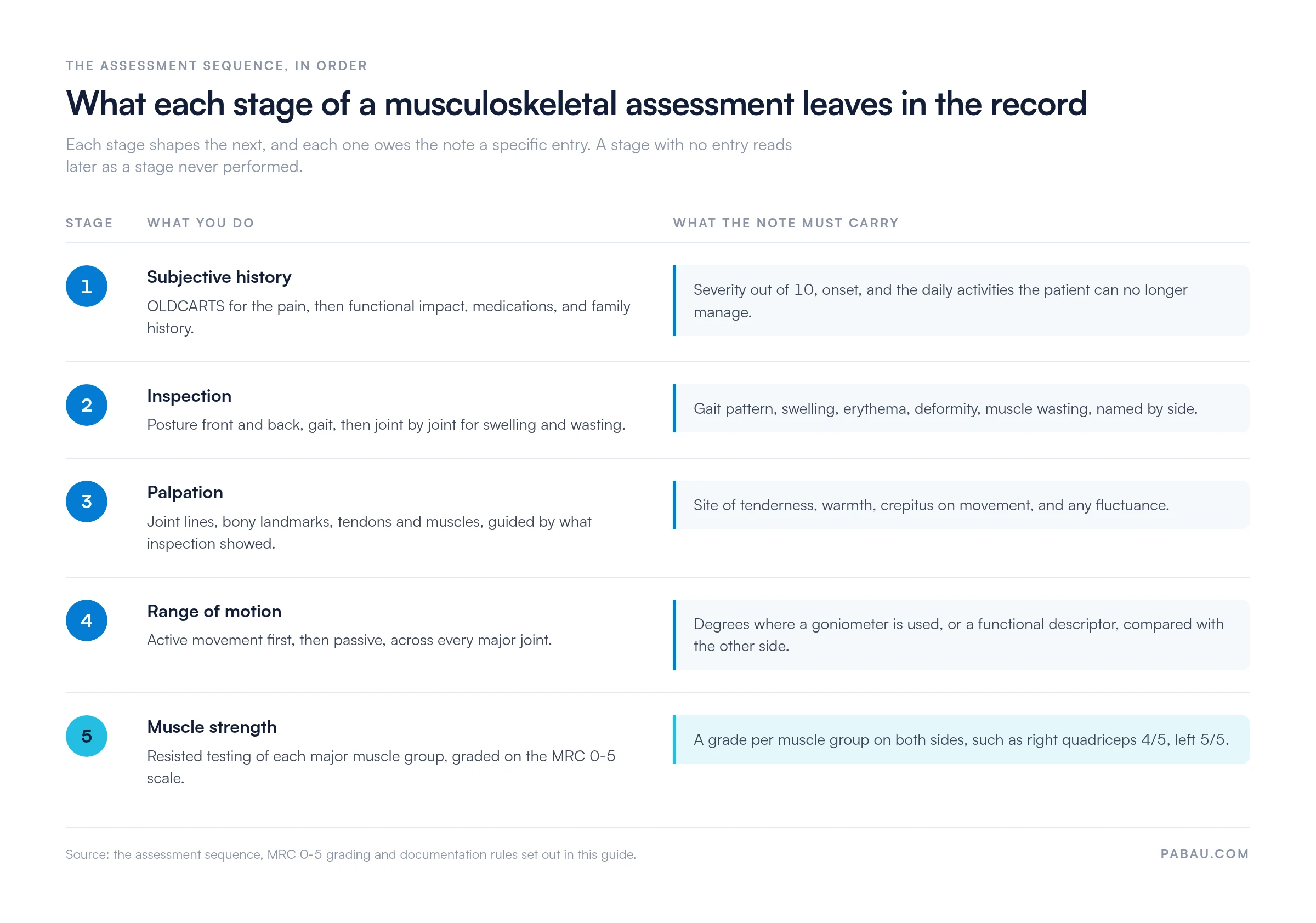
Each component builds on the last, and each one owes the patient record a specific entry. An inspection finding of joint swelling guides where to palpate. A palpation finding of warmth shapes how far you ask the patient to move the joint. The sequence below shows what every stage has to leave behind in the note.
Musculoskeletal conditions account for the largest single category of years lived with disability globally, according to the World Health Organization. In practice, that means patients presenting with pain, stiffness, reduced mobility, or a history of falls. They turn up everywhere, from physical therapy practices to acute care nursing.
Structured assessment matters because a missed finding is expensive. Undetected compartment syndrome causes irreversible muscle death within hours. An unrecognized cauda equina presentation becomes a surgical emergency. A functional limitation missed at admission becomes a falls risk that injures the patient during the stay. Nurses working from a systematic sequence, rather than an ad hoc conversation, catch those findings reliably.
Structured assessment also creates a defensible clinical record. Documenting a normal musculoskeletal finding at admission matters as much as documenting an abnormality. It establishes the baseline against which any deterioration is measured.
Every musculoskeletal nursing assessment begins with the patient’s own account of the problem. Before you examine anything, you need to know what hurts, when it started, and what makes it better or worse. The OLDCARTS mnemonic structures that conversation efficiently.
Beyond pain history, document functional impact explicitly. Can the patient dress independently, climb stairs, or carry groceries? Activities of daily living (ADL) limitations are clinically meaningful, and they are legally relevant when the degree of impairment at baseline is later questioned. Ask about past medical history, relevant medications, and family history of inflammatory arthropathies. Steroids matter most here, since they cause muscle weakness and bone loss.
The physical examination follows a systematic head-to-toe or joint-by-joint sequence. Consistency matters, because nurses who examine in the same order every time are less likely to skip a component under time pressure.
Begin with the patient standing, if it is safe to do so. Observe posture from front and back: note spinal curvature (kyphosis, scoliosis, lordosis), shoulder symmetry, and pelvic tilt. Then observe gait. A normal gait is smooth, with equal step length, arm swing, and heel-to-toe contact. Antalgic gait, meaning a shortened stance phase on the painful side, is an early and reliable sign of lower limb pathology.
Move to individual joints. Inspect each one for swelling, erythema, deformity, and muscle wasting. Common inspection findings and what they point to:
Palpation follows inspection. Palpate each joint line, bony landmark, and the associated tendons and muscles. Note tenderness (point or diffuse), warmth, crepitus on movement, and fluctuance, which indicates fluid. Crepitus is a grating or crackling sensation felt during movement. It is a consistent finding in osteoarthritis, but document it rather than dismiss it, particularly if it is new or painful.
Range of motion (ROM) testing evaluates how far a joint moves through its normal arc. Test active ROM first, where the patient moves independently, before passive ROM, where you move the joint. A discrepancy between the two points to pain inhibition or muscle and tendon pathology, rather than a structural joint problem.
Normal ROM values vary with age, sex, and body habitus. Always compare both sides, since a finding carries more weight when the same joint on the unaffected side moves normally. Record limitations in measured degrees where possible. Where no goniometer is available, use a functional descriptor instead, such as “patient flexes the knee to roughly 90 degrees and cannot achieve full flexion”.
Muscle strength testing uses the Medical Research Council (MRC) grading scale, a six-point system running from 0 (no contraction) to 5 (normal strength). It is the standard tool across nursing, physical therapy, and medicine. It is reproducible, quick to apply, and understood by everyone reading a handover note.
Test each major muscle group against resistance and document the grade on both sides. A grade of 4 or below warrants follow-up, and it should be escalated to the medical team when the history does not explain it. Practices running sports medicine software often build strength-testing templates that carry the MRC scale, which cuts transcription errors at the point of entry.
Normal musculoskeletal findings form the baseline every clinician needs before judging what is pathological. The table below, referenced against NCBI Nursing Skills Chapter 13, maps expected findings against concerning ones across each examination domain.
Certain musculoskeletal findings require immediate escalation rather than a documented plan for review. These red flags are non-negotiable, and any nurse performing a musculoskeletal nursing assessment needs to recognize them on sight.
Record the time of a red flag finding next to the escalation you made. In a later review, an entry reading ‘escalated at 14:32’ defends the care you gave. An entry reading ‘for review’ does not.
Musculoskeletal assessment documentation follows the SOAP framework used across nursing disciplines: Subjective, Objective, Assessment, and Plan. SOAPIE extends it with Implementation and Evaluation for ongoing care planning. Requirements vary by employer and jurisdiction. Apply the standards set by your professional body and organization. That means the Nursing and Midwifery Council in the UK, or the American Nurses Association in the US.
Teams running a shared MSK caseload need those entries in one structured format. A platform built for physiotherapy practice management lets clinicians build assessment templates that hold each SOAP component in the same place. That cuts documentation time and keeps entries comparable between practitioners.
Four documentation principles carry most of the weight in an MSK assessment:
Normal finding example (SOAP format):
Subjective: Patient reports no pain, stiffness, or functional limitation. No history of musculoskeletal injury or joint disease. Objective: Erect posture, smooth and symmetrical gait. All major joints: no swelling, erythema, or deformity on inspection. No tenderness or warmth on palpation. Full active ROM within normal limits on both sides. Muscle strength 5/5 throughout. Neurovascular status intact. Assessment: Normal musculoskeletal examination. Plan: No further action required at this time.
Abnormal finding example (SOAP format):
Subjective: Patient reports right knee pain 6/10 at rest, worsening to 8/10 on stairs. Onset three weeks ago following a fall. Taking ibuprofen with partial relief. Objective: Antalgic gait with shortened stance phase on the right. Right knee swelling with warmth; tenderness on the medial joint line. Active flexion 90 degrees, left 135 degrees. Passive flexion 100 degrees. Muscle strength right quadriceps 4/5, left 5/5. Neurovascular status intact on both sides. Assessment: Right knee pathology, possible medial meniscus or ligament injury. Plan: Refer to orthopedics. Maintain ibuprofen. Safety advice regarding fall prevention.
Pediatric musculoskeletal assessment uses different reference norms and a different approach to examination. Children have greater physiological ROM than adults, and open growth plates that injure more readily than ligaments. Pain expression also varies with developmental stage. Applying adult norms to a child produces false positives and missed diagnoses.
The pGALS screen (pediatric Gait, Arms, Legs, Spine) is the recommended pediatric MSK screening tool, first described in the original pGALS validation paper. It takes under three minutes and uses play-based instructions that children follow reliably from about age five. The screen opens with three questions. Do you have any pain or stiffness in your joints, muscles, or back? Can you dress yourself without any difficulty? Can you walk up and down stairs without any difficulty?
Practices seeing children across several disciplines need those screens in the same chart as the rest of the assessment. Occupational therapy software with configurable digital forms can hold pGALS records alongside developmental assessment data in a single patient record.
Use this checklist as a systematic prompt during assessment. It covers every component in the order they should be performed.
Paper-based musculoskeletal assessment records fail in two consistent ways: they are hard to read, and they are hard to complete. A clinician who cannot read the previous assessment cannot build on it. A form with blank fields gives the next reader no way to tell “examined and normal” from “not examined”.
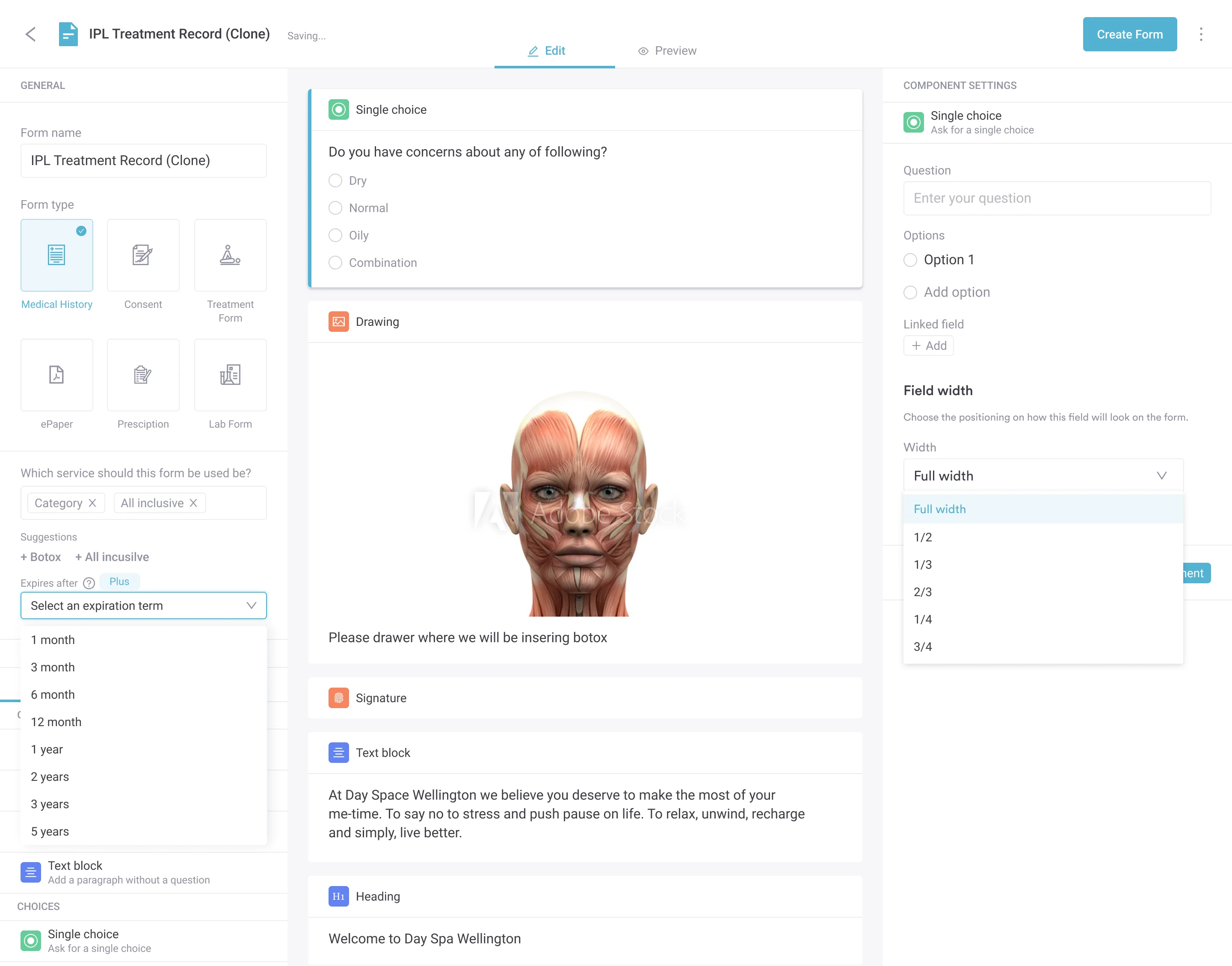
Pabau, our practice management platform, closes both problems in the form itself. Its digital clinical forms let MSK-focused practices build assessment templates with mandatory fields for each examination domain. A submitted form then shows that every component was at least attempted. Each assessment attaches to the patient’s longitudinal record, so today’s MRC grades sit next to last month’s.
Outcome tracking is the second benefit. A patient on a knee rehabilitation program who attends every two weeks generates a series of ROM measurements and strength grades. In one system, the clinician reads that series as a trend instead of re-reading paper notes from scratch.
Automated recall messages keep that series unbroken. Pabau sends the reminder for the next appointment in a treatment program. A patient who would otherwise drift out of the plan comes back while the series is still usable.

Pabau gives physical therapy, sports medicine, and chiropractic practices structured digital forms, longitudinal patient records, and automated recall workflows. Your musculoskeletal assessment data gets captured completely every time.

A musculoskeletal nursing assessment is only as useful as the record it leaves behind. A thorough examination documented poorly gives the next clinician no baseline to work from. A well-structured form filled in differently by each practitioner produces entries that cannot be compared across a treatment episode.
Examination technique is the part this guide settles. The harder habit is recording it the same way at every visit: one template, the same five stages, the same MRC grades. A team that records identically can compare a patient’s knee today with the same knee in March.
Book a demo to see how Pabau holds MSK assessment templates, patient histories, and outcome data in one record your whole team can read.

Need a structured outcome-tracking framework for your MSK practice? Return-to-running protocol for physical therapy sets out progressive loading for lower limb rehabilitation with documented outcome milestones.
Managing clinical documentation across a multi-practitioner team? Mandatory compliance for physiotherapy clinics covers record-keeping standards, registration requirements, and audit readiness.
Want to know how clinical software fits into a new MSK practice? Opening a physical therapy clinic covers regulatory, staffing, and technology setup from day one.
A musculoskeletal nursing assessment has five components. It opens with subjective history taking, using OLDCARTS to characterize the pain and its functional impact. Four objective elements follow. You inspect posture, gait, and each joint, then palpate for tenderness, warmth, and crepitus. Range of motion testing at every major joint comes next, then muscle strength testing on the MRC 0-5 scale. Neurovascular checks and red flag screening run throughout the physical examination.
Nursing uses the Medical Research Council (MRC) 0-5 grading scale. Grade 0 means no detectable contraction, and grade 1 is a flicker with no functional movement. Grade 2 is movement with gravity eliminated, and grade 3 is movement against gravity. Grade 4 is movement against some resistance, and grade 5 is normal strength against full resistance. Any grade of 4 or below warrants further investigation or escalation.
Document normal findings explicitly and affirmatively, in objective language, using SOAP format. A typical normal entry reads: “Erect posture, smooth symmetrical gait. All major joints: no swelling, erythema, or deformity. No tenderness or warmth on palpation. Full active ROM within normal limits on both sides. Muscle strength 5/5 throughout. Neurovascular status intact.” Recording normal findings matters as much as recording abnormalities, because it sets the baseline for detecting later deterioration.
Five findings require immediate escalation. Saddle anesthesia or bowel and bladder dysfunction suggests cauda equina syndrome. Acute neurovascular compromise, such as absent pulse, pallor, paresthesia, or paralysis, suggests compartment syndrome. Fever with a hot swollen joint suggests septic arthritis. Sudden severe pain after minor trauma in an older adult suggests a pathological fracture. Progressive bilateral leg weakness with sensory loss suggests spinal cord compression. None of these belongs on a list for later review.
OLDCARTS structures the subjective pain history during a musculoskeletal nursing assessment. It stands for Onset, Location, Duration, Character, Aggravating factors, Relieving factors, Treatment already tried, and Severity. Working through the mnemonic covers every clinically important dimension of the pain. That guides the physical examination that follows, and it helps separate mechanical, inflammatory, and neuropathic causes.
A pediatric examination uses the pGALS screening tool (pediatric Gait, Arms, Legs, Spine) rather than a full adult assessment. Its play-based instructions are matched to the child’s developmental stage. Children have greater physiological ROM than adults, open growth plates that injure readily, and pain expression that varies by age. Adult ROM and strength norms do not apply, so use age-appropriate reference ranges. The pGALS screen takes under three minutes and is endorsed by BSPAR for clinical and educational use.