

Yeoman’s Test Template
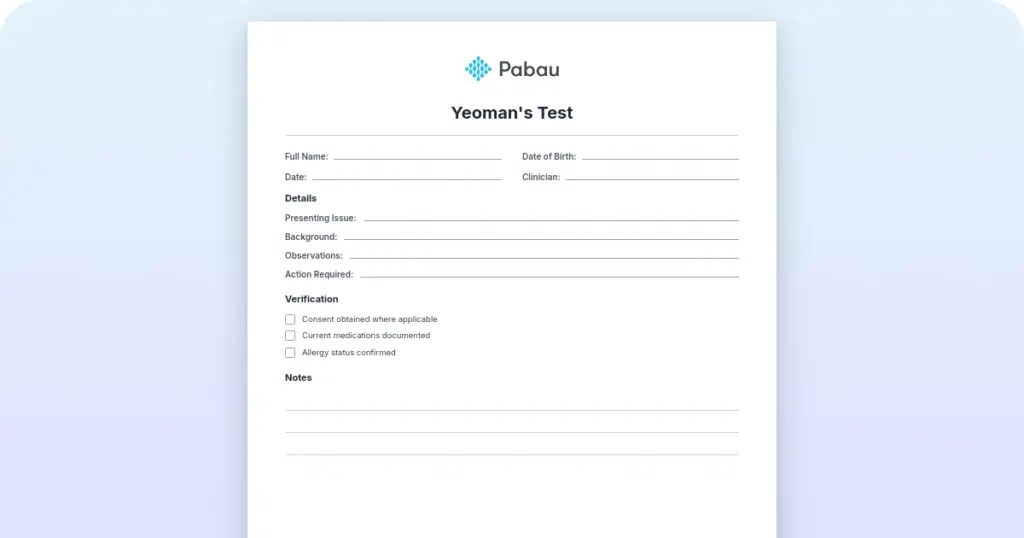
Yeoman’s test is a prone provocation test for sacroiliac joint (SIJ) pain. With the pelvis held down, the examiner flexes the knee to 90 degrees and passively extends the hip. That rotates the ilium forward and stresses the anterior sacroiliac ligament. Familiar pain reproduced over the SIJ, below the posterior superior iliac spine (PSIS), is […]
Upper body weight workout plan
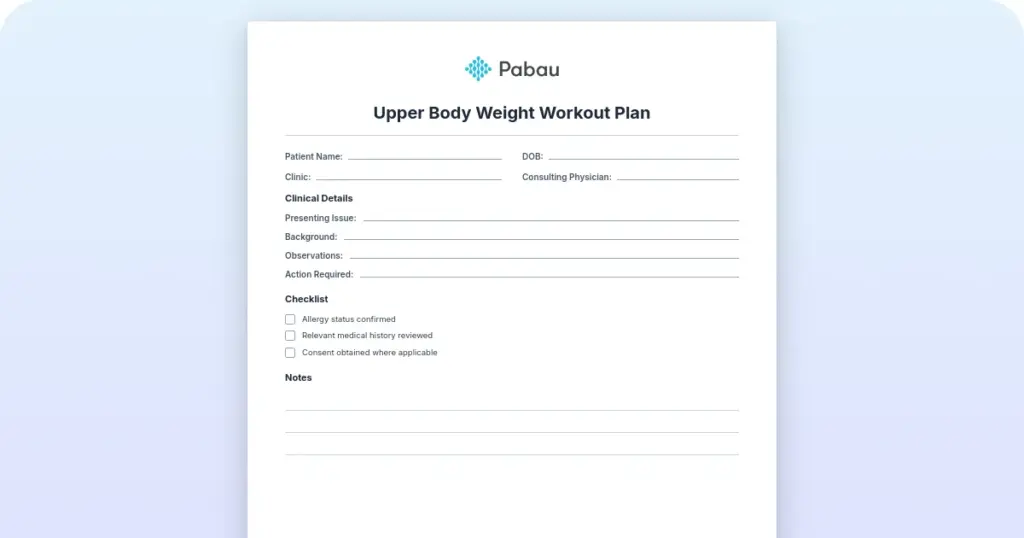
An upper body weight workout plan is a structured program that trains the chest, shoulders, back, biceps, and triceps with weights and bodyweight movements. Two or three sessions a week, built around a handful of compound lifts and logged every time, is enough to add strength and size. The template below gives you the schedule, […]
PT intake form
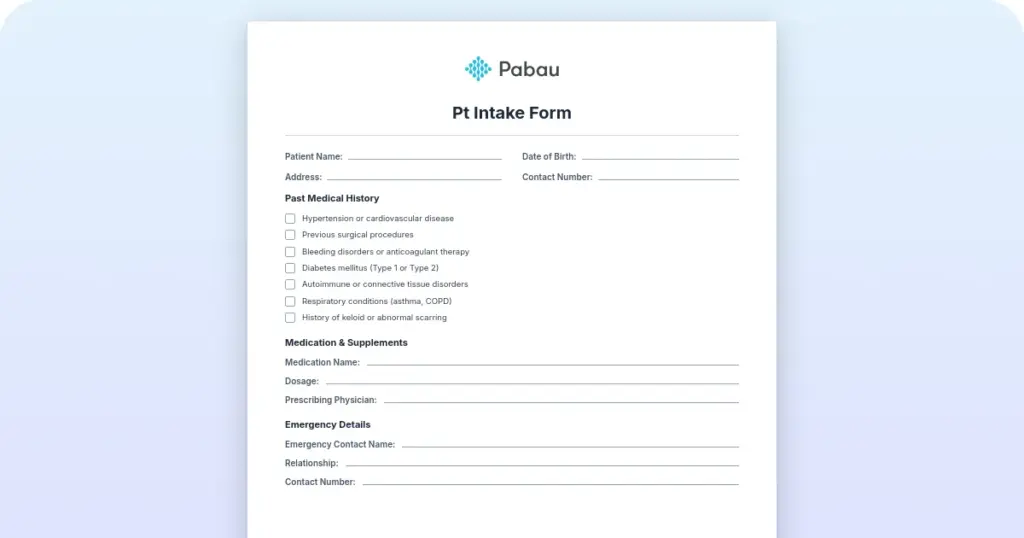
A PT intake form is the questionnaire a new physical therapy patient completes before the first appointment. It records demographics, medical history, pain, functional limitations, and HIPAA authorization, so the therapist starts the evaluation with a full baseline. This free template gives you that structure ready-made, from baseline range of motion and strength screening through […]
CPT code 64628: Basivertebral nerve ablation billing guide
CPT code 64628: quick reference CPT code 64628 reports radiofrequency ablation of the basivertebral nerve in the first two lumbar or sacral vertebral bodies, with all imaging guidance included. It sits in the nervous system surgery section of the AMA code set, among the codes for destruction of nerves by neurolytic agents. The table below […]
Hip quadrant test (scour test): how to perform and interpret
The hip quadrant test, also called the hip scour test, is a passive provocation test that screens for intra-articular hip pathology. You apply axial compression through the femur while sweeping the flexed hip from flexion-adduction to flexion-abduction. The test is positive only when it reproduces the patient’s own groin or anterior hip pain. Reported sensitivity […]
Heel thump test: how to perform, interpret, and document findings
The heel thump test is a clinical provocation test for syndesmotic ankle sprain, better known as a high ankle sprain. The examiner strikes the heel so axial force travels up through the calcaneus and loads the distal tibiofibular syndesmosis. Pain reproduced at the anterolateral ankle, above the joint line, is a positive result. Lindenfeld and […]
Cotton test: How to perform and interpret this ankle assessment
The cotton test is a manual orthopedic special test that detects instability of the distal tibiofibular syndesmosis. The examiner grips the hindfoot and translates the talus from side to side inside the ankle mortise. Lateral translation beyond 3 to 4 mm, compared with the uninjured ankle, counts as a positive result. It is one of […]
Shrug test: How to perform and interpret the shoulder shrug sign
The shrug test shows whether a patient lifts the shoulder girdle to compensate for restricted glenohumeral movement. You ask the patient to raise the arm out to the side toward 90 degrees of abduction, then repeat it in forward flexion. A positive shrug sign means the girdle rises early, before the glenohumeral joint has used […]
Costoclavicular test: How to perform, interpret, and document
The costoclavicular test is a provocation test for thoracic outlet syndrome (TOS). It narrows the space between the first rib and the clavicle so that neurovascular compression symptoms reappear. The patient braces both shoulders back and down for 30 to 60 seconds while you monitor the radial pulse. The result is positive only when the […]
ICD-10 Code M18.2: Post-traumatic CMC OA coding guide
ICD-10 code M18.2: Definition and official descriptor ICD-10 code M18.2 is defined as “Bilateral post-traumatic osteoarthritis of first carpometacarpal joints” in the ICD-10-CM tabular list. That list is maintained by CMS and the National Center for Health Statistics (NCHS). It is a specific, billable code valid for HIPAA-covered claim transactions in FY2025 and FY2026. Those […]