ICD-10 Code S42.444P: Medial epicondyle fracture, right humerus
ICD-10 Code S42.444P: full descriptor and code validity ICD-10 Code S42.444P car...

Last Updated: Oct 13, 2026
Billable Code Specific Code
M18.2 is the billable ICD-10-CM code for bilateral post-traumatic osteoarthritis of first carpometacarpal joints.
Most coders who reach for it have already ruled out M18.0, the primary bilateral form. The etiology documentation is what trips them up. A note reading "degenerative changes of both CMC joints" does not support M18.2. The provider must state the post-traumatic cause outright, and the record must show a prior injury to both hands. Where that statement is missing, the claim is downcoded or denied.
Let Pabau's smart automation suggest the right codes, reduce claim denials, and keep your practice compliant—effortlessly.
Automate repetitive tasks and focus on what matters most—your patients.
Reduce coding errors and ensure compliance with the latest regulations.
Clean claims, fewer denials, and faster reimbursements.
Powerful insights and reporting to help your practice thrive.
HIPAA compliant SOC 2 certified GDPR-compliant Trusted by 4,000+ clinics worldwide

M18.2 covers bilateral post-traumatic osteoarthritis of the first CMC joints only. Primary OA of the same joints is M18.0.
Both hands must be affected, and the provider must explicitly document post-traumatic etiology. Degenerative language alone does not support M18.2.
Undocumented etiology is the most common denial reason. Payers downcode to M18.30 when traumatic origin is absent from the record.
Practice management software like Pabau submits and tracks M18.2 claims through the Claim.MD clearinghouse, so denials surface in one place.
ICD-10 code M18.2 is defined as “Bilateral post-traumatic osteoarthritis of first carpometacarpal joints” in the ICD-10-CM tabular list. That list is maintained by CMS and the National Center for Health Statistics (NCHS). It is a specific, billable code valid for HIPAA-covered claim transactions in FY2025 and FY2026. Those fiscal years took effect on October 1, 2024 and October 1, 2025. No additional characters are needed, because M18.2 is complete at the five-character level.
The first carpometacarpal joint is the saddle joint where the first metacarpal meets the trapezium. Clinicians also call it the thumb CMC joint, the basal thumb joint, or the trapeziometacarpal joint. It is the joint most often affected in hand osteoarthritis.
Post-traumatic degeneration at this joint is a well-documented sequela of Bennett’s fractures, CMC dislocations, and crush injuries. Two qualifiers define M18.2 completely: bilateral presentation and post-traumatic etiology. Both must be present before the code can be assigned.
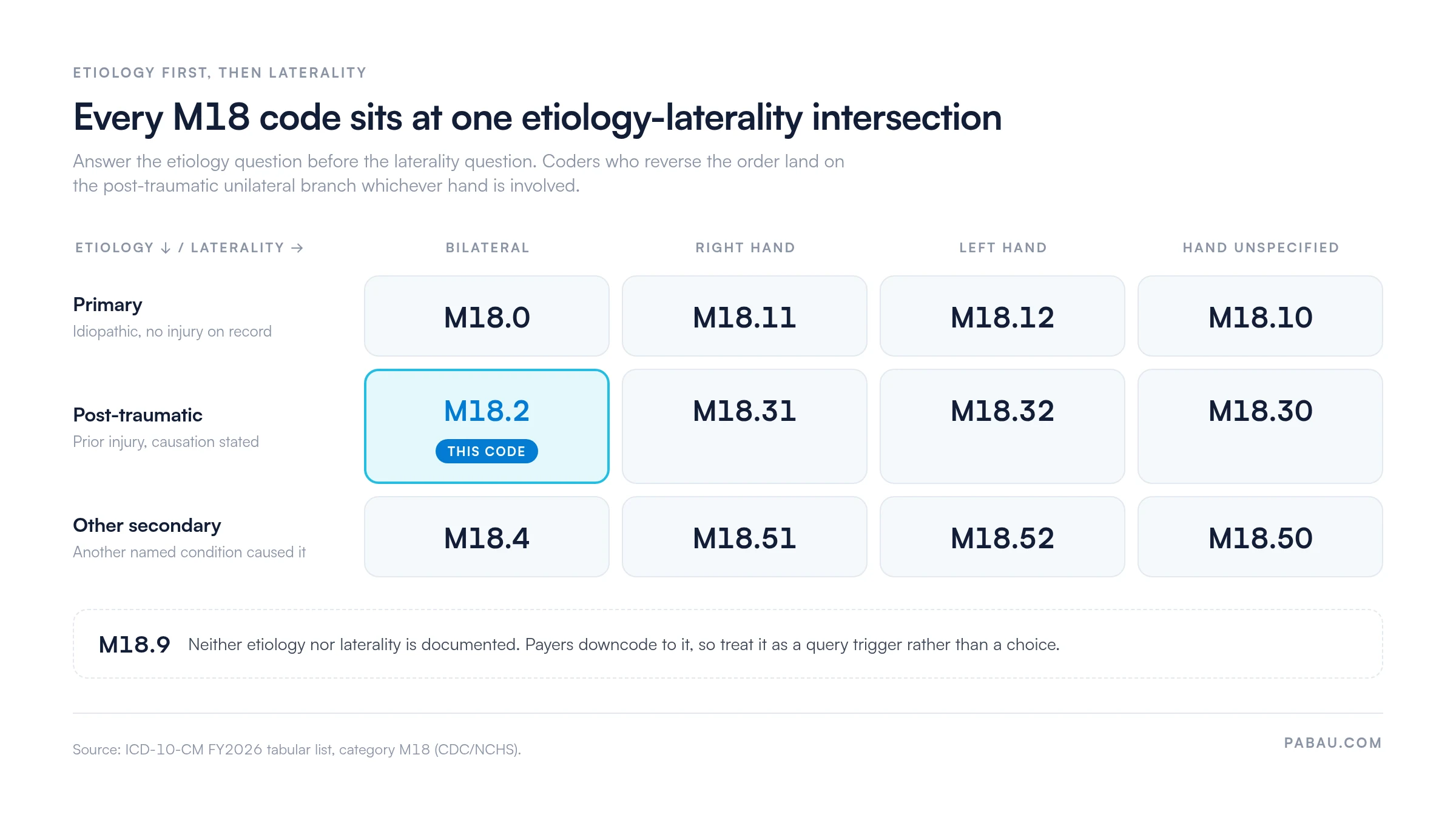
M18.2 sits in the ICD-10-CM musculoskeletal chapter (M00-M99), under the arthropathies block (M00-M25). Within that block it falls in the osteoarthritis group (M15-M19), inside category M18 for osteoarthritis of the first carpometacarpal joint. The table below lists the full category alongside the two variables that drive subcode selection.
Subcode selection runs on two axes in a fixed order. Etiology comes first, and the choice is primary, post-traumatic, or other secondary. Laterality comes second. M18.9 is the code to avoid, because it is non-specific and most payers downcode or deny it when a more precise alternative is documentable.
Three criteria must all be satisfied at the same encounter to assign ICD-10 code M18.2. If any one is absent, a different code applies.
The ICD-10-CM Official Guidelines for Coding and Reporting published by NCHS attach no Excludes1 or Excludes2 note directly to M18.2. The tabular structure still creates functional exclusions, and three of them account for most misassignments.
Primary bilateral OA of the same joints is M18.0, never M18.2. Bilateral secondary OA caused by another named condition is M18.4. Polyarthritis affecting several joint groups, the first CMC included, is M15. Hand osteoarthritis at any joint other than the first CMC belongs to the M19.04 and M19.14 subcategories, always at the sixth-character level.
M18.2 is most frequently confused with four neighboring codes. The distinction is always resolved by answering two questions in order. Is the etiology primary or post-traumatic? Is the presentation bilateral or unilateral? Coders who skip the etiology question and jump straight to laterality end up on the M18.30 to M18.32 branch, whichever hand is involved.
One practical note. M18.30 is the downcode destination payers reach for when a claim billed as M18.2 arrives without an explicit statement confirming both sides. Submitting M18.2 when only one side appears in the operative report is a frequent laterality mismatch denial.
Assigning ICD-10 code M18.2 is straightforward once the clinical note supports all three elements at the same time. Getting the note to that point is the harder job. Reviewers on pre-authorization and post-payment audit look for four specific items.
“Degenerative changes” documented without any reference to trauma will lead a payer to assign M18.0 or M18.9 instead of accepting M18.2. That distinction carries money with it. CMC arthroplasty (CPT 25447) attracts different prior authorization requirements depending on whether the diagnosis is primary or post-traumatic.
M18.2 is the diagnosis that anchors a range of hand surgery and rehabilitation CPT codes. The table below shows the procedures most frequently paired with it. It also says what each one is doing in the care pathway for bilateral thumb base OA.
Check the CMS NCCI Policy Manual for current bundling edits before submitting same-day combinations. Pairing CPT 20600 with an Evaluation and Management code on the same date requires modifier 25. The modifier confirms that a separately identifiable service was performed.
Payer requirements vary by plan and by region, so verify each one against the individual payer’s Local Coverage Determination (LCD). Consistent patterns still run across Medicare and commercial payers, and those patterns shape how M18.2 claims are handled.
A structured pre-authorization workflow catches a thin note before submission rather than after denial. Pairing that workflow with cleaner claims management keeps every conservative treatment attempt timestamped and tied to the M18.2 diagnosis in the record.
M18.2 denials almost always trace back to one of six root causes. Read the list below against the denial codes your own payer mix returns.
Treat each M18.2 denial as a symptom of how the practice documents, rather than a one-off billing error. A root-cause review of three to five denials usually surfaces one or two systemic problems that can be fixed upstream.
Run a five-second check before submitting any M18.2 claim. Does the diagnosis line carry the word ‘post-traumatic’ or an equivalent? Does the note name both hands? Does it cite a prior injury? If an element is missing, query the provider now rather than appealing later.
When M18.2 is the principal diagnosis on an inpatient admission, it maps to Major Diagnostic Category 8 under the CMS MS-DRG system. MDC 8 covers diseases and disorders of the musculoskeletal system and connective tissue. The specific DRG then shifts with the procedures performed during the admission. It also shifts with whether a major complication or comorbidity (MCC) or a complication/comorbidity (CC) is present.
CMC arthroplasty is not a major joint procedure. An admission with M18.2 as the principal diagnosis and CPT 25447 as the primary procedure therefore groups to the other musculoskeletal branch. Verify against the current CMS MS-DRG definitions manual, versions 43.0 and 43.1 for FY2026, because assignments shift with each annual update.
Capturing every secondary diagnosis that qualifies as a CC or an MCC changes reimbursement directly. Inpatient coders should query providers when the documentation suggests a comorbidity that is never stated as a clinically significant diagnosis. The remittance advice on a paid inpatient claim confirms which DRG the grouper assigned, which makes a useful post-submission audit check.
M18.2 is a stable, billable ICD-10-CM code that has remained unchanged since its introduction. It did not appear on the CMS deleted-codes list for FY2025 or in the FY2026 update cycle. Coders can submit it without modification for both fiscal years.
The CDC/NCHS ICD-10-CM web tool confirms its active status and provides the official tabular entry. For the annual update files, consult the AAPC ICD-10-CM code lookup or the CMS ICD-10 codes page each October. No additional specificity characters are expected for M18.2 in upcoming update proposals.
In most practices the etiology statement, the imaging report, the injection dates, and the splinting trial each live somewhere different. A coder assembling an M18.2 prior authorization packet has to go and find them, then hope nothing was recorded outside the chart.
Practice management software like Pabau keeps all of it on one patient record. The clinical note, the uploaded X-ray report, and every injection or splinting encounter sit together. The diagnosis attached to each visit stays searchable by code. Building the conservative-treatment history for a CPT 25447 authorization becomes a lookup rather than a hunt.
Claims then leave through the Claim.MD clearinghouse integration, which submits and tracks them and pulls the electronic remittance advice back against the same record. When an M18.2 claim is downcoded to M18.30, the denial lands next to the note that caused it. The fix then goes to the provider instead of into an appeals queue.

Pabau submits and tracks musculoskeletal claims through the Claim.MD clearinghouse and posts each remittance back to the patient record. Your team sees which documentation caused a denial instead of reopening the chart to find out.

“OA of both CMCs” and “bilateral post-traumatic osteoarthritis of first carpometacarpal joints” describe the same patient. Only the second one supports M18.2, and that single difference in wording is where most of these claims fail.
So the work belongs at the point of care, not at the point of denial. A provider query takes minutes before submission and weeks afterward, and the appeal still depends on wording that should have been in the original note. Practices that move the check upstream recover revenue faster and spend far less on appeals.
The trade-off worth remembering is specificity against speed. M18.9 clears the claim scrubber quickly and costs you on adjudication. Book a demo to see how Pabau keeps M18.2 documentation, claims, and remittances on one record.

Need to understand denial patterns across your billing workflow? Denial management in healthcare covers the root-cause frameworks revenue cycle teams use to reduce claim rejection rates.
Submitting musculoskeletal claims through a clearinghouse? What makes a clean claim outlines the elements payers check before adjudicating, including diagnosis-to-procedure matching for orthopedic codes.
Working with electronic remittance data after payment posting? Superbill documentation explains how encounter-level detail flows from the superbill through to remittance reconciliation.
ICD-10 code M18.2 is the billable ICD-10-CM diagnosis code for bilateral post-traumatic osteoarthritis of the first carpometacarpal joints. It describes degenerative joint disease in both thumb base joints caused by prior trauma. It is valid for FY2026 and needs no additional characters.
Yes. M18.2 is a billable, valid ICD-10-CM code at the five-character level, and it can be submitted on HIPAA-covered claim transactions without further specification. It has been billable since its introduction and remains active through FY2026.
The most common reason is that the physician’s note never states post-traumatic etiology, so payers downcode to M18.30 or M18.9. Other triggers include a laterality mismatch between the claim and the operative record. Use of the non-billable parent code M18 and missing conservative treatment documentation also cause denials.
Yes, as long as both first CMC joints show OA at the time of the encounter and the physician documents post-traumatic etiology for both. The original trauma does not need to have affected both hands at once. Sequential injuries to each hand over time can support M18.2 when the record establishes a post-traumatic cause for each side.