Treatment summary
A treatment summary is a written record of what care was delivered during an epi...

3
Last Updated: Oct 16, 2026
The hip quadrant test, also called the hip scour test, is a passive provocation test that screens for intra-articular hip pathology. You apply axial compression through the femur while sweeping the flexed hip from flexion-adduction to flexion-abduction.
The test is positive only when it reproduces the patient’s own groin or anterior hip pain. Reported sensitivity is about 75% and specificity about 43%, so a positive result raises suspicion without confirming a diagnosis.
A clinical review of hip examination makes the same point: no single hip special test is both highly sensitive and highly specific. Use the quadrant test inside a cluster with FABER, FADIR, and the log roll before you refer for imaging.

The hip quadrant test (also called the hip scour test) is a passive compression-and-arc test used to screen for intra-articular hip pathology.
A positive result is reproduction of concordant groin or anterior hip pain during the arc movement, not just crepitus or discomfort.
Published data suggest moderate sensitivity (around 75%) and limited specificity (around 43%), so use it as part of a test cluster.
Where the pain appears in the arc hints at the structure involved, so record the arc position every time.
Practice management software like Pabau lets physical therapy practices record arc position, pain character, and concordance the same way for every practitioner.
The hip quadrant test is a passive orthopedic special test. The clinician holds a sustained axial compression force through the femur while moving the hip from flexion-adduction to flexion-abduction. That load presses the femoral head against the acetabular cartilage and labrum across the arc. It should provoke pain only if intra-articular pathology is present.
It belongs to the same family as FABER and FADIR. Those tests load one static end-range position, while the quadrant test holds compression through the whole arc. That’s why it covers more of the joint surface in a single movement than most static provocation tests.
Students often trip over the two names. “Hip quadrant test” refers to the quadrant of motion the hip moves through. “Hip scour test” (or scouring test) describes the femoral head scouring across the acetabular cartilage under compression. Both terms appear in peer-reviewed literature, and this guide uses them interchangeably.
The acetabulofemoral joint is a ball-and-socket joint where the femoral head sits in the acetabular cup, ringed by the labrum. The labrum is fibrocartilage that deepens the socket, adds stability, and spreads load across the joint surface. When it tears, the torn tissue can get trapped between the femoral head and acetabulum. The result is a sharp, localized pain, unlike the diffuse ache of a muscle problem.
Femoroacetabular impingement (FAI) changes the joint’s geometry. In cam-type FAI, a non-spherical femoral head jams against the acetabular rim at the extremes of flexion-internal rotation. In pincer-type FAI, the acetabular rim overcovers the femoral head. Both mechanisms make arc movements under compression painful, which is exactly the stimulus this test applies.
Osteoarthritis behaves differently. Cartilage loss narrows the joint space and stiffens the capsule, so the whole arc becomes uncomfortable instead of one focal point.
The hip quadrant test is indicated whenever intra-articular hip pathology is in the differential. These presentations should put it in your examination battery.
Skip the test when you suspect acute joint inflammation, fracture, or severe osteoporosis. The compressive force could worsen symptoms or cause harm.
Small changes in hand placement, compression force, or movement arc change what the test loads and whether the result is valid. Follow these steps precisely.
Position the patient supine on the examination table with both hips and knees in a relaxed, extended position. The clinician stands on the side being tested, facing the patient’s head at roughly a 45-degree angle. The table height should allow the clinician to generate a downward compressive force through straight arms without leaning awkwardly.
The scouring arc is what distinguishes this test from static provocations like FABER. The clinician maintains a constant axial compression force through the femur throughout the entire movement. That loads the joint surfaces as the femoral head rotates across the acetabular cartilage.
The arc position where pain starts is a clue in itself, as the map below shows.
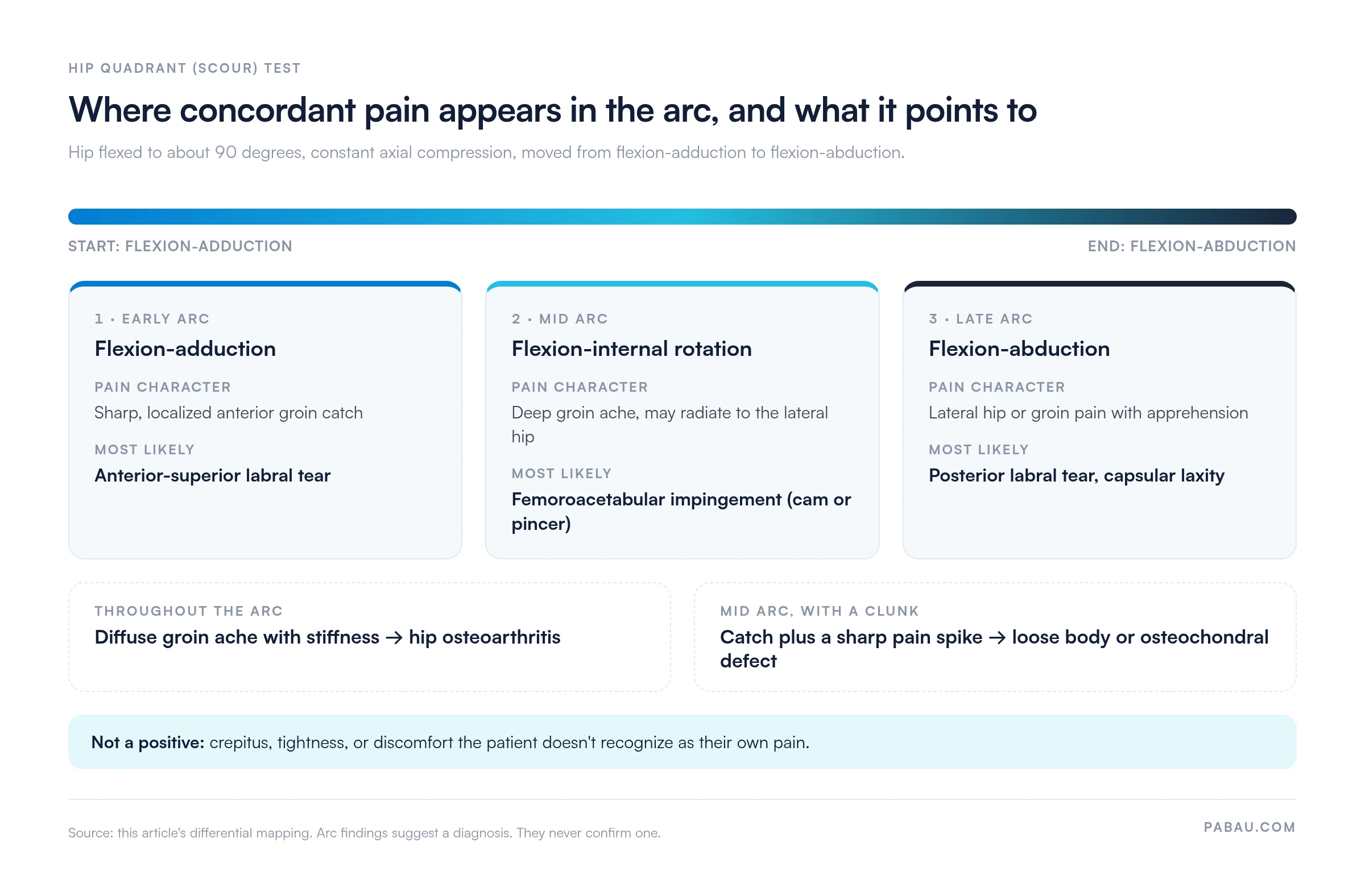
Recording that position at every visit gives you a reproducible baseline. Physiotherapy practice management software keeps the note in the same format across practitioners and repeat assessments.
Always ask the patient before the test whether the pain you are about to provoke is ‘the same pain’ that brought them in. A true positive requires reproduction of concordant pain, not just any discomfort. Establish this benchmark verbally before you start the arc.
A positive hip quadrant test is defined as reproduction of the patient’s concordant groin or anterior hip pain during the arc movement. Crepitus alone, a general sense of tightness, or discomfort that the patient does not recognize as their presenting complaint does not constitute a positive result.
The arc position where pain is provoked, and the character of that pain, offers diagnostic clues. The table below maps findings to their most likely differential diagnoses.
No. A negative hip quadrant test does not rule out labral tear or FAI. Its moderate sensitivity means false negatives happen. They’re most likely with early labral tears, where the torn tissue isn’t yet trapped consistently during the arc. High pain tolerance can also hide low-level concordant discomfort.
A negative result reduces the probability of intra-articular pathology. Always interpret it alongside other special tests (FABER, FADIR, log roll) and the patient’s history. When clinical suspicion remains high after a negative result, MRI arthrography remains the gold standard for labral visualization.
Published data for the hip quadrant test show moderate sensitivity and limited specificity. Narvani and colleagues reported sensitivity of approximately 75% and specificity of approximately 43% for detecting acetabular labral tears in athletes with groin pain. Physiopedia’s hip quadrant test entry summarizes the same figures.
In practice, the test catches roughly three in four patients who have the pathology, which is acceptable for a screen. It also flags a large share of patients who don’t.
The Journal of Orthopaedic and Sports Physical Therapy (JOSPT) has published several systematic reviews on hip special test accuracy. Their consistent finding is that no single hip special test achieves clinically useful likelihood ratios on its own.
The hip quadrant test performs best in a cluster, where two or three positive tests raise post-test probability substantially. A positive quadrant test plus a positive FADIR and restricted internal rotation makes a much stronger case than any one finding alone.
Choosing the right test, or the right combination, requires understanding how each special test loads the hip differently. This comparison draws on published sensitivity and specificity ranges from Physiopedia’s hip special tests reference and the JOSPT systematic review literature. In sports medicine practices, FADIR pairs well with the scour test for FAI screening.
The lumbar quadrant test is a different examination technique that targets lumbar facet joint irritation and spinal stenosis. Confusing the two is a common student error. Both can produce pain in the lower back or buttock region, and both use the word “quadrant.” Their anatomy, technique, and interpretation are entirely distinct.
When a patient presents with both groin pain and low back pain, both tests may be warranted in sequence. Always assess the lumbar spine and hip independently, because hip pathology and lumbar pathology frequently coexist and can present with overlapping symptom patterns.
Technique errors cause many of the false negatives and false positives that get blamed on the test. Watch for these six in student placements and peer supervision.
The hip quadrant test is most useful inside a structured examination sequence. For suspected intra-articular pathology, run the hip assessment in this order:
Our hip examination guide walks through each stage of that sequence in more detail.
When two or more tests in the cluster are positive, the post-test probability of intra-articular pathology rises. According to the American Physical Therapy Association (APTA), cluster-based examination is recommended over single-test reliance in hip assessment. At that point, refer for MRI arthrography to confirm labral pathology or FAI before choosing conservative or surgical management.
After hip arthroscopy, you can reintroduce the test at suitable recovery stages to monitor residual intra-articular irritability. Before a return-to-running protocol starts loading the hip dynamically, it gives you one objective marker of joint tolerance.
Documentation matters as much as technique. Record the arc position of pain provocation, whether the pain was concordant, the compression applied, and any painless crepitus. Those details turn a vague “hip special tests performed” entry into a note the next clinician can act on.
Run the hip quadrant test before FADIR in your examination sequence. FADIR is highly sensitive but can leave the joint irritated. The quadrant test’s sustained compression arc is better tolerated as a first provocative stimulus. Its result also gives you early directional information before the more aggressive impingement test.
In many physical therapy practices, special test results end up as free text. One clinician writes “scour positive,” another writes “groin pain on quadrant,” and a third skips the arc position entirely. Comparing results across visits then means reading every note line by line.
Practice management software like Pabau replaces that with a structured assessment form. You can build a hip template that prompts for arc position, pain character, concordance, and crepitus. Every practitioner then records the same fields, and Pabau’s software for physical therapists stores each completed form in the patient record.

The payoff shows up at reassessment. After arthroscopy or a rehab block, you can open the patient record and see how the quadrant test result changed from visit to visit. That trajectory supports the decision to progress loading, refer for imaging, or discharge.


Structured assessment forms and patient records help your team capture special test findings consistently and track them across visits.

Treat the hip quadrant test as a screen with a useful map attached. A negative result lowers suspicion without clearing the hip. A positive one justifies the rest of the cluster and, if that agrees, an MRI arthrogram.
The quality of the result depends on your hands. Hold compression through the whole arc, count only concordant pain, and write down where in the arc it appeared. That arc position turns a moderate test into a useful pointer toward the labrum, impingement, or arthritis.
If your team records special tests in free text today, standardizing the note is the quickest win. Book a demo to see how Pabau’s assessment forms keep hip exam findings consistent across your practitioners.

Managing a physical therapy practice? Physical therapy EMR covers how Pabau supports documentation, scheduling, and patient records for PT practices.
Assessing the whole hip? Hip examination covers how to structure a complete hip assessment.
Patient reports a clicking or snapping hip? Snapping hip test explains how to assess that complaint.
Checking femoral anteversion? Craig’s test template gives you a ready-made form for recording the result.
Working with sports medicine or rehabilitation patients? Sports medicine software shows how Pabau handles multi-practitioner sports and rehabilitation workflows.
The hip quadrant test screens for intra-articular hip pathology, including acetabular labral tears, femoroacetabular impingement (FAI), hip osteoarthritis, and loose bodies. It applies axial compression through the femur while moving the hip through an arc, provoking pain if pathological tissue is loaded.
Position the patient supine with hip and knee flexed to approximately 90 degrees. Apply a firm, sustained axial compression force through the knee along the femoral shaft toward the acetabulum. Slowly arc the hip from flexion-adduction through to flexion-abduction over 5 to 8 seconds while maintaining constant compression. A positive result is reproduction of the patient’s concordant groin or anterior hip pain during the arc.
In Narvani and colleagues’ study of athletes with groin pain, the test showed sensitivity of about 75% and specificity of about 43%. It misses roughly one in four true cases, and a positive result alone carries limited diagnostic weight. Its value improves when you combine it with FABER, FADIR, and restricted internal rotation findings.
Yes, hip osteoarthritis (OA) often produces a positive hip quadrant test, but the pattern differs from labral pathology. In OA, pain tends to spread across the entire arc instead of one point. It usually comes with stiffness and globally restricted range of motion. The test is not specific to OA and cannot confirm the diagnosis. Plain radiographs or MRI are needed for a definitive OA assessment.