

Piano key test: How to perform and interpret it
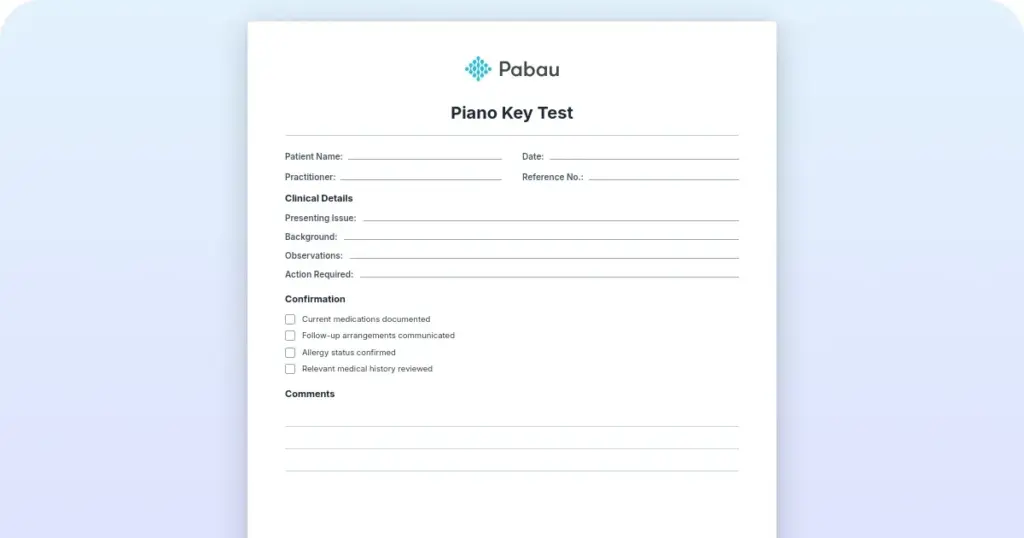
Download your free piano key test template A ready-to-use clinical assessment form covering patient positioning, examiner technique, and result interpretation. It includes bilateral comparison, DRUJ stability grading, differential diagnoses, and findings documentation. Download template The piano key test is a physical examination technique used by hand surgeons, physiotherapists, and orthopedic practitioners to assess distal radioulnar […]
Elderly home safety checklist
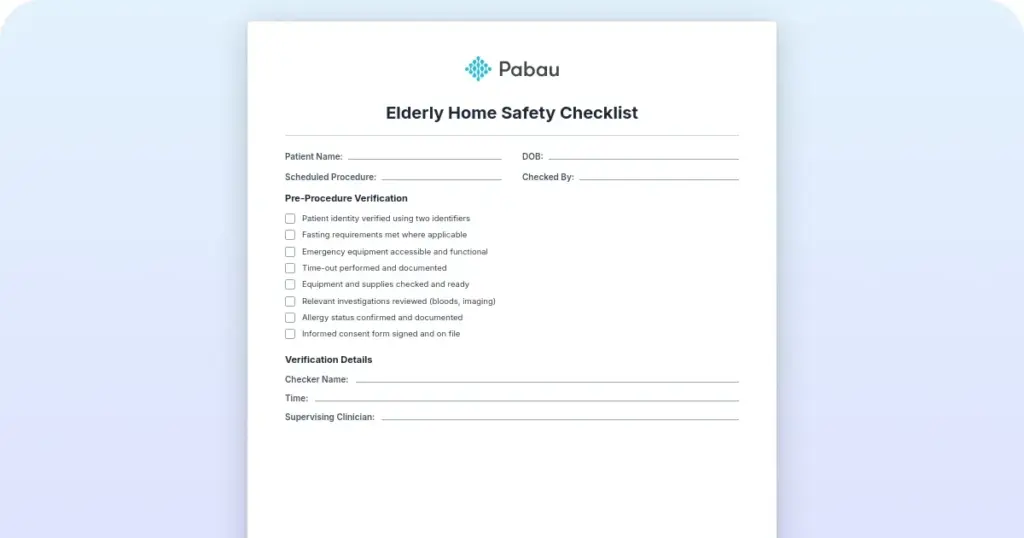
Download your free elderly home safety checklist A printable room-by-room assessment covering bathroom, kitchen, bedroom and stairway hazards, medication storage, fire safety, outdoor access, and emergency contacts. Use it during a home visit or a family safety conversation. Download template An elderly home safety checklist is a structured tool for finding hazards in an older […]
Knee examination: A systematic clinical guide
Knee injuries make up a large share of musculoskeletal presentations in primary care, physical therapy, and orthopedic settings. A systematic knee examination narrows the differential, guides the imaging decision, and shapes management before a single scan is ordered. This guide walks through the sequence in clinical order, from history-taking to special tests. It also sets […]
Bent knee stretch test: how to perform and interpret results
Proximal hamstring tendinopathy is one of the more stubborn presentations in MSK practice. As a result, it is often misdiagnosed as gluteal tendinopathy, sciatica, or a hamstring muscle tear. The bent knee stretch test (BKST) gives clinicians a repeatable way to isolate the proximal hamstring tendons. Done correctly, it reproduces the patient’s familiar symptoms at […]
Finger-to-nose coordination test: step-by-step
Hereditary cerebellar ataxia is rare, affecting roughly 6 people per 100,000, or about 1 in 17,000 to 20,000. Acquired cerebellar dysfunction is far more common. Stroke, multiple sclerosis, and alcohol-related neurodegeneration send a steady stream of patients to neurology, physical therapy, and sports medicine practices every year. The finger-to-nose coordination test is one of the […]
Compression rotation test: how to perform and interpret it
Shoulder special tests are only as useful as the clinician performing and interpreting them. The compression rotation test is one of a small group of orthopedic assessments that are highly specific for SLAP lesions. When it is positive, the finding carries clinical weight. Its sensitivity is low, though, so a negative result tells you far […]
Shoulder relocation test: technique, interpretation and accuracy
Anterior shoulder instability gets diagnosed at the examination table far more often than in the scanner. What separates a confident clinical diagnosis from an unnecessary MRI referral is usually how one examination sequence is performed and read. The shoulder relocation test sits at the center of that sequence. This guide covers the biomechanics, the step-by-step […]
Allied health software Australia: 7 compared on claiming (2026)

The best allied health software Australia practices can buy is the one that lodges claims with every payer they bill, and Nookal reaches the most. In our Claims-Readiness Matrix, Nookal is in fact the only one of seven platforms to reach Medicare, DVA, NDIS, health funds and state workers’ compensation. However, the right pick still […]
Valgus extension overload test: How to perform it, interpret it, and treat a positive result
The valgus extension overload test reproduces posteromedial elbow pain by applying valgus stress while you passively extend the elbow. It is the maneuver practitioners reach for when valgus extension overload (VEO) syndrome is suspected in a thrower. Posteromedial elbow pain in a baseball pitcher or cricket bowler is rarely straightforward, and several conditions share that […]
Posterior interosseous nerve test: Anatomy, technique, and interpretation
What is the posterior interosseous nerve test? The posterior interosseous nerve test is a clinical examination sequence that detects motor dysfunction of the posterior interosseous nerve (PIN). The PIN is the deep motor branch of the radial nerve. A positive test reveals finger and thumb extension weakness at the metacarpophalangeal (MCP) joints, with preserved but […]