GLP-1 diet plan
A GLP-1 diet plan is a structured eating framework for patients taking semagluti...

2
Last Updated: Oct 13, 2026

The finger-to-nose coordination test evaluates cerebellar function and upper-limb ataxia by having the patient alternate between touching their nose and the examiner’s moving finger.
Dysmetria (hypermetria or hypometria), intention tremor, and past-pointing are the three key abnormal findings to observe and document.
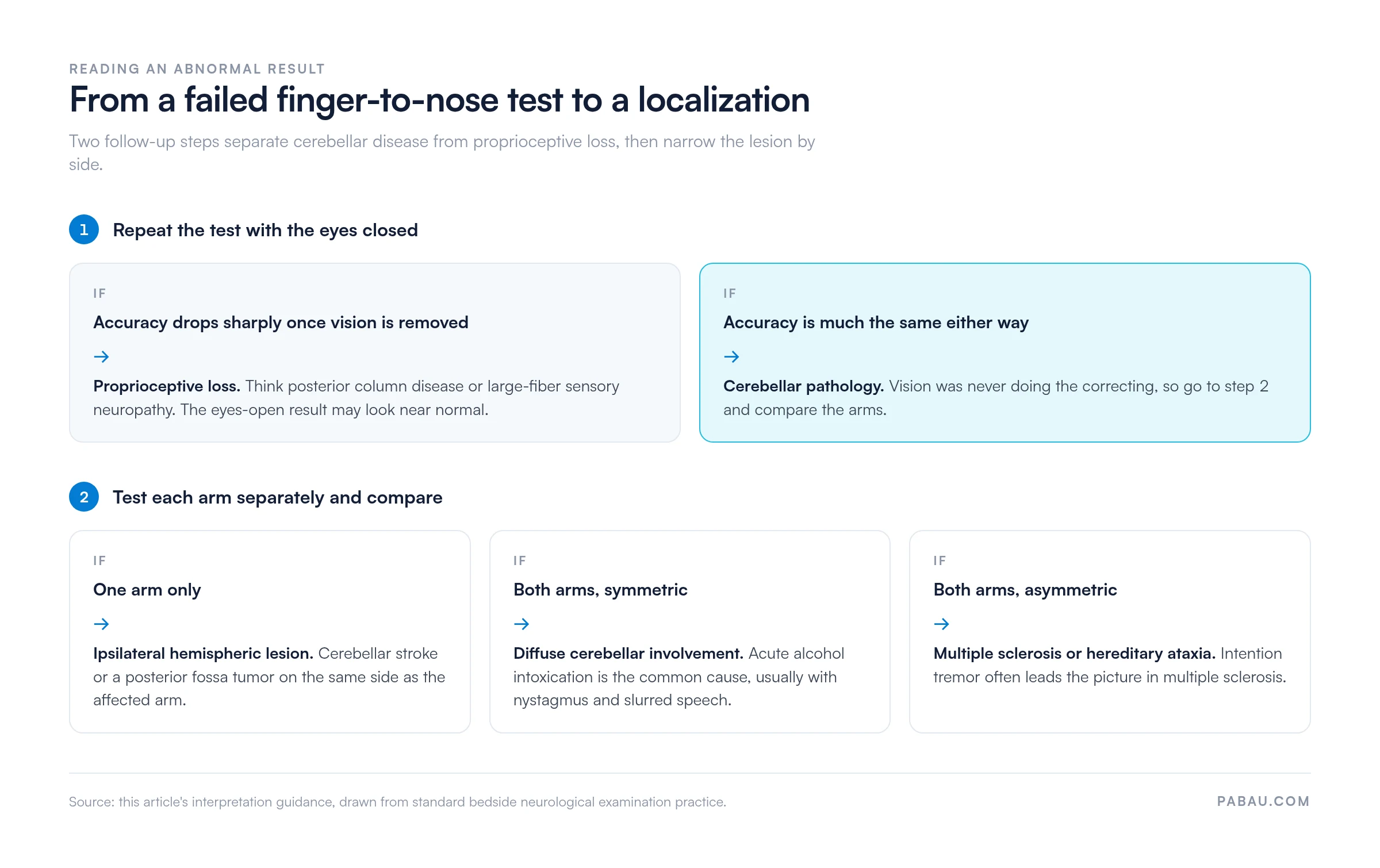
Repeat the test with the eyes closed, since a sharp drop in accuracy points to proprioceptive loss rather than cerebellar disease.
Always test both arms and compare sides, because asymmetric findings localize a unilateral cerebellar lesion more precisely than a bilateral deficit.
Pabau’s digital forms and AI scribe help neurology and physical therapy practices record coordination findings the same way at every visit.
Hereditary cerebellar ataxia is rare, affecting roughly 6 people per 100,000, or about 1 in 17,000 to 20,000. Acquired cerebellar dysfunction is far more common. Stroke, multiple sclerosis, and alcohol-related neurodegeneration send a steady stream of patients to neurology, physical therapy, and sports medicine practices every year.
The finger-to-nose coordination test is one of the fastest, most reproducible bedside tools for detecting upper-limb cerebellar dysfunction. It gives you an answer before imaging or a specialist referral is arranged. Knowing how to perform it correctly, read what it reveals, and document it accurately changes what happens next for the patient.
This guide is written for clinicians, physical therapists, and medical students performing neurological examinations in outpatient and inpatient settings. It covers technique, the interpretation of each abnormal finding, and the companion coordination tests. It also covers the differential diagnosis of a positive result and a practical framework for recording it.
The finger-to-nose coordination test is a standard maneuver in the neurological examination that assesses limb ataxia, proprioception, and cerebellar motor control. The patient alternates between touching the tip of their own nose and the tip of the examiner’s finger. That finger sits at arm’s length and moves to a new position between repetitions.
Cerebellar circuits integrate sensory feedback from the spinocerebellar tracts with motor commands from the cortex. When those circuits are disrupted, limb movement becomes inaccurate. The finger travels too far, not far enough, or shakes harder as it closes on the target. The test is sensitive enough to reveal that within seconds of starting.
The test matters as much in outpatient rehabilitation as it does on a hospital neurology ward. Both settings need serial records of the same finding, which is what a physical therapy EMR is built to hold.
Knowing which pathways the test stresses helps you read a lateralized finding against a bilateral one, and narrow the differential before ordering imaging.
The cerebellar hemisphere on each side coordinates ipsilateral limb movement. A lesion in the right cerebellar hemisphere produces ataxia in the right arm. The dentate nucleus, the superior cerebellar peduncle, and projections to the contralateral thalamus and motor cortex form the key efferent loop.
Proprioceptive input from the dorsal spinocerebellar tract keeps the cerebellum updated on limb position during movement. Three properties of that system explain the three abnormal findings clinicians look for:
Small variations in examiner positioning and instruction wording change what the test captures. These steps reflect the technique used in Stanford Medicine 25 and the University of Utah Neurologic Exam curriculum.
Once the patient starts, move your finger to a new position after each contact. Vary the height, the angle, and the distance. Repositioning forces the cerebellar system to recalibrate target distance on every repetition.
Test each arm separately, then compare. Asymmetric performance is one of the most localizing findings in the whole cerebellar examination, so bilateral testing is not optional. A right arm that overshoots beside a normal left arm points toward a right-sided hemispheric lesion.
Test with the eyes open first, then closed. Closing the eyes removes visual correction. If the deficit worsens substantially, proprioceptive loss or posterior column disease becomes the leading explanation rather than pure cerebellar pathology. Where that happens, a formal proprioception test separates sensory ataxia from cerebellar ataxia before you order imaging.
Watch four parameters throughout:
A normal result is smooth, accurate, consistent movement at every tested speed, with no tremor and symmetric performance between the arms. Slowing on its own is not abnormal. The defining question is whether the movement is accurate.
The table below summarizes the three principal abnormal findings, their definitions, and their most common clinical implications. Each is discussed in detail further down.
Naming the finding is only half the job. Two follow-up steps take you from an abnormal result to a working localization, and the map below runs through both in order.
Clinicians earlier in their training often confuse intention tremor with resting tremor. The distinction changes the differential diagnosis entirely.
According to the Merck Manuals Professional neurological examination guide, a tremor that worsens on approach and resolves at contact is a reliable sign. It points to cerebellar outflow tract disruption rather than basal ganglia pathology.
Test at two speeds. Start with slow, deliberate movement, then ask for as fast as the patient can manage. Mild dysmetria that is invisible at slow speed often becomes obvious at speed. That matters most in early multiple sclerosis, where faster movements are more sensitive to conduction slowing.
The finger-to-nose coordination test is almost never performed on its own. Three companion tests complete the upper and lower limb cerebellar assessment.
This is the lower-limb equivalent. The patient places their heel on the opposite knee and slides it smoothly down the shin to the ankle. Deviation from a straight path, difficulty placing the heel on the knee, or visible tremor during the slide all indicate lower-limb ataxia. Compare both sides, as you would above.
Where gait is affected too, score it with a tool such as the dynamic gait index. That gives you a number to track between visits rather than a description.
Ask the patient to slap their palm and then the back of their hand alternately on their thigh as fast as possible. Rapid supination and pronation works as well. Dysdiadochokinesia is the inability to perform these movements smoothly. It indicates cerebellar dysfunction affecting motor timing, and it often sits alongside dysmetria on the finger-to-nose test.
According to the University of Utah Neurologic Exam resource, a normal result is symmetric, rhythmic alternation with no significant speed asymmetry between the hands. Slowing on one side relative to the other is the finding to record.
In the finger-to-finger test, the patient touches their index fingers together repeatedly in front of their face. In the fingers-to-thumb test, they oppose each finger to the thumb in sequence. Both assess fine motor cerebellar control.
They earn their place when the standard test is inconclusive, or when fine motor skill is the clinical question. A musician reporting early coordination changes is the obvious example.
Sports medicine practices tracking post-concussion recovery need the same finding compared across visits. Sports medicine software that holds serial neurological findings side by side makes subtle improvement or deterioration visible.
A positive finger-to-nose test narrows the differential but is not diagnostic on its own. Read it alongside the rest of the neurological examination, the patient’s history, and the pattern of onset.
The conditions most commonly associated with a positive result:
Inconsistent documentation of coordination findings is a recurring problem in neurology outpatient audit. Two clinicians examining the same patient can produce records that do not support direct comparison, because their free-text note styles differ. Structured language solves that.
Use the phrasing below to make findings comparable across examiners and visits. Practices building structured note templates can lift this language straight in:
Formal grading scales for limb ataxia include the Scale for the Assessment and Rating of Ataxia (SARA) and the International Cooperative Ataxia Rating Scale (ICARS). Both include a finger-chase component that is functionally equivalent to the finger-to-nose test. For outpatient settings without a specialist ataxia service, descriptive grading is practical and reproducible. Grade none, mild, moderate, or severe, and always name the speed tested.
Whichever grading system you use, consistency across visits is what makes the record worth having. Inter-rater and intra-rater reliability depends on a structured, repeatable recording format.
Document the testing conditions every time: eyes open or closed, the speed tested, and which arm you tested first. Those details matter when a second clinician reviews the record, and when you are tracking disease progression over several visits.
In most practices the finger-to-nose result lands in free text. One clinician writes “FTN intact”. The next writes three lines about hypermetria at speed. Six months later, nobody can say from the record whether the patient improved.
Practice management software like Pabau replaces that with a structured form. You can build a neurological examination template with a named field for each cerebellar test. Every clinician in the practice then captures the same parameters in the same order.

Pabau Scribe, our AI scribe, captures findings by dictation during the examination or straight afterward. Notes written retrospectively at the end of a busy day lose detail, and detail is exactly what serial comparison needs.
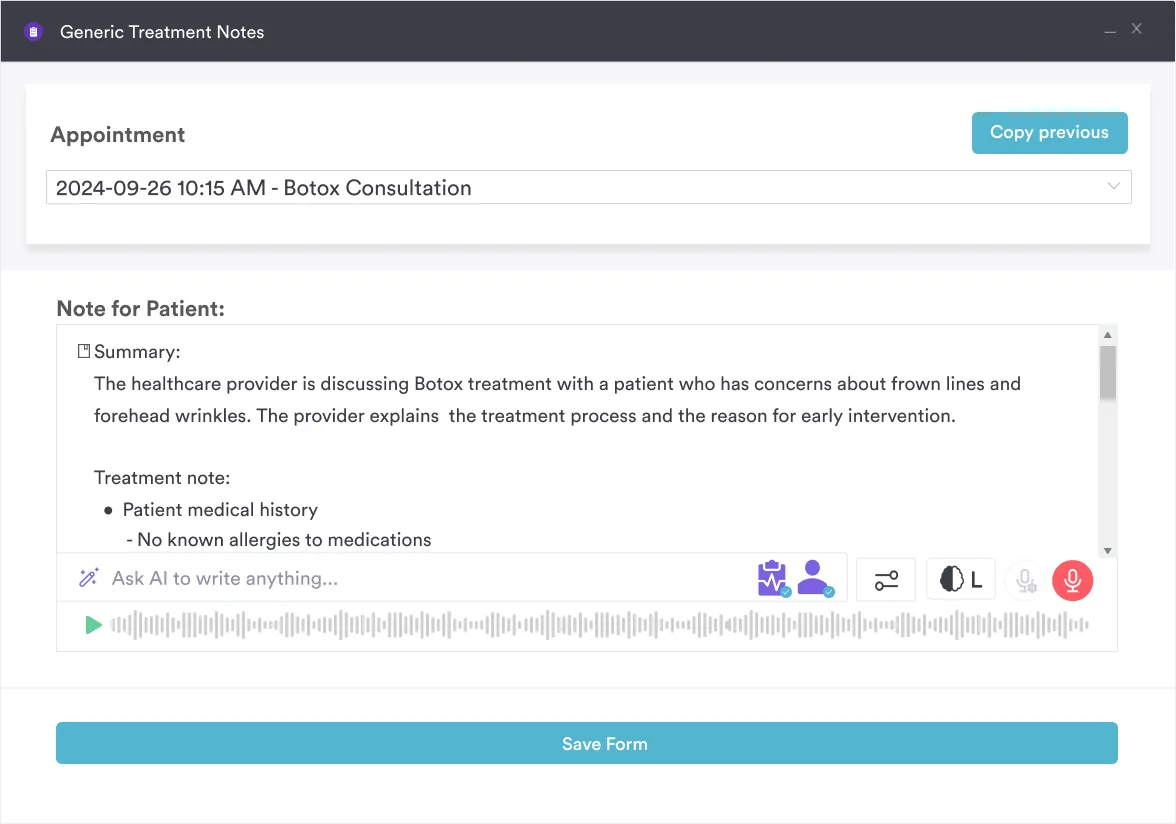
Both feed the same place. Structured client records hold each examination against the appointment it belongs to, so the next clinician opens one timeline instead of hunting through separate documents. That is what turns a repeated bedside test into a progression record you can act on.


Pabau’s structured clinical record templates let neurology and rehabilitation teams capture finger-to-nose, heel-to-shin, and dysdiadochokinesia findings in a consistent, searchable format. Track changes over serial visits with a complete audit trail.

Few maneuvers in the neurological examination return this much information for the time they take. Performed properly, with both arms, two speeds, and an eyes-closed comparison, it separates cerebellar pathology from proprioceptive loss. It also lateralizes the lesion and leaves you a measure you can repeat.
The harder part is recording it the same way every time. Structured templates, a fixed grading vocabulary, and serial comparison turn one clinical observation into longitudinal data. If your practice writes up coordination findings differently at every visit, start there. Book a demo to see how Pabau keeps neurological findings comparable from one appointment to the next.

Not sure whether the deficit is cerebellar or sensory? Proprioception test walks through the bedside tests that isolate position sense from cerebellar motor control.
Need a dynamic balance measure for a return-to-sport decision? Star excursion balance test covers reach distances, normalization, and how to read an asymmetry between limbs.
Want a scored balance assessment you can repeat every visit? Berg balance scale template gives you the 14 scored items and the cut-offs in a form you can hand to any clinician.
Tracking gait alongside limb coordination? Functional gait assessment template scores 10 gait tasks so progression shows up as a number rather than a description.
Documenting a visual-motor rather than a cerebellar finding? Beery VMI scoring and interpretation explains how raw scores convert to standard scores and what each band actually means.
It is a bedside neurological maneuver that tests cerebellar function, limb ataxia, and proprioception. The patient alternates between touching their own nose and the examiner’s index finger. The examiner holds that finger at arm’s length and moves it between repetitions. The test detects dysmetria, intention tremor, and past-pointing.
No. Dysmetria is inaccurate limb placement, where the finger lands too far past the target or not far enough. Intention tremor is an oscillation that appears during voluntary movement and worsens on approach, then resolves at contact. Both can occur together in cerebellar lesions, but they reflect different aspects of cerebellar motor control.
Record which arm was tested, the speed used, whether the eyes were open or closed, and which abnormal findings appeared. Note the severity of each one. Descriptive grading of none, mild, moderate, or severe with a speed qualifier suits most outpatient settings. Formal scales such as SARA and ICARS are used in specialist ataxia services.
Perform it whenever you suspect cerebellar dysfunction, limb ataxia, or dizziness with gait instability. It also belongs in post-stroke coordination assessment, suspected multiple sclerosis, and post-concussion return-to-sport evaluation. Patients with hereditary ataxia syndromes or chronic alcohol use disorder need it as part of routine neurological screening.