

Clonus reflex test: Technique, grading, and documentation
Most neurological examinations include a clonus reflex test, yet documentation of findings varies widely between clinicians. Beat counts go unrecorded. Laterality is omitted. Serial changes over time are lost. According to NCBI StatPearls, clonus in an adult is generally pathological, and more than 10 beats is classified as sustained clonus. That grading only earns its […]
Nursing pain assessment: Tools, frameworks, and documentation

Pain is consistently underassessed in clinical settings. NCBI StatPearls notes that inadequate pain assessment remains one of the most common failures in nursing practice. It contributes directly to undertreated pain, avoidable patient suffering, and increased litigation risk. For practice owners and managers, the consequence is tangible: poor documentation, inconsistent reassessment, and staff who rely on […]
Transverse ligament stress test: Anatomy, technique, and results
Transverse ligament stress test: What it is and why it matters Upper cervical instability is one of the highest-stakes findings in manual therapy. The transverse ligament stress test gives clinicians a structured, hands-on way to screen for atlantoaxial instability before any cervical treatment begins. Missing this screen on a patient with an undetected ligament injury […]
Femoral nerve tension test: Procedure, interpretation, and next steps
Upper lumbar radiculopathy is notoriously underdiagnosed. The straight leg raise dominates neurodynamic testing education, but it only tensions the sciatic nerve and its roots at L4-S1. That leaves L2 and L3 involvement frequently missed in clinical assessment. The femoral nerve tension test, also called the reverse straight leg raise, targets those upper lumbar roots directly. […]
Homan’s sign test: How to perform it and what the results mean
Homan’s sign test is a bedside physical examination maneuver with over eight decades of clinical history. John Homans first described it in 1941 and redefined it in 1944. Clinicians used it to screen for deep vein thrombosis (DVT) in patients with calf pain, one-sided leg swelling, or a high clot risk. DVT occurs when a […]
Hip mobility test: at-home self-assessments and how to read results

What is a hip mobility test and why does it matter? A hip mobility test is a structured self-assessment that checks how freely your hip joint moves through its full range of motion. It is not a clinical diagnosis. It is a screening tool that tells you where restrictions sit, so you can address them […]
Matles test: how to perform and interpret the results
Missing an Achilles tendon rupture at first presentation is one of the more consequential errors in musculoskeletal medicine. Swelling and pain can mimic an ankle sprain. Many patients also keep some active plantarflexion through intact accessory muscles, so the injury looks milder than it is. The Matles test gives you a passive bedside check that […]
Mill’s test: How to perform and interpret it for tennis elbow
Mill’s test is a passive provocation test for tennis elbow. You pronate the patient’s forearm, flex the wrist, then extend the elbow. Familiar pain at the lateral epicondyle counts as a positive. The whole sequence takes under 30 seconds and needs no equipment. Lateral epicondylitis affects roughly 1% to 3% of working adults, so it […]
Shoulder depression test: Procedure, interpretation and free template
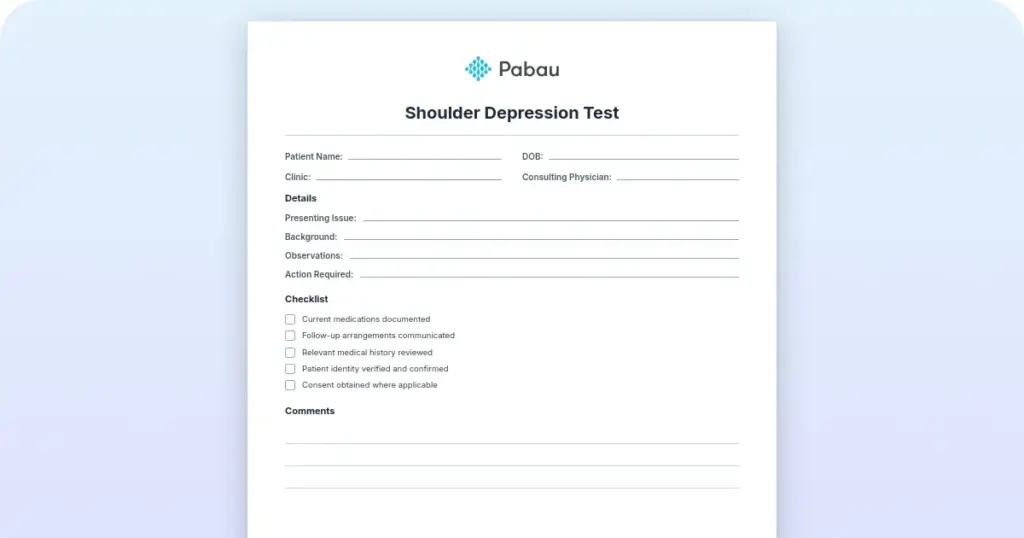
Download your free shoulder depression test template A one-page assessment form with fields for patient details, the side tested, the direction of cervical flexion, and the patient’s response. It closes with space for your clinical impression and the tests you correlated it against. Download template The shoulder depression test checks whether a cervical nerve root […]
Knee exam: A systematic guide for clinicians
Knee exam: A systematic four-phase clinical framework A knee exam done without structure leaves too much to chance. A missed joint effusion or an overlooked positive Lachman can slip through when the examiner jumps straight to special tests. So can a patellofemoral sign that only shows under load. Building from inspection first catches what a […]