GLP-1 diet plan
A GLP-1 diet plan is a structured eating framework for patients taking semagluti...

2
Last Updated: Oct 13, 2026

The bent knee stretch test (BKST) is a passive provocation test for proximal hamstring tendinopathy at the ischial tuberosity.
It is performed supine, with the hip and knee starting maximally flexed. The examiner then extends the knee slowly until familiar pain appears.
A prone patient, or a hip fixed at 90 degrees, describes the Puranen-Orava test rather than the BKST.
The modified version uses the same supine position, and only the speed of knee extension changes. Cacchio et al. reported 89% sensitivity and 91% specificity for it, against 84% and 87% for the standard test.
Practice management software like Pabau gives MSK teams digital assessment forms and structured patient records. Special tests then get documented the same way at every appointment.
Proximal hamstring tendinopathy is one of the more stubborn presentations in MSK practice. As a result, it is often misdiagnosed as gluteal tendinopathy, sciatica, or a hamstring muscle tear. The bent knee stretch test (BKST) gives clinicians a repeatable way to isolate the proximal hamstring tendons. Done correctly, it reproduces the patient’s familiar symptoms at the ischial tuberosity.
The test is supine, and it starts from maximal hip and knee flexion. Notably, that detail separates it from the Puranen-Orava test, which secondary descriptions routinely confuse it with.
What follows is the standard protocol, the modified variant, how to read a result, and where the test belongs in a wider examination. It is written for physiotherapists, sports medicine clinicians, and MSK practitioners assessing deep gluteal or posterior thigh pain.
The bent knee stretch test is a passive pain provocation test for the proximal hamstring tendon origin. Cacchio and colleagues validated it in the British Journal of Sports Medicine in 2012. They also tested it alongside the Puranen-Orava test and the modified bent knee stretch test.
The test is performed with the patient supine. The hip and knee both start in maximal flexion, and the examiner then extends the knee slowly until symptoms appear. Taking the knee toward extension while the hip stays deeply flexed lengthens the hamstring across both joints. In turn, that loads the shared tendon origin at the ischial tuberosity.
This is worth stating plainly, because a large number of secondary descriptions get it wrong. The BKST is not a prone test, and it does not hold the hip at 90 degrees. Both of those details belong to other assessments, and applying them changes how much load reaches the tendon.
A BKST result only means something against the anatomy the position loads. Specifically, five structures matter here.
In practice, documenting which of these structures you assessed supports continuity of care and medicolegal record-keeping. The next clinician needs to know whether the nerve was cleared, not just what the tendon did.
The bent knee stretch test is indicated when a patient presents with any of the following:
Exercise caution or defer the test in the following situations:
Record the contraindication screening alongside the test result, not just the result itself. In short, a note saying you deferred the test, and why, is worth more at review than a blank field.
Overall, the standard bent knee stretch test requires only a treatment table and takes under two minutes. Precision matters, because the depth of hip flexion and the speed of knee extension both change the tensile load reaching the proximal hamstring tendons.
In turn, recording the result in a physical therapy EMR at the point of assessment reduces transcription errors. The knee angle and the pain location then stay structured in the patient’s notes rather than buried in free text.

A positive bent knee stretch test is reproduction of the patient’s familiar deep buttock or proximal posterior thigh pain during passive knee extension. Indeed, the word “familiar” carries the weight here. Still, posterior thigh discomfort on its own does not make the test positive.
Key interpretation points:
The accuracy data comes from the validation study by Cacchio et al. (2012). The authors examined 92 athletes: 46 with chronic proximal hamstring tendinopathy and 46 without. Diagnosis required lower gluteal pain, tenderness at the ischial tuberosity, and positive MRI findings.
Sensitivity and specificity are the figures reported by Cacchio et al. Accordingly, the likelihood ratios in the table are calculated from those values. Intra-rater and inter-rater reliability exceeded 0.8 for all three tests.
A positive LR of 6.5 is useful, but it is not a diagnosis. Specifically, it shifts post-test probability upward by a moderate amount. A positive BKST supports proximal hamstring tendinopathy rather than confirming it.
These figures also come from a case-control design comparing symptomatic athletes with healthy controls. Accuracy in a mixed MSK caseload, where the differential is crowded, will be lower. Treat them as supportive data inside a clinical cluster.
The modified bent knee stretch test (MBKST) uses the same supine starting position as the standard test. In fact, the one thing that changes is the speed of knee extension. Instead of straightening the knee slowly, the examiner extends it rapidly.
Some descriptions add a preparatory step. The hip is first taken into extension, then moved into maximal flexion with the knee, before the rapid extension.
The rationale is rate of loading. A fast stretch challenges the tendon in a way that resembles the demands of sprinting. As a result, it can provoke symptoms that a slow, graded stretch does not reach. This is why the variant is also called the fast hamstring stretch test.
The modified version is most useful when the standard test is negative. Reach for it when history and load tests still point strongly to proximal hamstring tendinopathy. Because both versions share the same position, you can move from one to the other without repositioning the patient.
Explain the rapid movement before you do it. Then keep watching for the distal symptoms that indicate neural rather than tendinous provocation.
A lot of online descriptions present the BKST as a prone test with the hip fixed at 90 degrees. They then treat a larger hip angle as the modified version. That conflates two separate tests from the same validation study. Untangle it before you use either one.
The 90 degree hip position belongs to the Puranen-Orava test. Instead, that test is active and performed in standing. The patient rests the foot on a support at roughly hip height, which flexes the hip to about 90 degrees.
The knee stays fully extended, and the patient leans into the stretch. It reported the lowest accuracy of the three tests Cacchio et al. examined, at 76% sensitivity and 82% specificity.
The comparison below sets the three positions against their accuracy figures, so you can check which test you are actually running.
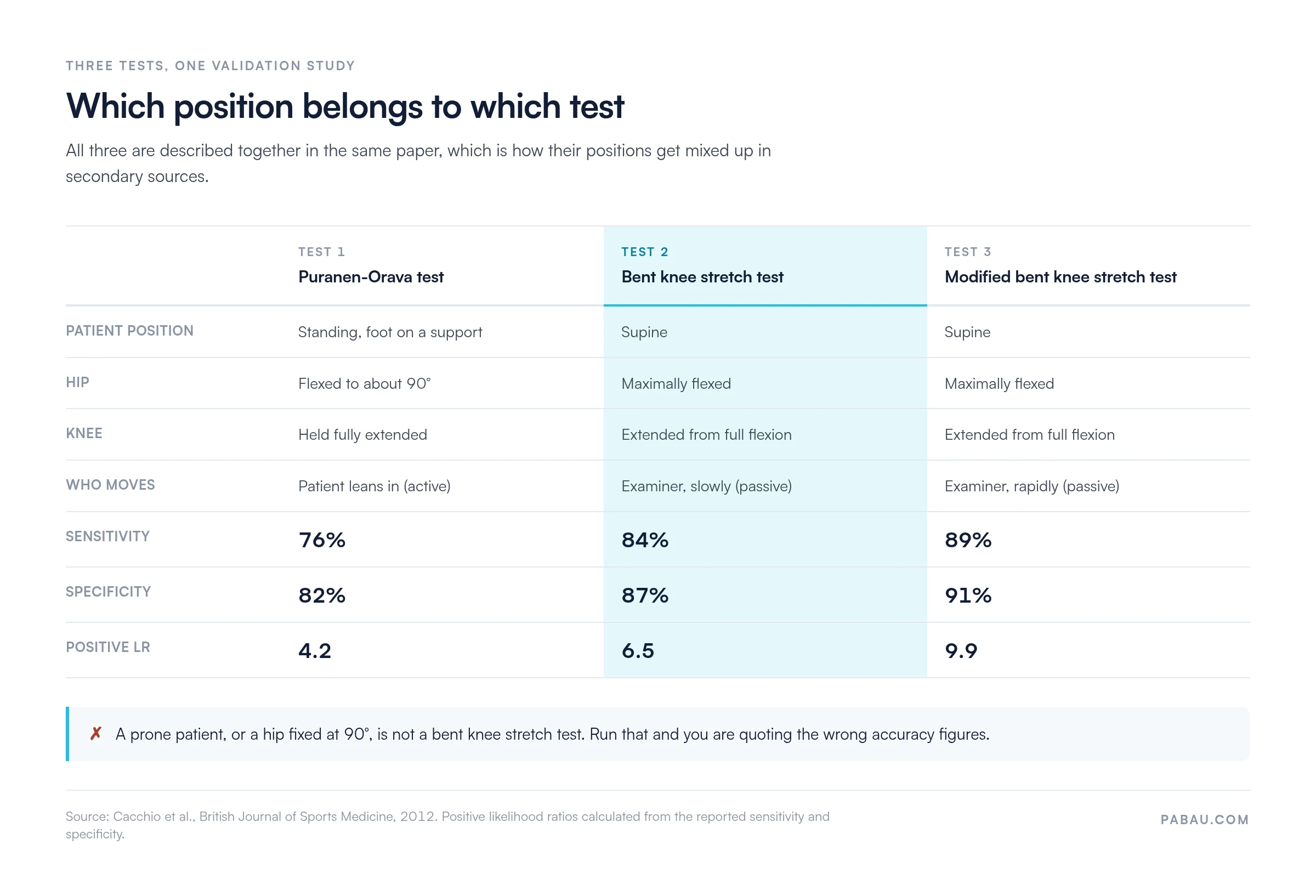
The practical consequence is straightforward. A supine BKST that starts from maximal hip and knee flexion applies more tendon load than a 90 degree position does.
Run the 90 degree version and call it a BKST, and you are using a less sensitive test. In other words, the figures you quote belong to a more demanding one.
The bent knee stretch test is reasonably specific, but deep gluteal and posterior thigh pain has a wide differential. These are the conditions most likely to sit alongside PHT on your list, and the features that help separate them.
Clinicians working in sports medicine practices see PHT often in runners and rowers. Over time, tracking which special tests were used at each appointment, and how the findings changed, builds an accurate longitudinal picture. That matters most when the presentation is atypical.
No single special test should be used in isolation. The bent knee stretch test is most useful inside a structured cluster for suspected proximal hamstring tendinopathy. Here is how it integrates with the rest of an MSK examination.
Ultimately, this reasoning has to stay visible between appointments. Practice management software like Pabau gives physiotherapy teams patient record tools for structured clinical assessments. Findings can then be tracked over time and flagged for review as referral thresholds approach.
Teams still choosing a system can weigh physiotherapy clinic management software against how their MSK caseload actually runs. Either way, the assessment workflow is the part worth testing in a demo.
The BKST has respectable accuracy figures in its validation study. Even so, several limitations affect how it performs in routine practice, and they matter more than the headline percentages.
Clinicians working through a return-to-running protocol often repeat the BKST at key milestones. It helps confirm that proximal hamstring load tolerance has improved before progressing to full sport-specific training. Recording those repeat assessments in structured notes supports both the clinical decision and the conversation with the patient.
A BKST result is only useful if the next clinician can tell exactly what was done. In most practices that detail lives in free-text notes.
Position, extension speed, knee angle at onset and side tested get recorded differently by every therapist. Six weeks later, nobody can say whether the tendon has improved or the technique simply changed.
Pabau, our practice management software for physiotherapy and MSK teams, replaces that free text with structured assessment forms you build once. A BKST field set can capture side, standard or modified version, knee angle at symptom onset, pain location, and whether the pain was familiar. The same form loads at every follow-up, so the comparison is like for like.
Those findings sit in the patient’s clinical record alongside consent forms, outcome measures, and appointment history. As a result, every clinician who sees that patient can read them. Every Pabau subscription includes the full feature set. Assessment forms, records, and automated pre- and post-appointment communication are available to your whole team from day one.

Pabau gives physiotherapy teams structured assessment forms, patient records across locations, and automated pre- and post-appointment workflows. See how it works for physical therapy practices.

Get the position right and the bent knee stretch test earns its place in a posterior hip examination. Supine, hip and knee maximally flexed, knee extended slowly. Extend it rapidly instead and you have the modified version, which is slightly more sensitive and slightly more specific.
Importantly, the test does not depend on a 90 degree hip angle. Any description built on that number is describing the Puranen-Orava test.
Treat a positive result as a probability shift, not a verdict. Its positive likelihood ratio of 6.5 comes from a single case-control study. That is strong enough to move your reasoning forward, and too weak to carry a diagnosis alone.
Instead, pair it with load testing, a lumbar screen, and a history that fits. Reserve imaging for the cases where a structural tear is genuinely in play.
The habit worth building is documentation. Record the version used, the angle of onset, and the side tested in the same fields every time, and your reassessments start to mean something. Book a demo to see how Pabau helps physiotherapy teams standardize clinical assessments from first appointment through to discharge.

Managing physiotherapy compliance across your practice? Physiotherapy compliance requirements covers the documentation and regulatory obligations UK-registered physiotherapists need to meet in clinical practice.
Considering opening or expanding your MSK service? Opening a physiotherapy clinic walks through the operational, regulatory, and staffing decisions involved in setting up a physiotherapy practice.
Looking for a return-to-sport milestone framework? Return-to-running protocol for physical therapy outlines a structured progression framework used alongside clinical reassessment at each stage.
The bent knee stretch test is a passive provocation test used to assess proximal hamstring tendinopathy. The patient lies supine with the hip and knee maximally flexed, and the examiner then extends the knee slowly. That movement loads the proximal hamstring tendons at the ischial tuberosity. A positive test reproduces the patient’s familiar deep buttock or posterior thigh pain.
A positive BKST reproduces the patient’s familiar deep buttock or proximal posterior thigh pain. The pain appears as the knee is slowly extended from maximal hip and knee flexion. It points to tendon irritability at the proximal hamstring origin. On its own it cannot exclude a partial hamstring tear, and it cannot rule out sciatic nerve involvement.
The difference is the speed of knee extension, not the hip angle. Both versions start supine with the hip and knee maximally flexed. The standard test extends the knee slowly and gradually, while the modified test extends it rapidly. Cacchio et al. reported 84% sensitivity and 87% specificity for the standard test, and 89% and 91% for the modified one.
Supine. Cacchio et al. described the test with the patient lying face up and the hip and knee maximally flexed. Descriptions that place the patient prone, or that fix the hip at 90 degrees, are describing something else. The 90 degree hip position belongs to the Puranen-Orava test, which is performed in standing.
Proximal hamstring tendinopathy differs from gluteal tendinopathy in symptom location, at the ischial tuberosity rather than the lateral hip. The aggravating activities differ too, with sitting and hip loading rather than hip adduction. Sciatica presents with radiating symptoms below the knee and positive neural tension tests. Hamstring muscle tears typically have acute onset with a palpable defect. A cluster approach using the BKST, load tests, and a lumbar spine screen improves diagnostic accuracy.
No. The straight leg raise is a neural tension test performed supine with the knee kept extended throughout, and it mainly assesses sciatic nerve mobility. The bent knee stretch test also starts supine, but the hip and knee begin maximally flexed and the knee is then extended slowly. Both can produce posterior thigh symptoms, so comparing the two helps separate neural from tendinous pain.
Cacchio et al. reported 84% sensitivity and 87% specificity, which gives a positive likelihood ratio of about 6.5. That is a useful shift in probability rather than a diagnosis. Reliability also depends on examiner technique, sciatic nerve sensitivity, and the population tested. Interpret the result within a cluster of load tests, subjective history, and imaging where appropriate.